Beef cow parasite control
 Call Kai
 Learn
Learn Practice Test
 Spaced Repetition
 Match
Match Flashcards
 Knowt Play
1/20

There's no tags or description
Looks like no tags are added yet.
Name | Mastery | Learn | Test | Matching | Spaced | Call with Kai |
|---|
No analytics yet
Send a link to your students to track their progress
21 Terms
How are beef herds managed differently from dairy herds?
All cows should calve within about 60 days
Degree of confinement varies depending on the time of year
Calves are mainly the responsibility of the cow
Calves are raised on pasture
Calves are weaned at about 200 days
Cows and post-weaned calves are managed as groups
Group management allows parasite control to be more targeted
What are the important Endoparasites parasites of beef cattle in Ontario?
Eimeria spp.
Cryptosporidium → rarely cause disease
Hypoderma spp.
Dictyocaulus viviparus
Ostertagia → must be on pasture
Trichostrongylus
Cooperia
Parasitic gastroenteritis is an important clinical outcome associated with some internal parasites
What are the important Ectoparasites parasites of beef cattle in Ontario?
Lice
Horn flies
Which macrocyclic lactones are listed for cattle, and what are their meat withdrawal times?
Ivermectin → most common
Injection: 35 days
Pour-on: 49 days
Doramectin
Injection: 40 days
Eprinomectin
Injection: 120 days → only used in spring
Pour-on: 0 days
meat withdrawal does not drive selection because the animals are not going to slaughter until months later
What other anthelmintic is available for use in beef cattle for gastrointestinal nematodes?
Fenbendazole (Safe-Guard) → benzimidazoles
Internal parasites
Oral
Given as a premix
Meat withdrawal time is 13 days
Used only for gastrointestinal nematodes (GINs)
What are the key points about lice in beef cattle?
Lice are common in Ontario
They are more common on beef cattle than dairy cattle
High numbers are especially seen on young livestock
Fall treatment is preventive
Some macrocyclic lactone pour-ons are sold with a 28-day co-mingling guarantee
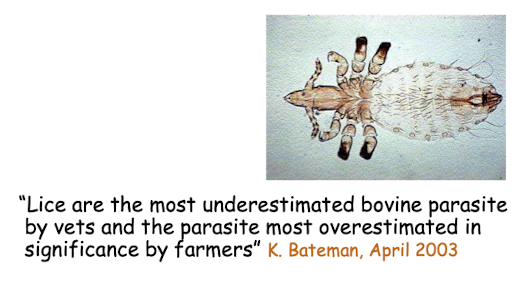
The slide notes that lice may be underestimated by vets but overestimated in significance by farmers
What are the important features of horn fly infestation in beef cattle?
Haematobia irritans
They are worst in July and August
They are commonly found on the withers, shoulders, flank, and around the eyes
Moderate infestations of more than 50 flies per side can decrease weight gain
Preventive measures commonly used by producers include:
Insecticide-impregnated ear tags
Backrubbers
Insecticide sprays such as permethrin
Macrocyclic lactone pour-ons such as ivermectin
Insecticide resistance may be a concern
When is coccidiosis most commonly a problem in beef calves?
The most important species are Eimeria bovis and E. zuernii
It is most commonly an issue in:
Early-born calves, especially February or March calves in yards around April → Giving birth in yards (indoors for the longest)
Calves at pasture in late summer and fall, often around feeding and watering areas
Backgrounding facilities and feedlots, usually within the first month
What are the main features of gastrointestinal nematode infection in beef cattle?
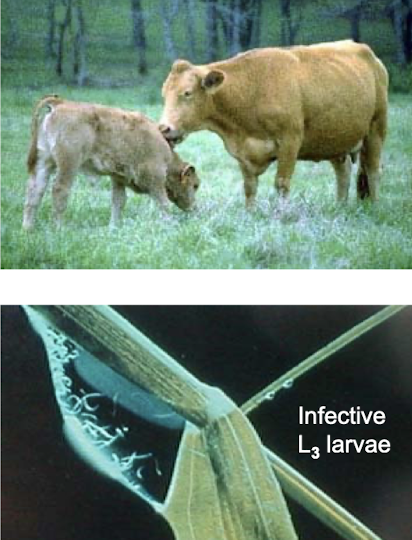
Exposure increases throughout the grazing season
Exposure is linked to pasture intake
Infection tends to occur as trickle infection
Immunity generally develops quicker than in dairy cattle
L3 burdens on pasture are generally lower than in dairy cattle
These parasites often have a subclinical impact
What is the basic timeline for the first year of life in beef calves?
About 75% of calves are born from February to May in yards
Calves are turned out to pasture around May 1
What parasite concerns are present in calves during the first part of the first year while they are in yards with their dams?
a) Feb/March calves
Calves stay in yards with their dams until about May 1
Cryptosporidiosis is noted as uncommon
Coccidiosis can be a problem around April
Even if creep feed is available, calves consume minimal amounts
Possible group treatment mentioned includes:
Long-acting sulfa boluses
Toltrazuril (not approved in the US)
b) April/May calves are noted as usually not having coccidiosis as a problem in this context
What parasite control issue is important for first-year calves on pasture?
Coccidiosis can be a problem in late summer and fall
It is typically associated with feeding and watering areas
Creep feed is sometimes provided in the last few months on pasture
That creep feed may include:
Decoquinate
Lasalocid
These may be included for 6 to 8 weeks before weaning
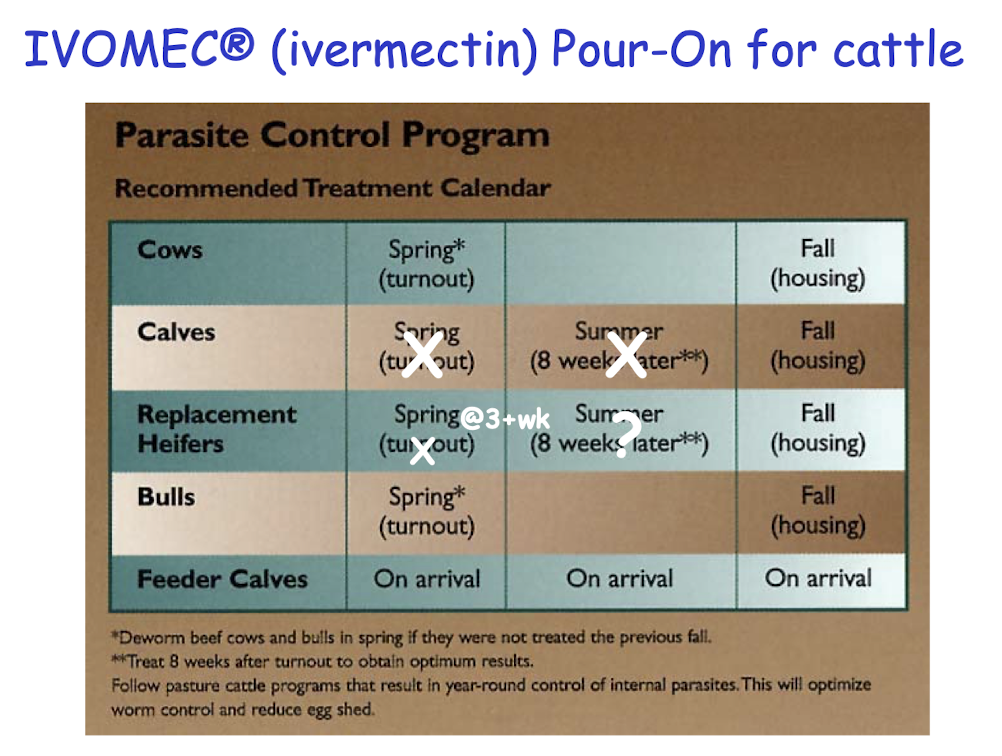
What deworming options are suggested for first-year calves at pasture?
a) If cows were not dewormed, calves can be treated in July
Ivermectin pour-on is suggested
February and March calves appear to benefit
Deworming may not be justified for May and June calves
The slide questions whether deworming at pasture is required in Ontario
OR
b) Another option is treating cows in the fall with a macrocyclic lactone
Fall treatment of cows can lead to heavier calves at weaning the following fall
Why are first-year calves treated with a macrocyclic lactone at confinement?
It is preventive for:
Lice
Gastrointestinal nematodes, especially Ostertagia
Warbles
Dictyocaulus viviparus
Calves are weaned at confinement at about October
Ivermectin pour-on, such as Ivomec, is commonly used in Ontario
What parasite-control approach is used for calves that remain in confinement until slaughter?
In backgrounding for 4 to 5 months:
Decoquinate may be included in feed for the first month
Monensin may be included for the remaining time → for growth enhancement
In the feedlot:
Decoquinate may be included in feed for the first month
Monensin may be included for the remaining time
Clinical coccidiosis is rarely seen if a coccidiostat is used
What is important to remember for second-year replacement heifers at pasture?
Their grazing history is very different from dairy heifers
An important consideration is whether all were treated with a macrocyclic lactone the previous fall
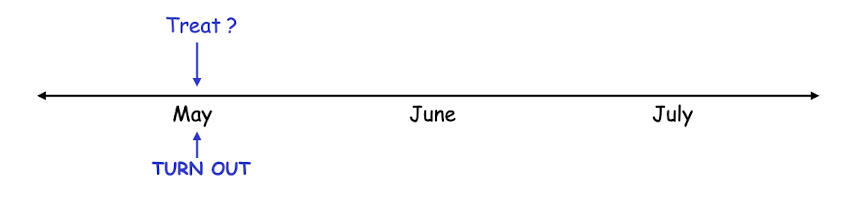
When is the optimal time to treat second-year heifers after turnout?
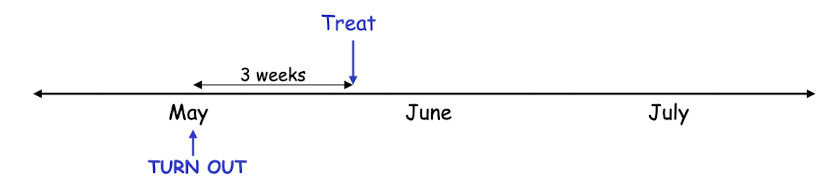
The preferred timing is 3 or more weeks after turnout
This is considered optimal if they were at pasture the previous year and treated with a macrocyclic lactone in the fall
If handling is not possible, treatment can be given via feed, such as fenbendazole
If handling is possible, a macrocyclic lactone such as ivermectin can be used
When might treatment at turnout be justified in second-year cattle?
Treatment at turnout could be justified if:
They were not treated with a macrocyclic lactone the previous fall
Medicating after turnout is difficult
A drug with residual activity must be used
If eprinomectin injectable (LongRange) is used, ideally about 10% (random selection) should be left untreated due to resistance
Are two treatments during the grazing season justified for second-year cattle in Ontario?
Probably not in Ontario, especially if cows are treated in the fall
Definitely not if eprinomectin injectable is used
Fecal egg counts may be monitored 4 or more weeks after anthelmintic activity has ended
What is recommended for replacement heifers when they come off pasture?
Treat with a macrocyclic lactone when they come off pasture
Replacement heifers usually come off pasture at the end of September
They have their first calf the following spring
What is the parasite-control recommendation for adult cows in the third year at pasture?
Treat adult cows with a macrocyclic lactone in the fall → once a year, do not need to treat offspring in grazing season
This is preventive for:
Lice
Warbles
It also helps prevent overwintering of Ostertagia in cows
This increases weaning weights of calves
If cows are treated in the fall, the justification for treating calves before housing at the end of their first grazing season becomes questionable