GRAMMAR 501 2025
 Studied by 9 people
 Call Kai
 Learn
Learn Practice Test
 Spaced Repetition
 Match
Match Flashcards
 Knowt Play
 Podcast
1/68

Earn XP
Description and Tags
Name | Mastery | Learn | Test | Matching | Spaced | Call with Kai |
|---|
No analytics yet
Send a link to your students to track their progress
69 Terms
J.Firth
British linguist
highlight the importance of context in understanding a language
“you shall know a word by the company it keeps”
His work significantly influenced modern linguistics and the study of language in social context
J.Sinclair
British linguist and professor
known for pioneering work in corpus linguistic, discourse analysis and lexicography
form part in the Cobuild project (1980) → leading to the creation of Collins English Dictionnary + Collins English Grammar
His work significantly influenced linguistics, language teaching and lexicography, which promotes a data-driven approach to understanding a language.
THEOR = idiom principle vs open choice principle
L.Wittgenstein
Austrian-British philosopher
consider one of the most significant figures in 20th century philosophy
in “Tractatus Logico-Philosophicus” → proposed that the structure of language reflects reality
in “Philosophical Investigation” → focus how language is used in everyday contexts
how language is used in everyday context
K.Popper
Austrian philosopher
known for his ideas about falsifiability, which asserts that a scientific theory must be testable and able to be proven false
encourages a deductive approach, where hypotheses must be structured in such a way that they can be empirically tested and potentially refuted.
His work influenced various fields, including the development of scientific methodology.
E. Rosch
American psychologist
known for her work on categorization, particularly prototype theory
Her research challenged classical views of categorization, suggesting that categories are organized around best examples (prototypes) rather than strict sets of necessary and sufficient features.
Her work has had a significant impact on cognitive psychology, linguistics, and philosophy.
D.Dennett
American philosopher
degree of cognition : different mechanism linked thought (paying attention, remembering , deciding)
he studied conciousness, cognition and intentionality).
E.Benveniste
French linguist
Explored the relationship between language and subjectivity, arguing that language is not merely a tool for communication but also shapes our perception and expression of self.
Introduced the distinction between 'énonciation' (the act of uttering) and 'énoncé' (the utterance itself).
His work has influenced semiotics, literary theory, and philosophy.
A.Goldberg
American cognitive linguist
1963
Known for her work on Construction Grammar, which posits that constructions (form-meaning pairings) are the basic units of language.
Her work highlights how grammatical patterns themselves carry meaning, contributing significantly to cognitive linguistics and psycholinguistics.
N.Chomsky
American linguist
1928
Widely regarded as the "father of modern linguistics."
The founder of the theory of Generative Grammar (also known as Universal Grammar), proposing an innate capacity for language in humans.
competence → what is the head
performance → doing smth
G.Lakoff
American cognitive linguist.
Known for his work on conceptual metaphor and cognitive linguistics. ex : showing that our conceptual system – and therefore our language – our language methaphorical
His work emphasises the embodied nature of cognition and language.
what is falsafiability
The quality of a theory that allows it to be tested and potentially proven false by evidence.
→ by Karl Popper
What is a prescriptive approach to language?
focuses on rules for how language should be used, setting standards for “correct” grammar, pronunciation, or word choice. It contrasts with a descriptive approach, which studies how people actually use language in real contexts.
What is a descriptive approach?
aims to observe, analyze, and explain how language is actually used by speakers — without judging it as right or wrong. It focuses on real linguistic behavior rather than prescribed rules.
What is the ‘idiom principle’?
an idiom is : multiple words unit that are non compotisional
states that speakers often use prefabricated phrases or chunks of language—like by the way or kick the bucket—rather than creating sentences word by word. Language use relies heavily on these fixed or semi-fixed expressions stored in memory.
≠ Open-choice principle
→ by J.Sinclair 1991 (J.Firth)
Explain the ‘open-choice’ principle
describes language production as a slot-and-fill process, where speakers build sentences word by word, choosing freely from grammatical options at each point. It contrasts with the idiom principle, which emphasizes using ready-made phrases or chunks.
states that one can combine any adj with any noun => but it’s questionable
What is a collocation?
is a pair or group of words that frequently occur together more often than by chance — such as make a decision, strong tea, or heavy rain. These habitual combinations reflect patterns of usage stored in speakers’ minds.
What is an idiom?
A fixed or partially fixed expression whose overall meaning cannot be fully derived compositionally from the meanings of its parts.
Examples: it’s raining cats and dogs, too big a shock, the X-er the Y-er.
Explain the difference between an encoding idiom and a decoding idiom
An encoding idiom is relatively transparent and can be productively used by speakers, whereas a decoding idiom has an opaque, non-compositional meaning that must be memorized and is mainly used for comprehension.
What is a prototype?
is the most typical example of a category that represents its features best. For example, a robin is a prototypical bird, while a penguin is a less typical bird. Categories are organized around prototype (unlike S&N C where cat are organized around conditions and characteristic)
Research by E.ROSCH (1975)
What is the ‘necessary & sufficient conditions’ model?
This model defines a category according to the classical view (Aristotle) by “necessary and sufficient” criteria.
These criteria are inherent in the category members. The criteria are binary: x or not x → it’s either in the category or not. Ex: a square = closed, flat figures, 4 sides all equal in length. Excludes: triangle, rectangle etc…
In classical view, linguistic categories are defined by N&S C -→ knowledge of language = knowledge of the categorical differences between classes of linguistics elements.
Prototype vs N&S C
Categorization is a basic cognitive ability that is reflected in all human activity, including language
The classical view = Categories are formed on the basis of N&S C
This view is challenged and replaced with a model of prototype categories
What is cognition?
refers to the mental processes involved in
acquiring,
processing,
storing,
and using knowledge.
This includes a range of functions such as
perception,
attention,
memory,
reasoning,
problem-solving,
and decision-making.
What is cognitive science?
a field that studies the nature of the mind and its processes.
It combines insights from psychology, linguistics, to understand how cognitive functions work, how they develop, and how they can be replicated.
seeks to explore how information is processed in the brain and how this influences understanding.
What is the ‘cognitive commitment'?
Cognitive commitment refers to the extent to which a speaker has mentally entrenched or internalized a construction.
It reflects how strongly a construction is stored in memory, based on usage and experience.
Explain the notion of ‘entrenchment’.
refers to the idea that frequent use of constructions or phrases leads to stronger mental associations.
Thus, according to De Smet and Cuyckens (2007: 188), a highly entrenched unit “represents an automated, routinised chunk of language that is stored and activated by t
What is the structuralist representation of a linguistic sign?
proposed by Ferdinand de Saussure, consists of two key components:
the signifier and the signified.
The signifier is the physical form of a word (its sounds or letters)
the signified is the mental concept or idea that the word evokes.
Saussure emphasized that the relationship between the signifier and signified is arbitrary, meaning there is no inherent reason why a particular word represents a specific idea.
Why can it seem unsatisfactory today ?
It's reductive and limited to the word; through networks of linguistic signs, we will create a language
What is Generative Grammar, and why is it also called ‘Universal Grammar’?
developed by Noam Chomsky
a theory that explains the implicit knowledge speakers have about sentence structure.
It suggests there are universal rules governing the syntax of all languages.
indicates there are shared grammatical principles across languages, linked to an innate capacity for language acquisition
Langue
the abstract, social system of rules shared by a community
Parole
the individual, concrete use of language in speech
personal and variable
Langue vs Parole
Together, they highlight the distinction between the social rules of language and its practical application.
Competence
a speaker’s internal knowledge of their language
Performance
the acutal use of language, influenced by memory, attention or errors
What is the ‘poverty of stimulus’ argument?
is the argument — originally from Noam Chomsky — that children receive limited and incomplete linguistic input (the "stimulus"), yet manage to acquire rich, generative grammatical competence. That gap between input and eventual knowledge is used to argue for innate, language-specific mechanisms (e.g. universal grammar).
→ for Chomsky : children learning to speak just don’t have enough information to form the complex grammatical schemas that allows them to generate unlimited new and original sentences yet they do so with ease.
Why is there no corpus linguistics according to N. Chomsky?
Because for Chomsky, corpora show performance (people’s actual, messy language use), but linguistics should study competence (the mental grammar in the mind).
Since corpora contain errors, gaps, and only finite data, they cannot reveal the abstract rules of grammar. Therefore, corpus data cannot be the basis of linguistic theory.
What is the ‘dictionary & grammar’ model of language?
Dictionary & Grammar Model (Taylor 2012)
makes a clear distinction between knowledge of vocabulary on one hand and knowledge of grammar on the other.
linguistic knowledge consists of a mental lexicon that has all the words (vocabulary) and some kind of grammar component that has the syntax.
Model that has been very succesfull but Construction Grammar = opposed to it bc for them = only construction
In the D&G M, idioms forms a kind of ‘appendix’ to dictionnary a. list that contains expression such as beat it or hit the road. These expressions needs a different entries in the mental lexicon bs speakers habe to learn that the two means ‘to leabe’ and each aren’t appropriate in the same context of use
what do you know when you know a language
What speakers have to know:
• must know words
• must know how to combine words into phrases and sentences
• must know how to put the right endings on words
• must be able to understand newly coined words
• must know that sometimes what is meant is different from what is said
• must know that language varies across different contexts
• must know idiomatic expressions
What speakers have to know, according to Construction Grammar:
• must know constructions
What is a construction in cognitive linguistics?
they are form-meaning pairs which have either non predictable formal characteristics, non-compositional meanings or a high enough frequency to be remembered as such (Goldberg 2006)
Constructions are central in construction grammar, where the idea is that all grammar consists of learned form-meaning pairings, not just rules plus words.
How does a construction differ from the Structuralist ‘linguistic sign’?
A construction differs from the Structuralist linguistic sign in that it can pair larger grammatical patterns (not just single words) with meanings, whereas a linguistic sign (in Saussure’s sense) links only a form (signifier) and a concept (signified) at the word level.
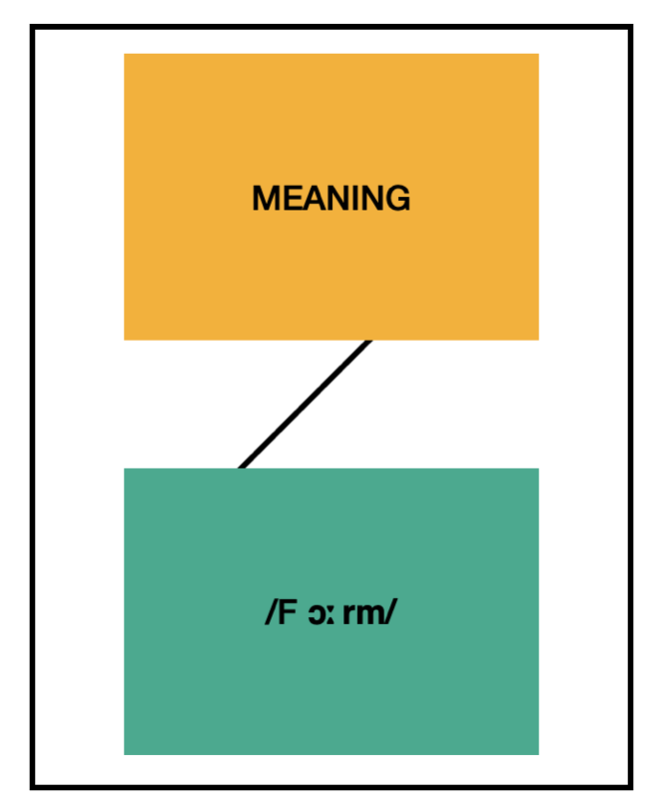
which are the three axes along which constructions may vary ?
Overall meaning can /not be derived compositionnally )→ accessible to native
Variable degree of fixedness: expression ficed strings like it’s raining cats and dogs but some are more flexible ex : too big of a shock were the Adj and the N can be replaced and the meaning would still be there )→ speakers have to memorize a kind of schema
Idiomatic expression are productive : ex the Xer the Yer )→ it allows syntactic variation
What is non-compositionality? Illustrate.
Compositionality is the principle that the meaning of a whole expression comes from the meanings of its parts and how they are combined.
Non-compositionality means that the meaning of an expression cannot be predicted from the meanings of its individual parts.
‘The cat sat on the mat’
The meaning of The+ cat+ sat+ on+ the+ mat -= meaning of the sentence
Idiomatic Expression: 'Kick the bucket' means 'to die,' which cannot be understood from the meanings of 'kick' and 'bucket.'
Metaphorical Language: 'Time is a thief' conveys the metaphorical idea that time steals moments from our lives, beyond the literal meanings of 'time' and 'thief.'
Phrasal Verbs: 'Give up' means 'to stop trying,' distinct from the meanings of 'give' and 'up.'
Cultural References: 'The Big Apple' refers to New York City, where understanding requires cultural knowledge
what is the constructicon
a large inventory of form-meaning pairs representing speaker’s knowledge of language
important addendum
- no chaotic ‘bag of constructions’ but instead :
- hierarchically structured
- links between constructions
The line between the mental lexicon (knowledge of words) and mental grammar (knowledge of rules) becomes blurry so much that Const Grammar propose to abandon it altogether. Instead, knowledge of language is seen as a large inventory of constructions, a construct-i-con
how does the constructicon differ from a family tree ?
constructions do not form a family tree because they are not organized in a strict hierarchy with inheritance one-directional (top to down). Instead, they are connected in a network with multiple inheritance, gradient relations, and family resemblances, reflecting usage-based and cognitive organization rather than rigid classification.
what is a construct ?
A construct is a concrete, actual instance of a construction as it appears in real language use.
Construction: the ditransitive construction
→ (“X gives Y Z”)Construct: She gave him a book.
Explain and illustrate the notion of semantic coercion ?
The phenomenon is that the meaning of an item may vary systematically with the constructional contexts in which it is found. Laura Michaelis has formulated a principle (2004: 25):
If a lexical item is semantically incompatible with its syntactic context, the meaning of the lexical item conforms to the meaning of the structure in which it is embedded.
non compositionality vs semantic coercicion ?
La non-compositionnalité désigne le fait que le sens global d’une expression ne peut pas être déduit de la combinaison des sens de ses parties.
La coercition sémantique est un processus interprétatif par lequel une construction impose ses contraintes sémantiques à un élément lexical, entraînant une réinterprétation du sens du mot.
what do you know about the phonology, semantics and pragmatics of the x let alone y construction
How it sounds – the rhythm and stress when people say it.
What it means – that Y is even less likely or important than X.
When to use it – to emphasize contrast and gradation // speaker’s evaluation
what do you know about the meaning of the WXDY construction
it stands for the “What’s X doing Y?” pattern (e.g., What’s this fly doing in my soup?), originally discussed by Kay & Fillmore (1999) as an idiomatic construction in English. In this pattern:
What’s + X + doing + Y
does not literally ask about an action; instead it expresses surprise, incongruity, or about a state of affairs
It encodes a non‑compositional interpretation of the situation it describes — a kind of pragmatic surprise or question about an unexpected state — that must be learned → not predicted from the individual words alone.
What, according to A. Goldberg, is the difference between ‘Alex baked Jean a cake’ and ‘Alex baked a cake for Jean’?
The double-object construction (Alex baked Jean a cake) encodes a Beneficiary–Theme relation as part of the construction itself, whereas the prepositional-object construction (Alex baked a cake for Jean) expresses the same relation but via the preposition “for”, not by the construction itself. This illustrates that constructions can carry abstract meaning beyond individual words.
what is a thematic role ?
a thematic role is the semantic function that an argument plays in an event . In Construction Grammar, constructions can assign thematic roles independently of the verb, as in the double-object construction.
what thematic roles do you know ? (illustrate)
AGENT
the initiator of an action
Pat ate a waffle.
PATIENT
the participant undergoing an action or a change of state
Pat ate a waffle.
THEME
the participant which is moving
Pat threw the rope over.
EXPERIENCER
the participant who is aware of a stimulus
Pat heard a sound.
STIMULUS
the participant that is experienced
Pat heard a sound.
BENEFICIARY
the participant who benefits from an action
Pat sang for me.
RECIPIENT
the participant receiving an item
Pat gave me a waffle.
INSTRUMENT
the participant serving as a means to an action
Pat opened it with a knife
LOCATION
the place of an event
Pat was born in Florida.
GOAL
the end point of a movement
Pat threw it into the fire.
SOURCE
the starting point of a movement
Pat came home from work.
what is an argument structure ?
synonym term for valency
is encoded by constructions rather than verbs alone. These constructions have independent meaning, and encode recurrent event types, while remaining constrained by semantic coherence (Goldberg), in contrast to Chomsky’s verb-based view.
What argument structures do you know ? (illustrate)
Pat gave Bill a book = Double object construction
Recipient-Theme relation
John sneezed the foam off his cappuccino = caused motion
Theme-Goal relation
Bob hammered the metal flat = resultative construction
Alex baked a cake for Jean = prepositional object construction
the prep mark the beneficiary
She fought her way through crowd = way-construction
motion interpretation + scene encoding
What is the difference between ‘everything was paid for’ and ‘the hall was walked across’ and why ?
According to Hilpert, everything was paid for is grammatical because pay for selects its object as a true argument that is affected by the event and can therefore be passivized. By contrast, the hall was walked across is ungrammatical because across the hall is an adjunct expressing path rather than a selected argument, and the hall is not affected. This shows that passivization depends on argument structure and constructional meaning, not surface form alone.
Can you have a passive imperative in English ? If so give an example
English does allow passive imperatives, such as Be warned or Be seated . These forms are possible because imperatives do not require an explicit agent and because the construction focuses on the resulting state rather than the actor. However, passive imperatives are restricted and occur only with certain verbs and in specific pragmatic contexts (warning, instructions, etc) .
What is the role of frequency constructions ?
is crucial in Construction Grammar because repeated usage leads to entrenchment and productivity of constructions.
Frequency vs entrenchment
In Hilpert’s usage-based view, frequency refers to how often a construction occurs in usage, whereas entrenchment refers to how strongly that construction is cognitively represented as a result of repeated exposure.
What are the different ways of looking for constructions .
can be identified by looking for structural deviations, non-compositional meanings, idiosyncratic form–meaning constraints, or collocational preferences.
What is the ‘scene-encoding hypothesis’ ? (Goldberg 1985)
According to Goldberg (1995), the scene-encoding hypothesis states that syntactic constructions encode prototypical event types that reflect recurrent human experiences, such as transfer, motion, or causation.
what is the link between scene-encoding hypothesis (Goldberg) and Hilpert’s argument structure ?
Goldberg’s hypothesis proposes that constructions encode prototypical event types, and Hilpert (who based his idea on Goldberg’s) extends this to argue that argument structure constructions assign thematic roles and convey abstract event meaning learned from usage.
Give 2 instances of NI
Null instantiation refers to cases where a verb’s argument is not overtly expressed.
Indefinite null instantiation is a subtype in which the omitted argument has an indefinite or generic interpretation.
The crucial distinction is whether the speaker knows the specific identity of the missing argument.Compare the following examples:
Kim was reading. I just don't remember what.
Kim understood. *I just don't remember what.
While it is perfectly acceptable for me to say that Kim was reading and to have only a vague idea of what it was that she was reading, saying that Kim understood conveys that I know more or less exactly what she understood.
→ Ruppenhofer (2005)
Explain briefly what information packaging is
are sentence-level constructions that serve the purpose of organising and presenting information in such a way that hearers can successfully connect pieces of new information to already shared pieces of information.
Speakers will choose a given information packaging constructions in a given situational context depending on their assumptions of what the hearer already knows, what he may infer, and what is completely new to him.
It was John who lost his wallet
As for John, he lost his wallet
What John lost was his wallet
→ John lost his wallet
→ Prince 1981
Define the notions of topic and focus
The topic is what a sentence is about, while the focus is the new or emphasized information, defined as the difference between pragmatic presupposition and assertion. Both are characteristics of sentences, not texts.
predicate focus (illustrate)
a type of emphasis where the focus is placed on the predicate ( expresses the action, state, or event).
Example
Q: What happened to your car
A: My car broke down
argument focus
a type of emphasis where the focus is placed on one of the arguments of the verb, the focus is on the participant in the action
Q: i heard that your motorcycle broke down ?
A: my car broke down
sentence focus
a type of emphasis in which the entire sentence or the core proposition is highlighted, often by placing it in a special structure or position to signal its importance. In sentence focus, the focus on the whole action or event.
Q: why are you late ?
A: my car broke down
Give two exemples of topicalization constructions ?
are sentence structures in which an element, is moved to the beginning of the sentence to make it the main topic of discussion. Create an effect of emphasis.
1. Left dislocation:
As for John, he lost his wallet
2. Left dislocation:
The coolest guitar I own, it’s a black US stratocaster form the 80’s
3. Topicalization:
Most heavy metal I don’t really like.
What are the main characteristics of spoken language, that make it different than written language ?
Transitoriness: Once an utterance has been made, its sound does not linger in the way that written words stay on the page
Irreversibility: Whatever is said is said. By contrast, writing can be edited.
→ phenomenon self-repair = The speaker backtracks to the part of the current utterance at which the so-called trouble source is located and starts over at that point.
Synchronisation: of actions carried out by the speaker and the hearer.
→ phenomenon of co- construction in which utterances are collaboratively produced.
→ AUER
How does complexity in spoken language differ from complexity in written language ?
complexity in spoken language is local, increasing, and interactive, relying on context, whereas in written language, complexity is global, hierarchical, and structurally elaborated, relying on planned syntax and organization.
Give a few examples of markers specific to spoken language
hesitation marker = uh, hum
discourse marker = oh
→ Clark & Foxtree 2002
 Note
Note  Flashcards (244)