Week 5 -- Muscle function and structure
 Call Kai
 Learn
Learn Practice Test
 Spaced Repetition
 Match
Match Flashcards
 Knowt Play
1/14

There's no tags or description
Looks like no tags are added yet.
Name | Mastery | Learn | Test | Matching | Spaced | Call with Kai |
|---|
No analytics yet
Send a link to your students to track their progress
15 Terms
What are the location, appearance, function, innervation and contractility differences of skeletal, cardiac and smooth muscle?
Skeletal | Cardiac | Smooth | |
Location | Attached to skeleton | Heart muscle | Lines hollow intestines/blood vessels/airways |
Appearance | Obviously Striated (Long & Cylindrical) | Not obviously Striated (Inter colated disks) | Non-striated |
Function | Movement, produce heat, stabilise joints | Makes rhythmic contractions to pump blood throughout the body | regulates blood pressure, sends food through the GI tract, manages bladder, controls airway diameter. |
Innervation | Voluntary/Involuntary | Involuntary | Involuntary |
Contractility | Powerful and rapid, but fatigue easily | Autorhythmic | Not powerful but sustained |
What is muscle made up of (hint: group, cell, organelle)
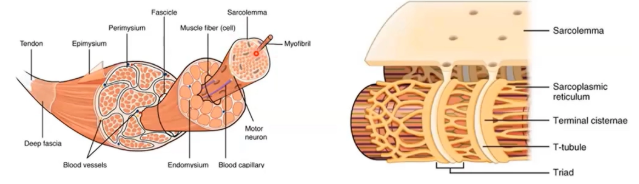
Skeletal Muscle —> Fascicle —> Muscle Fiber —> Myofibril (organelle made up of overlapping action and myscine)
Muscle connective tissue coverings (hint: mysiums)
Endomysium
Surrounds each muscle fibre
Perimysium
Surrounds each fascicle
Epimysium
Surrounds each skeletal muscle
What happens when the mysiums combine?
They combine to form tendons and attach to periosteum (the layer surrounding bone)
Each muscle is supplied by ….. nerve, …… artery and ……or more veins
Each muscle is supplied by one nerve, one artery and one or more veins
Each one of those nerves and arteries …… to extend to each …. ……..
A single somatic motor neuron innervates each muscle, which branches many times to extend to each muscle fibre
An artery runs alongside the somatic motor neuron and branches into capillaries so that each muscle fibre is in close contact with a capillary
Muscle fibre meaning
Long, cylindrical, multinucleated muscle cell
What is the sarcolemma? What makes it special?
the plasma membrane of a muscle cell.
T-tubules (infoldings of sarcolemma towards center of each muscle fibre) quickly spread an AP (Action potential) through muscle fibre — ensures AP stimulates all parts of the muscle fibre at the same time.
What is the sarcoplasm? what makes it special?
the cytoplasm of a muscle cell
Sarcoplasm contains large amounts of glycogen (glucose) and myoglobin (muscle protein that binds to oxygen for quick diffusion)
What is a myofibril?
Contractile organelles of muscle fibres (very narrow in diameter but extend entire length of muscle)
Anatomy of a myofibril?
A sarcoplasmic reticulum wraps around each myofibril
Dilated ends of the sarcoplasmic reticulum (terminal cisterns) lie against T-tubule.
Myofibrils contain thick and thin filaments arranged into sarcomeres (basic functional unit of myofibrils).
Thin filaments mostly composed of actin
Thick filaments mostly composed of myosin
Z disc separates one sacomere from the next
What is the thick filament
Thick filament = Myosin
Myosin has a tail and two heads
Myosin contains binding sites for actin and ATP
What is the thin filament
Composed of actin, troponin and tropomyosin
Actin contains binding site for myosin
Tropomyosin blocks myosin binding site
Tropomyosin strands held in place by troponin molecules
What is tropomyosin
a rod-shaped, two-stranded -helical coiled-coil protein that stabilizes and regulates actin filaments
Explore top notes

Explore top flashcards
