Chapter 18 - Conditioning and Learning
 Studied by 0 people
 Call with Kai
 Learn
Learn Practice Test
 Spaced Repetition
 Match
Match Flashcards
 Knowt Play
1/47

There's no tags or description
Looks like no tags are added yet.
Name | Mastery | Learn | Test | Matching | Spaced | Call with Kai |
|---|
No study sessions yet.
48 Terms
Learning
a process by which behaviour or knowledge changes due to experience
2 types of learning
cognitive learning - direct learning
associative learning - associating a sense to a particular person/thing, even when that person or thing isn’t there
ex. your uncle smells cigarettes, so you think of him when you smell cigarette smell, even if he isn’t there
ivan pavlov
physiologist who won a nobel prize for his research on digestion
created the idea of “psychological reflex”
psychological reflex
ex. sight of food produced salivation
this response is called a psychic secretion
classical conditioning (pavlovian conditioning)
learning that occurs when a neutral stimulus causes a response that was originally caused by another stimulus
ex. Dogs salivating when they hear boots
elements of classical conditioning
unconditioned stimulus (US) - stimulus that causes a reflexive response without learning
unconditioned response (UR) - a reflexive, unlearned reaction to an unconditioned stimulus
ex. salivation, flinching, blinking, etc.
neutral stimulus - stimulus that does not normally cause a reflexive response
conditioned stimulus (CS) - a once neutral stimulus that later causes a response because it has a history of being paired with an unconditioned stimulus
conditioned response (CR) - the learned response that occurs to the conditioned stimulus
ex. salivation, flinching, blinking, etc.
the CS must cause a CR in the absence of the US (ex. food) for conditioning to have occurred
possible mechanism of conditioning
during conditioning, weak synapses fire at the same time as related strong synapses
the simultaneous activity strengthens the connections in the weaker synapse
stages of conditioning
acquisition
the initial phase of learning where a response is made (ex. dog salivating in response to a tone)
CS helps predict that the US will appear
acquisition is stronger if the CS and US are consistently presented close together in time
extinction
loss or weakening of a CR when a CS and US no longer happen together
spontaneous recovery
the reoccurrence of an extinguished conditioned response, usually after some time has passed since extinction
stage generalization
process in which a response that originally occurs to a specific stimulus also occurs to different (but similar) stimuli
ex. cats generalized the opening of cat food to all canned foods. And thought that all the can noises were its food
stimulus discrimination
when an organism learns to respond to one original stimulus but not to new stimuli that may be original stimulus
often occurs when similar stimuli are NOT paired with a US
Phobia
when fear of an object or situation becomes irrational and interferes with normal activities
can occur naturally (possibly due to genetics)
however many fears are learned through experience
Little Albert Experiement
Little Albert was an 11 month old infant with no fear of animals
but when researchers made a loud noise (UCS) behind his head, he would jump (UCR)
researchers repeatedly did this to condition the loud noise (US) whenever he saw the animal (CS)
Albert quickly developed a fear (CR) of the rat (CS)
this fear generalized to other furry animals or stimuli
Conditioned emotional responses
emotional and physiological responses that develop to a specific object or situation
preparedness
the biological predisposition to rapidly learn a response to a particular class of stimuli (hard wired to fear certain stimuli over other)
fear conditioning in the brain
the amygdala is involved in fear conditioning
some patient groups have hypersensitive amygdalae (they learn fear extremely quick) compared to others
contextual fear conditioning
learning to fear a location (ex. cage where a shock occurred)
increased activation in the hippocampus
pairs with fear conditioning (since amygdala and hippocampus are so close to one another)
Conditioned taste aversions
an acquired dislike or disgust of a food or drinks due to it paired paired with illness
triggers a decreased reward response in the brain
ex. ate a Buddy Burger than got food poisoning, so then you’re scared and you fear it/don’t want it
Garcia effect
tastes produces stronger aversive conditioning than sights and sounds
one exposure is often enugh
CTAs (Conditioned Tasted Aversions) develop even if illness occurs hours later
this biological tendency likely evolved through natural selection because it enhances a species’ survival
Latent inhibition
when frequent experience with a stimulus before it is paired with a US makes it less likely that conditioning will occur after a single episode of illness
it’s hard to create a CTA for something if you’ve often had the stimuli that was often positive/neutral beforehand
Classical conditioning and advertising
advertising techniques are based on classical conditioning
using these techniques, they stimulate positive feelings and associate it with those items/people
using popular songs in commercials
music caused a UCS
pens became a CS
using attractive people in commercials
mermaid drinking bottled water
evaluative conditioning
pairing emotional stimuli (ex. attractive people) with a target in order to influence people’s perceptions and attitudes toward that target
political advertising techniques and evaluation conditioning
using advertisements to stimulate silly feelings on politicians we see to associate those silly feelings whenever we see or hear about them
influences our view on them
ex. conservative party mocked the Prime Minister’s physical ability
this caused the conservative party to lose almost all of their seats
their plan backfired
negative political advertising (attack ads)
consist of black-and-white, grainy images that are frustrating to look at
images that allow you to judge/mock the target
using images of a politician making an angry face and an angry narrator whose voice causes autonomic responses
Thorndike and cat experiemtn (Law of effect)
Thorndike observed cats in a “puzzle box”
initially, the cat would scratch or paw at the box, it would accidentally escape and get the reward
cat notices a pattern after repeatedly doing this
escaping from the puzzle box reinforced the cat’s actions
it quickly learned the behaviour required to escape
Law of effect
choosing a behaviour that has been reinforced with reward in a reoccurring situation
ex. Thorndike observed cats in a “puzzle box”
initially, the cat would scratch or paw at the box, it would accidentally escape and get the reward
cat notices a pattern after repeatedly doing this
escaping from the puzzle box reinforced the cat’s actions
it quickly learned the behaviour required to escape
Operant conditioning
type of learning in which behaviour is influenced by consequences
a response (behaviour) and a consequence (ex. reward or punishment) are needed for learning to happen
the consequence depends on the action
processes of operant cooling
Increasing likelihood
reinforcement - process in which an event or reward that follows a response increases the likelihood of that response occurring again
reinforcer - the action that causes a response which increases the chance of the response happening again
ex. Me training a dog to sit by giving it treats (reinforcer) will increase its likelihood to sit (reinforcement)
Decreasing likelihood
punishment - process that decreases the future chance of a response or behaviour
Punisher - stimulus that is contingent upon a response and that results in a decrease in behaviour
ex. Cindy getting me to get her stuff but when I come she gets angry (punisher) and now I won’t get her stuff (punishment)
Studying operant conditioning using a skinner box
lab apparatus containing levers or keys that the animal can manipulate
experimenter can control whether behaviours are rewarded or punished
2 types of reinforcement
Positive reinforcement - increases behaviour by increasing or gaining a stimulus
ex. getting praised which motivates you to study more
Negative reinforcement - increase behaviour to decreasing or remove a stimulus
ex. parents giving in to a whining child
studying for an exam so your parents can stop nagging you
2 types of negative reinforcement
escape learning - response removes a stimulus that is already present
avoidance learning - removes the chance of a stimulus occuring
associated with increased activity in the frontal lobe’s reward centres
2 types of punishment
positive punishment - behaviour decreases as a result of an unpleasant stimulus
ex. getting mocked by your friends causes you to study less (because now you feel bad)
negative punishment - behaviour decreases because it decreases or removes a desired stimulus
ex. grounding a child
they can’t see their friends (who they want to hang out with), which causes them to study less
Primary reinforcers
reinforcing stimuli that satisfy basic motivational needs, which are needs that affect an individual’s ability to survive and reproduce
secondary reinforcers
stimuli that acquire their reinforcing effects after we learn that they have value
ex. money
reinforcer in brain activity
reinforcers trigger dopamine release in reward centres of the brain (nucleus accumbens)
larger dopamine response during learning of stimulus-reward association (initial learning)
larger in people prone to high-risk behaviours
discriminative stimulus
a cue or event that indicates that a response, if made, will be reinforced
when the cue isn’t present, there is no point in responding
so then no reinforcement will occur
ex. steve wearing white socks to indicate to the children that he’s going to play with them
black socks show that he will not have time to play with them
generalization in operant conditioning
when an operant response takes place to a new discriminative stimulus that is similar to the stimulus present during original learning
ex. steve wearing beige socks (which are similar in colour to white)
discrimination in operant conditioning
when an operant response is made to one discriminative stimulus but not to another, even if they are similar
shaping
a procedure in which a specific operant response is created by reinforcing successive approximations of that response (rewarding baby steps in order to reach the desired goal)
chaining
shaping several behaviours into a sequence
delayed reinforcement
conditioning is stronger when the reinforcement immediately follows the behaviour
the more delayed the reinforcement, the fewer responses there is
extinction
the weakening of an operant response when reinforcement is no longer available
decreased dopamine response
decrease in response rates when reward loses value (like becoming less appealing)
Continuous reinforcement
when every response made results in reinforcement
leads to rapid learning
partial reinforcement (intermittent reinforcement)
when only a certain number of responses are rewarded, or a certain amount of time must pass before another reinforcement
there are 4 types of partial reinforcement schedules
types of partial reinforcement
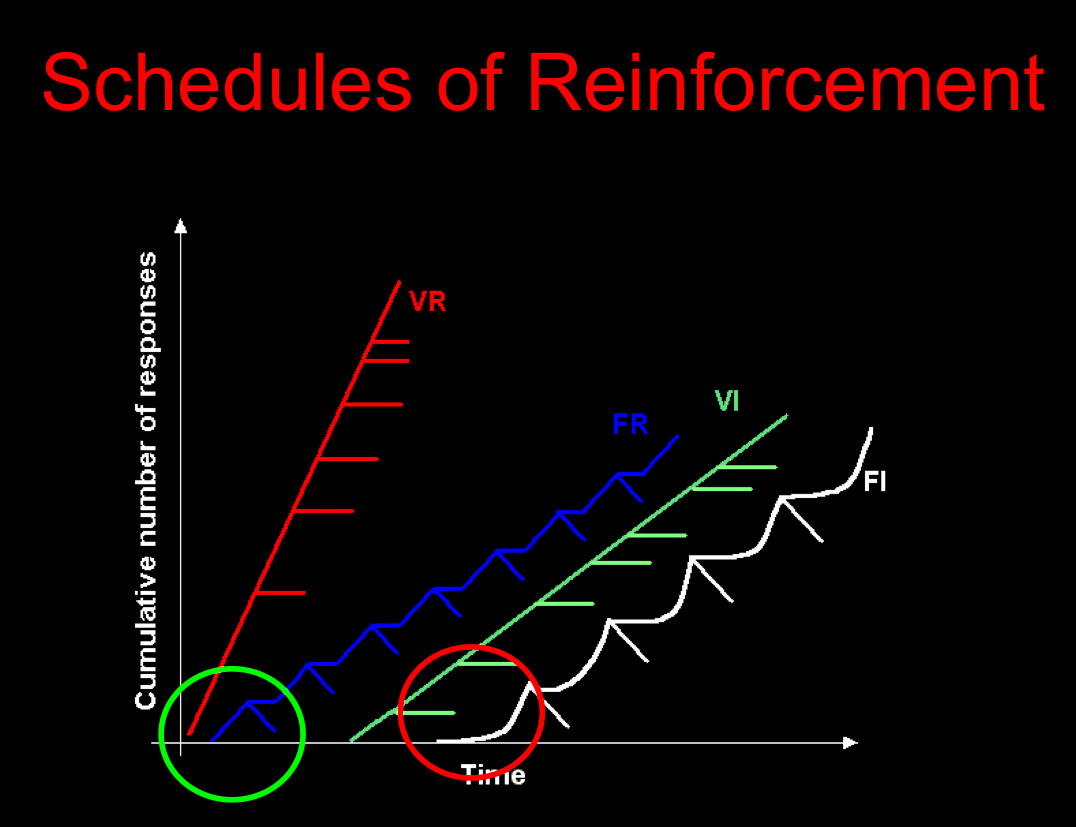
fixed-ratio schedule - when reinforcement is delivered after a specific number of responses have been completed
FR7 = reinforcement occurs after every 7 responses
ex. being paid per product made
variable-ratio schedule - when the number of responses required to receive reinforcement varies according to an avaerage
VR7 = reinforcement occurs randomly, with the average being after every 7 responses
ex. frequency of winning on a slot machine
fixed-interval schedule varies linked- when reinforcement occurs following first response happening after a set amount of time passes
FI 5 min = 1 piece of candy for the first response after 5 minutes
ex. students study the most for an exam because they know the exam is upcoming
variable-interval schedule - when the first response is reinforced following a variable amount of time
VI 5 min = reinforcement occurs randomly, with the average being after 5 minutes
ex. waiting for falling stars during a meteor shower
partial reinforcement effect
a phenomenon where organisms that have been conditioned under partial reinforcement resist extinction longer than those conditioned under continuous reinforcement
AKA superstitions
how are superstitions helpful?
superstitious behaviour can help (maintain) performance on tasks involving control (like sports)
otherwise they are useless
punishment and how its used in the real world (speeding tickets)
photo radar has small effects on speeding behaviour
punishment arrives a week after the behavioir
tickets from officers are more immediate and effective
principles of effective punishment
severity - severity of punishment should match
Initial punishment level - level of punishment needs to be strong enough to reduce the chance of another offence occurring
contiguity - punishment is most affective when it happens right after the behaviour
consistency - punishment should be administered consistently
show alternatives - punishment is more successful, and side effects are reduced, if the individual is clear on how reinforcement can be obtained by engaging in appropriate behaviours
 Note
Note  Flashcards (25)