Unit 2 Psychology
 Studied by 1 person
 Call Kai
 Learn
Learn Practice Test
 Spaced Repetition
 Match
Match Flashcards
 Knowt Play
1/112

There's no tags or description
Looks like no tags are added yet.
Name | Mastery | Learn | Test | Matching | Spaced | Call with Kai |
|---|
No analytics yet
Send a link to your students to track their progress
113 Terms
Biological psychology
The scientific study of the links between biological (genetic, neural, hormonal) and psychological processes. (Some biological psychologists call themselves behavioral neuroscientists, behavior genetics, physiological psychologists, or biopsychologists)
Neuron
A nerve cell; the basic building block of nervous system
Dendrites
A neuron's bushy, branching extensions that receive messages and conduct impulses toward the cell body
Axon
The neuron extension that passes messages through its branches to other neurons or to muscles or glands
Myelin sheath
A fatty tissue layer segmentally encasing the axons of some neurons; enables vastly greater transmission speed as neural impulses hop from one sausage-like node to the next
Action potential
A neural impulse; a brief electrical charge that travels down an axon
Refractory period
A period of inactivity after a neuron has fired
Threshold
The level of stimulation required to trigger a neural impulse
All-or-none response
A neuron's reaction of either firing (with a full-strength response) or not firing
Synapse
The junction between the axon tip of the sending neuron and the dendrite or cell body of the receiving neuron. The tiny gap at this junction is called the synaptic gap or synaptic cleft
Neurotransmitters
Chemical messengers that cross the synaptic gaps between neurons. When released by the sending neuron, neurotransmitters travel across the synapse and bind to receptor sites on the receiving neuron, thereby influencing whether that neuron will generate a neural impulse
Reuptake
A neurotransmitter's reabsorption by sending neuron
Endorphins
"Morphine within"--natural, opiate-like neurotransmitters linked to pain control and to pleasure
Agonist
A molecule that, by binding to receptor site, stimulates a response
Antagonist
A molecule that, by binding to a receptor site, inhibits or blocks a response
Nervous system
The body's speedy, electrochemical communication network, consisting of all the nerve cells of the peripheral and central nervous system
Central nervous system (CNS)
The brain and spinal cord
Peripheral nervous system (PNS)
The sensory and motor neurons that connect the central nervous that connect the central nervous system (CNS) to the rest of the body — responsible for transmitting messages between CNS and all of the parts of the body. Divided into two parts: The Somatic Nervous System and Autonomic System
Nerves
Bundled axons that form neural "cables" connecting the central nervous system with muscles, glands, and sense organs
Sensory (afferent) neurons
Neurons that carry incoming information from the sensory receptors to the brain and spinal cord
Motor (efferent) neurons
Neurons that carry outgoing information from the brain and spinal cord to the muscles and glands
Interneurons
Neurons within the brain and spinal cord that communication internally and intervene between the sensory inputs and motor outputs
Somatic nervous system
The division of the peripheral nervous system that controls the body's skeletal muscles. Also called the skeletal nervous system. Transmits sensory messages to the central nervous system
Autonomic nervous system (ANS)
The part of the peripheral nervous system that controls the glands and the muscles of the internal organs (such as the heart). Its sympathetic division arouses; its parasympathetic division calms
Sympathetic nervous system
The division of the autonomic nervous system that arouses the body, mobilizing its energy in stressful situations — preparing the body for action (Fight or Flight)
Parasympathetic nervous system
The division of the autonomic nervous system that calms the body after emergencies, conserving its energy
Reflex
A simple, automatic response to a sensory stimulus, such as the knee-jerk response
Endocrine system
The body's "slow" chemical communication system a set of glands that secrete hormones into the bloodstream
Hormones
Chemical messengers that are manufactured by the endocrine glands travel through the bloodstream and affect other tissues
Adrenal glands
A pair of endocrine glands that sit just above the kidneys and secrete hormones (epinephrine and norepinephrine) that help arouse the body in times of stress. Cause liver to release stored sugar, making energy available for emergencies. Triggered by the sympathetic nervous system
Pituitary gland
The endocrine systems most influential; gland. Under the influence of the hypothalamus, the pituitary regulates growth and controls other endocrine glands. Growth hormones regulates growth of muscles, bones, and glands. Prolactin stimulates production of milk in nursing women. Oxytocin is responsible for stimulating labor in pregnant women
Lesion
Tissue destruction. Brain ___ is a naturally or experimentally caused destruction of brain tissue
Electroencephalogram (EEG)
An amplified recording of the waves of electrical activity sweeping across the brain's surface, These waves are measured by electrode placed on the scalp
CT (computed tomography) scan
A series of X-ray photographs taken from different angles and combined by computer into a composite representation of a slice of the brain's structure. (Also called CAT scan)
PET (positron emission tomography) scan
A visual display of brain activity that detects where a radioactive form of glucose goes while brain performs a given task
MRI (magnetic resonance imaging)
A technique that uses magnetic fields and radio waves to provide computer-generated images of soft tissue. Scans show brain anatomy
fMRI (functional MRI)
A technique for revealing blood flow and, therefore, brain activity by comparing successive MRI scans. Scans show brain function as well as its structure.
Brainstem
The oldest part and central core of the brain, beginning where the spinal cord swells as it enters the skill; the brainstem is responsible for automatic survival functions
Medulla
The base of the brainstem controls heartbeat and breathing
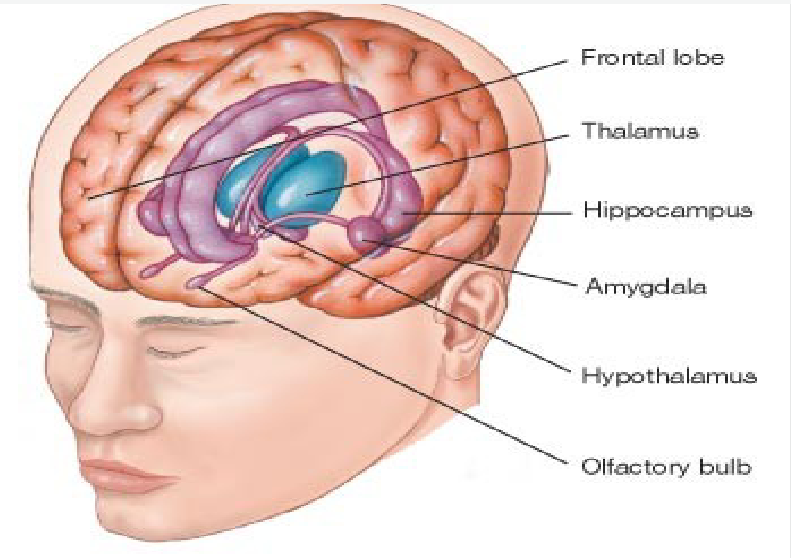
Thalamus
The brain's sensory control center, located on top the brainstem; it directs messages to the sensory receiving areas in the cortex and transmitted replies to the cerebellum and medulla.
Reticular formation
A nerve network that travels through the brainstem and thalamus and plays an important role in controlling arousal
Cerebellum
The "little brain" at the rear of the brainstem; functions include processing sensory input, coordinating movement output and balance, and enabling nonverbal learning and memory
Limbic system
Neural system (including the hippocampus, amygdala, and hypothalamus) located below the cerebral hemispheres; associated with emotions and drives
Amygdala
Two lima-bean-sized neural clusters in the limbic system linked to emotion
Hypothalamus
A neural structure lying below the thalamus; it directs several maintenance activities (eating, drinking, body temperature) helps govern the endocrine system via the pituitary gland, and is linked to emotion and reward
Cerebral cortex
The intricate fabric of interconnected neural cells covering the cerebral hemispheres; the body's ultimate control and information-processing system center
Glial cells (glia)
Cells in the nervous system that support, nourish, and protect neurons; they may also play a role in learning and thinking
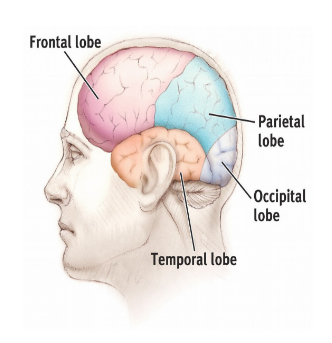
Frontal lobes
Portion of the cerebral cortex lying just behind the forehead involved in speaking and muscle movements and in making plans and judgements
Parietal lobes
Portion of the cerebral cortex lying at the top of the head and toward the rear receives sensory input or touch and body position
Occipital lobes
Portion of the cerebral cortex lying at the back of the head; includes areas that receive information from the visual fields
Temporal lobes
Portion of the cerebral cortex lying roughly above the ears; includes the auditory areas, each receiving information primarily from the opposite ear
Motor cortex
An area at the rear of the frontal lobes that controls voluntary movements
Somatosensory cortex
Area at the front of the parietal lobes that registers and processes body touch and movement sensations
Association areas
Areas of the cerebral cortex that are not involved in primary motor or sensory functional rather, they are involved in higher mental functions such as learning, remembering, thinking, and speaking
Plasticity
The brain's ability to change, especially during childhood, by reorganizing after damage or by building new pathways based on experience
Neurogenesis
The formation of new neurons
Corpus callosum
The large band of neural fibers connecting the two brain hemispheres and carrying messages between them
Split brain
A condition resulting from surgery that isolates the brains two hemispheres by butting the fibers (mainly those of the corpus callosum) connecting them
Consciousness
Our awareness of ourselves and our environment
Cognitive neuroscience
The interdisciplinary study of the brain activity linked with cognition (including perception, thinking, memory, and language)
Dual processing
The principle that information is often simultaneously processed on separate conscious and unconscious tracks
Behavior genetics
The study of the relative power and limits of genetic and environmental influences on behavior
Environment
Every external influences, from prenatal nutrition to the people and things around us
Chromosomes
Threadlike structures made of DNA molecules that contain the genes. Normal humans contain 46 chromosomes in 23 pairs in a double helix formation. 22/23 pairs are similar in both males and females (23rd is what determines whether we are male or female)
DNA (deoxyribonucleic acid)
A complex molecule containing the genetic information that makes up the chromosomes
Genes
The biochemical units of heredity that make up the chromosomes; segments of DNA capable of synthesizing proteins
Genome
The complete instructions for making an organism, consisting of all the genetic material in that organism's chromosomes
Identical twins (monozygotic twins)
Twins who develop from a single fertilized egg that splits in two, creating two genetically identical organisms
Fraternal twins (dizygotic twins)
Twins who develop from separate fertilized eggs. They are genetically no closer than brothers and sisters, but they share a fetal environment
Molecular genetics
The subfield of biology that studies the molecular structure and function of genes
Heritability
The proportion of variation among individuals that we can attribute to genes. The ___ of a trait may vary, depending on the range of populations and environments studied
Interaction
The interplay that occurs when the effect of one factor (such as environment) depends on another factor (such as heritability)
Epigenetics
The study of environmental influences on gene expression that occur without a DNA change
Gene-environment interaction
Biological appearances have social consequences. People respond differently to recording artist Nicki Minaj and concert violinist Hilary Hahn
Evolutionary psychology
The study of the evolution of behavior and the mind, using principles of natural selection
Natural selection
The principle that, among the range of inherited trait variations, those contributing to reproduction and survival will most likely be passed on to succeeding generations
Mutations
A random error in gene replication that leads to a change
Excitatory neurotransmitter
Positive ions arrive into the ion channel = more likely the next neuron will fire
Inhibitory
Negative ions arrive into ion channel = less likely the next neuron will fire
Acetylcholine
Control of muscles; required for movement
Dopamine
Motor behavior and pleasure
Noradrenaline
Prepares the body for action
Dopamine
Too little plays a role in Parkinson’s disease, as seen in the tremors and rigid, uncoordinated movements
GABA
An inhibitory neurotransmitter implicated in anxiety
Serotonin
Excitatory neurotransmitters that’s responsible for the balance of our mood - emotional arousal and sleep
Curare
Acetylcholine antagonist that causes paralysis
Black widow spider venom
Acetylcholine agonist causing seizures
Morphine
Agonist and boosts the effects of endorphins — increased use = body will stop producing endorphins causing drug withdrawal symptoms
Depression
Low levels of serotonin
Prozac
Agonist - A “selective serotonin reuptake inhibitory, blocks the reuptake of serotonin allowing more time for it to take effect, therefore boosting its effects
Dopamine
Too much causes schizophrenia
Norepinephrine
Reward, mood, arousal, fight/flight behavior
Norepinephrine
Too much: autonomic arousal, anxiety, manic behavior, schizophrenic behavior
Norepinephrine
Too little: possible depression, memory impairment
Alcohol
GABA agonist in that it boosts its inhibitory tendencies to stop action potentials
Hindbrain
The medulla, pons, and cerebellum
Midbrain
Small region located above the spinal cord between the hindbrain and the forebrain. Coordinates simple movements and sensory information: Vision and hearing. Reticular Activating System.
Forebrain
The Limbic system (thalamus, hypothalamus, hippocampus, amygdala), cerebrum, cerebral cortex
Cerebral Cortex
Occipital, temporal, parietal, frontal
 Note
Note  Flashcards (20)