AP Microeconomics - ALL TERMS (Units 1-6)
 Studied by 7 people
 Call Kai
 Learn
Learn Practice Test
 Spaced Repetition
 Match
Match Flashcards
 Knowt Play
1/420

Earn XP
Description and Tags
some things are a little confusing about what unit they apply to- i am trying to fix that as I study
Name | Mastery | Learn | Test | Matching | Spaced | Call with Kai |
|---|
No analytics yet
Send a link to your students to track their progress
421 Terms
How do you calculate marginal revenue product?
MRP = Marginal Product (MP) × Marginal Revenue (MR)
What does a firm’s decision to hire a factor of production not depend on?
The average product of the factor input
What are the factors of production
land, labor, and capital
Which of the following will occur in a given labor market when the wage rate rises?
The quantity of labor supplied will increase.
Suppose the demand for automobiles increases. Which of the following explains what happens in the labor market for automobile workers?
The demand for automobile workers increases resulting in higher wages and employment.
Which of the following will result in a decrease in the supply of labor?
An increase in the preference for leisure
A firm is currently producing 3,000 units of output daily by employing 20 units of labor at a price of $100 per unit and 40 units of capital at a price of $40 per unit. The marginal product of the last unit of labor employed is 50, and the marginal product of the last unit of capital employed is 30. In order to minimize its production costs, the firm should do which of the following?
Responses
Employ less labor and more capital because the marginal product per dollar spent on labor is less than the marginal product per dollar spent on capital.
In comparison to a firm in a perfectly competitive labor market, a firm in a monopsonistic labor market typically will hire
fewer workers and pay a lower wage
how to calculate marginal factor cost
ΔTFC / ΔQ
derived demand
demand for factors of production (land, labor, capital) because of a change in the (product) market. (Demand for steel increases because of a demand increase for cars.)
marginal product of labor
change in output associated with adding an additional worker
value of the marginal product (VMP)
marginal product of an input multiplied by the price of the output it produces (slopes downward due to diminishing MP)
marginal profit
vmp-wage
The labor-leisure trade-off
people work because they need to earn a living (they have other interests, obligations, and goal)
substitution effect
occurs when laborers work more hours at higher wages, substiting labor for lesiure (oppurtunity cost of enjoying more leisure means giving up more income)
income effect
occurs when laborers work fewer hours at higher wages, using their additional income to demand more leisure
leisure
normal good meaning that as income increases, workers may use their additional income to demand more leisure
backward bending labor supply curve
occurs when workers value additional leisure more than additional income (offset substitution effect)
what are the changes in the supply of labor?
other employment oppurtunities, the changing composition of the workforce, immigration and migration,
other employment oppurtunites
if a firm offers higher wages, more workers will be willing to work there. Decrease in competition wages increase in supply of firm
the changing composition of the workforce
many more women being employed than a generation ago
immigration and migration
increase supply of (inexpensive) labor
How does the market for labor reach equilibirum
wages = price at which workers are willing to “rent” their time to employers
what does an increase in demand result in?
shortage
what does an increase in supply result in?
surplus
outsourcing of labor
occurs when a firm shifts jobs to an outside company, usually overseas, where the cost of labor is lower
what does outsourcing do in the LR?
benefits domestion consumers & producers since it lowers costs and prices, which enhances social welfare
monopsony
situation in which there is only one buyer (market power, can pay workers less)
economic rent
difference between what a factor of production earns and what it could earn in the next best alternative
how do you decide if you should use more land labor or capital?
divide the VMP, MP, or MRP by the wage or price(use less of the factor with the smallest bang per buck and more of the factor with the largest)
Marginal product
this refers to the change in output as a result of additional labor or units.
Marginal Revenue
this is an increase in total revenue generated by increase in production. Marginal revenue can be generated by producing one more unit of output or selling an additional unit of a good.
MRP vs VMP
MRP is MRxMP and VMP is PxMP
Marginal revenue product
This is an increase in a firm's revenue resulting from adding one more resource unit called the marginal product.
Marginal Resource cost
The amount the total cost of employing a resource increases when a firm employs 1 additional unit of the resource
Where should a firm produce?
where MRP = MRC or as close to it as possible
how do you find MRC?
constant cost (wage or rent)
Why is supply and MRC seperate in a monopsony?
when the firm increases the wage for one worker, they need to increase the wage for all workers) ( when looking at a table for a monopsony, the wage of the max worker is what all workers earn)
How do monopsonies compare to perfect competition?
they hire less workers and pay less
How do you find the quantity and wage in a monopsony?
find where MRC=MRP and bring down to supply because thats how much you have to pay that number of workers
Where is demand and supply from? (factor market)
demand = firm
supply = individual
When does demand shift?
If something impacted the MRP
What is a monopoly `
1 seller of a product with no substitutes . They have extremely high barriers to entry and are the price makers. They have higher prices and less output than competitive markets
What conditions enable a monopoly?
firm has something unique to sell, it must have a way to prevent competitors from entering the market (patents or deals with the government)
Monopoly power
a measure of monopolies ability to set the price of a g/s
barriers to entry
restrictions that make it difficult for new firms to enter a market (set apart monoploies from regular firms and allow them to enjoy long run economic profits)
What are the natural barriers?
control of resources, problems in raising capital, economies of scale
control of resources
if you have control of a scarce resource, other companies will not be able to find enough of it to compete. extremely effective but difficult
problems in raising capital
monopolies have grown over an extended period and the chance of a new company successfully competing against a monopoly is low
economies of scale
LRATC falls as production expands. create massive cost advantages for a single large firm, making it inefficient for multiple smaller firms to compete,
natural monopoly
occurs when a single large firm has lower costs than any particular smaller competitor
government created barriers
can be intentional or unintentional. Consists of licensing(Creates corruption), patents, and copyright laws (government ensurance that nobody else can copy without permission of creator (stronger incentives for innovation))
price maker
some control over the price it charges
Why is the demand curve downward sloping? (monopoly)
limits monopolists ability to make a profit (many different price-output combos)
Profit maximizing rule for monopolies
MR=MC quantity brought up to demand.
locating profit
difference between the price and atc*Q
why can a monopoly earn longrun profits?
high barriers to entry, such as patents, control over resources, or economies of scale, that prevent other firms from entering the market and competing away those profits
problems of a monopoly
inefficient level of output (charges too much and produces too little & creates DWL, CS is transferred to the monopoly), few choices (restrict options & pay more for what you want, great for company, bad for consumers), encourage firms to lobby for government protection (rent seeking)
rent seeking
occurs when resources are used to secure monopoly rights through the political process (lobbying)
solutions to a monopoly
breaking up the monopoly (eliminating DWL & restricting efficiency, promoting competition, antitrust laws (prevent monopoly protections), reducing trade barriers, regulating markets (policymakers create a more efficient outcome and maximize society’s welfare by regulating monopolists’ prices)
why are natural monopolies permitted to exist?
because they have such high fixed/upfront costs it makes more sense to have 1 firm to give us g/s
Why are demand and MR separate?
to sell an additional unit, the price must be lowered on all units sold, not just the last one.
where is revenue maximizing qunaity? (unit 4)
when MR intersects the x-axis
why are there profits in the long run for monopolists?
because they have barriers to entry which allows them to have long-run economic profits. Along with that they are the only firm in the industry which allows them to set price and still ensure customers will buy their products.
Per unit subsidies
decrease in MC and atc. Every time the firm makes the g/s they get a subsidy
lump sum subsidy
decrease ATC (fixed costs). one-time payment from the government to make something (could make whatever quantity they want)
allocatively efficient
MC = Demand (where DWL points) (where perfectly competitve firms produce) ( socially optimal) (total welfare max)
Fair return
ATC = Demand (firms break even or have 0 economic profit)
productively efficient
ATC = MC (TC are the lowest)
lump sum tax
increased fixed cost, leaving the profit-maximizing quantity and price unchanged because it doesn't affect marginal cost (MC); however, it reduces the monopolist's total profits (or increases losses) by the tax amount, shifting the Average Total Cost (ATC) curve up
per unit tax
added cost for each unit produced, shifting the Marginal Cost (MC) and ATC curve upward, leading to reduced output, a higher price for consumers, and a larger deadweight loss, making the monopoly even less efficient, though the tax burden is shared between consumers and producers depending on demand elasticity, with consumers paying more if demand is inelastic
what does a monopoly look like
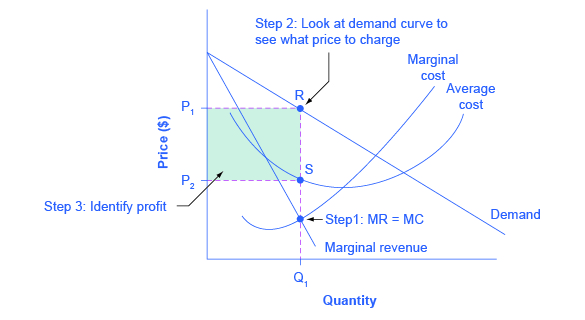
what does a natural monopoly look like
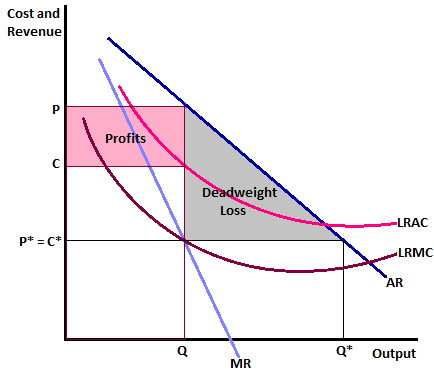
what does a LR competitive monopoly look like

price discrimination
occurs when a firm sells the same g/s at different prices to different groups of customrs (allows firm to make more money by dividing their customers into ateleast 2 groups (must be a price maker))
distinguishing groups of buyers
generate additional revenues by charging more to customers with inelastic demand and less to customers with elastic demand (price sensitive vs willing to pay full price)
Why do you need to prevent resale when trying to price discriminate?
prevent customers who recieved a discount to sell it to another customer willing to pay full price
perfect price discrimination
occurs when a firm sells the same g/s at a unique price to every customer (difficult, not price discrimination acts as a lost oppurunity for revnue)
is there DWL in perfect price discrimination?
no!
is there consumer surplus in price discrimination?
no
total welfare
sum of consumer surplus (the extra benefit consumers get from paying less than they're willing to) and producer surplus (the extra benefit producers get from selling for more than their minimum cost) in a market, representing the total economic benefit or well-being generated from all market transactions, maximized at allocative efficiency
monopolistic competition
is a type of market structure characterized by low barriers to entry, many different firms, and product differentiation
product differentiation
the process firms use to make a product more attractive to potential customers
how much market power do monopolistically competitive firms have?
small amount
how do firms product differentiate?
by style/type (mall stores are tailored to certain groups), location (convience builds pricing power) and quality (fast food vs luxury)
What are some overall monopolistic competition characteristics?
demand is relatively elastic. The firm earning a profit, experiencing a loss, or breaking even is a function of other firms exiting/entering the market
monopolistic competition in the SR
if P>ATC there is a profit, if P<ATC therer is a SR loss
monopolistic competition in the LR
when firms can easily enter/exit a market profit will be 0. In the LR, they will always earn 0 economic profit.
Why are they earning 0 economic profit in the LR of a monopolistically competitive market?
If firms are making losses, some will exit, shifting the demand curve for remaining firms to the right until profits are restored; if they're making profits, new firms enter, shifting demand left until profits disappear.
Markup
difference between the price the firm charges and the MC of production (only possible when firm enjoys some market power)
What is the difference in prices in mono comp vs perfect comp?
P=ATC is higher in monopolistic competition than in perfect competition; therefore, monopolistic competition produces higher prices
excess capacity
occurs when a firm produces at an output level smaller than the output level needed to minimize ATC
Why can governments not regulate in monopolistic competition?
many firms sell differentiated but similar products (like restaurants or clothing), allowing for easy entry/exit, competition, and consumer choice, which naturally limits excessive pricing or market power, making deep intervention unnecessary and potentially stifling the innovation and variety that benefit consumers
How does product differntiation impact a firm?
significant differentiation increase price, large amounts of excess capacity, and pretty inelastic demand. Less product differentiation does the opposite.
Why do firms advertise?
to increase demand (highlight important info about the g/s, make more people want the product, increase market power & prices)
How does advertising work in monopolistic competition?
it is widespread and the gains go directly to the firm paying for it.
How does advertising work as a monopoly?
does not have to advertise because consumer choices are already limited. Monopolies only really advertise to inform consumers about products & simulate demand (only beneficial if it can cover costs)
What are the negative effects of advertising?
it increase costs (increase ATC & MC) and can be deceitful.
How do you show advertising on a graph?
shift MR and Demand to the right (becomes more inelastic as well). Increase ATC and MC. Can lead to SR profits
Why is product differentiation necessary for monopolistic competition?
how firms gain some control over their prices and a competitive advantage in a market with many sellers
 Note
Note  Flashcards (76)