Exam 2 Women in Visual Arts
 Call Kai
 Learn
Learn Practice Test
 Spaced Repetition
 Match
Match Flashcards
 Knowt Play
1/57

There's no tags or description
Looks like no tags are added yet.
Name | Mastery | Learn | Test | Matching | Spaced | Call with Kai |
|---|
No analytics yet
Send a link to your students to track their progress
58 Terms
Angelica Kauffman (1741-1807)
Born in Switzerland, she was a child prodigy trained by her artist father. She achieved success in Italy before moving to London, where she became a founding member of the Royal Academy in 1768, a rarity for a woman. She was known for "history paintings" (the highest genre) and neoclassicism, often focusing on virtuous, moral tales.
Adelaide Labille-Guiard (1749-1803)
A French painter who, unlike her peers, came from a non-artistic, bourgeois family. She developed her skills over many years, becoming a skilled portraitist and a passionate advocate for women's artistic education. She became a member of the French Academy in 1783.
Elisabeth Vigée-Lebrun (1755-1842)
Daughter of a painter, she became the preferred portraitist of Queen Marie Antoinette. She was admitted to the French Academy in 1783 on the same day as Labille-Guiard. Known for her portraits, she skillfully managed her image and career, fleeing France during the Revolution to work for European royalty.
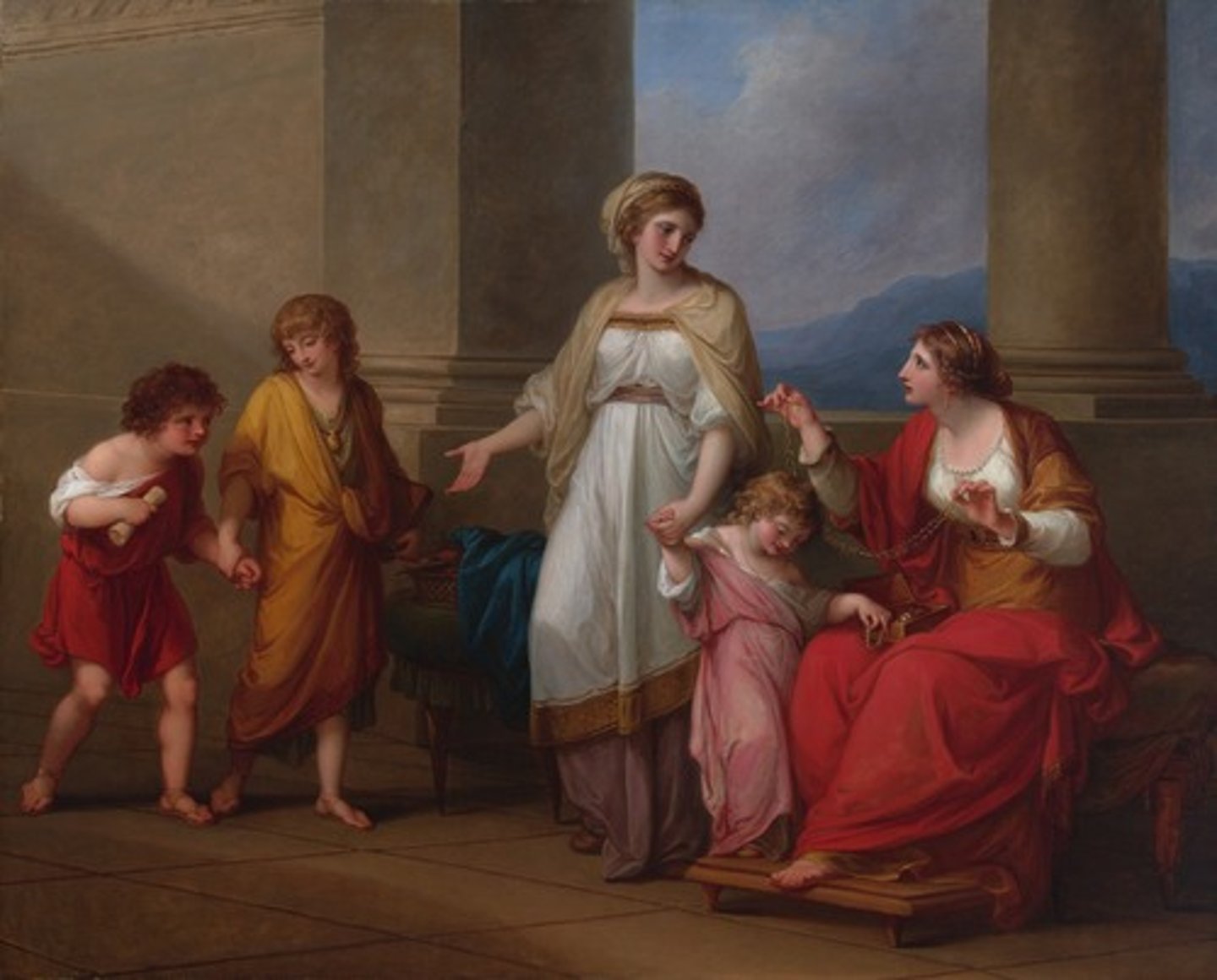
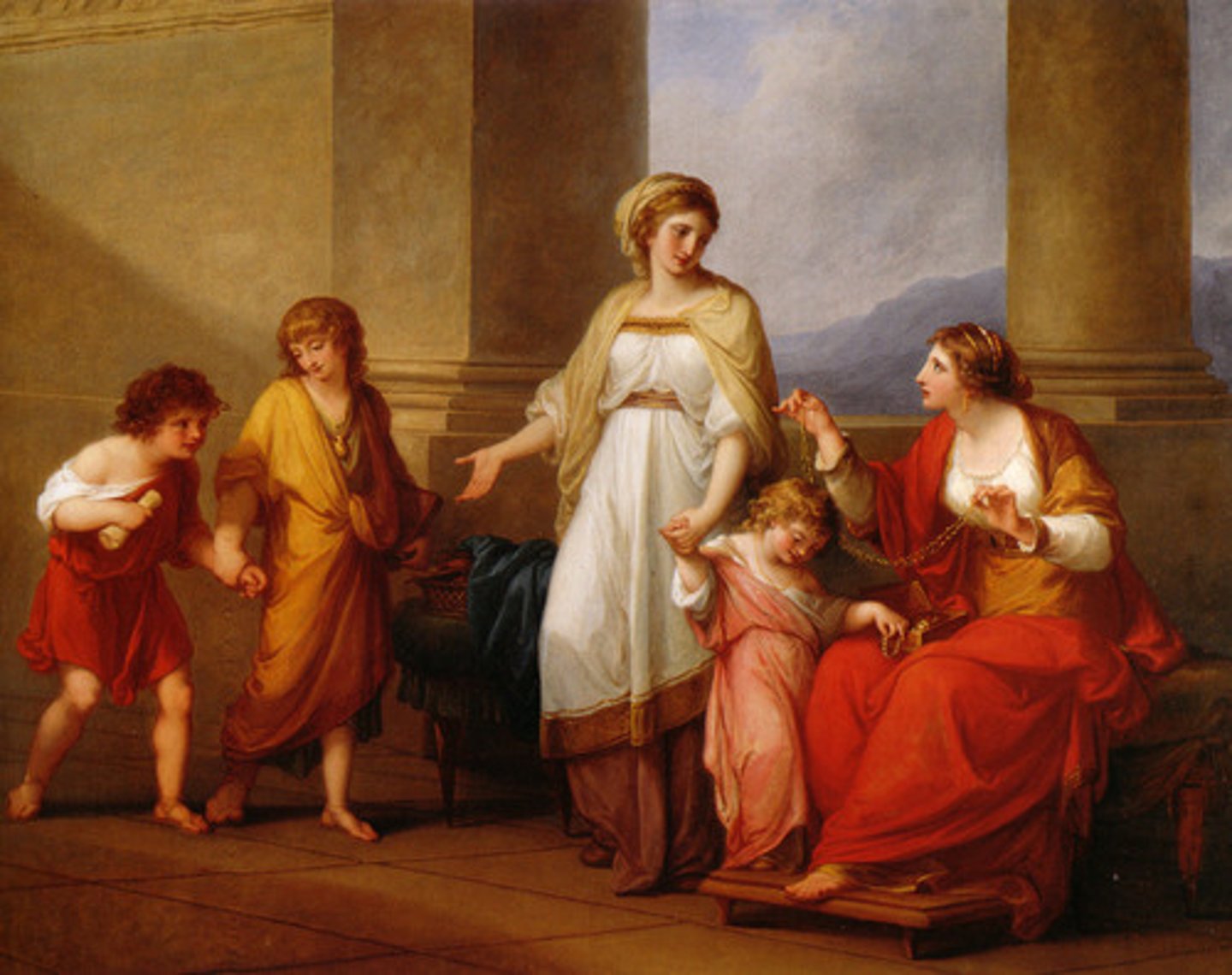
Angelica Kauffman, Cornelia Pointing to Her Children as Her Treasures (1785):
Context: Neoclassical exemplum virtutis (model of virtue).
Description: The Roman matron Cornelia is shown with her children, contrasting with a visitor flaunting jewelry. Cornelia suggests her children are her true jewels.
Significance: It highlights the "good mother" trope, emphasizing civic duty and moral education over materialistic vanity.
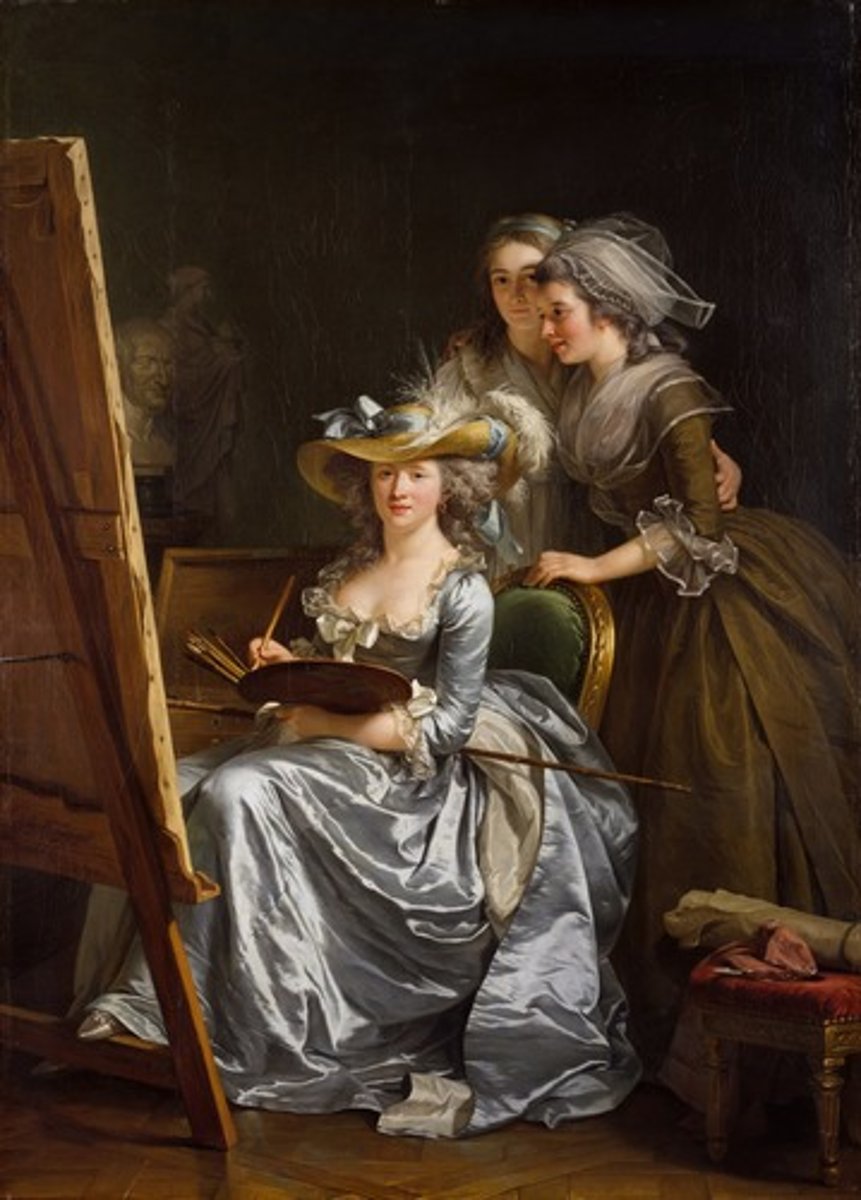
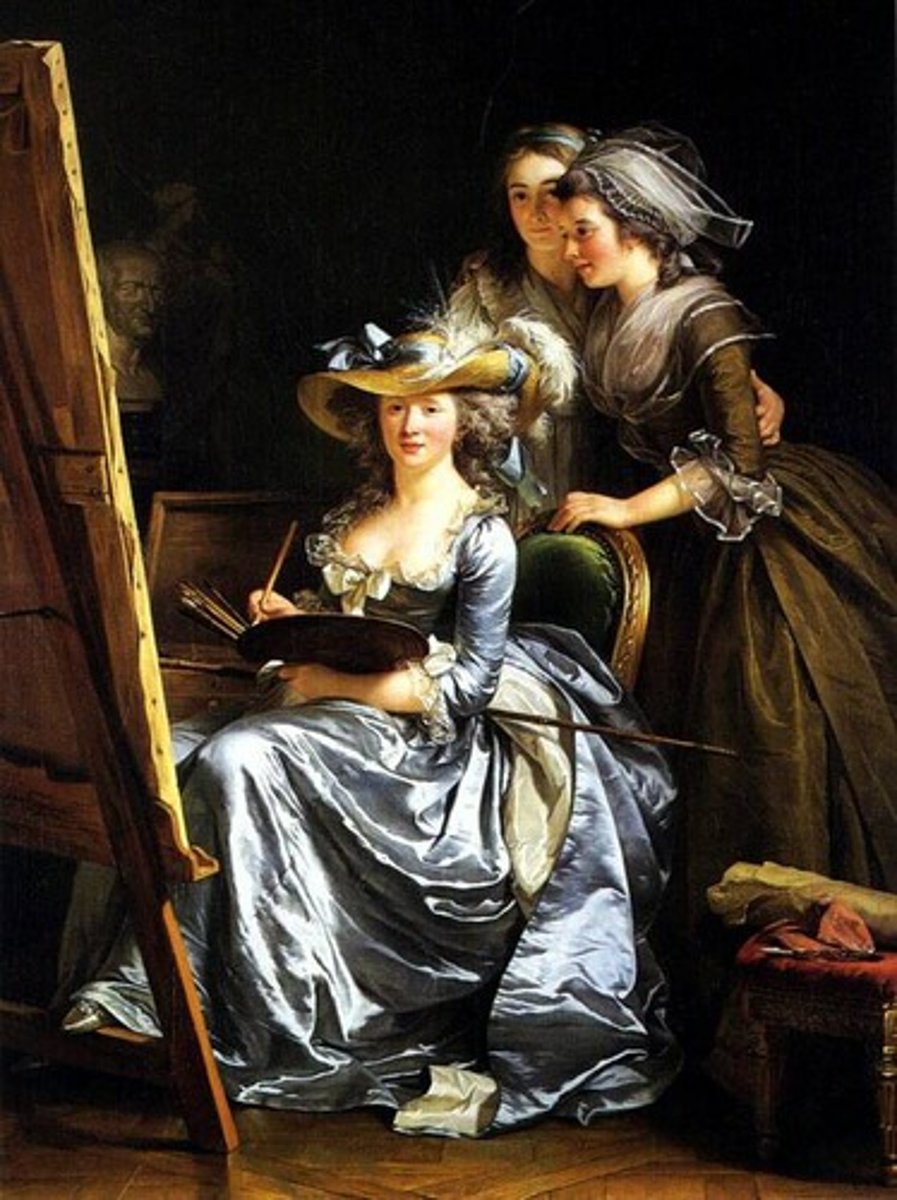
Adelaide Labille-Guiard, Self-portrait with Two Pupils (1785):
Context: Exhibited at the 1785 Salon as a "manifesto" to argue for the inclusion of women artists.
Description: Labille-Guiard paints herself in elegant, fashionable clothing, asserting her status as a professional, alongside her pupils Marie Gabrielle Capet and Marie Marguerite Carreaux de Rosemond.
Significance: It promotes women's mentorship, the validity of women's art education, and challenges the male-dominated Salon.
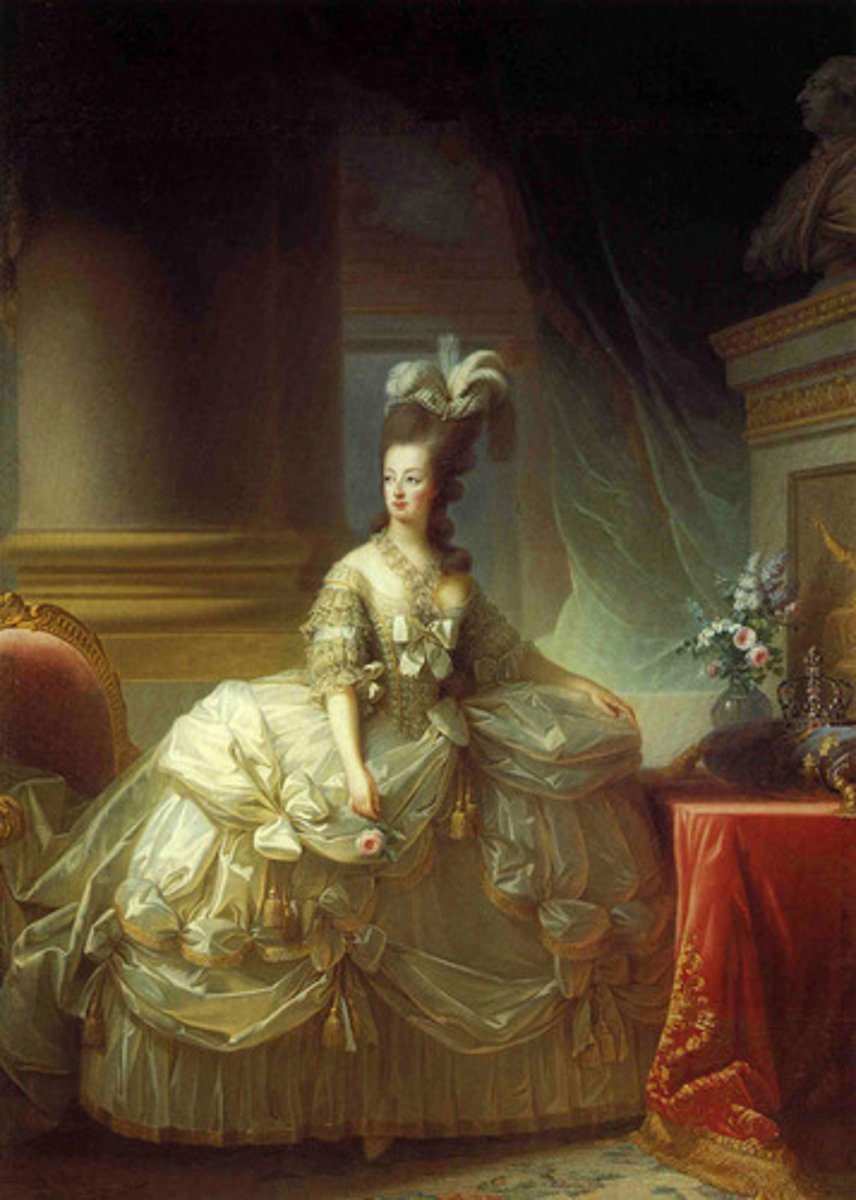
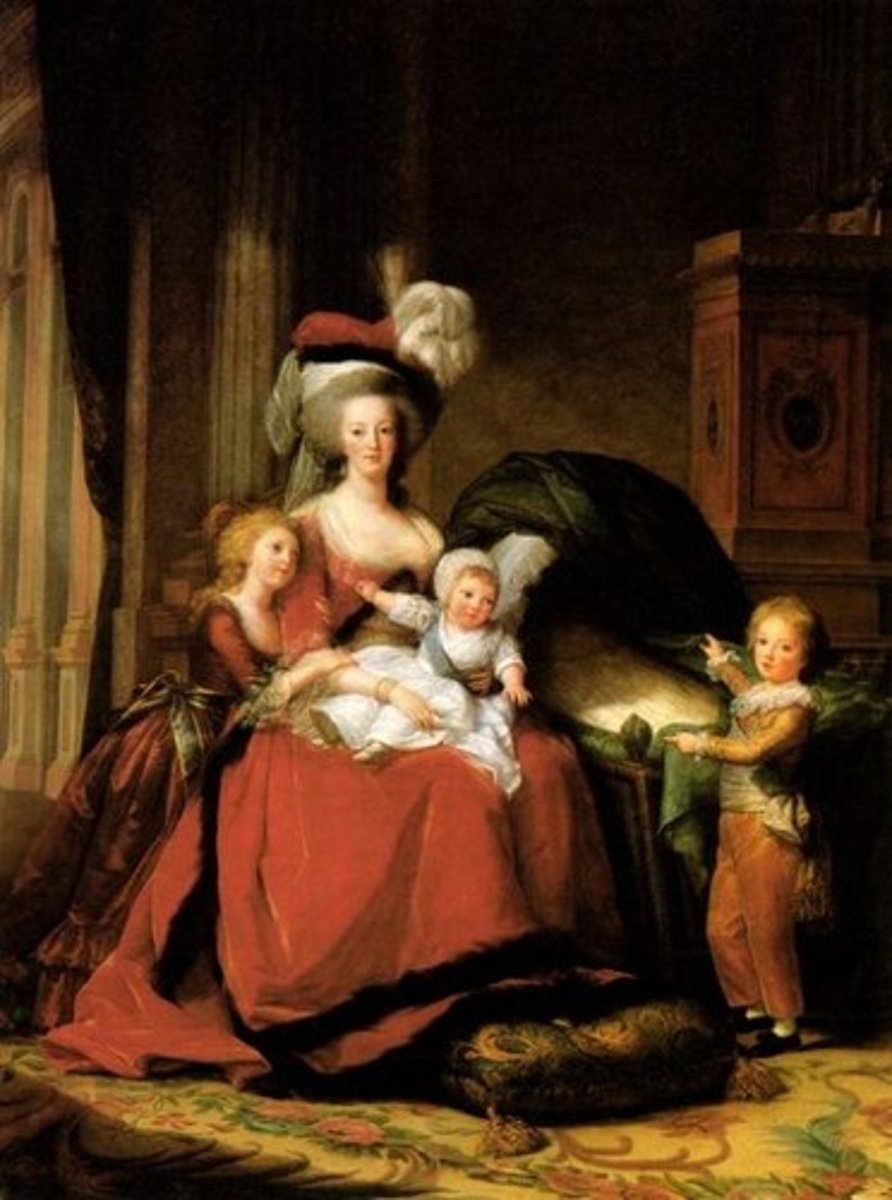
Elisabeth Vigée-Lebrun, Marie Antoinette and Her Children (1787):
Context: Commissioned to improve the Queen's unpopular image, presenting her as a devoted, loving mother rather than a frivolous, profligate spender.
Description: The queen is shown in a domestic setting at Versailles, with an empty cradle symbolizing the death of a child, designed to evoke public sympathy.
Significance: It uses maternal, neoclassicized propaganda to bridge the gap between royalty and the public.
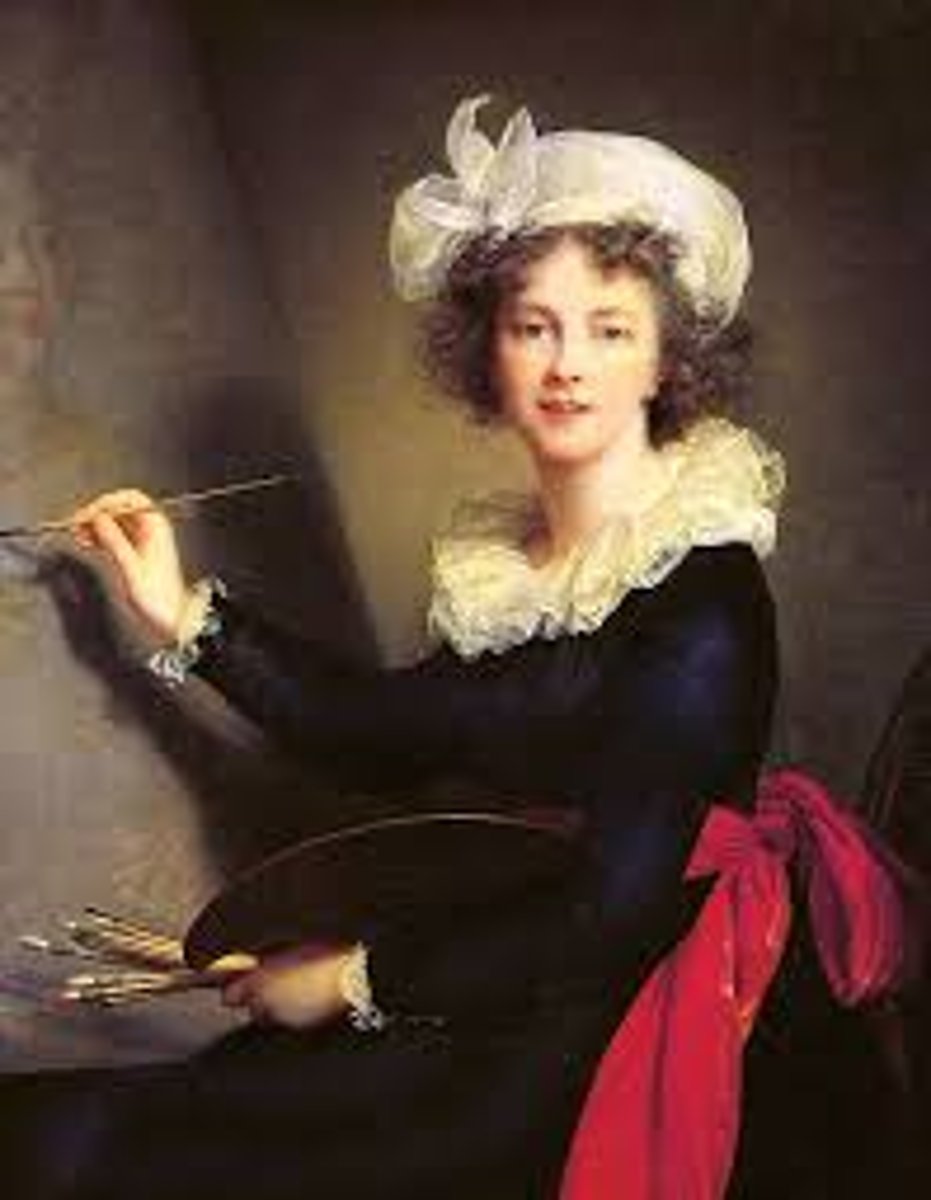
Elisabeth Vigée-Lebrun, Self-Portrait (1790):
Context: A confident, Neoclassical representation of herself at the height of her career, often showing her working on a portrait of her royal patron. It presents her as independent, talented, and fashionable.
Institutional Sexism and Possibilities
Academy Restrictions: The French Academy (Académie Royale) strictly limited the number of women members to four at any given time, forcing artists like Labille-Guiard and Vigée-Lebrun to compete intensely.
Slander: As attractive, successful women in a male-dominated field, they were frequent targets of gossip, rumor, and professional sabotage by jealous male counterparts.
Education Limitations: Women were generally excluded from life-drawing classes (drawing from male nudes), which was essential for creating "high art" (history painting), thus limiting them to portraiture or genre painting.
The "Charm" Critique: Their work was often condescendingly criticized as being "too charming" or "easy on the eye," dismissing the technical proficiency they displayed.
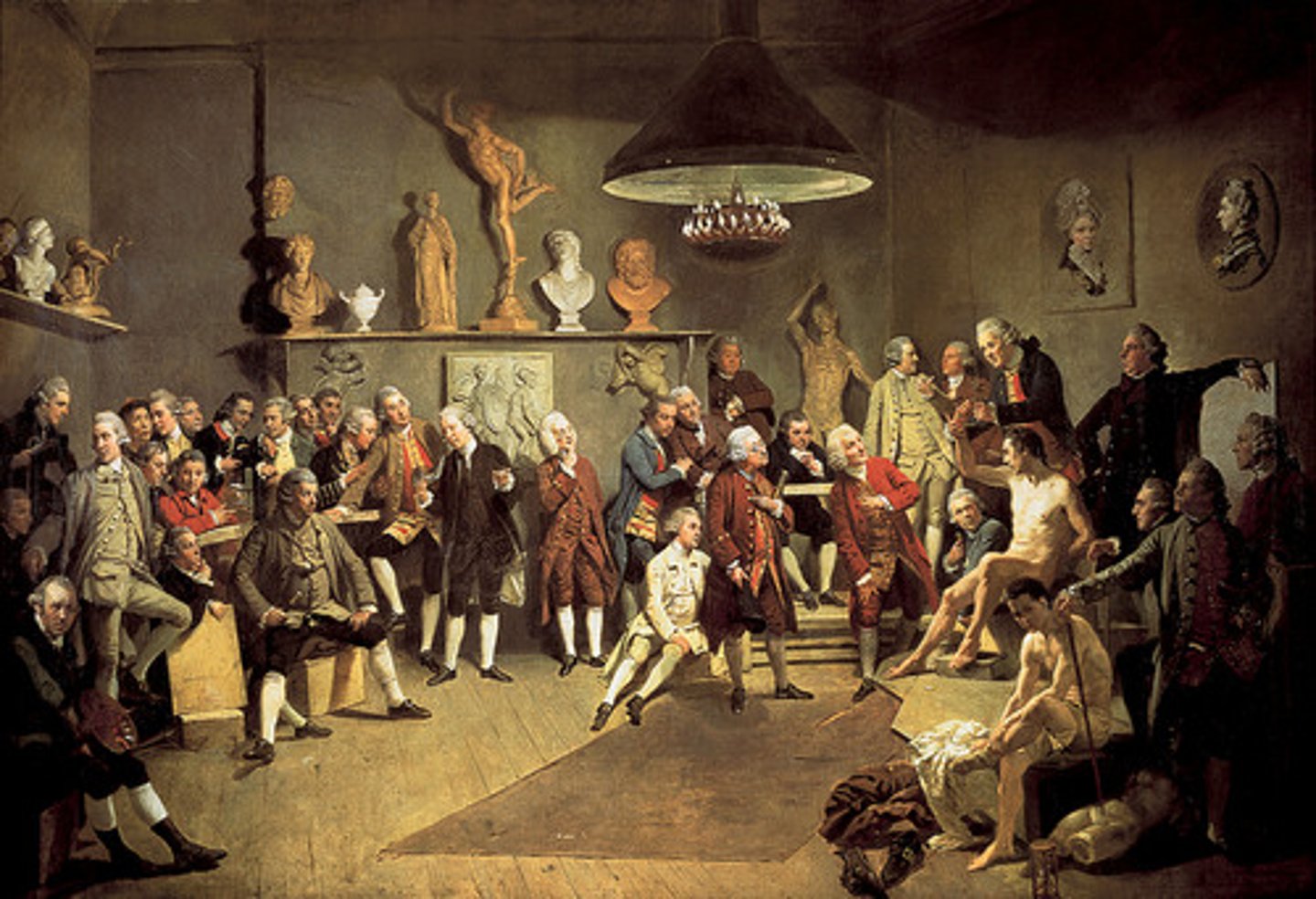
4. Johann Joseph Zoffany, A Gathering of the Members of the Royal Academy (1772)
Significance: The painting shows the Royal Academy in London with its members, including Kauffman, present.
Institutional Sexism: Although Angelica Kauffman and Mary Moser were founding members of the Royal Academy, Zoffany depicts them only as portraits on the wall, not as living, present members. This literally and figuratively "frames" them as objects of art rather than active, equal artists within the institution.
Royal Academy
A state-sponsored institution that controlled the standards of art, exhibitions, and professional reputation (e.g., in London or Paris).
salon exhibition
The official art exhibition of the French Academy, where artists needed to display their work to achieve success and reputation.
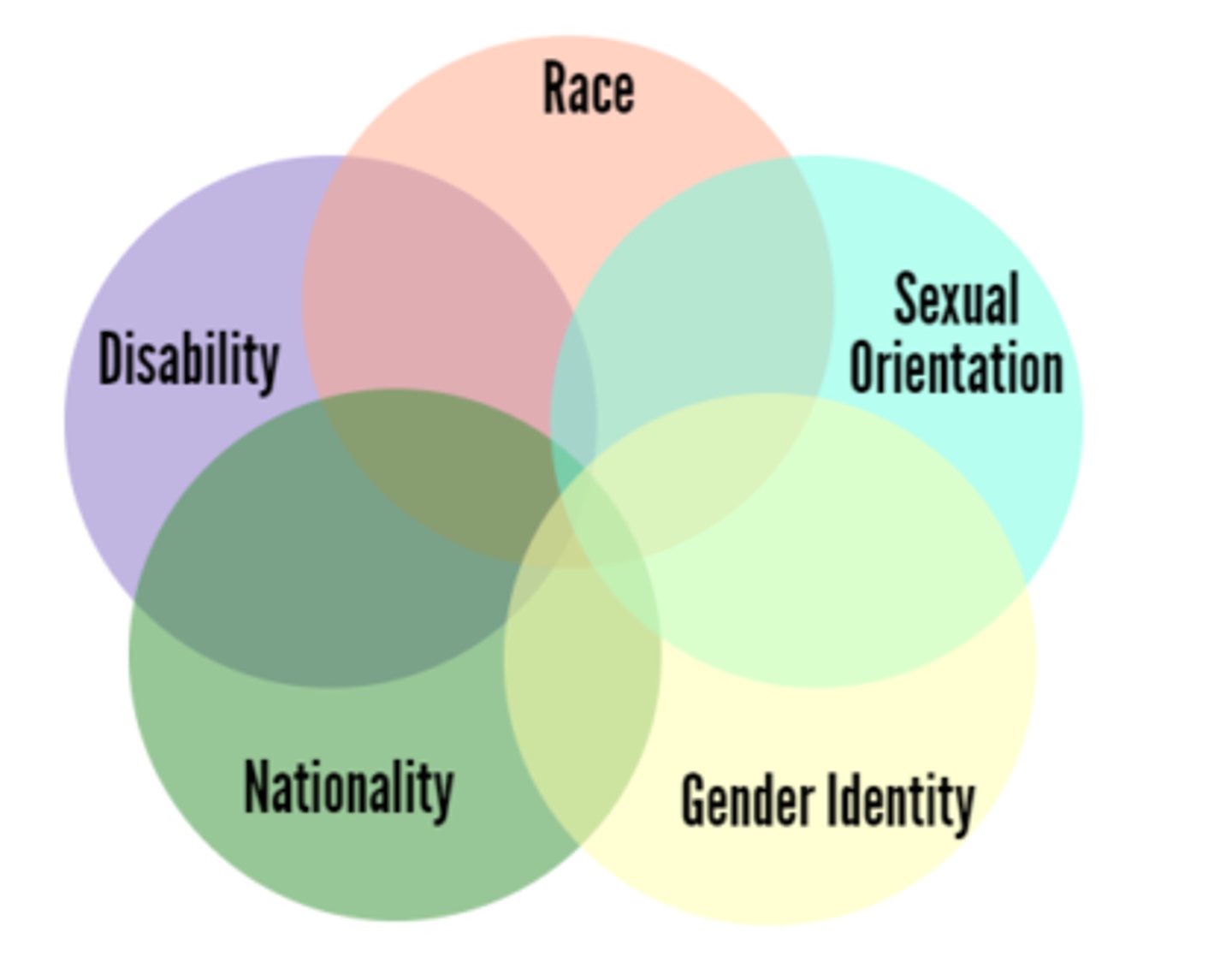
Intersectionality
a framework for understanding how various social identities (like race, gender, class, sexuality, disability) overlap and interact to create unique experiences of discrimination, privilege, and oppression
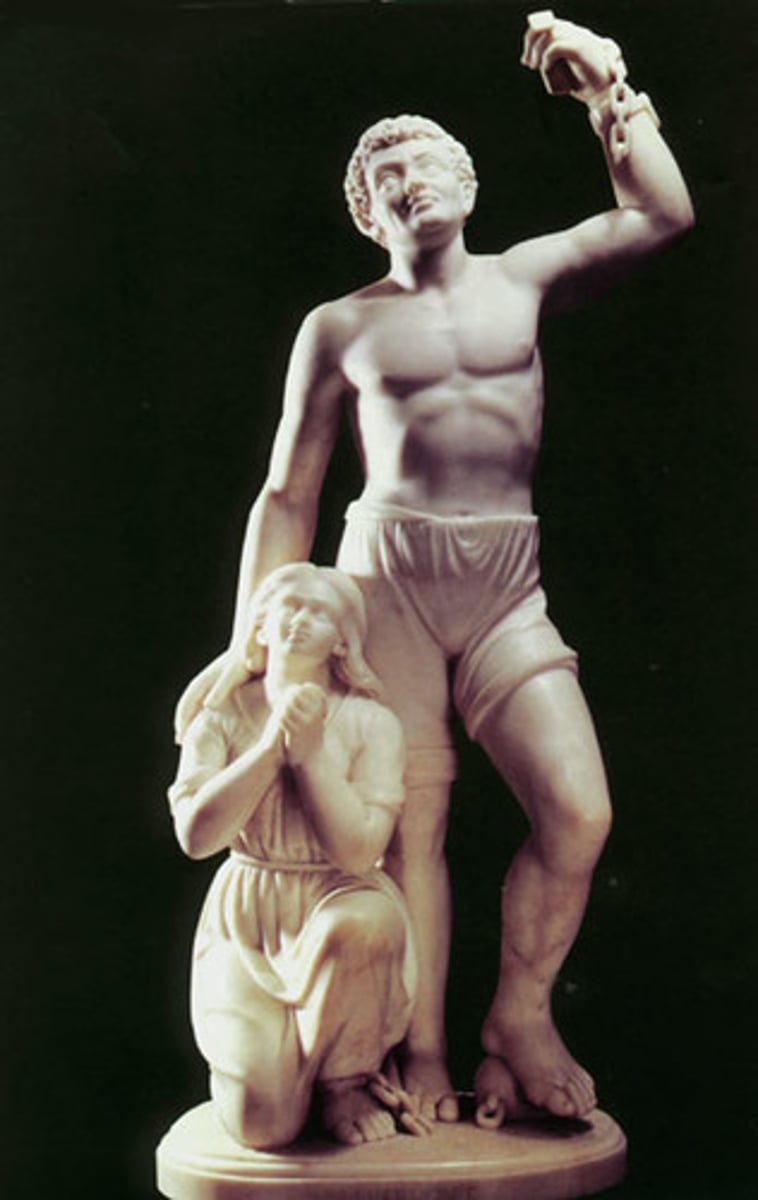
Edmonia Lewis, Forever Free, 1867
Subject: Commissioned to celebrate the Emancipation Proclamation (1863) and the 13th Amendment, this marble sculpture depicts a newly liberated Black man and woman.
Symbolism: The man stands tall with a broken chain, gazing upward in triumph. The woman kneels at his side with her hands in prayer, symbolizing gratitude.
Significance: It challenges the era's common depictions of Black figures as passive or dependent on white, patriarchal figures for their freedom. While the woman is kneeling, the sculpture emphasizes the couple's agency, affection, and the restoration of their right to family and marriage.
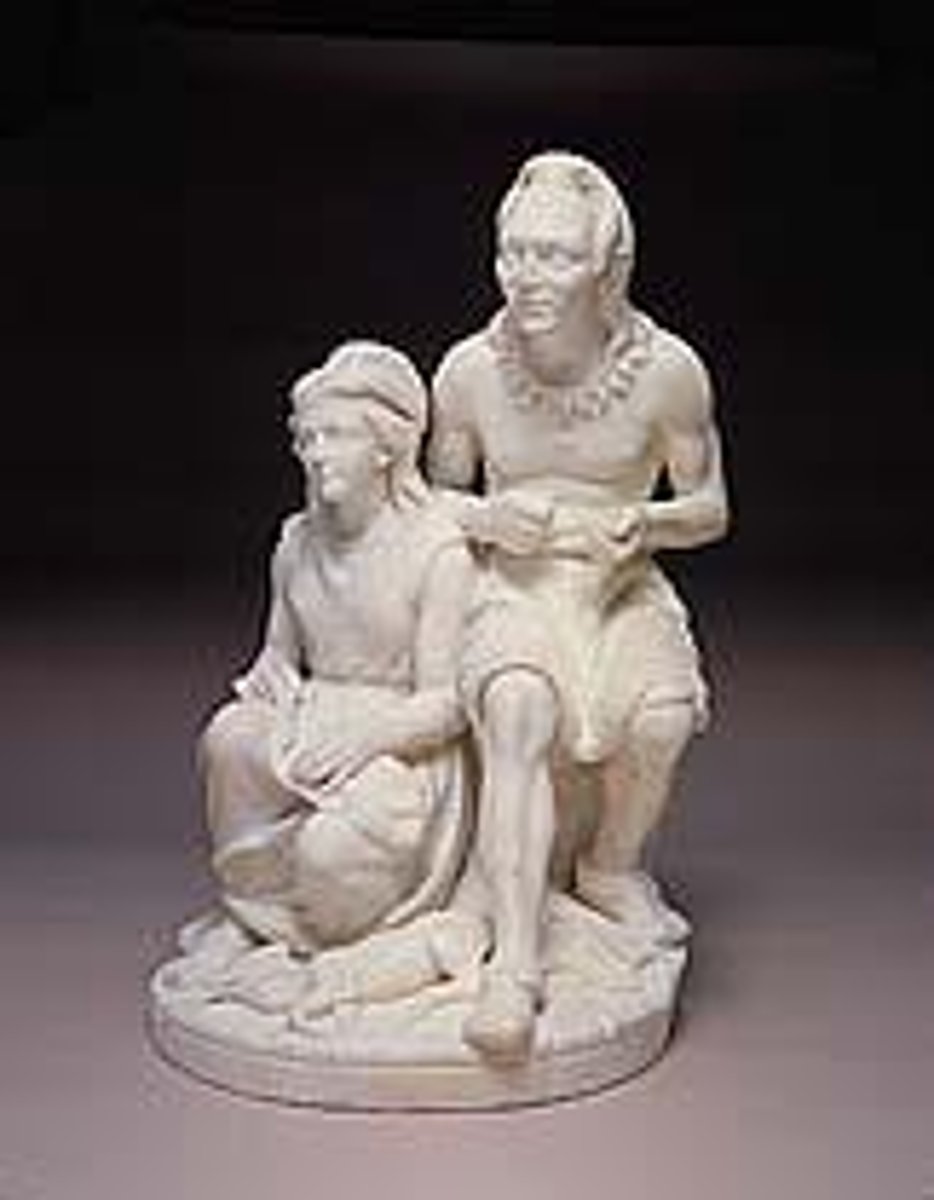
Edmonia Lewis, Old Indian Arrow-Maker and His Daughter, 1872:
Based on Longfellow's The Song of Hiawatha, this piece honors Native American culture by portraying a Dakota father and daughter (Minnehaha) engaged in traditional craft. It reflects her Ojibwe heritage and counters "vanishing race" myths by focusing on presence and skill.
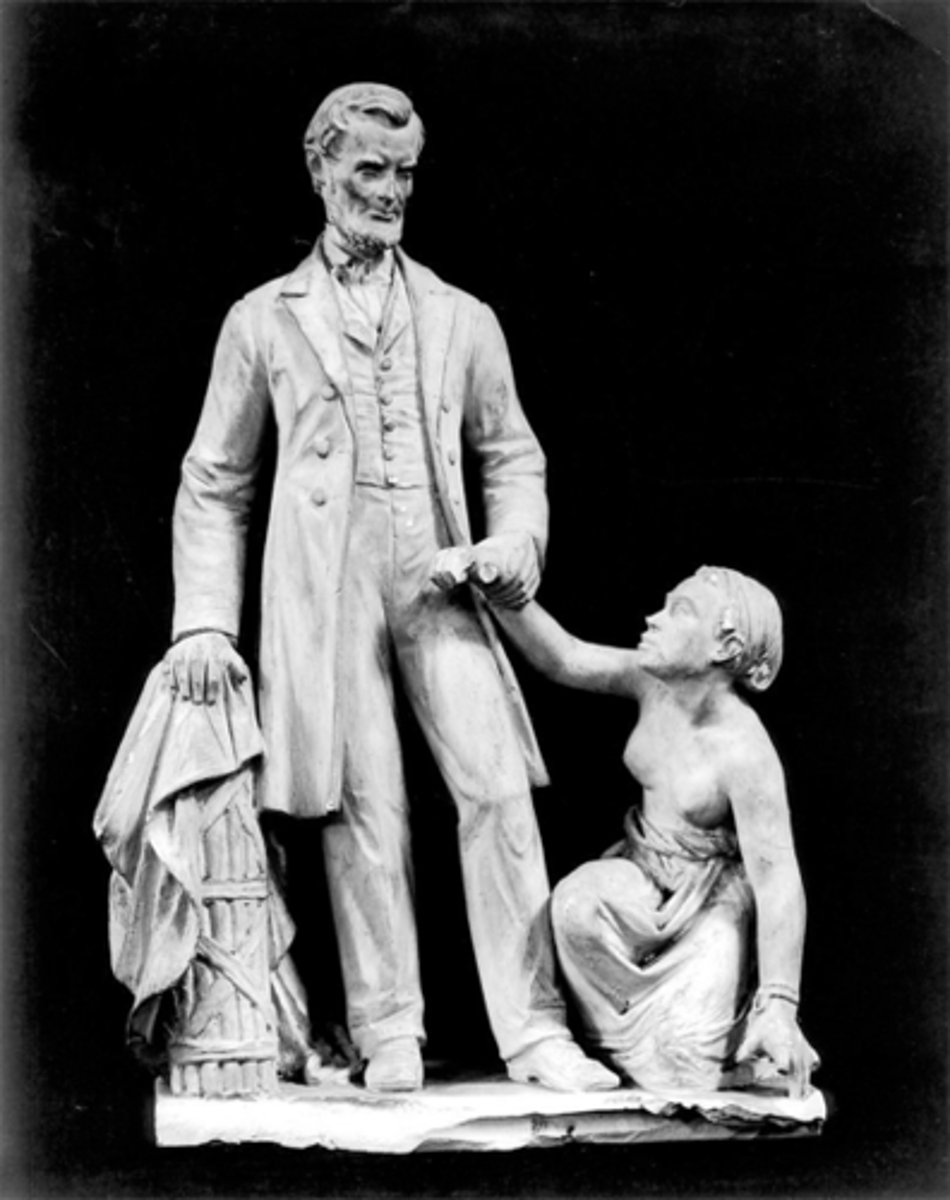
Randolph Rogers, Lincoln and the Emancipated Slave, c. 1866:
A, white-produced, neoclassical depiction often contrasting with Lewis's work by focusing on Lincoln as the primary agent of freedom.
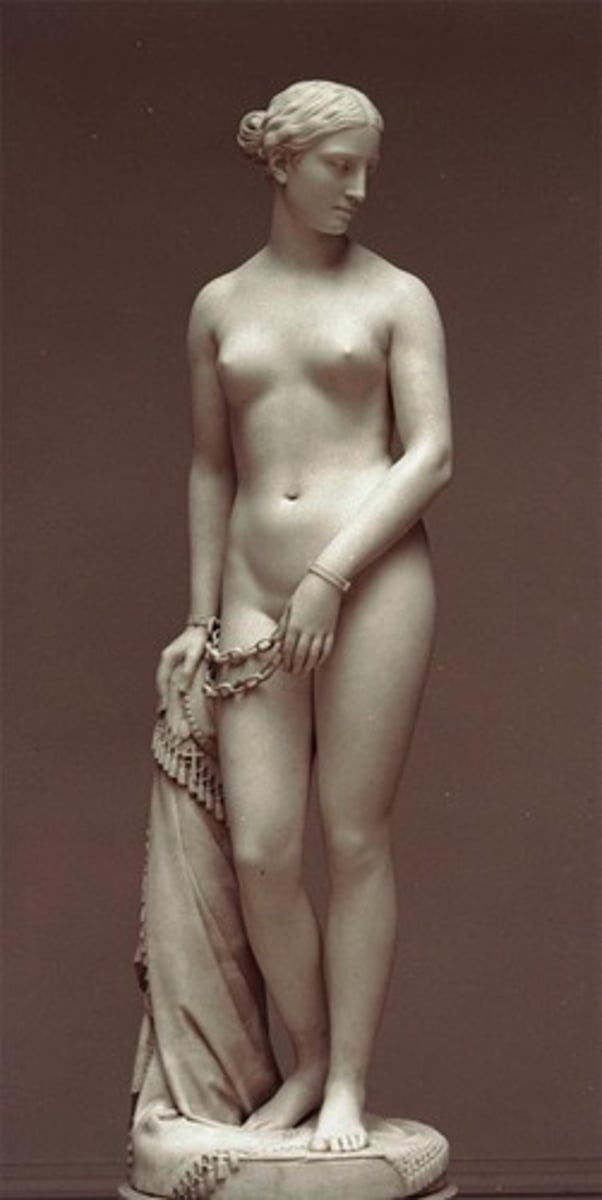
Hiram Powers, Greek Slave, 1847:
A highly acclaimed neoclassical statue of a nude woman that became a symbol for abolitionists, though it portrayed slavery through a white, European lens.
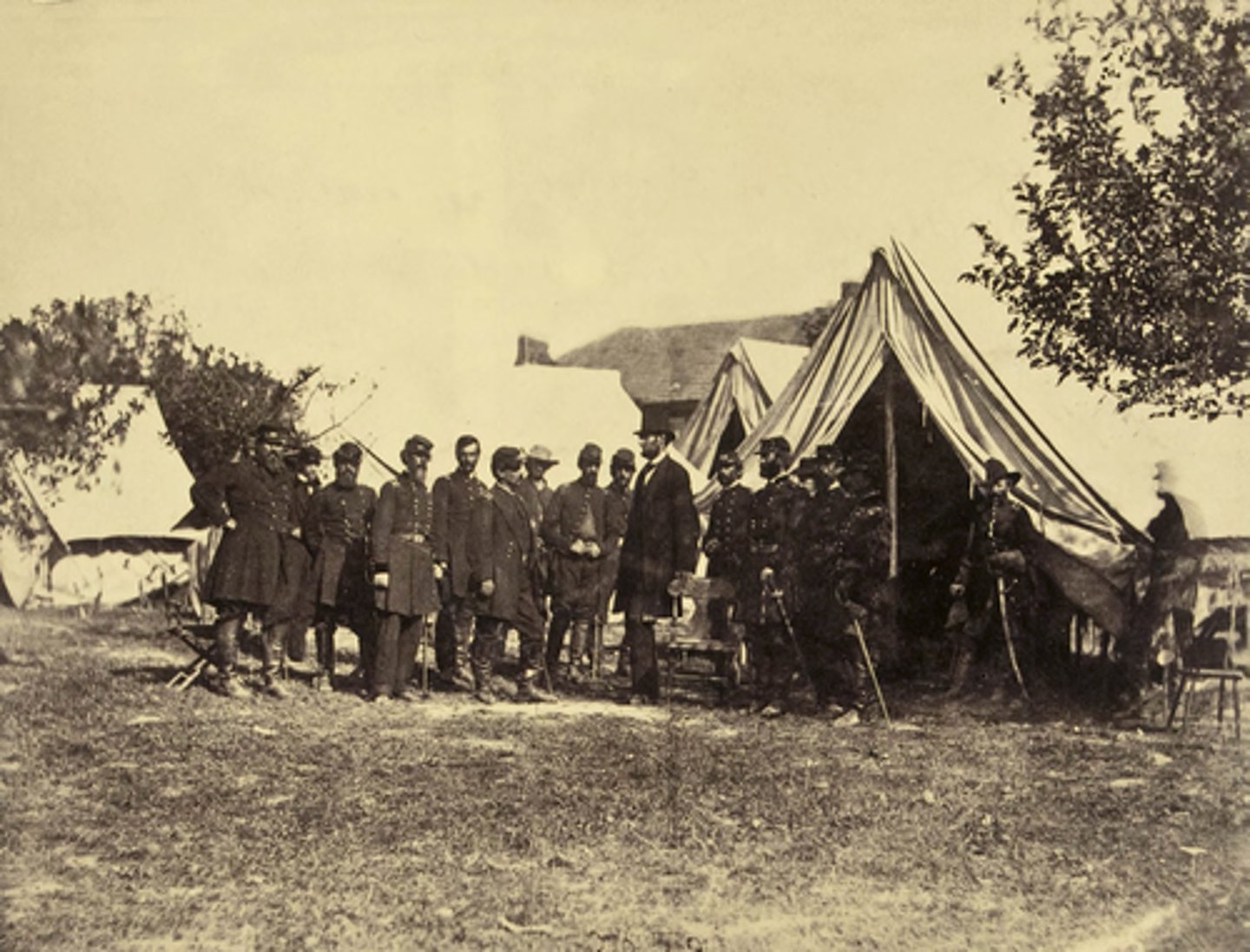
Vinnie Ream, Lincoln, 1866
The first woman to receive a commission from the US government for a statue, located in the Capitol Building [2].
![<p>The first woman to receive a commission from the US government for a statue, located in the Capitol Building [2].</p>](https://knowt-user-attachments.s3.amazonaws.com/dd14e7f7-2307-4dfa-b98a-5f2ac6a02970.jpg)
"Emancipation of the Slaves" print:
Typical 19th-century abolitionist imagery, often featuring a kneeling, submissive Black figure
How did Edmonia Lewis' treatment of the subjects of slavery and the Emancipation Proclamation differ from other imagery at the time?
Focus on Agency: Unlike contemporary white artists (e.g., Thomas Ball) who portrayed enslaved people as passive recipients of freedom bestowed by Lincoln, Lewis's figures in Forever Free are agents of their own liberation.
Independence: The figures are not shown in a "contented servant" trope, but as individuals reclaiming their bodies, rights, and family structure.
Defiance of Patronage: Lewis created Forever Free despite her white patron, Lydia Maria Child, discouraging her from doing so.
Classicism and Subject: She used the elite, traditional medium of white Carrara marble—usually reserved for mythological figures—to represent Black people, thus elevating their status and humanity.
How did Edmonia Lewis's biracial identity impact her life and career?
Artistic Themes: Her work was deeply personal, reflecting her Ojibwe and Black heritage, notably through Native American subjects and themes of bondage and freedom.
Overcoming Discrimination: Facing severe racism and sexism in the US—including a violent assault at Oberlin College—she moved to Rome to escape the "constantly reminded" feeling of her color.
Strategic Self-Promotion: She,sometimes, adjusted the narrative of her life to,suit, her,audience, often,using her,status, as a,rare, woman of,color, to garner,interest, in her,work.
Redefining "White" Marble: By creating Neoclassical works with,non-white, subject matter, she forced a space for her,identity, within a,field, dominated by,white, men
How did Rosa Bonheur's sexual orientation impact her life and career?
Defiance of Gender Norms: Bonheur lived as an openly queer artist, which was a "brave act" in the 19th century. She maintained lifelong, "sapphic" relationships with two women: Nathalie Micas (for 40 years) and later American painter Anna Klumpke.
Autonomy and Career: Choosing not to marry a man allowed her to avoid being an "adjunct or appendage" to a male, enabling her to be the breadwinner and focus entirely on her art.
Practicality and Cross-dressing: Her rejection of gender norms extended to wearing men's clothing, for which she obtained a legal "cross-dressing permit" from the police. This allowed her to visit slaughterhouses and horse markets to sketch for her paintings without harassment.
Icon of Liberation: While she did not use modern terminology, her lifestyle positioned her as a "pioneering figure in feminist art history".
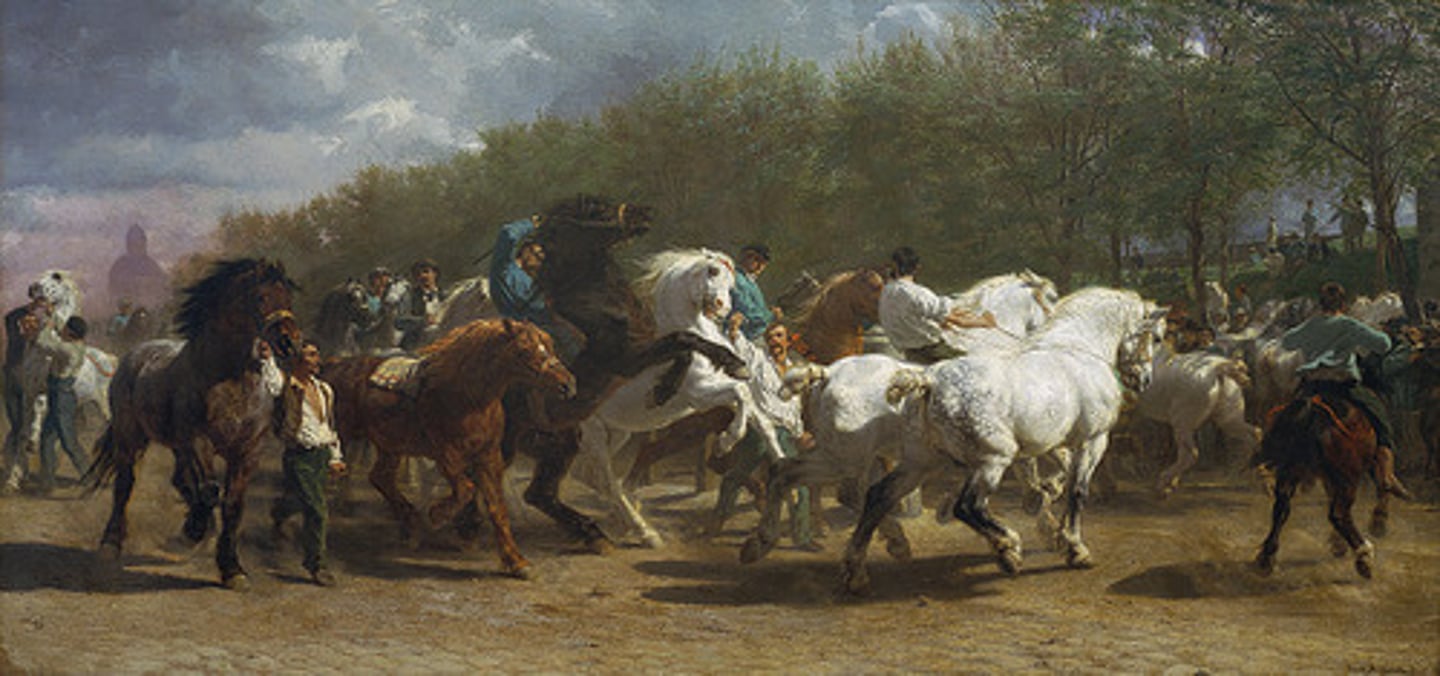
Explain why The Horse Fair was so important by discussing its use of the genres of animal painting and history painting.
Elevating Animal Painting: The Horse Fair (1853-1855) is crucial because it elevated the "low" genre of animal painting to the "high" status of history painting.
Scale and Scope: The massive size of the canvas (8 x 16 feet) mimics the scale of historical, religious, or allegorical works, demanding that viewers take her animal subjects as seriously as they would a grand, heroic scene.
Realism and Technique: The work represents a pinnacle of 19th-century Realism. Bonheur spent over a year researching by visiting the Paris horse market twice a week, leading to extraordinary anatomical accuracy and "real life" energy.
Significance: It was a masterpiece created by a woman in a male-dominated field, serving as a "Parthenon frieze" of modern life.
Why was Degas's friendship significant to Cassatt's career?
Inclusion in the Avant-Garde: In 1877, Edgar Degas invited Cassatt to exhibit with the Impressionists, bringing her into the heart of the Parisian avant-garde.
Mutual Artistic Respect: Degas admired her drawing abilities, famously saying of her, "There is someone who feels as I do".
Technical Exchange: They shared a passion for experimenting with mediums, particularly printmaking, pastel, and the use of metallic paints.
Mentorship/Colleagueship: While sometimes tumultuous, the relationship offered her a "respected colleague" to challenge her, and she considered him "the only man" whose judgment was helpful to her.
Discuss Cassatt's images of motherhood. What was she expressing about motherhood with these paintings?
Realistic Domesticity: Unlike traditional, often idealized, religious Madonnas, Cassatt portrayed the "realistic," daily, and "disheveled" moments of motherhood.
Valuing Women's Work: Her paintings (e.g., The Bath) highlighted the physical, intellectual, and emotional labor of women as primary caretakers.
Intimacy and Connection: She focused on the physical touch and tender, "sainte famille moderne" (modern holy family) bond between mother and child, often placing them in comfortable, private, and feminine settings.
How can Cassatt's paintings be interpreted as feminist statements?
Focus on Women's Lives: Cassatt's work is deemed feminist because she focused on women in non-seductive, active, and domestic roles, rather than as objects of the male gaze.
Shunning Male Presence: Her scenes frequently omit men, emphasizing a "matriarchy" or a private world where women are central and capable, in charge of raising the next generation.
Intellectual and Modern Women: Paintings like In the Loge show women not just as passive viewers, but as active participants in modern, urban life (the theater), gazing out rather than merely being gazed at.
How did class impact the life and career of Mary Cassatt?
Financial Independence: As a wealthy, American-born woman, Cassatt did not rely on selling her art for survival, which allowed her to pursue a less conventional, more experimental path than many of her peers.
Access to Subjects: Her, and her family's, high-class status provided her access to the upper-middle-class domestic sphere she painted, allowing her to depict the private, refined lives of women.
Education and Travel: Her family's wealth enabled her to travel to Europe, train with masters like Gérôme and Couture, and live in Paris, which was essential for her development into an Impressionist artist.
How did Cassal's work intersect with first wave feminism? Discuss her mural for the
1893 World's Columbian Exposi5on in Chicag
The Mural: "Modern Woman": Commissioned for the Woman's Building, this monumental 54-foot triptych envisioned a "visual history of women" that revised traditional male-centric narratives.
Subverting the Biblical Narrative: The central panel, Young Women Plucking the Fruits of Knowledge or Science, famously subverted the story of Eve. Instead of knowledge being a source of sin, Cassatt depicted it as a source of strength and liberation passed between generations of women.
Contemporary Ideals: The flanking panels, Young Girls Pursuing Fame and Arts, Music, Dancing, symbolized women's ability to function independently of men and their right to professional and intellectual ambition.
Dress Reform: The figures wore loose, "modern" clothing rather than restrictive corsets, aligning with the contemporary dress reform movement
What's the difference between naked and nude?
Naked vs. Nude:
Naked: To be oneself without clothes; a state of being true to one's own feelings and individuality.
Nude: To be seen naked by others for their pleasure; a "conventionalized form of dress" where the body becomes an object on display.
allegorical use of the female nude to represent the concept of vanity
Allegory of Vanity: Berger identifies the mirror as a tool of male hypocrisy. Artists painted women naked for their own pleasure, then placed a mirror in their hands to call the painting "Vanity"—morally condemning the woman for the very sight the artist created.
What role did female artists play in developing abstract and nonobjective art? Discuss at
least three artists?
Women were pioneers in developing non-objective art, often pushing the boundaries of what was considered "art" through spiritual or experimental lenses.
Three artists that show the roles of women
Hilma af Klint: A radical pioneer who created massive abstract works based on spiritual visions years before her male counterparts.
Lee Krasner: A key figure in Abstract Expressionism who explored "all-over" compositions and the rhythm of organic forms.
Helen Frankenthaler: Invented the "soak-stain" technique, pouring thinned paint directly onto unprimed canvas to merge color with the surface.
Self-Portrait on her Sixth Wedding Anniversary (1906)
A seminal, intimate work (101.8 x 70.2 cm) in which she portrays herself pregnant, exploring themes of femininity, maternity, and identity.
Reclining Mother and Child II (1906)
A life-size depiction of a mother and child, highlighting her focus on the "animal-like love" and raw sensuality of motherhood.
Kneeling Mother and Child (1906/1907) Paula Modersohn-ecker
A painting exploring maternal themes, often titled Kneeling Mother with Child at Her Breast.
Why was Paula Modersohn-Becker's nude self-portrait so significant?
Paula Modersohn-Becker created one of the first nude self-portraits by a woman.
Women had traditionally been painted nude by men, not by themselves
She presents her own body without idealization or sexualization
Some versions show her pregnant, symbolizing creativity and motherhood
She takes control of how her body is seen
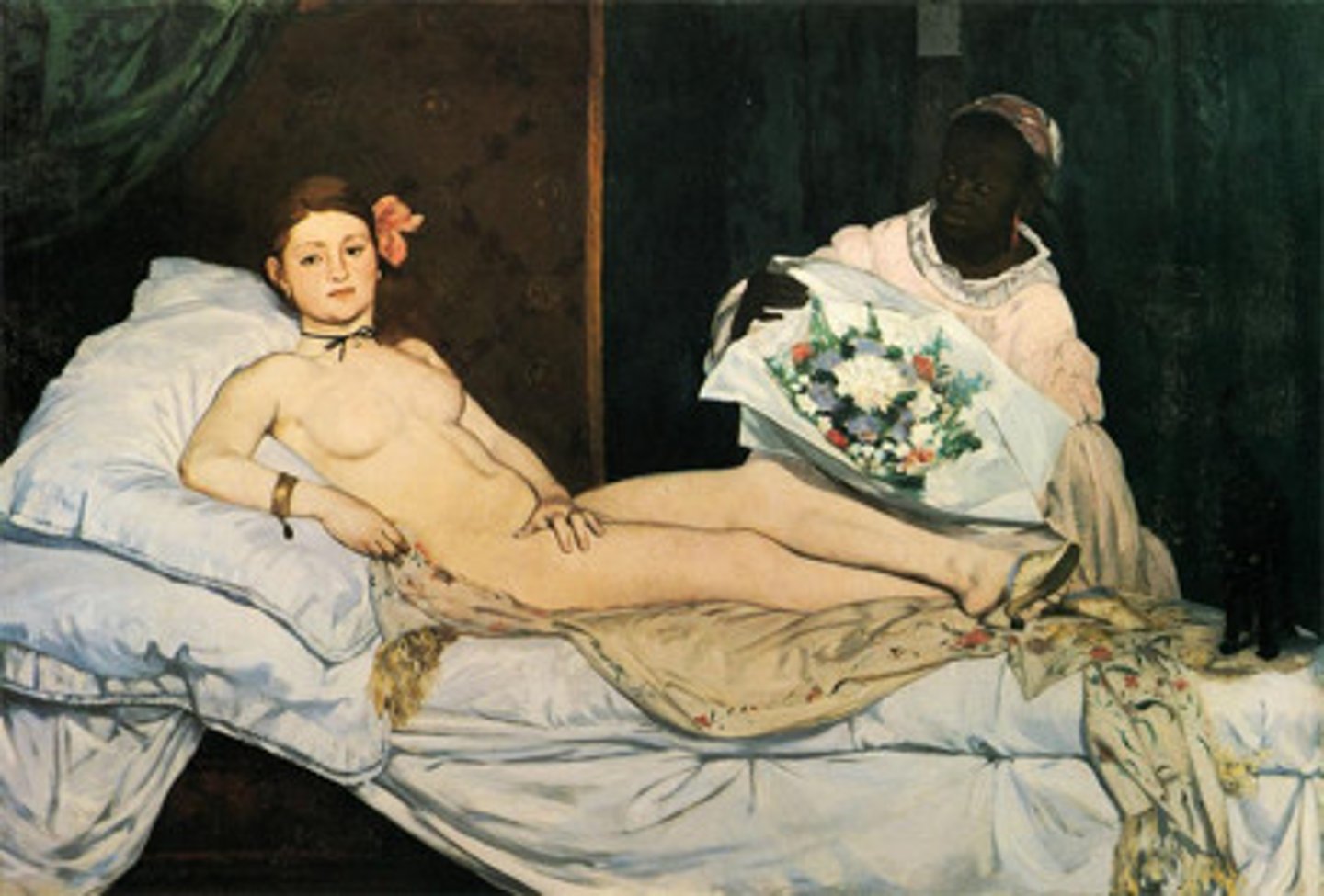
Compare Reclining Mother and Child to Titian's Venus of Urbino
Modersohn-Becker:
Mother's body is solid, simplified, not idealized
Focus is on care, connection, and motherhood
Not sexual → more emotional and human
Titian:
Venus is idealized, smooth, and sexualized
Painted for the male viewer
Represents beauty and desire
What does Kneeling Mother and Child say about motherhood? How is it different from Cassatt? Paula Mohderson-becker
Kneeling Mother and Child shows:
Motherhood as serious, physical, and even heavy
Figures are simplified → emotional, not decorative
Less warmth, more raw reality
Compare to Mary Cassatt:
Cassatt shows tender, intimate, nurturing moments
More gentle and affectionate
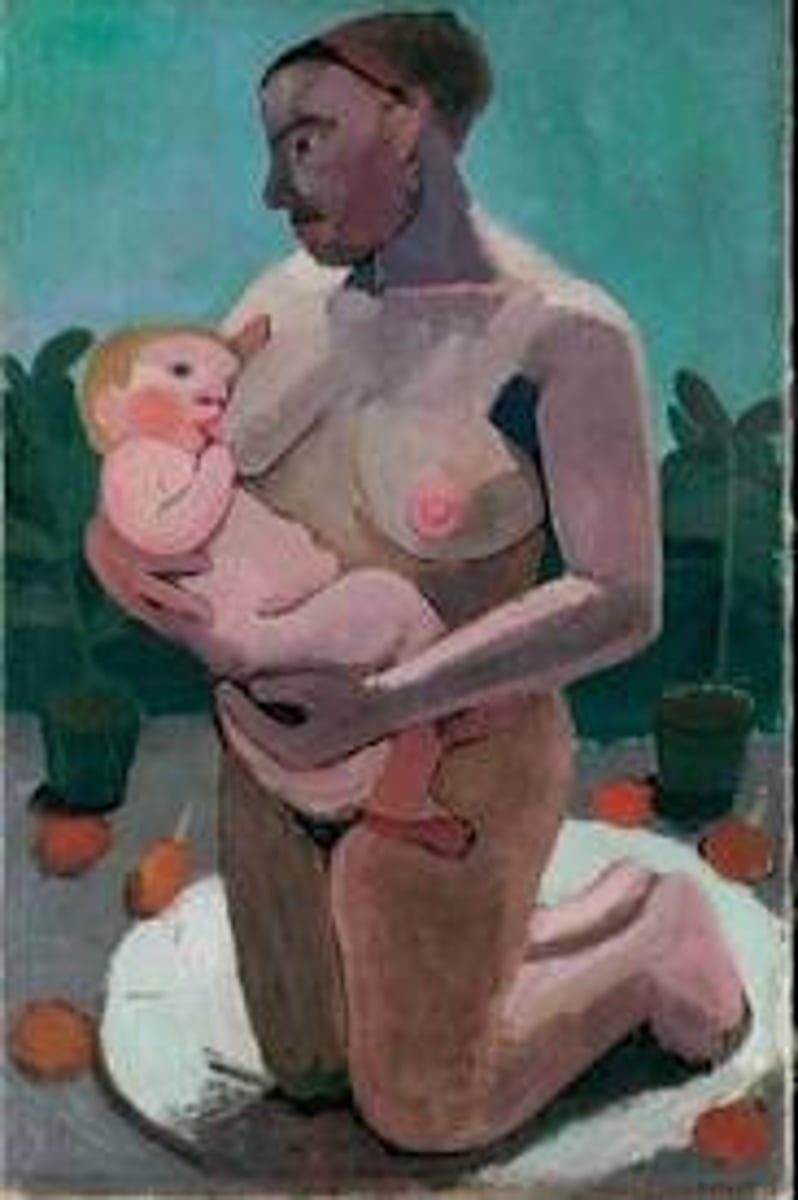
How do her paintings express the female gaze? How does it relate to the male gaze?
Female gaze:
Shows women from their own perspective
Focus on experience, identity, and emotion
Male gaze (opposite idea):
Women shown as objects for male pleasure
Often idealized or sexualized
Modersohn-Becker:
Paints women as real, solid, and unidealized
Focuses on inner life, not appearance
Removes the idea of women as objects
Discuss her paintings in relation to abstraction
Modersohn-Becker moves toward abstraction by:
Simplifying bodies into basic shapes
Using flattening (less depth)
Applying subjective color
Emphasizing outline and form over detail
This connects to German Expressionism:
Focus on emotion, not realism
Distortion to express meaning
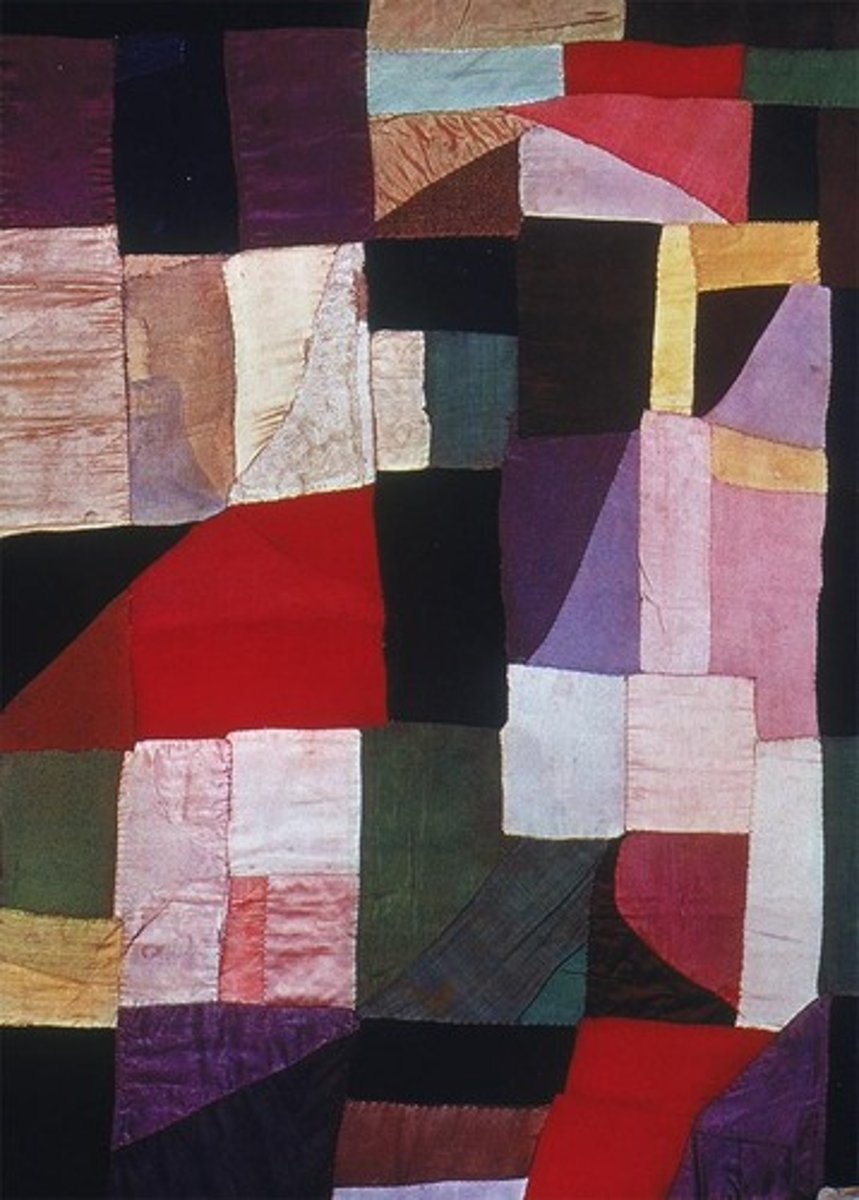
How did androgyny express lesbian identity in the early 20th century?
Androgyny = blending masculine and feminine traits
At a time when being openly lesbian was dangerous, women used androgynous style to:
Signal identity subtly
Reject traditional femininity
It challenged the gender binary and heteronormative society

How did Brooks' female nudes challenge tradition?
Traditional female nudes = sexualized for men
Brooks:
Removes male gaze
Uses cool tones, distance, and restraint
Creates a more psychological and emotional nude
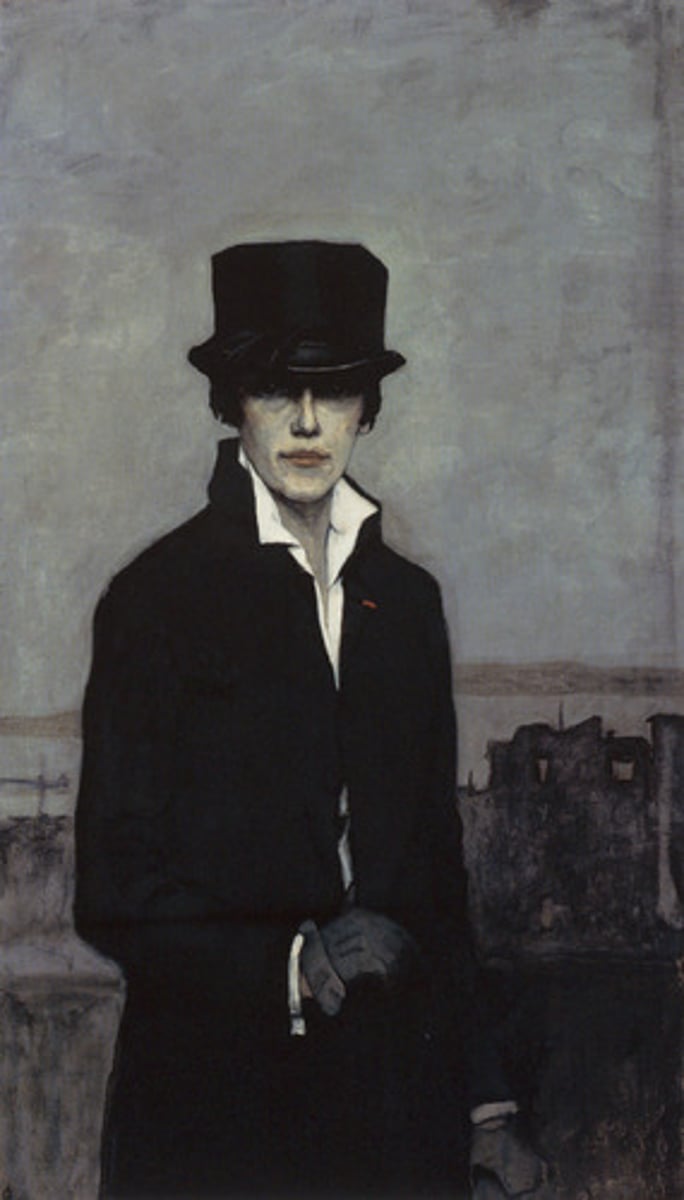
Analyze her self-portrait
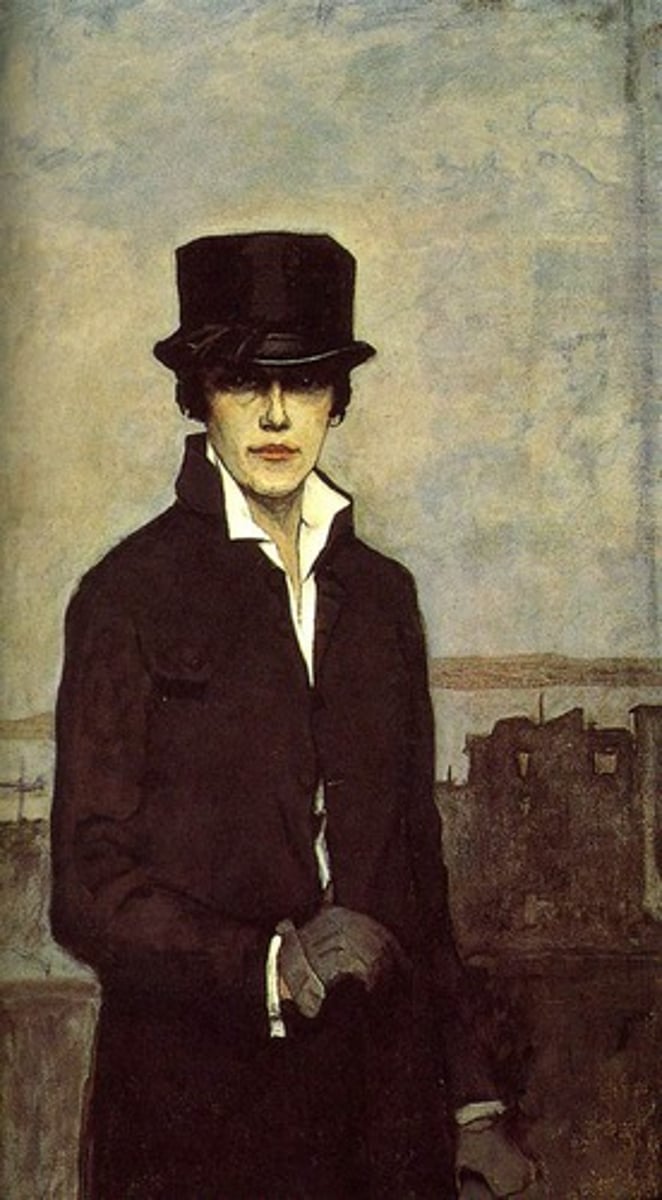
Self-Portrait
Wears masculine clothing → androgyny
Dark palette → seriousness, control
Confident pose → independence
👉 Simple takeaway: It presents her as gender nonconforming, self-defined, and powerful.
Abstraction Comparison (Münter vs Kandinsky)
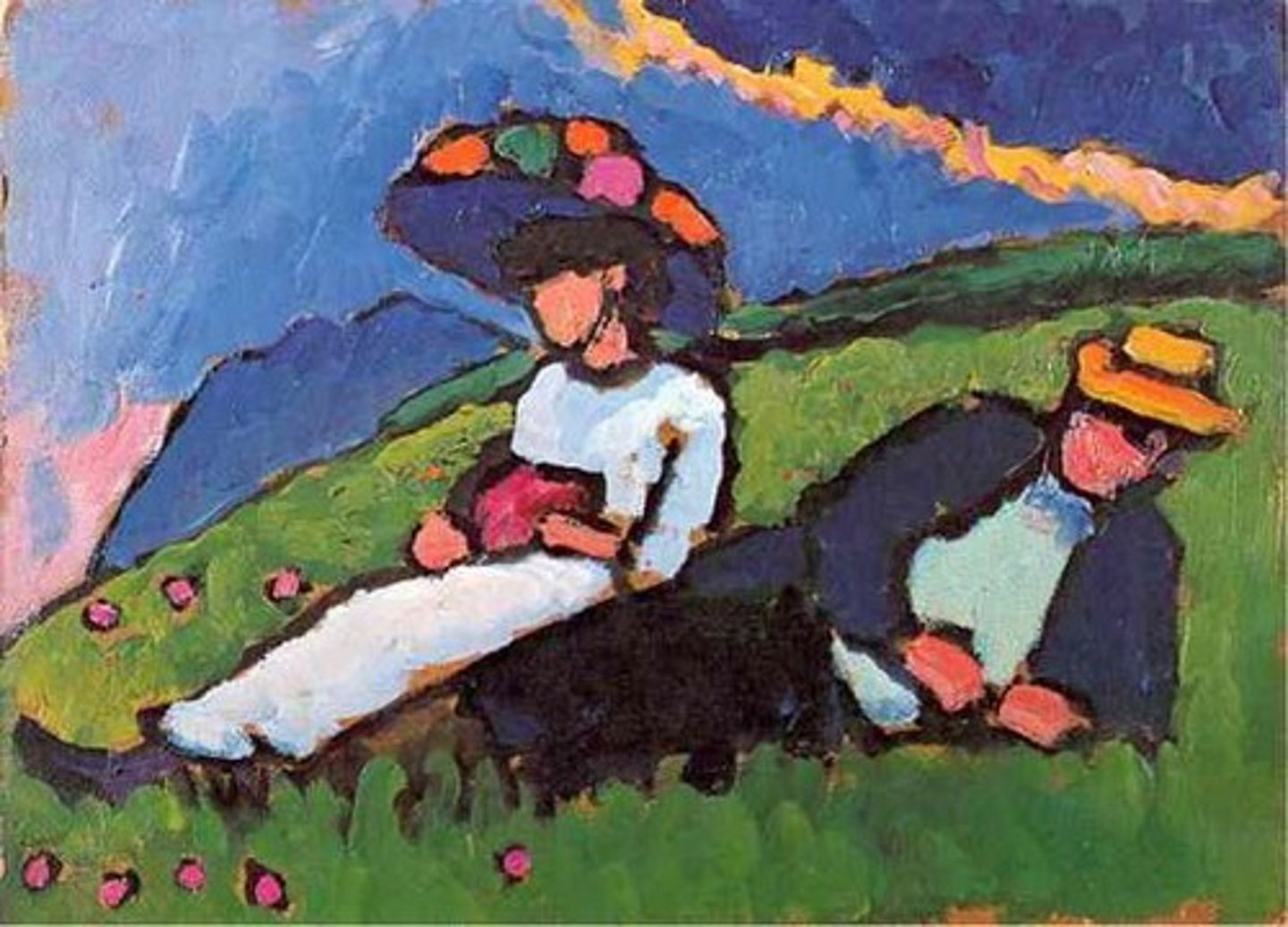
Münter:
Simplifies forms but keeps recognizable objects
Uses bold color and outline
Kandinsky:
Moves to pure abstraction (nonobjective art)
No real-world subject
How did she use Expressionism to speak against war?
Mary Cassatt
Warm, nurturing, intimate
Paula Modersohn-Becker
Simplified, serious, raw
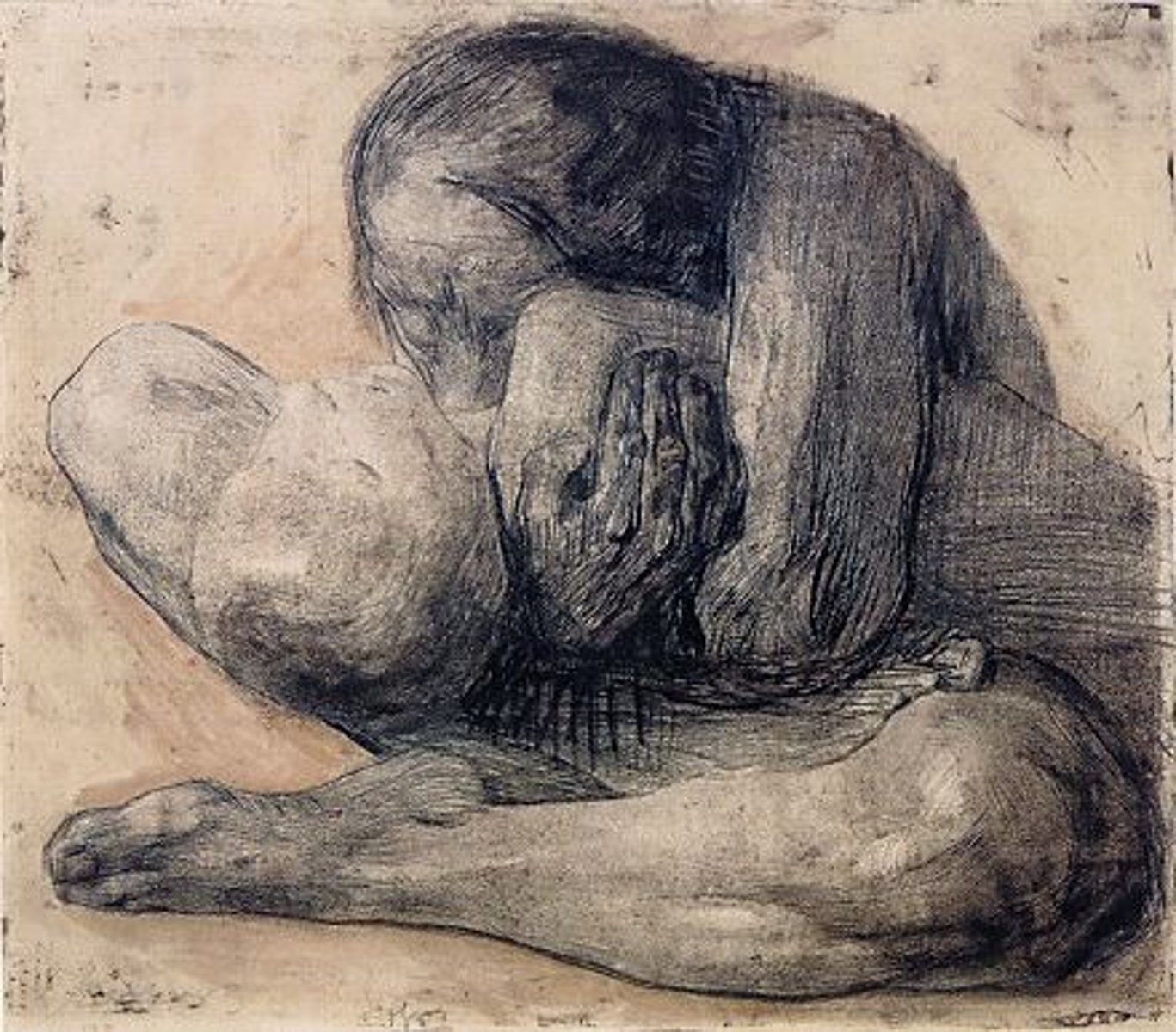
Kollwitz
Grieving, protective, tragic
AVANT-GARDE & ABSTRACTION
Avant-garde = experimental, new ideas
Abstraction = not realistic
Nonobjective art = no subject at all
Cubism / Orphism = geometric + color abstraction

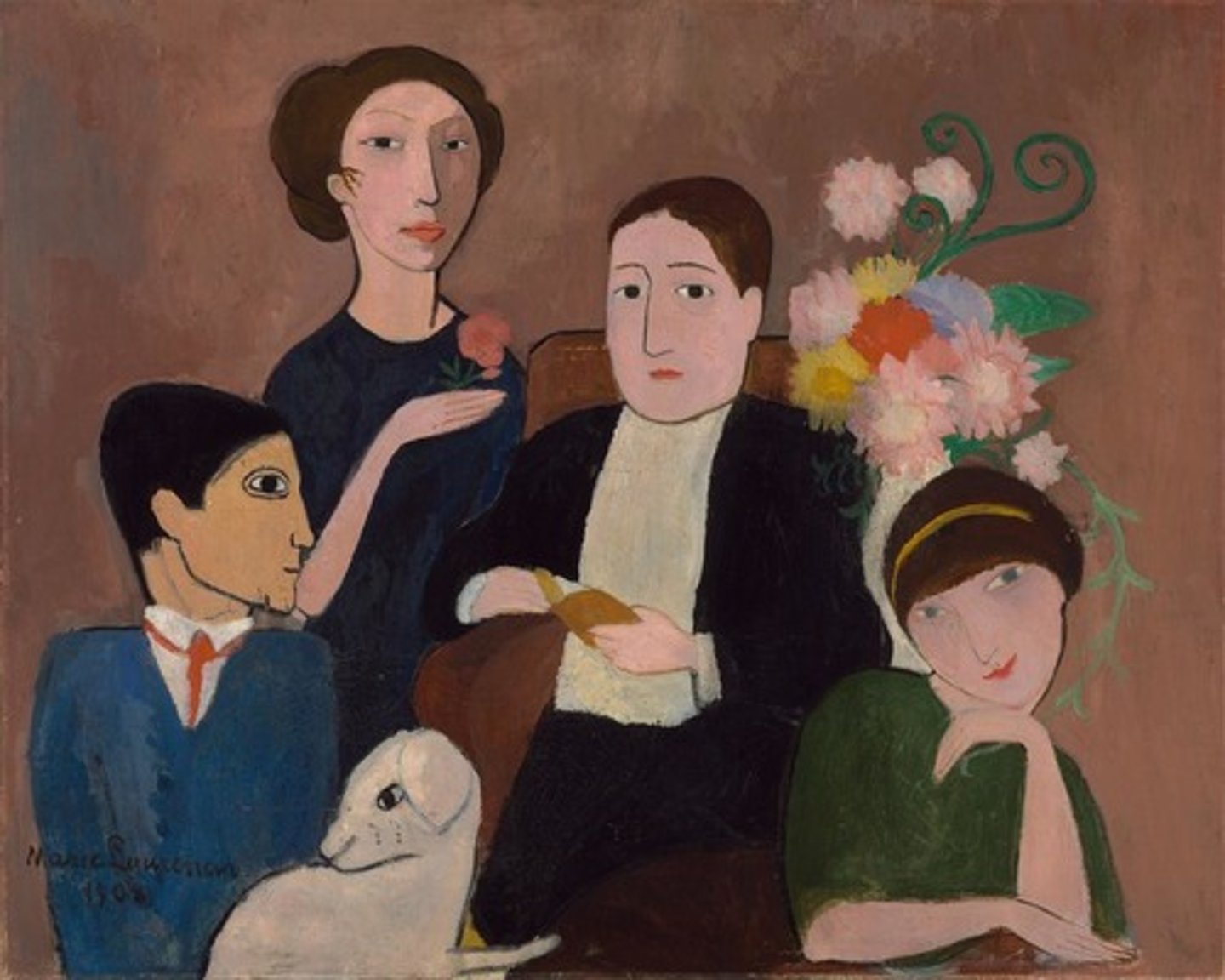
Intersectionality & Marie Laurencin
Marie Laurencin
Intersectionality = overlapping identities (gender, class, sexuality)
She was:
A woman in a male-dominated movement
Associated with Cubists but excluded
👉 Simple takeaway: Her identity shaped how she was included/excluded in modern art.
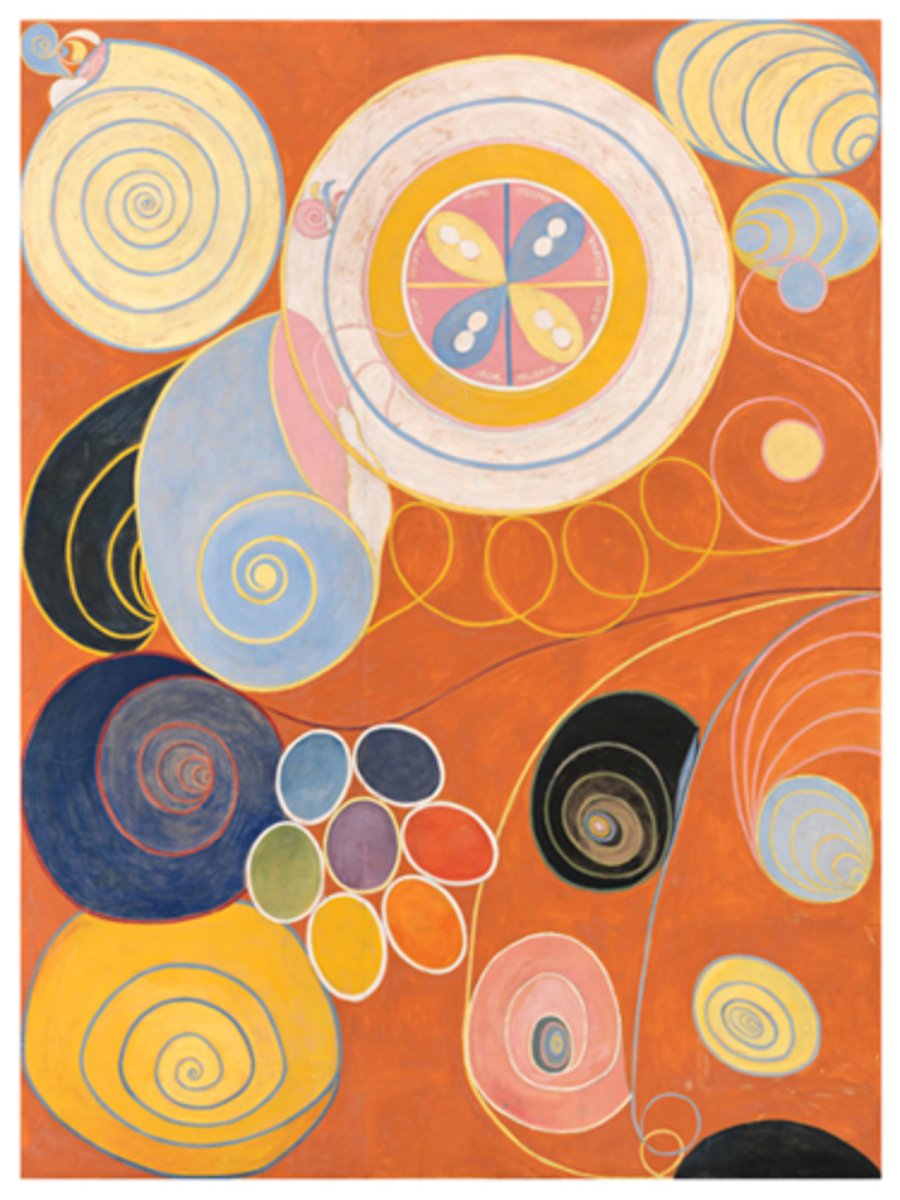
HILMA AF KLINT
Why didn't she show her work?
Believed people weren't ready
Spiritual meaning might be misunderstood
2. Why is she important?
Created abstraction before Kandinsky
One of the first abstract artists
3. Role of spiritualism
Participated in séances
Believed she was guided by spirits
4. Paintings for the Temple
Large spiritual series
Made through automatic drawing and guidance
👉 Simple takeaway: Her abstraction came from spiritual ideas, not just artistic theory.
GEORGIA O'KEEFFE
Georgia O'Keeffe
Connected to Alfred Stieglitz
1. Impact of Stieglitz
Promoted her work
Exhibited her art
But also shaped public image (sometimes sexualized her work)
2. Connection to New Mexico
Landscapes = personal and spiritual
Uses abstraction to simplify natural forms
Shows identity tied to place
👉 Simple takeaway: Her art expresses a deep emotional connection to landscape.

ROMAINE BROOKS
Romaine Brooks used androgyny as a subtle way to express lesbian identity in the early 20th century, when open expression of same-sex desire was socially restricted. By blending masculine and feminine traits in her figures, she challenged the traditional gender binary and rejected heteronormative expectations. Androgyny allowed women to signal queer identity without explicit representation, creating a visual language understood within certain circles. In this way, Brooks's work resists patriarchal norms and offers an alternative understanding of gender and sexuality.
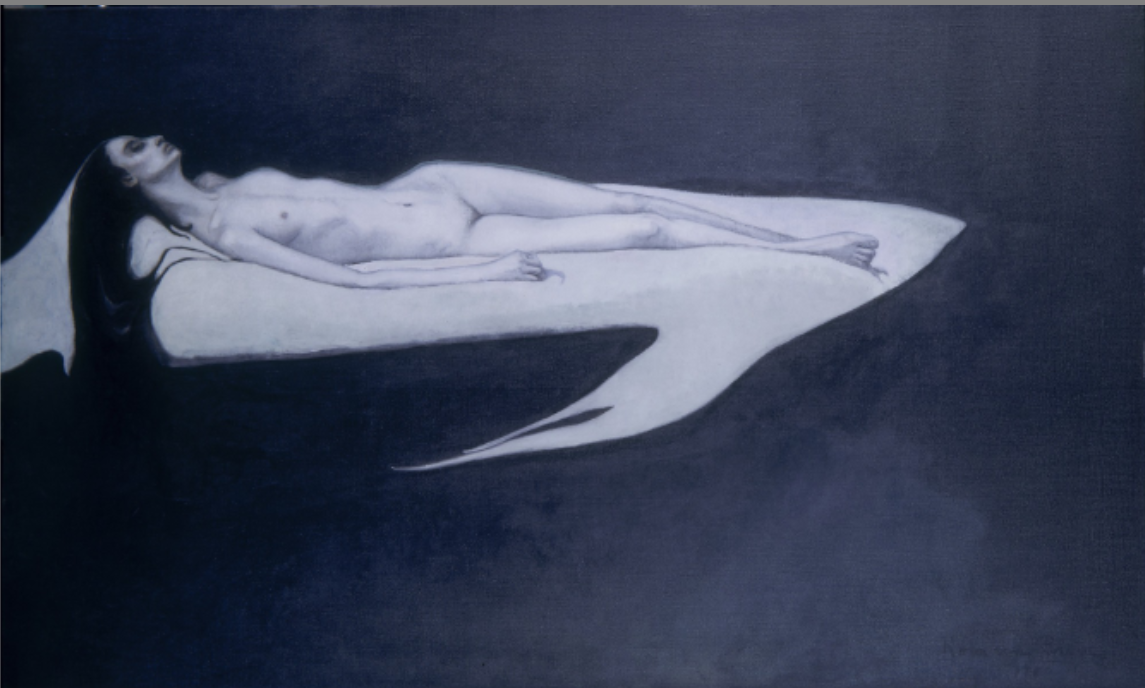
Romain Female Nude & New Erotic Convention
Brooks's female nudes challenge traditional depictions by rejecting the male gaze and creating a new kind of eroticism for female viewers. Instead of idealized, sexualized bodies meant for male pleasure, her figures are distant, introspective, and emotionally complex. Through muted colors and restrained poses, she removes the objectification typically associated with the nude. This redefinition allows the female body to exist as a subject rather than an object, opening space for lesbian desire and a more personal, psychological interpretation of the nude.
Romaine Self-Portrait Analysis
In her Self-Portrait, Brooks presents herself as independent, controlled, and androgynous. Dressed in masculine clothing with a dark, muted palette, she rejects traditional feminine ideals and instead emphasizes strength and self-possession. Her direct gaze and reserved expression communicate confidence and autonomy, suggesting a carefully constructed identity. The portrait reflects her position as gender nonconforming and subtly conveys her queer identity, while also asserting her authority as an artist.
GABRIELE MÜNTER vs KANDINSKY
Abstraction Comparison
Gabriele Münter uses abstraction by simplifying forms, flattening space, and emphasizing bold outlines and color, while still maintaining recognizable subjects such as landscapes or figures. In contrast, Wassily Kandinsky moves toward nonobjective art, in which forms are completely detached from the visible world. While Münter's work remains grounded in reality, Kandinsky's abstraction is more spiritual and theoretical, aiming to express inner emotions through pure color and form. This comparison shows Münter as part of the transition toward abstraction, while Kandinsky represents its full development.
KÄTHE KOLLWITZ
Art Against War
Käthe Kollwitz used the style of German Expressionism to powerfully criticize war by focusing on its emotional and human consequences. Through distorted figures, heavy lines, and dark tones, she conveys grief, suffering, and loss, particularly among mothers and children. Works like Woman with Dead Child emphasize the pain of those left behind rather than glorifying battle. By centering ordinary people instead of soldiers or victories, Kollwitz transforms art into a form of protest, making the viewer confront the devastating realities of war.
KATHE
Motherhood Comparison (Cassatt, Modersohn-Becker, Kollwitz)
Representations of motherhood differ significantly among Mary Cassatt, Paula Modersohn-Becker, and Kollwitz. Cassatt presents motherhood as intimate, warm, and nurturing, emphasizing emotional bonds and everyday care. Modersohn-Becker, however, portrays motherhood in a more simplified and serious way, using abstraction to convey its physical and emotional weight. Kollwitz offers the most tragic vision, depicting motherhood as marked by grief and loss, especially in the context of war. Together, these artists show how motherhood can be understood as loving, complex, and deeply affected by social conditions.
MARIE LAURENCIN 2
Intersectionality
Marie Laurencin's work can be understood through intersectionality, as her identity as a woman in a male-dominated avant-garde movement shaped both her artistic style and her marginalization. Although associated with Cubism, she was often excluded from its central narratives, reflecting gender-based inequality. Her soft, pastel imagery of female figures creates an alternative vision that contrasts with the more rigid, analytical style of her male counterparts. Intersectionality helps explain how overlapping factors such as gender and social position influenced both her opportunities and artistic expression.
HILMA AF KLINT
Why She Didn't Exhibit & Significance
Hilma af Klint did not exhibit her abstract paintings during her lifetime because she believed that audiences were not ready to understand their spiritual meaning. Deeply influenced by spiritualism and theosophy, she saw her work as guided by higher forces rather than created solely for public display. Today, she is recognized as a pioneer of abstraction, having created nonobjective works before artists like Kandinsky. Her work challenges traditional art history by showing that abstraction developed not only from formal experimentation but also from spiritual exploration.
GEORGIA O'KEEFFE
Stieglitz's Impact
Georgia O'Keeffe's relationship with Alfred Stieglitz significantly shaped her career by providing exposure and professional support. Stieglitz exhibited and promoted her work, helping establish her reputation in the modern art world. However, his photographs and interpretations of her art often emphasized sexuality, influencing how critics and audiences viewed her paintings. While he played a key role in her success, O'Keeffe maintained her independence and developed a distinct artistic voice.
George
Connection to New Mexico
O'Keeffe's work reflects a deep connection to the landscape of New Mexico, which she experienced as both personal and spiritual. Through simplified forms and abstraction, she transformed natural elements such as flowers, bones, and mountains into powerful visual symbols. Her paintings emphasize space, color, and form to convey the emotional impact of the landscape rather than its exact appearance. This connection allowed her to create a unique artistic identity rooted in place and personal experience.

