FOUNDATIONS OF SPEECH SOUND DEVELOPMENT AND DISORDERS
 Studied by 0 people
 Call Kai
 Learn
Learn Practice Test
 Spaced Repetition
 Match
Match Flashcards
 Knowt Play
1/80

There's no tags or description
Looks like no tags are added yet.
Name | Mastery | Learn | Test | Matching | Spaced | Call with Kai |
|---|
No analytics yet
Send a link to your students to track their progress
81 Terms
According to the NIH, the prevalence of SSD in young children is ____ to _____%
8 to 9
Umbrella term: problems in correctly producing speech sounds
SSD (speech sound disorder)
T/F: Our field used the terms phonological disorder and articulation disorder in the dinosaur days
true
what type of disorder is:
purely physical— just can’t produce sound
fairly intelligible
only a ____ sounds affected
T/F: there are patterns of sounds affected
articulation disorder
only a few sounds impacted
false- no patterns
Articulation Disorder— SODA
substitution
omission
distortion
addition
substituting a correct sound in a word with an incorrect sound
ex: w/r, f/th (wabbit/rabbit; fing/thing)
substitution
what is an omission
a sound is dropped in a word
distortion
the sound is produced, but not clearly (lateral lisp /s/)
addition
a sound is added (puhlace instead of place)
Phonological disorders have:
______ sound errors
______ unintelligibility
are there patterns?
multiple sound errors
highly unintelligible
patterns of errors
phonological disorders are due to ____
due to underlying problem with phonological knowledge
Importance of Intelligibility
•Caseloads—many children with speech sound disorders (SSDs)
•Cases more ____ these days—more ___ _____ involvement
•Reduced _______ causes many academic and social problems
more COMPLEX these days—> more ORAL MOTOR involvement
reduced INTELLIGBILITY
T/F: luckily, mild SSD’s have no impact on children
FALSE- even mild disorders have an impact
kids scared to raise hand and talk
adults with lisp seen as less intelligent
T/F SSDs and language impairments are separate concepts and don’t intertwine
FALSE- they coexist
***Macrae and Tyler found Ch with SSD (speech sound disorders) and LI (learning impairment) had more ______of sounds than ch with just ____
omissions of sounds than ch with just SSD
***Macrae & Tyler:
SLPs need to be most concerned about ch with ______ of sounds
why?
needs to be most concerned about ch with OMISSIONS of sounds
omissions more predictive of lang/reading problems than sound disorders
Study of physical, physiological, and acoustic variables associated with speech sound production
phonetics
•Branch dedicated to practical application of knowledge
clinical/applied phonetics
•Family of sounds that the listener perceives as belonging to the same category-- /t/
phoneme
•Not a distinct phoneme; allophone is a member of a particular phoneme family
tea buettr let character
allophone
morphemes
minimal units of meaning
free morpheme: whole word that _____ be linguistically broken down into smaller units
bound morpheme: ____ or ____that attaches to a word to ____ the words meaning
free morpheme: whole word that CANNOT be linguistically broken down into smaller units
bound morpheme: SUFFIX or PREFIX that attaches to a word to ALTER the word’s meaning
minimal pair
morphemes that are similar except ONE phoneme
ex: car/bar
suprasegmentals / prosody
speech features that extend over more than one sound segment (syllables, words, phrases instead of individual vowels or consonants)
the “musical” aspect of speech
includes pitch, loudness, length, stress, etc
used to convey meaning, emotion & rhythm
** not in the PPTs, just so we know wtf a suprasegmental is
***is emily being crazy again? likely
suprasegmental aspects of speech (4) - JRIS
juncture
rate of speech
intonation
stress
Combination of intonation, pausing, and other suprasegmentals to mark special distinctions in speech or express certain grammatical divisions
•“Get the money bag!” vs.“Get the money, bag.”
•“Let’s eat Grandma!” “Let’s eat, Grandma.”J
juncture
rate of speech:
In rapid speech, decreased vowel duration leads to ____ ______
the faster the rate, the less _____ a person is
vowel reduction
intelligible
rate of speech:
____ - missing articulatory positions as speech rate increases
very important to address in ____
undershooting
very important to address in treatment
Clear Speech (as opposed to conversational speech)
•Longer _____
•Slower
•_____ of some speech sounds
•_____ sounds are made more clearly
Longer pauses
•Slower
•Lengthening of some speech sounds
•Stop sounds are made more clearly
would you use clear or conversational speech in these scenarios?
•When talking with persons who have a clinically significant hearing loss
•With persons for whom English is a foreign language
clear speech is appropriate for both
MOOSE
MOVE your lips
OPEN your mouth
OVEREXAGGERATE/ over enunciate
SLOW down
ELONGATE vowels
changes in pitch contours
Intonation
•The degree of effort, prominence, or importance given to some part of an utterance
“I want the white car, not the blue one
stress
•Produced by some narrowing or closing of the vocal tract—complete or partial closure ( ʃ vs. p)
consonants
a sound can be in the INITIAL, MEDIAL, or FINAL position in a word
in roseberry terms,
initial is the same as _____
medial is the same as _____
final is the same as _____
prevocalic
intervocalic
postvocalic
• what forms the nucleus of a syllable?
•/r, l, m, n/ (e.g., butter, bottle); special diacritic
syllabics
• what type of sounds are produced with an open vocal tract
what are the two types of vowels
vowels
pure vowels
dipthongs
____ _______ —if you reduce them to pure vowels, the meaning changes ( e.g., /aɪ/, /ɔɪ/)
Pipe → Pop Boil → Bowl
Phonemic diphthongs —if you reduce them to pure vowels, the meaning changes ( e.g., /aɪ/, /ɔɪ/)
Pipe → Pop Boil → Bowl
____ ______ —if you reduce them to pure vowels, the meaning doesn’t change ( e.g., /eɪ/, /oʊ/ )
Nonphonemic diphthongs —if you reduce them to pure vowels, the meaning doesn’t change ( e.g., /eɪ/, /oʊ/ )
Which of these characteristics is not clear speech
A. high pitch
B. Slow speed
C. long pause
D. long speech sounds
A.
what are these (place, manner, voice) ______ (apparently not on exam but CONSONANT CHART
linguapalatals
linguadentals
glottals
lingua-alveolars
bilabials
labiodentals
velar
place (WHERE a sound is produced)
what are these (place, manner voice?)
stops
nasals
glides
liquids
fricatives
affricatives
manner (HOW a sound is produced)
________ Features
•Is a feature absent or present?
•/b/ = -vocalic, +anterior, -nasal, -strident, +voice
distinctive
•_____—voiced or voiceless
•_____—how sound is produced
•______—where sound is produced
voicing
manner
place
what are the two factors to vowel production
tongue position (height/advancement)
lip rounded (rounded/unrounded)
•IPA helps with _____(E.g. /f/ allographs in tough, physical, taffy)
gh, ph, & ff all make the same sound in the words above and are all considered allographs of the IPA symbol /f/
allographs
•. Broad Transcription
•______— slashes /b/ /n/ /t/ for phonemic transcription (abstract)
•______for phonetic transcription [m] (actual production of the sound by the speaker)
virgules
brackets
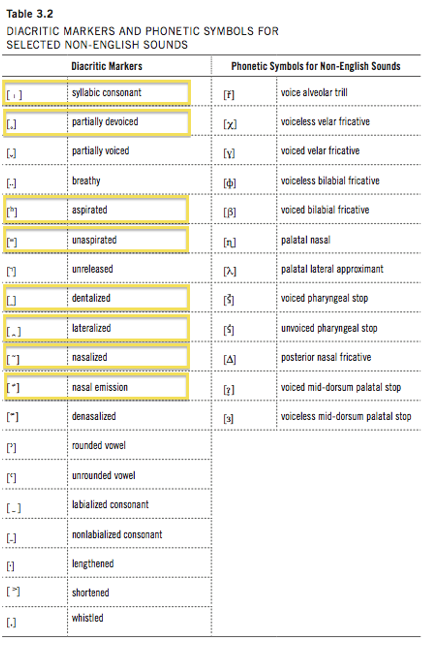
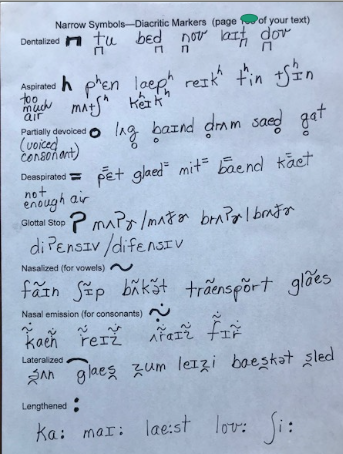
•This type of transcription uses diacritic markers
•Gives us more detail
•Especially helpful for accent clients, clients with hearing loss, cleft palate
narrow transcription
PUT IN DIATCRITICAL MARKERS FROM 3.2
NARROW SYMBOLS FROM LECTURE
•Open syllable word ends in a _____(free, my, hello)
•Closed syllable word ends in a _____ or ____ ____(box, zipper, bed)
•Open syllable word ends in a vowel (free, my, hello)
•Closed syllable word ends in a consonant or consonant cluster (box, zipper, bed)
•Stampe first described ____ _____, or simplifications of adult sound productions that affect entire classes of sounds
phonological processes
•T/F: The term phonological pattern is preferred
•Stampe’s phonological processes are normal in _____-developing children, but are a _____ when they persist beyond a certain age level
•After a normal age of disappearance, we use the term phonological ______
true
•Stampe’s phonological processes are normal in typically-developing children, but are a disorder when they persist beyond a certain age level
•After a normal age of disappearance, we use the term phonological pattern
patterns that should disappear by age 3 include
weak syllable deletion
final consonant deletion
patterns that persist beyond age 3 include
cluster reduction
gliding
•many ppl today
Use the terms phonological process and phonological pattern _____
interchangeably
•One class of sounds is substituted for another class of sounds
substitution patterns
anterior sounds replace /k, g, ŋ/; usually alveolar stop (e.g., t/k, d/g); most common in word-initial position.
ex: tup instead of cup
velar fronting
Stop substituted for fricative (e.g., tu/ʃu, keɪb/keɪv).
ex: tuz instead of shoes
stopping
substitution of vowel (usually /o/ or /u/) for syllabic liquid
bado/bottle; ovo/over; tabu/table
vocalization
affricate is replaced by a stop or fricative
“tip” vs trip
dump vs jump
deaffrication
substitution of glide for liquid
w/r, j/l
wak/rak
waugh/jaef
T/F: this isn’t a common SSD
liquid substituting
false- it’s VERY COMMON
posterior sounds replace anterior sounds
rare in ____ _____ children
present in ch with severe ____
bet vs “bek”
tooth vs kooth
tailer vs “kaelir”
backing
rare in typically developing children
SSD
what sounds are typical for backing
k/t and g/d
ex: koy/toy, gish/dish
affrication
occurs when “sh” or voiced “sh” is made into an affricate
One sound changes to resemble another sound, particularly a neighboring sound
assimilation patterns
Sound that changes precedes the sound that caused the change
(sound at the end of the word is also put at the beginning of the word)
•E.g., instead of saying “lack,” child would say /kæk/; instead of saying “yum!” the child would say /mʌm/
regressive assimilation
•The sound that changes follows the sound that influences the change
(sound at the beginning of the word also goes to the end)
•E.g., instead of saying “might,” the child says /maɪm/; instead of saying “ghost,” the child says /goʊg/
progressive assimilation
Kinds of Assimilation
. Alveolar tom →tot lɪp → lɪd
•2. Nasal noʊz → noʊn map → mam
•3. Velar kʌp → kʌk dag → gog
•4. Labial boʊt → boʊp maʊθ → maʊm
•5. Prevocalic voicing taɪt → daɪt
•6. Postvocalic devoicing fliz → flis
•. what is this an example of
•Celeste → Lest tomato → meɪdo
Weak/unstressed syllable deletion
•(partial or complete)
•Repetition of a syllable
Complete = baba/bottle
reduplication
•insertion of schwa between 2 consonants (Mark: Stepuhney/Stepney)
epenthesis
some members of a cluster are deleted (fæp/flæp)
partial cluster reduction
all members of the cluster deleted (-æp/flæp)
total cluster reduction
deletion or substitution of some or all members of a cluster
cluster reduction
•another sound replaces one or all members of the cluster
•Examples: twi/tri, pwiz/pliz, bun/spun
cluster substitution
remember our goal:
•Is to help our clients achieve maximal ____ _____ for life success
speech intelligibility
adding /i/ to end of word; mami/mam, dagi/dag
diminutization
what is this an example of
hi “own” vs hi “joan”
peek at what is inside vs “eek” at what is inside
**LESS COMMON
initial consonant deletion
what is this an example of
I don’t wanna see a “ra” in my garage (rat)
i love my “pe” vs i love my pet
final consonant deletion
usually the _____ sound is deleted
marked/more difficult
 Note
Note  Flashcards (24)