4.5 GCSE Biology AQA Homeostasis and response
 Call Kai
 Learn
Learn Practice Test
 Spaced Repetition
 Match
Match Flashcards
 Knowt Play
1/114

There's no tags or description
Looks like no tags are added yet.
Name | Mastery | Learn | Test | Matching | Spaced | Call with Kai |
|---|
No analytics yet
Send a link to your students to track their progress
115 Terms
What is Homeostasis?
Is the regulation of conditions inside the body to maintain a stable internal environment
What are the 3 main things that Homeostasis regulate?
Blood glucose concentration
Body Temperature
Water levels
What are the 3 main components of Automatic control systems?
Receptors - Detect a stimuli (changes in the environment)
Coordination Centres - receive and process information from receptors (brain, spinal chord and pancreas)
Effectors - Muscles or glands, which bring about responses which restore optimum levels
How is Homeostasis controlled?
Controlled automatically through nervous responses or chemical responses (hormones)
What does the Nervous system do?
Sends very fast and precise electrical impulses through nerves and respond to stimuli very quickly - e.g: being poked by a sharp object
What does the Endocrine system do?
Relies on hormones which are released in the bloodstream and travel throughout the entire body but only affect certain cells
Slower, longer-lasting and more generalised than nervous system
What is Negative feedback? 2 Examples
Does the opposite of whatever the change was
If glucose levels are too high, it will decrease it back to normal but if it is too low, it will increase it again
Receptors in the skin detect environment change (Too cold) and the nervous system will send an impulse to coordination centres which interpret impulse and send signals to effectors that carry out a useful response (Shivering)
Synapse definition and what it does
Between each neurone there is a synapse and its job is to send neurotransmitters from one neurone to another
Neurotransmitters diffuse down the concentration gradient from a high concentration in the vesicles of presynaptic neurone to the receptors of the post synaptic neurone which are complementary to neurotransmitters and pass impulse
Nerve cells: Adaptations
Adapted to carry electrical impulses from one point to another
Long and thin + branched connections enables them to pass messages
Large surface area to increase rate of diffusion of neurotransmitters
Neuron structure
Cell body that contains nucleus, organelles and most of the cytoplasm of the neurone
One or more dendrons, which carry nerve impulses towards the cell body
Axon, a single fibre that carries nerve impulses away from the cell body
Fatty, myelin sheath that covers and insulates the neurone
Central Nervous system (CNS)
Brain and Spinal chord
Takes in sensory information and sends out orders to rest of the body
What are the jobs of sensory neurones?
Carry information from receptors all over the body to the central nervous system
E.g: Changes in temperature or Co2 in blood
What are the jobs of motor neurones?
They are type of nerve cells which can cause muscles to contract or glands to release hormones after being told by CNS
What are Reflex actions and why are they important?
Reflex actions are automatic and rapid - They do not involve the conscious part of the brain
Reflex actions happen immediately + automatically and stop the body from harm
Path of impulse in a reflex action
Receptors in the skin are sensitive to the stimulus of the object
They send an impulse via the sensory neuron to the relay neuron of the brain or spine
These cells then send an impulse via the motor neurones
This causes the muscles in the part of body affected to contract
Between each neurone is a synapse which helps the signal to be passed between the different nerve cells
Stimulus —→ receptor —→ coordinator —→ effector —→ response
What does the brain do?
Brain controls complex behaviour + makes important decisions
It is made of billions of interconnected neurones and has different regions that carry out different functions
Different regions of the brain
Cerebral cortex
Cerebellum
Hypothalamus
Medulla within Brain stem
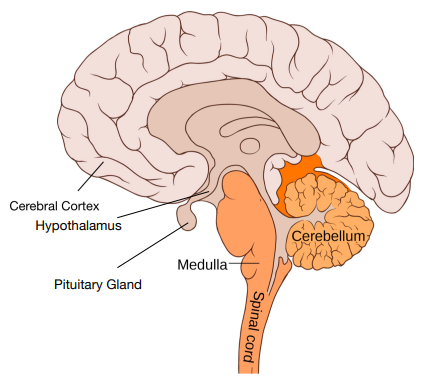
What does the Cerebral Cortex do?
Responsible for consciousness, intelligence, memory and language + senses.
2 Hemispheres - Right hemisphere controls left half of the body and left hemisphere controls right half of the body
What does the cerebellum, hypothalamus and medulla do?
Cerebellum: Controls balance and muscle coordination
Hypothalamus: Regulate body temperature and sends signals to the pituitary gland
Medulla: Responsible for unconscious activities like breathing and heart beating
How do scientists study the brain? 3 ways + Scanning brain methods
Study people with brain damage
Electrically stimulate different parts of the brain with an electrode
Scanning the brain: CT scans are used to find which areas of the brain are damaged
PET scans and MRI Scans measure underlying activities
Why treating the brain is difficult - 3 things and why they make it hard to treat the brain
Wide range of things that can be treated: Tumours Trauma, Mental health problems and infection
Encased in skull and surrounding tissue is fragile makes it difficult to physically fix anything
Brain is complex therefore is difficult to fix with drugs and chemicals
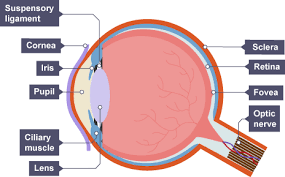
Cornea (Adaptations and why it is needed)
Transparent and no blood vessels to allow light through.
Oxygen that it needs has to diffuse from outside air
It causes the light that passes through it to refract (always by same amount)
Iris, Pupil (Adaptations and why they are needed)
Controls how big or small the pupil is
Pupil is a gap in the iris which allow light to pass through to the lens
Lens (adaptations and why they are needed + how the shape is controlled)
Lens refracts light and can change its shape which can control how strongly it refracts the light
Helps to focus light perfectly onto the retina at the back of the eye
The ciliary muscles and suspensory ligaments control the shape of the lens
Retina + Fovea (adaptations and why they are needed)
Retina made of two different types of receptor cells
Cone cells: Sensitive to the colour of light allowing us to see light. Don’t work well in low light conditions
Rod cells: More sensitive to light. Can only see in black and white
Fovea: Spot on retina with only cone cells. Light is mostly focused here to see things most clearly
Optic nerve (Why it is needed)
Takes impulses generated by receptor cells and takes them to the brain
Path of light in the eye
As light hits the eye, the cornea allows it to pass through and refract slightly through the pupil in the iris and pass onto the lens
The lens refracts the light onto the fovea on the retina so eye can see most clearly
The optic nerve takes impulses generated by receptor cells to the brain
What does the Iris Reflex do?
Intensity of bright light can cause damage to retina
Iris reflex prevents this by controlling size of pupil
Smaller in bright light conditions so less light gets in and damages retina (Constricted Pupil)
Pupil gets larger in low light conditions to allow maximum amount of light into retina (Dilated Pupil)
What does the pupil do in Bright and Dark conditions
Smaller in bright light conditions so less light gets in and damages retina (Constricted Pupil)
Pupil gets larger in low light conditions to allow maximum amount of light into retina (Dilated Pupil)
How do the muscles in the Iris control the Iris reflex?
(2 Muscles and what they do)
Two types of muscles in iris to control this:
Circular muscles nearer the pupil
Radial muscles on the outside
In bright light, the circular muscles contract making the pupil smaller and the radial muscles relax so they can be stretched longer
In dark light, the circular muscles relax and the radial muscles contract making them shorter and pulling the pupil open
What is Accommodation in the eye?
A reflex that changes the refractive power of the lens to see both near and distant objects
What happens to the light rays of an object that is close to eye?
The light rays have to be refracted a lot
The ciliary muscles contract towards the lens
Due to this, the suspensory ligaments loosen
The lens is then thicker and refracts the light rays strongly
What happens to the light rays of an object that is distant to eye?
The light rays don’t have to be refracted as much
The ciliary muscles relax moving away from the lens
Due to this, the suspensory ligaments are pulled tight
The lens is then pulled thin and only slightly refract light rays
Why are two common defects of the eyes? Name and how they work
Myopia (short sightedness) - Light refracts too much from distant objects and the light doesn’t focus onto the retina (image forms before it hits retina) causing the image to appear blurry
Hyperopia (long sightedness) - Light can’t refract enough therefore light isn’t focused when it hits the retina (image forms after it is hits retina) causing the object to appear blurry
How are myopia and hyperopia treated?
Hyperopia treated with glasses with convex lenses which help to refract light more so eye can focus light on the retina properly
Myopia treated with glasses with concave lenses which refract light outwards and counteract the over-refraction of the lens. Allows light to focus on the retina properly
New technologies to treat eye defects (hyperopia and myopia)
Hard and soft contact lenses
Laser surgery to change the shape of the cornea
Replacement lens in the eye
How is thermoregulation monitored/controlled?
Body temperature is monitored and controlled by the thermoregulatory centre in the hypothalamus of the brain
The thermoregulatory centre contains receptors sensitive to the temperature of the blood
The skin contains temperature receptors and sends nervous impulses to the thermoregulatory centre
Why is thermoregulation important?
Keeping body at 37 degrees is important as it is the optimum temperature for our enzymes to work
What happens if body temperature is too high?
Vasodilation (blood vessels widen) occurs so more heat energy can be transferred to the surroundings
Erector muscles relax
Sweat is produced and as sweat evaporates, it takes heat energy away from it
What happens if body temperature is too low?
3 ways body warms us up and how it is done
Vasoconstriction occurs (blood vessels constrict) and less blood flows near the surface therefore less heat energy is lost
Sweating stops and skeletal muscles contract (shiver) - Energy from respiration causes heat energy to be released, warming us up
Erector muscles contract making hair stand on end trapping layer of insulating air (harder for heat to be lost from skin)
The endocrine system
(What it does)
Composed of glands which secrete chemicals called hormones directly into the bloodstream
The blood carries the hormone to a target organ where it produces an effect
Some of the tissues will have receptors which are specific to the hormones and the hormone molecules can act as signals to trigger changes inside the cell
Compared to the nervous system, the effects are slower but act for longer
What does the Pituitary gland do and where is it?
Releases hormones into the blood in response to body conditions
These hormones in turn act on other glands to stimulate other hormones to be released to bring about the effects
Near brain
What does the thyroid gland do and where is it?
Secretes thyroxine which regulates the rate of metabolism for growth and development
In the neck
What do the Adrenal glands do and where are they?
Secrete adrenaline during fight or flight response - Increases heart rate and gets blood pumping faster
Chest
What does the Pancreas do and where is it?
Secretes insulin to regulate blood glucose concentration
Below chest
Why does the blood glucose concentration need to be balanced
If blood glucose levels are too high, it can damage our tissues
If blood glucose levels are too low, there will not be enough glucose for respiration
How does the body fix high levels of glucose in the blood?
If the BGC is too high, the pancreas will detect it and will produce the hormone insulin that causes glucose to move from the blood into the cells
The insulin will bind to receptors on certain cells (mostly liver and muscle cells) which tells the cells to take in some glucose in the blood
The extra glucose taken up will be combine together to form glycogen which is for long term storage
The extra glucose will be removed from the blood so the BGC will decrease
Why does the body’s blood glucose concentration constantly fluctuate?
+ Negative feedback loop
If BGC is too high, insulin is released and if BCG is too low, glucagon is released so the BCG is constantly fluctuating
How does the body fix low levels of glucose in the blood?
If BGC is too low, the pancreas releases a hormone, glucagon, which increases blood glucose concentration
The glucagon binds to lots of different cells but mainly liver cells which takes the glycogen stored and breaks it down into glucose which is then released back into the blood to increase BGC
What do the testes and ovaries do?
Testes produce testosterone for puberty and to produce sperm for reproduction
Ovaries produce oestrogen for puberty/menstrual cycle and to produce egg cells
Difference between Endocrine System and Nervous System
The endocrine system relies on hormones transported in the blood whereas the nervous system relies on electrical impulses transported by nerve cells
The effects of the endocrine system last longer as they spread more slowly than the fast effects of the nervous system
The endocrine system act more generally whereas the nervous system impulses act on one specific area (precise)
What is Type 1 Diabetes?
When it occurs
Disorder in which the pancreas fails to produce sufficient insulin
It is characterised by uncontrollable high blood glucose levels
Occurs in childhood and teenage year and is a lifelong condition
How is Type 1 Diabetes treated?
Is normally treated with insulin injections into abdomen or thigh bringing down blood glucose levels especially after a meal
The amount of insulin needed depends on what they have eaten and how much they exercise
If they had lots of carbohydrates, they would need to inject more insulin
If they exercise regularly, they would need to inject less insulin as muscles absorb glucose from blood when exercising
What does the amount of insulin a patient with Type 1 Diabetes need depend on?
Depends on what they have eaten and how much they exercise
If they had lots of carbohydrates, they would need to inject more insulin
If they exercise regularly, they would need to inject less insulin as muscles absorb glucose from blood when exercising
What is Type 2 diabetes
The body cells no longer respond to insulin produced by the pancreas so they cells won’t take in glucose from the blood stream
Happens to older people who have had an unhealthy diet for a long time
How can Type 2 diabetes be treated?
Injecting insulin doesn’t do anything as the cells don’t respond to insulin anymore
Treated by a healthy, low-sugar diet and regular exercise
What are the 2 main jobs of the Kidney?
Filter the blood and remove waste especially urea
Regulate the levels of useful things like ions and water
How is urea made?
Made in the liver by the process of deamination where excess amino acids from digestion of proteins are converted to fats and carbohydrates for storage in the liver
This forms ammonia which is toxic and is immediately converted to urea for safe excretion
How do we get ions?
How are they lost?
We get ions like sodium and potassium from our diet
If levels get too high or too low, it can damage our cells
We lose some ions from sweating but the main way we regulate ions is from our kidneys
How do we get water?
How is it lost?
We get water from food and drinks and we lose it from skin when we sweat and lungs when we breathe
Most water is lost from our kidneys in the form of urine
Why is water regulation important in the body?
Wate regulation is so important as cells will lose or gain water through osmosis due to how much water is in our body
If there is too much water, cells will swell due to osmosis of water into the cell and possibly burst
If there is too little water, cells will lose their water and possibly shrink
What is Filtration in the Kidneys?
Inside two kidneys, there are nephrons with tubule which absorb anything small from the blood (water, glucose, amino acids and urea)
The tubules have a partially permeable membrane to allow these small molecules to diffuse across without allowing larger molecules like cells and proteins to diffuse across
What is selective reabsorption in the Kidneys?
All the things the body wants to keep are reabsorbed (all glucose reabsorbed, some water and no urea)
How are water levels regulated in the body if it is too low?
The hypothalamus in the brain detects the concentration of water in the blood
If the water levels are too low, they signal to the pituitary gland to release a hormone called ADH into the blood stream
The ADH reaches the tubules in the kidneys through the body, telling them to reabsorb more water so we produce less urine
How are water levels regulated in the body if it is too high?
The hypothalamus will stop sending signals to the pituitary glands and won’t release as much ADH
The tubules in the kidneys will reabsorb less water into the blood as there will be less/no ADH to tell them reabsorb water.
More water will stay in the tubules so the kidneys will have to produce more urine to get rid of the extra water
How are water levels controlled by negative feedback?
If the water levels get too high, the body will bring it back down by releasing less/no ADH and if the water levels get too low, the body will bring it back up by releasing more ADH to keep the water levels balanced in the body
What are the main consequences of Kidney failure?
Water substances would build up in the blood stream
Patients would be unable to regulate water and ion levels
Patients would become sick and could die
What are the treatments for Kidney failure?
Mild kidney disease can be treated with medication
Only treatment for kidney failure is dialysis or a kidney transplant
What is a dialysis machine?
Dialysis machines are artificial kidneys which filter a patient’s blood
What is in the dialysis fluid?
The dialysis fluid contains the same concentration of water and other molecules as healthy blood (glucose, ions and amino acids but no urea)
What separated the patient’s blood and the dialysis fluid?
Separated by a partially permeable membrane which allows small molecules like water and ions to diffuse across but not cells or proteins
How does the dialysis fluid work to remove filter a patient’s blood?
How is equilibrium prevented?
If there is too much of something (water or ions), they will diffuse down the concentration gradient through the partially permeable membrane into the dialysis fluid bringing the patient’s blood levels back down to normal
To prevent equilibrium, the dialysis fluid is constantly replaced therefore there is always a concentration gradient
Problems with dialysis
Treatment is time consuming
Long and Unpleasant experience
Expensive to run and patient’s will have to have it for the rest of their life
Advantages and Disadvantages of kidney transplants
Advantages: Cheaper than dialysis
Disadvantages: Surgical procedure (risk something will go wrong)
Organ may be rejected and be attacked by patient’s immune system (medications given to suppress immune system don’t always work)
Not enough available organs to give everyone who needs one a transplant
What is puberty?
Physical changes in the body and when it begins
Puberty is the period during which adolescents develop secondary sexual characteristics
Physical changes in the body:
Growth Spurts
Development of body hair
Process usually begins between ages of 8 and 14
What triggers the start of puberty?
Triggered by hormonal changes in the body
For Males, Testosterone produced in the testes triggers puberty and sperm production
For Females, Oestrogen produced in the ovaries triggers puberty and menstrual cycle
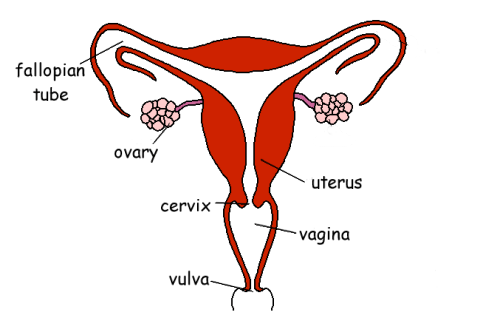
Female reproductive system
Structure and summary
Uterus in the middle surrounded by uterus lining which builds up and breaks down during the menstrual cycles
Ovaries containing eggs travel through the Fallopian tubes to the Uterus after ovulation where they implant into the uterus lining or break down and are expelled from body
Stage 1 of the Menstrual cycle
Menstruation: Bleeding normally lasts 4 days due to breakdown of uterus lining
Stage 2 of the Menstrual Cycle
Uterus lining starts to build up again
Becomes thick and spongy layer with lots of blood vessels
About 10 days long
To prepare uterus lining for fertilised egg
Stage 3 of the Menstrual Cycle
Ovulation
Single day
Egg released from one of the ovaries
Stage 4 of the Menstrual Cycle
Maintaining uterus lining
Rest of the Menstrual Cycle
What happens after the menstrual cycle?
If no egg has been fertilised, cycle repeats
If there was a fertilised egg, it would implant into the uterus lining and develop into a foetus and the menstrual cycle would stop as the woman is pregnant
What are the hormones which are involved in the menstrual cycle?
Oestrogen
Progesterone
Luteinising hormone (LH)
Follicle stimulating hormone (FSH)
Produced in ovaries stimulated uterus lining to grow, levels increase during stage 2
Progesterone maintains the lining of the uterus. If the P levels drop, uterus lining breaks down
Luteinising hormone and follicle stimulating hormone produced in the Pituitary gland
What do oestrogen and progesterone do?
Where are they made?
Oestrogen and Progesterone produced in the ovaries
Oestrogen stimulates uterus lining to grow therefore levels increase during stage 2
Progesterone maintain uterus lining. If levels drop, uterus lining breaks down
What do FSH and LH do?
Where are they made?
Both FSH and LH secreted in Pituitary Gland
LH Stimulates the release of egg on day 14 (Stage 3)
FSH stimulates one egg to mature in one of the ovaries
How do hormones change during the Menstrual Cycle?
High levels of FSH stimulate ovaries to produce oestrogen
Oestrogen inhibits release of FSH and stimulates the release of LH
LH spike. High levels or LH = Ovulation
Levels of Progesterone increase which inhibits LH and FSH
What is contraception?
2 Main types
Any artificial method that people use to prevent pregnancy
Hormonal methods and non-hormonal methods
How do hormonal methods of contraception work?
Oestrogen and Progresterone
Rely on releasing oestrogen, progesterone or combination
If oestrogen released steadily everyday, it inhibits FSH so no egg will be developed or released
Progesterone stimulates production of thick mucus in the cervix so it prevents the sperm from reaching the egg
Main Hormonal Contraceptives
Combine oral contraceptive pill containing combination of both oestrogen and progesterone
99% effective at preventing pregnancy
Side effects: Headaches and Nausea
Progesterone only pill - just as effective but fewer side effects
Other methods of slowly releasing hormones
Contraceptive patch slowly releases Progesterone and Oestrogen Each patch lasts 1 week
Contraceptive injection injecting Progesterone
Lasts 2 - 3 months
Contraceptive implants releasing Progesterone
Last up to 3 years0
Intrauterine device (IUD) - Plastic and releases Progesterone
Lasts over 3 years
Copper version of IUD has no hormones but kills sperm (non-hormonal)
Non hormonal contraceptive methods
Work by preventing the sperm from meeting the egg
Condoms - worn over the penis which traps any sperm
Female condoms - worn inside the vagina
Also protect against sexually transmitted diseases
Diaphragm - fits over the cervix (blocking sperm from entering uterus) - unreliable so not good alone
Used with spermicide which kills sperm and can also be used as contraception
Sterilisation for women - cutting or tying fallopian tubes so eggs can’t pass from ovaries to uterus. Permanent
Sterilisation for men - sperm ducts cut and tied
Natural methods - only having sex at certain times of the month and stopping sex before ejaculation - Unreliable and not recommended
100% good contraceptive - abstaining from sex altogether
Fertility treatments
Can increase fertility using hormones and IVF
How can hormones be used to increase fertility?
FSH stimulates ovaries of a woman to mature an egg.
Some women have low levels so their eggs won’t mature properly
Can give FSH in a pill form which helps eggs to mature
Can give LH to stimulate ovulation
How does IVF work?
Women are given FSH and LH to stimulate eggs to mature
Eggs are collected from ovaries and fertilised by sperm in lab.
If the man has low sperm count, intracytoplasmic sperm injection where sperm is injected into the egg cell with small needle
Eggs placed in incubator to grow into embryos
Embryo inserted into mother’s uterus so grow into a foetus
Pros and cons of IVF
Pros: Allows infertile couples to have kids
Cons:
Doesn’t always work
UK: 1 in 4 chance of it working
Stressful. Emotionally upsetting and physically unpleasant (abdominal pain and vomiting)
Often leads to multiple births (twins and triplets) - higher risk of complications, miscarriage or still birth
Often results in unused embryos which are eventually destroyed. Some people think that this is unethical as the embryos had potential for life
Microscope Technology in helping Fertility
Pros and Cons
Improves success rate of IVF
Remove single cells from an embryo and test for diseases
Cons:
Can find out characteristics of future babies and may lead to people picking physical characteristics - currently illegal
What is Adrenaline and when is it produced?
Adrenaline is a hormone produced by the adrenal glands which sit just on top of the kidneys
Adrenaline is produced during Fight of flight response, when you get scared. Stressed, or need to exercise. It prepares the body for activity
What does Adrenaline do?
Increases heart rate
Increases blood pressure
Increases blood flow to muscles
Increases blood sugar levels by stimulating liver to break down glycogen into glucose
What does Thyroxine do
Thyroxine is produced by the thyroid gland, which is found in the neck
Thyroxine has lots of roles in the body, including growth and development, but the main role is to increase your metabolic rate (rate at which chemical reactions take place)
How is Thyroxine stimulated?
The pituitary gland produced thyroid stimulating hormone TSH which stimulates the thyroid gland to produce thyroxine
Thyroxine then inhibits the production of TSH from the pituitary gland

