Maternal Disease
 Call Kai
 Learn
Learn Practice Test
 Spaced Repetition
 Match
Match Flashcards
 Knowt Play
1/72

There's no tags or description
Looks like no tags are added yet.
Name | Mastery | Learn | Test | Matching | Spaced | Call with Kai |
|---|
No analytics yet
Send a link to your students to track their progress
73 Terms
Maternal Disease
placenta exchanges gas, nutrients, and waste products btwn maternal + fetal circulations by diffusion, active transportation, and pinocytosis (extracellular fluid absorption)
substances w/ larger molecules are unable to cross the placenta
unable to enter fetal circulation d/t the “placental barrier”
this barrier prevents the mixing of the maternal and fetal circulations
some substances can cross
ex: infectious agents, drugs, + antibodies
What are the effects of maternal disease on the pregnancy?
some mat diseases may directly injure the placenta and indirectly harm the fetus
maternal vascular disease (HTN) decreases uteroplacental blood flow + compromises the placenta’s function of providing nutrients for the fetus
FGR can be found
Maternal drug use can lead to:
fetal addiction
tetrogenesis
depends on drug, dosage, + time of exposure
if early in gestation → HEART
altered uteroplacental flow
FGR
Amphetamines:
stimulant drugs may be used to treat ADD/ADHD
increased risk of fetal:
cleft palate
FGR
Barbiturates:
cause CNS depression and may be used for sleep, anxiety, + seizures
increased risk of fetal:
cardiac anomalies
cleft lip / palate
Cannabis:
causes increased risk of fetal:
preterm birth
low birth weight / FGR
long-term cognitive issues w/ attention, memory, problem-solving skills, & behavior later in life
Cocaine:
stimulant
increased risk of fetal:
placental abruption
genitourinary malformations
limb reduction anomalies
cardiac defects
Nicotine:
increased risk of Fetal:
spontaneous abortion
perinatal mortality
placenta previa
preterm delivery
FGR / low birth weight
Opioids:
Codeine, Morphine, Oxycodone, Hydrocodone, Demerol, & Heroin
increased risk of fetal:
placental abruption
miscarriage
stillbirth
FGR / low birth weight
cognitive delay
Fetal Alcohol Spectrum Disorder AKA:
Fetal Alcohol Syndrome
Fetal Alcohol Spectrum Disorder
consumption of alcohol during pregnancy
approx 45-50 g of ethanol per day suffer from the effects
there is no threshold
11% of pregnant women are problem drinkers
permanent effects
most common form of cognitive delay in the US today
Fetal Alcohol Syndrome is associated with:
microcephaly
abnormal faces
mental delays
CNS malformations
behavioral problems
Maternal disease during pregnancy:
feta infection from maternal disease can occur at various times during gestation
can have a wide variety of clinical outcomes
maternal infection even before conception may have an adverse effect on future pregnancies
Maternal TORCH titers may be drawn to confirm the most common viral infections:
Toxmoplasmosis
Other viruses (syphilis, varicella-zoster, parovirus B19)
Rubella (German Measles)
Cytomegalovirus (CMV)
Herpes
Extent of fetal damage depends upon:
virulence of agent
route of transmission
gestational age
Infection that occurs before implantation:
may result from local infection of the maternal reproductive tract
infection may destroy the zygote or embryo
Infection that occurs after implantation:
during organogenesis
accounts for the largest number of adverse fetal effects
may lead to serious fetal abnormalities
infectious agent enters mother, then infects placenta, enter fetal circulation and spread throughout ‘fetus’ body
Cytomegalovirus (CMV)
most common known cause of congenital infections in humans
features of CMV disease in neonates include:
hepatosplenomegaly
jaundice
thrombocytopenia
choriotinitis
cerebral calcifications
hydrops
premature foramen ovale closure
FGR
oligohydramnios
microcephaly
Ebstein-Barr Virus (EBV)
causes mononucleosis
uncommon in pregnant women
has been linked to spontaneous abortions, stillbirths, low-birth-weight infants, congenital heart anomalies, and microphthalmia
Herpes Simplex
Infection during first half of pregnancy has been associated w/ spontaneous AB & stillbirths
associated congenital malformations
microcephaly, hydrancephaly, intracranial calcifications, microphthalmia, hepatosplenomegaly
C-section indicated if present in birth canal
Varicella-Roster (Chicken Pox)
congenital abnormalities
Postnatal newborn disease (benign to fatal)
Zoster (shingles)
May appear months or years after birth
FGR, limb aplasia, microphthalmia, brain calcifications
Observed when virus transmitted 8-20 weeks GA
Rubella (German Measles)
contagious viral infection usually causing mild symptoms like fever, swollen glands, and a pinkish-red face
MMR vaccine protects against virus
Infection during pregnancy may result in spontaneous AB, stillbirth, or congenital defects
Microcephaly, hydrocephaly, cephalocele, cardiac anomalies, eye defects, FGR, deafness, and cognitive delay
HIV
most cases in children are a consequence of transmission of infection from mother to infant near the time of birth
Factors affecting HIV transmission from mother to infant include:
maternal HIV particles
Effectiveness of maternal and fetal immune response
Effectiveness of maternal and fetal immune response
Integrity of the placental barrier
Maternal viral load**
Hx of anti-viral meds
Syphilis
Syphilis infection early in pregnancy may result in spontaneous AB
Infection later in pregnancy:
stillborn / neonatal death
Infection very late in pregnancy:
signs of congenital syphilis may not appear for 2-4 weeks
hepatosplenomegaly, hyperbilirubinemia, hemolysis, lymphadenopathy
Gonorrhea
increased incidence of prematurity, prolonged fetal membrane rupture, chorioamnionitis, sepsis, FGR
can be treated w/ Penicillin
Parasitic Infections:
Toxoplasmosis
Malaria
Both treated w/ antiparasitic drugs**
Toxoplasmosis
usually acquired in last semester
FGR, hydrocephaly, microcephaly, cerebral calcifications*, hepatosplanomegaly, fetal demise
Malaria is associated w/:
placental insufficiency
FGR
low birth weight
abortion
stillbirth
What is the most common maternal disorder?
Diabetes mellitus
Maternal Diabetes types:
Type I
Insulin Dependent
Type II
Non-Insulin Dependent
Other/Secondary Diabetes
Pancreatic disease or pancreatectomy, hormones, drugs, or chemical + certain genetic syndromes
Gestational Diabetes*
Diabetes mellitus only during pregnancy
Maternal Diabetes is at increased risk for:
early + late term loss
congenital anomalies
growth disturbances
c-section
shoulder dystocia
Maternal Diabetes causes certain maternal complications:
difficulty controlling glucose levels
infections
pyelonephritis
delivery complications
Fetal anomalies related to maternal DM:
macrosomia
CHD (TOGV, TOF), NTD’s, caudal regression
single umbilical artery
concurrent maternal vascular disease increases risk for FGR
Maternal Diabetes
disorder of carbohydrate metabolism related to insulin deficiency and characterized by hyperglycemia
glucose is the main ““fuel” for fetal growth
means maternal glucose levels being too high (not enough insulin production = macrosomia
associated w/ polyhydramnios and can cause:
PTL, PROM, + Maternal Discomfort
Macrosomia
greater than the 90th %ile for GA
>4500 grams at birth (9lb 9oz)
Maternal DM procedure:
screen for congenital anomalies
check placental thickness (2.5-5cm) + AFV
fetal growth
after 28 weeks → BPP, NST, + Umbilical Artery Dopplers are often used to monitor fetal well-being
twice weekly testing
Cardiac anomalies associated w/ mat DM:
TOGV w/ or w/o VSD
VSD
ASD
Coarctation of the aorta w/ or w/o VSD
Cardiomegaly
GI anomalies associated w/ mat DM:
duodenal atresia
anorectal atresia
small left colon syndrome
Renal anomalies associated w/ mat DM:
hydronephrosis
renal agenesis
ureteral duplication
CNS anomalies associated w/ mat DM:
caudal regression syndrome
NTD’s
anencephaly
microcephaly
Other anomalies associated w/ mat DM:
single umbilical artery
Gestational Diabetes manifestation:
manifest signs of dm during pregnancy and have normal glucose levels when not pregnant
detected primarily btwn 24-28 weeks GA
gestational diabetes occurs when an expectant woman’s pancreas doesn’t produce enough insulin to account for placental hormone fluctuations
GDM may be diet controlled or require insulin
Gestational Diabetes risk factors:
previous stillbirth
baby w/ congenital anomalies
prev macrosomic infant
family hx of DM
Possible effects of GDM on baby after birth:
increased risk of breathing difficulties
low blood sugar levels
jaundice
2 Types of HTN:
Pregnancy Induced Hypertension
pre-eclampsia, severe pre-eclamsia, eclampsia
Chronic Hypertension
present prior to pregnancy
Pre-eclampsia
HTN w/ proteinuria + edema
Severe Pre-eclampsia
Immediate delivery needed
Eclampsia
Risk for seizures and coma
HELLP Syndrome
H
EL
LP
associated w/ pre-eclampsia
early diagnosis is critical b/c of the morbidity and mortality rates associated w/ the syndrome are reported to be as high as 25%
HELLP Syndrome risk factors:
rarely occurs until the third trimester
1/3 of cases develop within 2 days after delivery
more likely to occur in women of African descent and multiparous Caucasian women
Increased risk in women w/:
Family hx if HELLP
pre-eclampsia
HELLP syndrome symptoms:
headache
Nausea / vomiting / indigestion w/ pan after eating
Epigastric (abd) or wubsternal (chest) tenderness
RUQ pain (from liver distension)
Shoulder pain / pain when breathing deeply
Bleeding
Swelling
High BP
Proteinuria
Sickle cell Disease (Anemia)
inherited disorder that affects the hemoglobin molecule in the blood
inflexible sickle-shaped cells cause complications d/t inability to change shape in the small blood vessels of the body
Sickle Cell Anemia is more common in individuals from:
Africa, central / South America, the Caribbean islands, Mediterranean countries, India, and Saudi Arabia
African-Americans have 1/500 chance in inheriting this (very high)
Hispanic Americans have a 1/1000-1400 chance
Sickle Cell Disease is at risk for fetal:
spontaneous AB
prematurity
stillbirth
short femurs
LBW / FGR
Monitor Sickle Cell Disease pt’s for:
FGR
Abnormal Umbilical Artery Doppler
Sickle Cell Anemia treatment:
women w/ sickle cell disease may be urged to take iron and folic acid supplements during pregnancy
may require blood transfusions
Thalassemia (Beta-thalassemia)
reduction in hemoglobin and RBC production that leads to anemia
D/t gene mutation and similar to Sickle Cell Disease
What is one of the most common maternal autosomal recessive genetic abnormalities associated w/ pregnancy worldwide?
Beta-thalassemia
Two forms of Beta-Thalassemia:
Cooley anemia / thalassemia major → more severe
Thalassemia intermidia
There is an increased risk of thalassemia in individuals from:
Mediterranean countries
North Africa
The Middle East
India
Central Asia
Southeast Asia
Thalassemia is associated with:
most women w/ thalassemia major die before reproductive age
Can be associated w/ fetal hydrops
Thrombophilias
group of disorders that promote blood clotting
Most common antiphospholipid syndrome (APS)
Thrombophilias are at increased risk of:
repeated late first-trimester miscarriages
Stillbirth
Placental abruption
FGR
Maternal deep vein thrombosis
Rh Sensitization
occurs when Rh- woman is pregnant with an Rh+ fetus
Cells from Rh+ fetus enters mom’s bloodstream
Mom becomes sensitized and as a result antibodies form to fight Rh+ cells
In the next Rh+ pregnancy the fetal cells are attacked due to the antibodies formed
What does Rh Sensitization result in?
destruction of the fetal RBC’s lead to fetal anemia
Immune Hydrops
Rh- Moms are treated w/ injection called RhoGAM to prevent fetal cell attack
Systemic Lupus Erethmatosus
common in women of childbearing age
Spontaneous AB / Fetal death is common
Placenta affected by immune complex deposits / inflammatory response in placental vessels can account for:
↑ loss
spontaneous AB’s
IUGR
Risk for congenital Heart Blocks + Peric Effusion
Urinary Tract Disease
4-6% of pregnant women w/ asymptomatic bacteriuria leads to pyelonephritis if untreated
Pyelo Symptoms: fever, flank pain, WBC’s in urine
Hydronephrosis symptoms:
flank pain
prescence of progesterone dilatory effect on ureter muscle
↑ uterize size d/t ureter compression at pelvic brim
Hyperemesis Gravidarum
dehydration electrolyte imbalance
hospitalization for IV fluids
confirm lack of maternal gallstones, ulcers, trophoblastic disease
Maternal Obesity
BMI >30
3 major antenatal complications are:
↑ risk NTD’s → d/t poor diet
↑ risk for multiples
↑ risk of UTI’s
Fetal Demise
absence of a FHR confirmed by Color Dp, PW DP, M-mode and/or Power Dp
May present as S<D, decreased fetal movement, post-trauma, or asymptomatic
always document absence of FHR + always do biometry
to estimate how long ago demise occured
Fetal Demise U/S appearance:
may see skin, scalp, + generalized edema
spalding sign** (cranial bone overlapping)
ascites
oligohydramnios
abnormal position / spine curvature
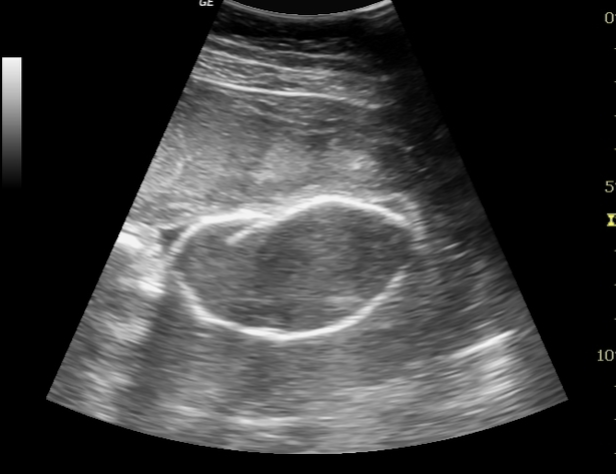
Potential fetal demise causes
spontaneous
infection
chromosome abnormality
congenital anomaly
preeclampsia
placental abruption
diabetes
FGR
Rh incompatibility

