AP Psychology Unit 4 Review
 Call Kai
 Learn
Learn Practice Test
 Spaced Repetition
 Match
Match Flashcards
 Knowt Play
1/133

There's no tags or description
Looks like no tags are added yet.
Name | Mastery | Learn | Test | Matching | Spaced | Call with Kai |
|---|
No analytics yet
Send a link to your students to track their progress
134 Terms
Person Perception
Mental processes we use to form judgments and draw conclusions about other people.
Attribution Theory
Theory we credit someone's behavior on either the situation (situational attributes) or the person's character (dispositional attributes). Varies among cultures.
Explanatory Style
Habitual way people explain life events; affects how one views themself and how others view them. Can be optimistic (+) or pessimistic (-).
Fundamental Attribution Error
Tendency for observers to underestimate the impact of a situation and overestimate the personal involvement someone else has; "logical leap"
Actor-Observer Bias
Tendency of people to attribute their behavior on outside forces but others on internal forces.
Self-Serving Bias
Tendency to judge our failures on outside forces but our successes on dispositional factors.
Locus of Control
A person's tendency to perceive the control of rewards as internal (we control our own fate) or external (environment determines our fate).
Mere-Exposure Effect
Repeated exposure causes people to like something more.
Equity
People get from a relationship what they put into it.
Altruism
Unselfish regard for the welfare of others
Bystander Effect
The tendency for any given bystander to be less likely to help if other bystanders are present.
Social Exchange Theory
Proposes social behavior is an exchange that aims to maximize benefits and minimize costs.
Reciprocity norm
An expectation that people will help, not hurt, those who have helped them
Social Responsibility norm
An expectation that people will help those who need help.
Self-Fulfilling Prophecy
An individual's prediction causes new behavior that in turn makes their original (often false) beliefs come true.
Social Trap
A situation in which the conflicting parties pursue their own self-interests, creating mutually destructive behavior
Mirror-Image Perceptions
Mutual views often held by conflicting people, I.e. when each side sees itself as ethical and the other side as evil.
Superordinate Goals
Shared goals that override differences among people and require their cooperation.
Social Comparison
The theory that people evaluate themselves by judging other's worth relative to them.
Relative Deprivation
The idea that one can feel deprived or entitled to something in comparison to another.
Social Facilitation
Stronger responses on simple or well-learned tasks and weaker responses on difficult ones in the presence of others
Social Loafing
Tendency to exert less effort toward attaining a common goal in a group than when individually accountable.
Group Polarization
Tendency of group members to move to an extreme position after discussing an issue as a group.
Groupthink
A situation in which group members seek unanimous agreement despite their individual doubts.
Antisocial Behavior
Negative, destructive, unhelpful behavior
Stereotype
Overgeneralized belief about a group.
Discrimination
Unjustifiable negative behavior toward a group and its members.
Prejudice
An unjustifiable (usually negative) attitude toward a group/its members; often based on stereotypes.
Implicit Attitudes
People hold an attitude unconsciously, often contradicting our conscious beliefs.
Other-Race Effect
The tendency to recall faces of one's own race more accurately than faces of other races.
Just-World Phenomenon
Tendency for people to believe the world is fair and
that people therefore gets what they deserve.
Culture
Beliefs, customs, and traditions of a specific group of people.
Social identity
The "we" aspect of our self-concept
Outgroups
Social groups we don't identify with; "them"
Ingroups
Social groups we do identify with; "we"
Outgroup Homogenity
Tendency to see members of outgroups as more similar to one another than our ingroups.
Deindividuation
Loss of self-awareness and self-restraint occurring in group situations.
Ingroup Bias
Preferring your own group over others.
Ethnocentrism
Tendency to use your own culture as a standard to judge other cultures; believing your culture is superior.
Contact Hypothesis
Integrating different groups increases exposure and makes more positive attitudes.
Types of Love
Romantic (passionate love) or platonic (companionate love).
Belief Perseverance
Clinging to already disproven beliefs despite contrary evidence.
Cognitive Dissonance
Sense of discomfort or distress that occurs when a person's behavior does not correspond to that person's attitudes; justify or change.
G.R.I.T.
A global strategy designed to decrease international
tensions.
Social Norm
Understood rules and expectations for behaving.
Normative Influence
Conforming to fit in for approval or to avoid disapproval.
Informative Influence
Following others since their behavior is logical.
Role
Norms of behaving for a social position.
Persuasion
Attempting to change someone's beliefs.
- Can be done through logic (central route) or through emotion/incidentally (peripheral route)
Halo Bias
Cognitive bias where our impression of someone/something influences how we feel about its traits.
Foot-In-The-Door Technique
Tendency for people who first agreed to a small request to comply later to a larger request.
Door-In-The-Face Phenomenon
Large, unreasonable demand is followed by a smaller request that is the actual one expected to work.
Obedience
Compliance, influenced by social and personal control.
False Consensus Effect
The tendency to overestimate the extent to which others agree with us.
Personality
Patterns of thinking, feeling, and behaving.
Psychodynamic Theory
Any theory of personality that emphasizes the influence of childhood conflicts and unconscious motivations.
Unconscious
Processing that we are unaware of; Reservoir of mostly unacceptable thoughts, memories, etc.
Free Association
Person talks freely without censoring thoughts, revealing unconscious motives.
Psychoanalytic Theory
Personality arises from a conflict between impulse and restraint; trying to solve this determines personality.
Id
Reservoir of unconscious psychic energy that strives to satisfy basic sexual/aggressive drives; demands pleasure.
Superego
Partly conscious part of personality that represents moral principles that provide standard for judgement.
Ego
Conscious, executive part of personality mediating between the demands of the Id, Superego, and Reality; Compromise.
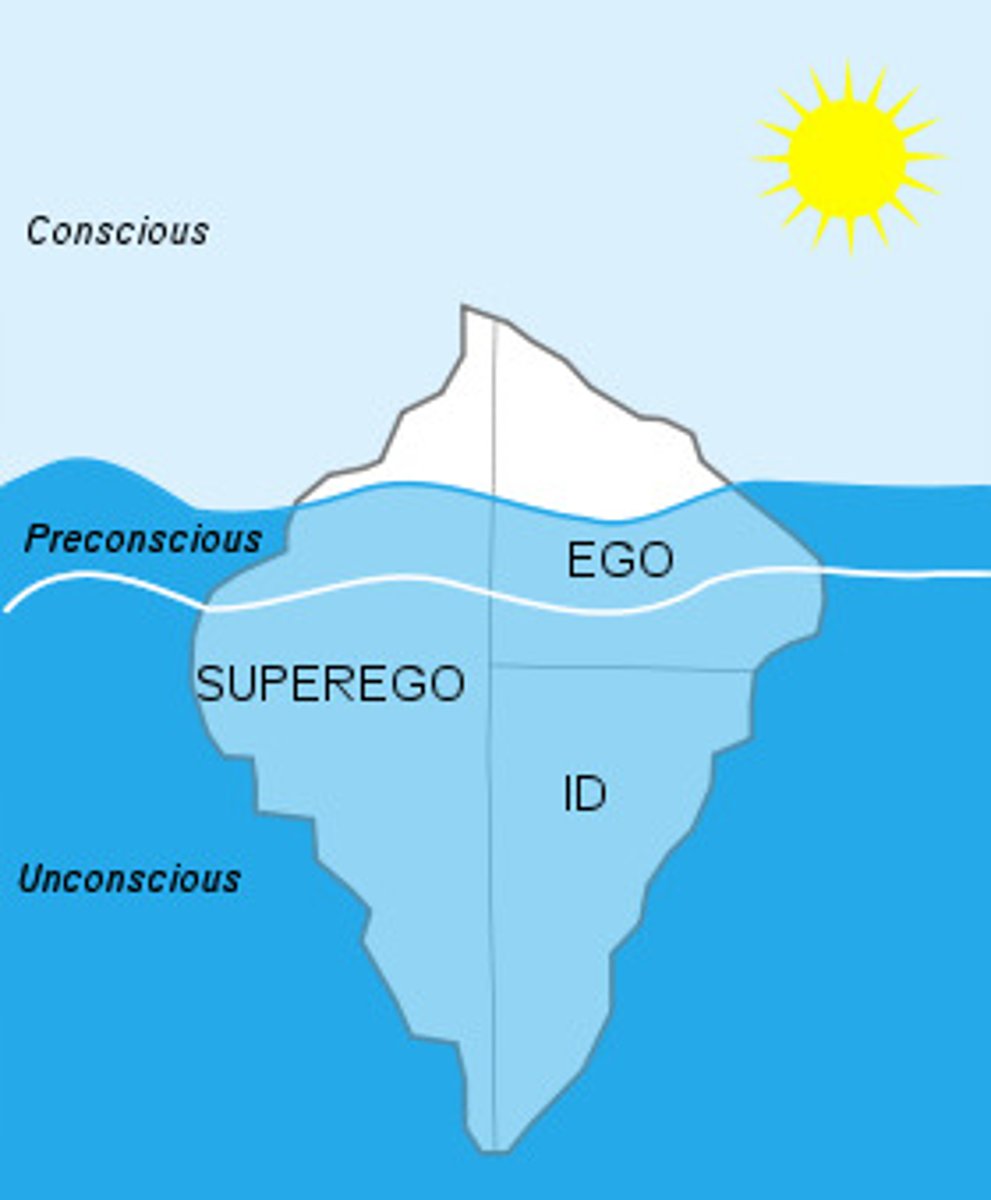
Ego Defense Mechanisms
Ego unconsciously distorts reality to defend itself from threats/anxiety.
Repression
Banishes conscious anxiety-arousing thoughts.
Regression
Revert to child-like behavior.
Projection
Accusing someone of your own feelings/behavior, concealing own impulse.
Displacement
Redirecting impulses to something less bad.
Reaction Formation
Switching unacceptable impulses into their opposites.
Rationalization
Self-justifying unacceptable actions or thoughts.
Denial
Refusing to acknowledge threats.
Sublimation
Channel unacceptable impulses to positive, constructive activity.
Collective Unconscious
Jung's name for the memories shared by all members of the human species.
Terror-Management Theory
How people cope with the knowledge of their own mortality.
Projective Tests
Personality test that uses ambiguous "vague" images to explore the unconscious mind.

Rorschach Inkblots
A projective test where people describe what they see in inkblots.
Thematic Apperception Test
A projective test where people make up stories about ambiguous images.
Physiological Needs
Basic bodily requirements.
Humanistic Theory
Emphasizes ways people strive for self-determination and self-realization based on self-reports.
Self-Actualization Tendency
The striving to fulfill one's innate capacities and capabilities
Self-Transcendence
Striving for identity, meaning, and purpose beyond the self.
Unconditional Positive Regard
Caring acceptance and non-judgemental behavior towards others.
Social Cognitive Theories
Explore interaction between traits and social context
Behavioural Approach
Emphasizes affect of learning on personality development.
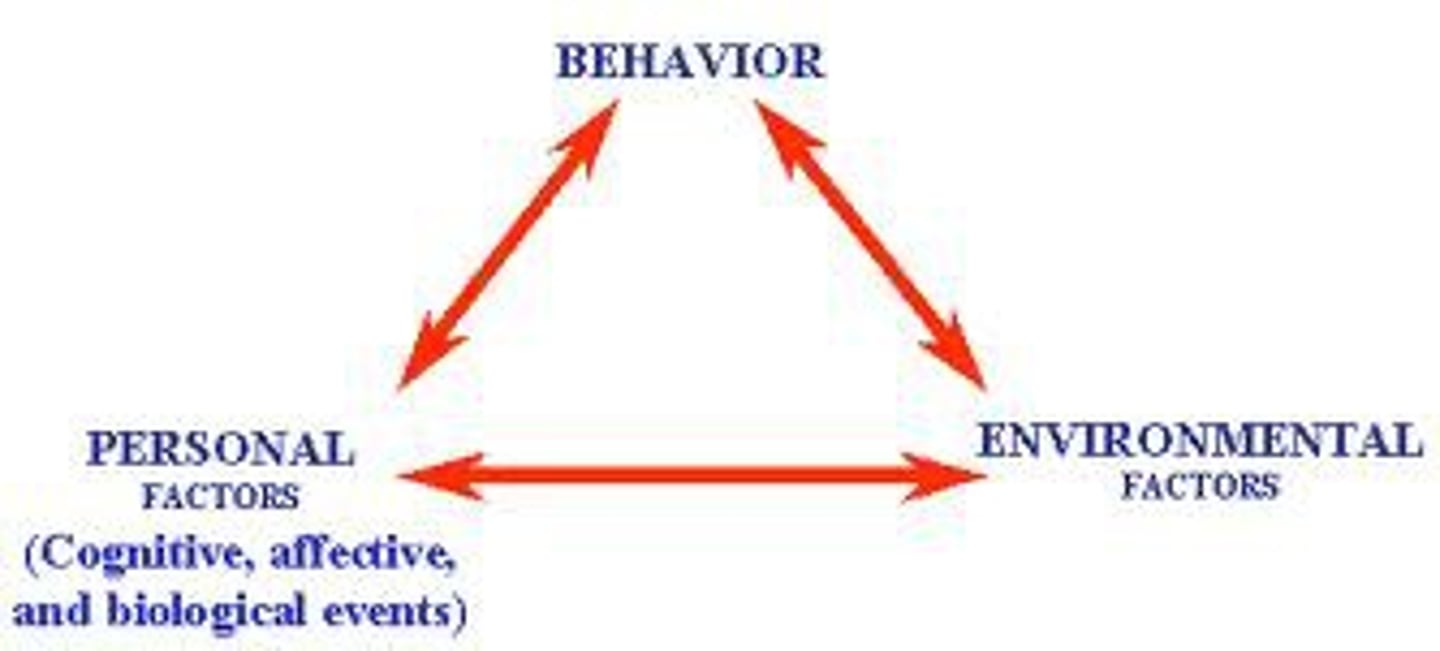
Reciprocal Determinism
Interacting influences of behavior, internal cognition, and environment that shape personality.
Traits
Enduring characteristics assessed by self/peer-reports.
Personality Inventory
A questionnaire (often with true-false or agree-disagree items) to gauge feelings and assess personality traits.
Empirically Derived Tests
Test developed by testing a pool of items and then selecting those that discriminate between groups.
Minnesota Multiphasic Personality Inventory (MMPI)
a well-researched, clinical questionnaire used to assess personality and psychological problems.
Self
Center of personality
Self-Concept
Description and evaluation of oneself
Self-Efficacy
Perception of capabilities
Self-Esteem
Degree to which self concept is perceived as positive.
Spotlight effect
Overestimating how much others notice us.
Factor Analysis
Statistical procedure that identifies clusters of items associated with traits.
Big Five Theory (OCEAN)
5 Main, Stable Personality Traits:
• Openness (Creativity / Curiosity)
• Conscientiousness (Organization / Responsibility)
• Extraversion (Outgoingness)
• Agreeableness (Cooperativeness / Caring)
• Neuroticism (Emotional Stability)
Narcissism
Excess self-love
Individualism vs Collectivism
The prioritization of an individual versus a group.
Drive Reduction Theory
Body creates a drive that motivates an organism to satisfy a need.
Homeostasis
Body's tendency to maintain internal steady state of metabolism.
Arousal Theory
Relationship between arousal and performance based on Yerkes-Dodson Law.

