Chapter 8 - Hormones & Sex
 View linked note
 Call Kai
 Learn
Learn Practice Test
 Spaced Repetition
 Match
Match Flashcards
 Knowt Play
1/43

There's no tags or description
Looks like no tags are added yet.
Name | Mastery | Learn | Test | Matching | Spaced | Call with Kai |
|---|
No analytics yet
Send a link to your students to track their progress
44 Terms
What are hormones?
chemicals that travel through the bloodstream to act on target tissues
What are the four chemical communication methods?
Synaptic
Endocrine
Pheromone
Allomone
Define synaptic chemical communication
A process where neurotransmitters are released from neurons and travel across synapses to influence adjacent cells.
Define endocrine chemical communication
hormones released into the bloodstream to selectively affect distant target tissues
Define pheromone chemical communication
chemicals released outside the body to affect other individuals of the same species
Define allomone chemical communication
chemicals released outside the body to affect individuals of another species
Where are neuroendocrine cells found?
posterior pituitary
Where are classic endocrine cells found?
anterior pituitary
What is the difference between endocrine and neuroendocrine cells?
Endocrine cells release hormones directly into the bloodstream
Neuroendocrine cells receive signals (neurons) from the nervous system and then release hormones into the bloodstream.
What is the shared delivery system of both endocrine and neuroendocrine cells?
bloodstream
How do neuroendocrine cells convert action potentials into hormones?
Neuroendocrine cells convert action potentials into hormones by releasing neurotransmitters in response to neuronal signals, which trigger the release of hormones into the bloodstream.
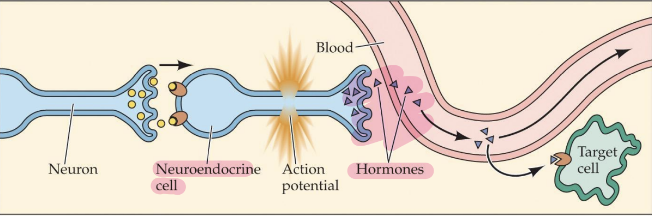
__ hormones are short strings of amino acids
Peptide
__ hormones are derived from cholesterol, and made of 4 carbon rings
Steroid
What are the differences between the mechanism of action of steroid hormones and peptide hormones?
Steroid hormones cross the cell membrane and bind to receptors inside the cell to control expression of specific genes (can take up to hours, days, and even years).
Peptide hormones bind to specific receptors on the surface of a cell and activate secondary messengers (takes seconds-minutes).
The pituitary gland is connected to the hypothalamus via the ___?
pituitary stalk
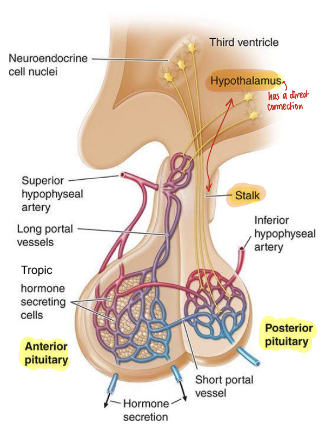
What are some notable things about the posterior pituitary?
does not make hormones, it RELEASES what has already been made!
hormones are made in the neuroendocrine cells of the hypothalamus and transported to the posterior pituitary for storage and release when needed.
What is the function of oxytocin hormone?
Produced by the hypothalamus and released by the posterior pituitary.
Plays a crucial role in reproductive and parenting behavior, milk letdown reflex, and childbirth.
What is the function of vasopressin hormone?
A hormone produced by the hypothalamus and stored in the posterior pituitary, vasopressin (also known as antidiuretic hormone).
aids in water conservation, pair bonding, and social behaviors
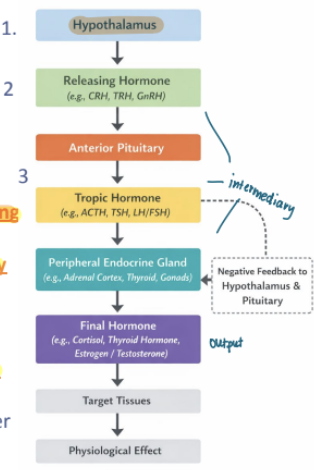
What are the three important steps in the hormone cascade?
The very top of the hierarchy is hypothalamus
Releasing hormone - stimulates the anterior pituitary to release its hormones
Anterior Pituitary - the hormones that anterior pituitary releases/makes are called tropic hormones
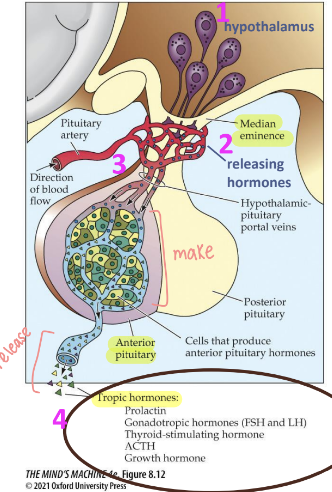
What are the 4 steps in the sequence for how tropic hormones are released and controlled?
Hypothalamus controls jsut how much anterior pituitary will release
Hypothalamus secretes releasing hormones onto the median eminence
Local blood vessels go to the anterior pituitary
Anterior pituitary releases tropic hormone. Tropic hormones enter the general bloodstream and affect target organs
What are the three steps in HPG axis?
Hypothalamus releases gonadotropin-releasing hormone (GnRH)
Anterior pituitary secretes luteinizing hormone (LH) and follicle-stimulating hormone (FSH)
Gonads produce steroid hormones such as testosterone and estrogen.
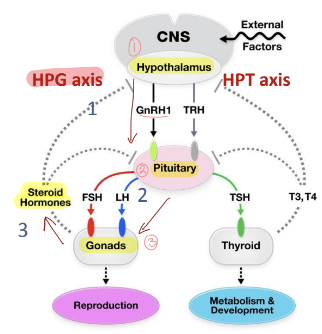
The tropic hormones that directly stimulate the gonads are collectively known as __?
gonadotropins
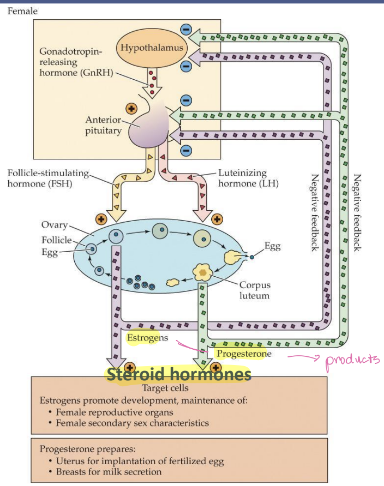
What are the two gonadotropins in females and what are their functions?
luteinizing hormone (LH) - release of egg from follicle and progesterone release
follicle-stimulating hormone (FSH) - maturation of follicle and estrogen release
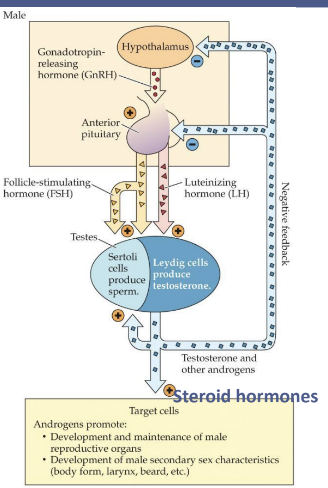
What are the two gonadotropins in males and what are their functions?
luteinizing hormone (LH) - stimulates testosterone production
follicle-stimulating hormone (FSH) - promotes sperm production
In males the gonads are the __?
testes
In females the gonads are the __?
ovaries
What is simple negative feedback?
circulating hormones function as negative feedback the hormone (or its effects), acts directly back on the endocrine gland to inhibit further secretion
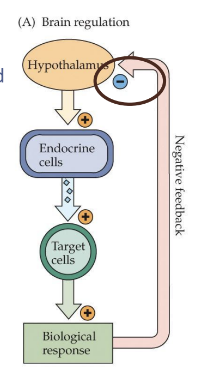
What is complex negative feedback?
Requires a “middle man,” the endocrine gland has an indirect negative feedback by the hypothalamus and pituitary
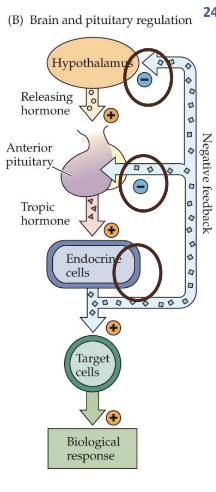
What is the sequence of order for hormone contraceptives?
Hormone contraceptives contain synthetic estrogen and/or progesterone
The excess circulating hormone introduced will exert negative feedback on the hypothalamus, inhibiting GnRH
Without GnRH, no FSH or LH will be released, and no ovulation occurs.
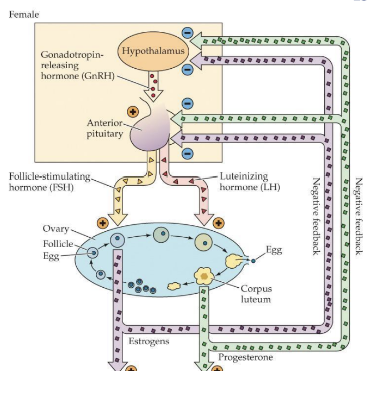
__ are a well known example of a complex negative feedback system in action
Hormonal contraceptives
Describe organizational effects.
“blueprint”
Development of physical and behavioral traits (long-term)
Timing: two critical periods; utero and puberty
Action: they organize the physical structure of the nervous system aka sexual differentiation
Describe activational effects.
“trigger”
Activation: temporary changes in behavior
Timing: adulthood
Effects will stop if the hormone is removed
Once courtship begins, the receptive female (in uterus) adopts a position called, __, allowing for intromission when the male rat mounts.
lordosis
In the female rat circuit, what two things will estrogens acting on the ventromedial hypothalamus cause?
Increases dendritic branching of VMH neurons
Stimulates production of progesterone receptors
What is the pathway of the female rat mating circuit?
estrogens on VMH → estrogens on periaqueductal gray (PAG) in the midbrain → medulla and spinal cord
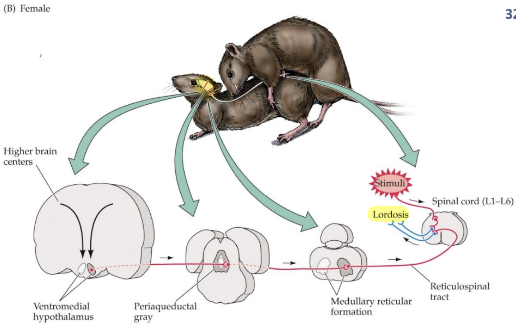
What is the pathway of the male rat mating circuit?
Vomeronasal organ (VNO) → androgens on medial amygdala → androgens on medial preoptic area (mPOA) of hypothalamus → androgens on ventral midbrain and spinal cord
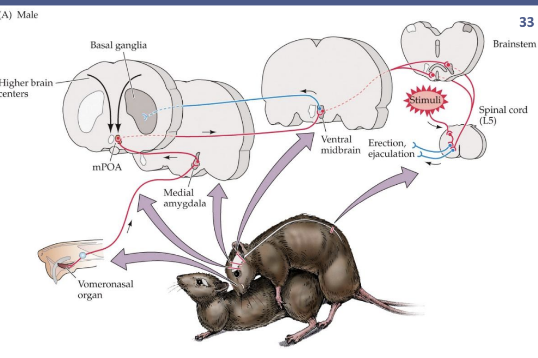
In male rats, the region that commands and coordinates the rat mating circuit is the __ of the hypothalamus.
medial preoptic area (mPOA)
What are some maternal behaviors?
Exposure to pregnancy hormones shapes her brain to display maternal behaviors:
nest building
crouching over pups
nursing
retrieving pups
What is the role of the SRY gene?
The SRY gene, located on the Y chromosome, is responsible for the development of male characteristics by initiating testes formation and promoting the production of male sex hormones.
Without the SRY gene, gonads develop into ovaries.
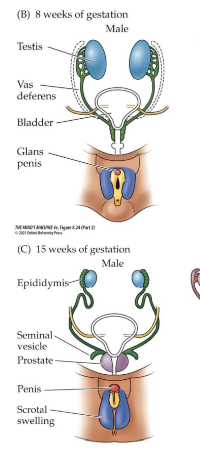
What are wolffian ducts?
embryonic structures that develop into male reproductive ducts, such as the vas deferens and seminal vesicles, under the influence of male hormones.
SRY gene presence indicates testes
Testes produce testosterone
Testosterone promotes growth of wolffian ducts
Anti-mullerian hormone induces shrinking of mullerian ducts and prevents the development of female reproductive structures.
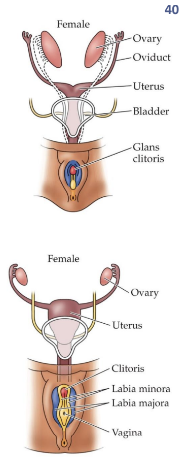
What are mullerian ducts?
embryonic structures that develop into female reproductive structures, such as the fallopian tubes, uterus, and upper two-thirds of the vagina, in the absence of male hormones.
No SRY gene present, so no testes, stays as ovaries
No testes → no testosterone so the wolffian ducts regress
In many fish, warmer spring water increases GnRH release in the brain. GnRH then triggers LH and FSH release, which boost gonadal hormones and start reproductive behaviors. Because these hormone changes happen in adulthood and water temperature varies across seasons, scientists view warm water as a seasonal environmental cue for fish. Based on the difference between organizational and activational effects, are these hormone effects organizational or activational, and why? Name the type of effects that are being illustrated here—organizational or activational-- and explain how you know.
activational; because they occur in adulthood and trigger immediate reproductive behaviors in response to changes in environmental conditions, such as warmer water temperatures.
Two related mammal species grow up in slightly different environments. In one species, the young are exposed to higher hormone levels early in development, while the other species is not. A group of researchers note these early hormones helped shape brain and neural structures in the developing young. When both species reach adulthood, they have similar hormone levels, but their adult social behaviors are very different and behaviors stay stable throughout life. Name the type of effects that are being illustrated here—organizational or activational-- and explain how you know.
organizational; because they refer to the effects of hormones on developing neural structures early in life, leading to long-lasting changes in behavior that persist into adulthood.
A population of birds shows strong territorial aggression during the breeding season, but this aggression drops sharply outside the breeding season. Researchers find that the birds’ testosterone levels rise in adulthood during the breeding season, and this rise makes certain brain regions more sensitive to social cues from rivals. When testosterone levels fall later in the year, the aggression decreases again. Name the type of effects that are being illustrated here—organizational or activational and explain how you know.
activational; because the changes in aggression and sensitivity to social cues are linked to fluctuations in testosterone levels occurring in adulthood, directly influencing behavior seasonally.
