Solar System and the Moon Test - Science 8
 Studied by 0 people
 Call Kai
 Learn
Learn Practice Test
 Spaced Repetition
 Match
Match Flashcards
 Knowt Play
1/54

There's no tags or description
Looks like no tags are added yet.
Name | Mastery | Learn | Test | Matching | Spaced | Call with Kai |
|---|
No analytics yet
Send a link to your students to track their progress
55 Terms
How do stars start off as?
Stars start off as nebulas!
Nebulas
A cloud of gas and dust, (mostly consists of hydrogen with other trace elements). Nebulas have so much mass, it has gravity.
A Nebula Over Time
size→smaller
density→increase
pressure→increase
temperature→increase
Dynamic Equilibrium
When GRAVITY is EQUAL to pressure, the star will be in DYNAMIC EQUILIBRIUM
Nuclear Fusion
happens in the core of a star, where the temperature and pressure are super high!
produces new elements and light
ex. Lithium(3) and Carbon(6) fuses together to make Florine
When does a nebula become a star?
A nebula becomes a star when dynamic equilibrium occurs and goes through nuclear fusion
THE LIFE CYCLE OF A STAR
Stars began as a nebula
goes into a main sequence star and it stays in this stage most of it’s life
it either produces into a red giant or produces into a super giant
- supergiant path: becomes a supernova
- red giant path: becomes a white dwarf
From being a supernova it either explodes and goes back to being a nebula/ or the largest stars become a black hole, the most dense in the universe/ or the largest stars become a neutron star, very dense
Solar System Formation
Step #1: There is a Nebula is left over from a previous supernova, mostly H & He but it also contains more complex elements because we find these elements on earth
Step #2: Closer to the center of the nebula is heavier elements(iron, aluminum, rocks), farther away from the center are light elements(hydrogen, helium, gaseous)
Step #3: Time passes and a solar wind kicks out a thin disk of elements
Step #4: 4 Rock planets and 4 gas planets are formed, 1 STAR AND 8 PLANETS
Terrestrial Planets
Earth like planets
Made of rocks (compounds of Fe, O, Al, Si)
Mercury, Venus, Earth, Mars
Terrestial Planets Size
small
Terrestrial Planets Mass
low
Terrestrial Planets Density
high
Terrestrial Planets Location
Closer to sun
Asteroid Belt
Separates GAS from ROCKY planets
Jovian Planets Location
found in the outer part of the solar system
Jovian Planets
made of hydrogen +helium gas
Jupiter, Saturn, Venus, Neptune
very thick atmosphere
Jovian Size
big
Jovian mass
big
Jovian Density
low
Earth Crust
Most important because it’s all we can get to, (the surface layer
Oxgen *
Silicon *
Aluminum
Iron
Calcium
Sodium
Potassium
Magnesium
Core
Mostly made of Iron and Nitrogen and a little Magnesium
Earth’s Formation STEP BY STEP
Step #1: Rocks pulled together by gravity
Step #2: Time passes and a sphere forms when it has enough mass. Earth is completely liquid!
Step #3: Earth layers itself through density!
Lithosphere
Mostly made of Oxygen, Silicon, and Aluminum
It’s the crust and upper most solid mantle
Liquid Outer Core
The flowing and moving Iron and Nitrogen in the liquid outer core creates the Magnetic Field! This protects us from harmful energy from the Sun.
How was the Moon created?
An object around 50 % of the size of the current actual Earth collided with Earth. The impact took 10% of the collision. Through the dust and debris an outer ring was created around Earth. A moon was created thourgh the orbital
What percent is the moon “always” illuminated by the Sun?
50% unless a Lunar Eclispe
Day into Night, Rise and Set Explanation with the Moon
The Moon and Everything else rise in the east and set in the west! This is caused by Earth’s counterclockwise rotation “spin”
Lunar Revolution
The Moon’s orbit around Earth
-around 27.3 days to complete
Cycle of Phases
A new moon phase to the next new moon phase
-around 29.5 days to complete
The Near Side
The same side of the Moon that always faces the Earth, closest to the Earth
Why does the near side always face the Earth?
This happens because 1 Lunar Revolution(orbit) equals 1 Lunar Rotation(spin)→once every 27.3 days
Called a “TIDAL LOCK”
What degrees is the Moon’s orbit tilted at?
5 degrees with respect to the Ecliptic
the Ecliptic
Earth’s Orbital Planet
Infinite flat surface extended in all directions
What does the moon appear to do?
It “appears” change in size, but really it’s just because of the distance, how far or close the Moon is.
How is the Moon’s orbit shaped?
The Moon’s orbit is oval shaped!
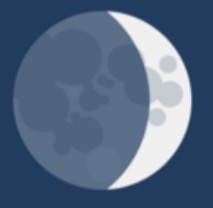
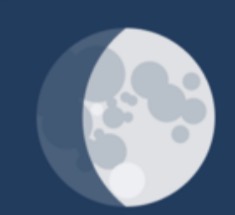
“WAXING” Moon
This is when the light is on the right, and the light is increasing
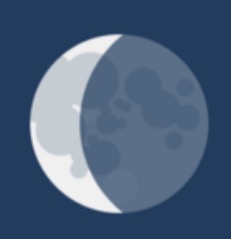
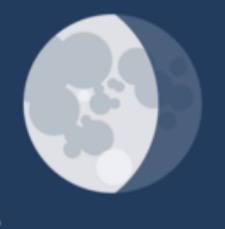
“WANING” Moon
This is when the light is on the left and it’s decreasing
“CRESCENT” Moon
Light looks like a banana
“GIBBOUS” Moon
Darkness looks like a banana
Waxing Crescent
Waning Crescent
Waning Gibbous
Waxing Gibbous
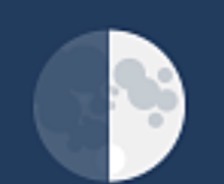
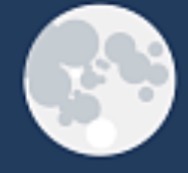
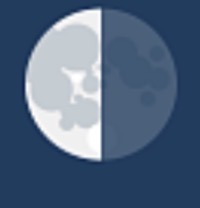
What are the four major phases?
New Moon, 1st quarter, Full Moon and 3rd/last quarter
New Moon

1st Quarter
Full Moon
3rd/ Last Quarter
List the Cycle of Phases in Order
New Moon, Waxing Crescent, First Quarter, Waxing Gibbous, Full Moon, Waning Gibbous, 3rd/Last Quarter, Waning Crescent
Eclipse
to block light
Umbra
a shadow of complete blockage of light, cones inward towards Earth
Penumbra
a shadow of partially blocked light, cones outward towards Earth
SOLAR ECLISPE
“Sun Blocked”
The Moon’s shadow is on the Earth’s surface.
New Moon Phase
Most rare because the Moon’s orbit is tilted at 5 degrees causing it to miss Earth most months. It needs to be perfectly aligned.
LUNAR ECLIPSE
“Moon Blocked”
The Moon’s falls into Earth’s shadow
Full Moon phase
It’s rare because the Moon’s orbit is tilted at 5 degrees respective to the Ecliptic. It needs to be aligned. More common than a solar eclipse because it’s easier for a smaller object to fall into a bigger object’s shadow.
 Note
Note  Flashcards (129)