Module 8: instrument design and classification
 Call Kai
 Learn
Learn Practice Test
 Spaced Repetition
 Match
Match Flashcards
 Knowt Play
1/92

There's no tags or description
Looks like no tags are added yet.
Name | Mastery | Learn | Test | Matching | Spaced | Call with Kai |
|---|
No analytics yet
Send a link to your students to track their progress
93 Terms
what design characteristics should be considered when selecting instruments for perio instrumentation?
handle, shank, and working end
what is the average pinch force exerted during instrumentation?
11-20% of the clinicians max pinch strength
how can you reduce the pinch force required during perio instrumentation?
by relaxing the fingers of the grasp between instrumentation strokes
T/F: ergonomically designed perio instruments can help reduce the prevalence of carpal tunnel syndrome amazing dental clinicians
true duh
what characteristic of perio instruments handles have significant effects on the hand muscle load and pinch form of clinicians?
the weight and diameter of perio instruments handles
what are the criteria for selecting instruments handles?
weight, diameter, taper. and texture
what is recommended for handle selection criteria?
large handle diameter (10mm)
lightweight hollow handle (>= 15g)
handle tapers near shank
raised texturing
what should be avoided in handle selection?
small handle diameter (6mm)
heavy, solid metal handle
non tapered handle
no texturing or nonraised texturing
What is optimal instrument weight?
lightweight instrument - 15g or less
why are lightweight instruments optimal?
place less stress on the muscles of the hand during perio unenthusiastic with heavier weight handles are associated with greater muscle activity
what handle diameter requires the least amount of pinch force?
instrument with a large diameter handle (10mm)
T/F: Traditional smaller handle diameters (7mm) are associated with less pinch force and do not tend to cause muscle cramping.
False: greater pinch force and they do tend to cause muscle cramping
what shape instrument handles reduces muscle force and compression?
a round instrument when compared to a hexagon shaped handle
what taper of instrument handles reduces muscle may decrease pinch force?
unmentioned handles that taper at the end of the handle where it is grasped may decrease pinch force by improving the coupling of the finger pads to the handle (reduce slipping of fingers) during instrumentation in wet oral cavity environment
how much reduction of average pinch force results from a tapered instrument handle compared to a non tapered one?
11% reduction
what type of instrument handles reduces muscle requires the least pinch force during use?
a lightweight instrument with a round and tapered shape and a large diameter (10mm)
what is another term for texturing?
knurling pattern
what does texturing do?
increases static friction between the fingers and handle resulting in reduced pinch force in the grasp
what do handles with no texturing do?
decrease control unenthusiastic in wet environment and increase muscle fatigue
what texture is easier to hold in the wet environment?
raised texture, thus maximizing control of the instrument and reducing muscle fatigue
when is an instrument said to be balanced?
when its working ends are aligned with an imaginary line that runs vertically through the center of the handle lengthwise (long axis of handle)
what does a balanced instrument do?
assures that pressure applied with the fingers against the handle is transferred to the working end resulting in pressure against the tooth
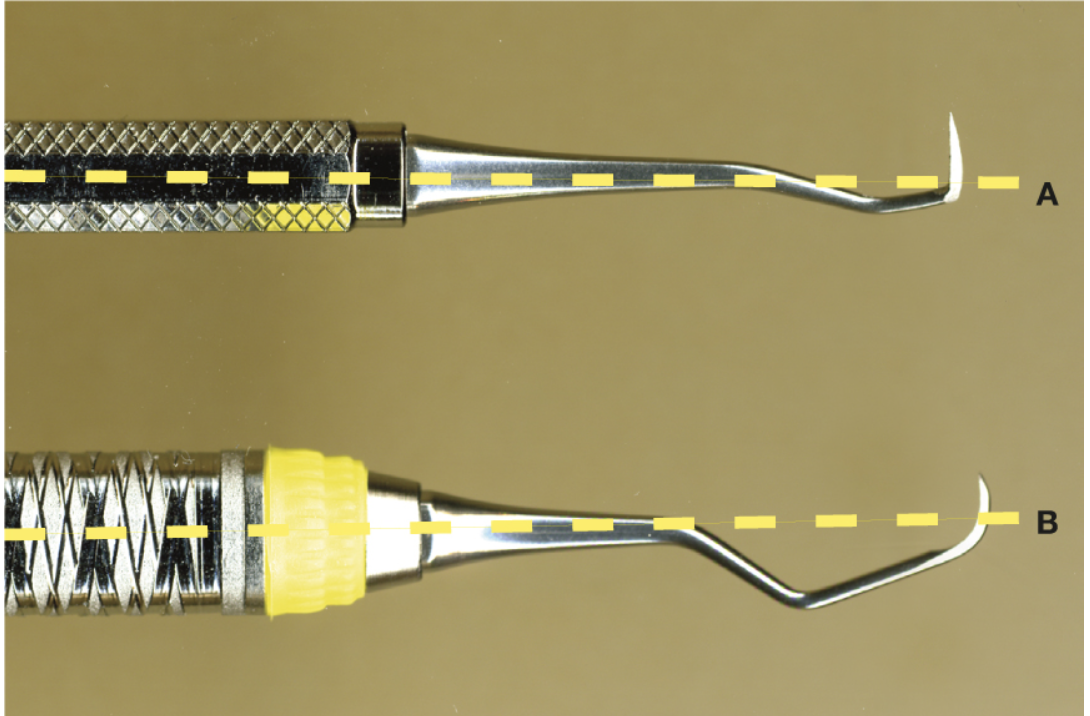
which instrument is balanced?
B - working end is centered on a line running through the long axis of the handle
what is an easy method for determining if an instrument is balanced?
align midline of handle with a line on the paper. the instrument is balanced if the working ends are centered on the line
T/F: the shanks of most perio instruments are bent in one or more places to facilitate placement of the working end against the tooth surface
true
what is a simple shank design?
a shank that is bent in one plane (front to back)
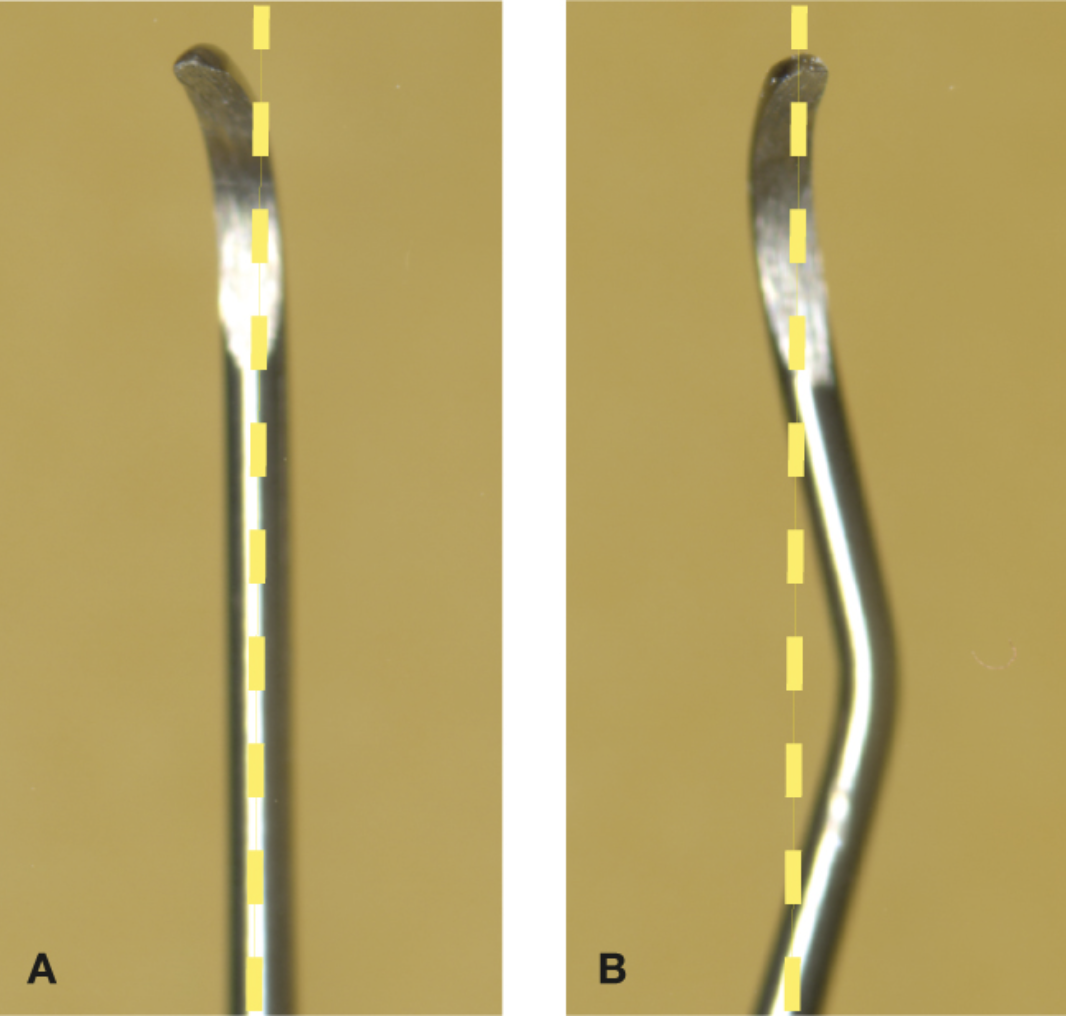
What type of shank design is A?
a simple shank design
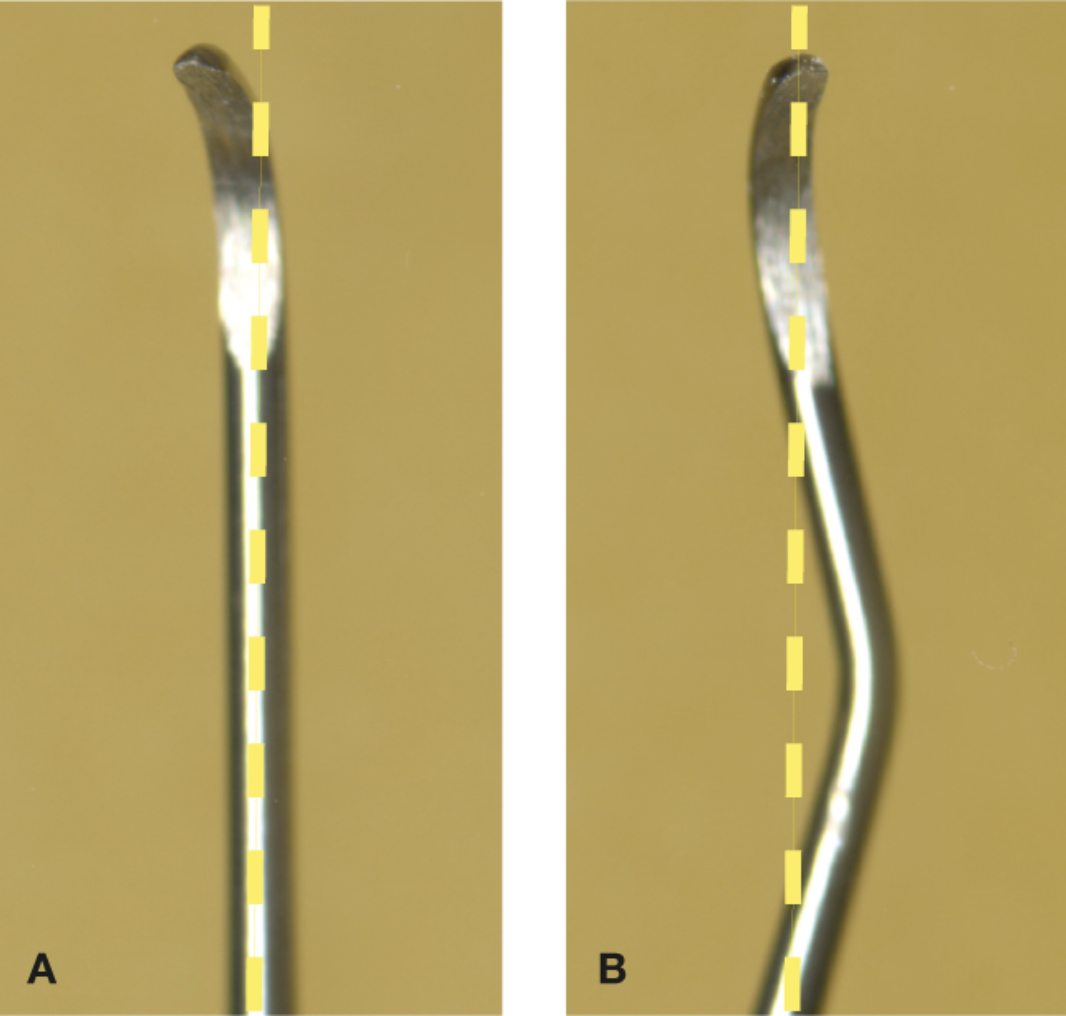
what type of shank design is B?
complex shank design
How should you hold the instrument in order to determine whether the shank is simple or complex?
hold the instrument so that the working end tip or toe is facing you
what shank design should be used on an anterior tooth?
a simple straight shank design is adequate to reach along the crown and onto the root surface
what is another term for a simple shank
straight shank
what is a complex shank design?
a shank that is bent in two planes (front to back and side to side) to facilitate instrumentation of posterior teeth
what is another term for a complex shank?
an angled or curved shank
T/F: a simple shank is needed to reach around a posterior crown and onto the root surface
false - a complex shank
what does the front to back shank bends enable?
enable the working end to reach around the crown and onto the lingual and facial surfaces of the root
what do side to side shank bends enable?
enable the working end to reach around the crown and onto proximal (mesial and distal) surfaces of the tooth
T/F: an important characteristic of an instrument shank is its strength
true
what determines the strength of the shank?
the type and diameter of metal used in the shank
What are shanks classified as?
either rigid or flexible
what is a rigid shank?
an instrument shank that will withstand the pressure needed to remove heavy calculus deposits; a large calculus deposit can be removed more quickly and with less effort if the instrument has a rigid shank
what is a flexible shank?
an instrument shank that will not withstand the pressure needed to remove heavy calculus deposits but works well to remove small and medium sized calculus deposits
what happens when a flexible shank is used against a heavy calculus deposit?
it will bend or flex as pressure is applied against the deposit
what type of shank enhances the amount of tactile information transmitted to the clinicians fingers?
flexible shanks - for this reason, a flexible shank design is desirable for instruments that are used to locate calculus deposits hidden beneath the gingival margin
What type of information is of limited use when using instruments beneath the gingival margin?
visual information since the clinician cannot see the working end hidden subgingivally
Instead of using visual information, what must a clinician rely on to locate calculus deposits hidden beneath the gingival margin?
sense of touch
what is tactile sensitivity?
the clinicians ability to feel vibrations transmitted from the instrument working end with his or her fingers as they rest on the shank and handle
When are vibrations created?
when the working end quivers slightly as it move over irregularities on the surface of the tooth
where are vibrations transmitted from?
transmitted from the working end, through the shank, and into the handle
what is the functional shank?
the portion of the shank that allows the working end to be adapted to the tooth surface
where does the functional shank begin?
below the working end and extends to the last bend in the shank nearest the handle
where are instruments with short functional shanks used?
on the crowns of the teeth; i.e. to remove supra gingival calculus deposits from a tooth crown
where are instruments with long functional shanks used?
on both the crowns and roots of the teeth; they may be used to detect calculus deposits beneath the gingival margin on the roots of the teeth
what is the section of the functional shank that is nearest to the working end?
lower shank aka terminal shank
why is the lower shank important?
the lower shank provides an important visual clue for the clinician in selecting the correct working end for the particular tooth surface to be instrumented
what is a general rule for working end selection?
lower shank should be parallel to the tooth surface of the crown or root surface to be instrumented
what is an extended lower shank?
a shank length that is 3 mm longer than that of a standard lower shank
instruments designed for use in deep perio pockets have extended lower shanks
use for a simple shank with short functional length
supragingival use on anterior teeth
use for simple shank with long functional length
subgingival use on anterior teeth
use for complex shank with short functional length
supragingival use on posterior teeth
use for complex shank with long functional length
sub gingival use on posterior teeth
T/F: perio probes are often double-ended instruments and curets are frequently found on single ended instruments.
false - opposite, perio probes are often single ended and curets are often double ended
what types of double ended instruments are there?
unpaired working ends (dissimilar) and paired working ends (exact mirror images)
what is an example of an instrument with paired working ends
Gracey girl 11/12 curet
what is an example of an instrument with unpaired working ends?
an explorer and a probe combination
how is each individual perio instrument identified?
a unique design name and number(s)
what is the design name?
identifies the school or individual originally responsible for the design or development of an instrument or group of instruments
what is the design number?
a number designation that when combined with the design name provides an exact identification of the working end
how many design numbers will a double ended instrument have?
2
when marked along the long axis of the handle, which number identifies which end?
working end identified by number closest to it
when marked around the handle, which number identifies which end?
the first number (left) identifies the working end at the top and the second number (right) identifies working end at the lower end of the handle
what primarily determines an instruments function?
the design of its working end
what is necessary to identify to be able to determine and instruments use?
must be able to identify the face, back, lateral surfaces, cutting edges, and toe or tip of the working end
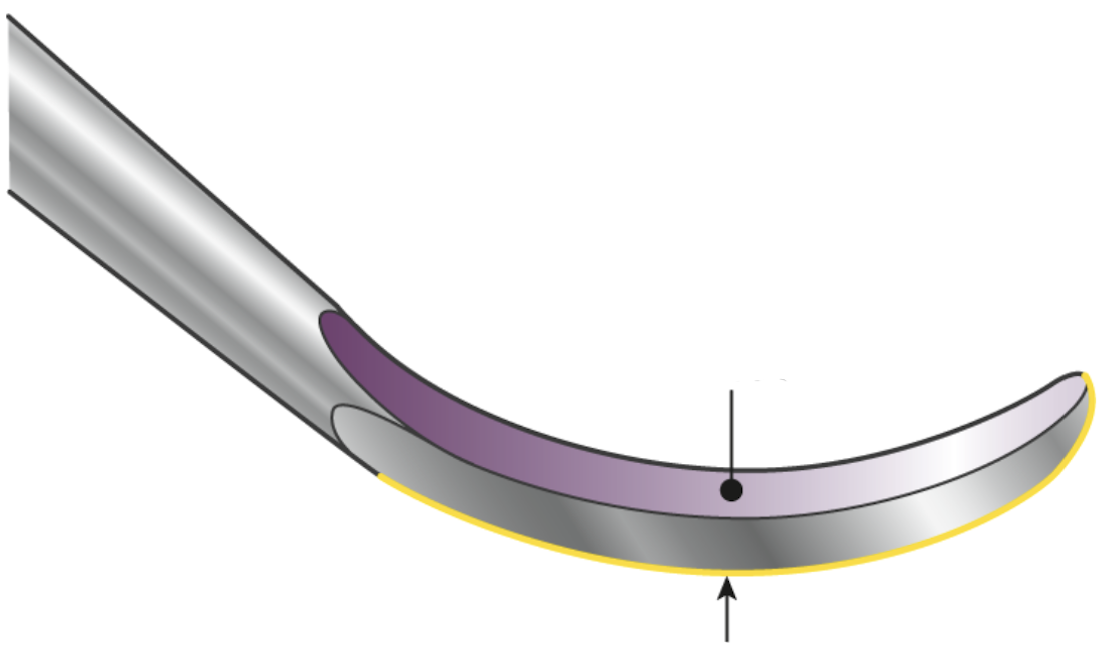
what surface is shaded in purple and what is outlined in yellow?
purple: face
yellow: back
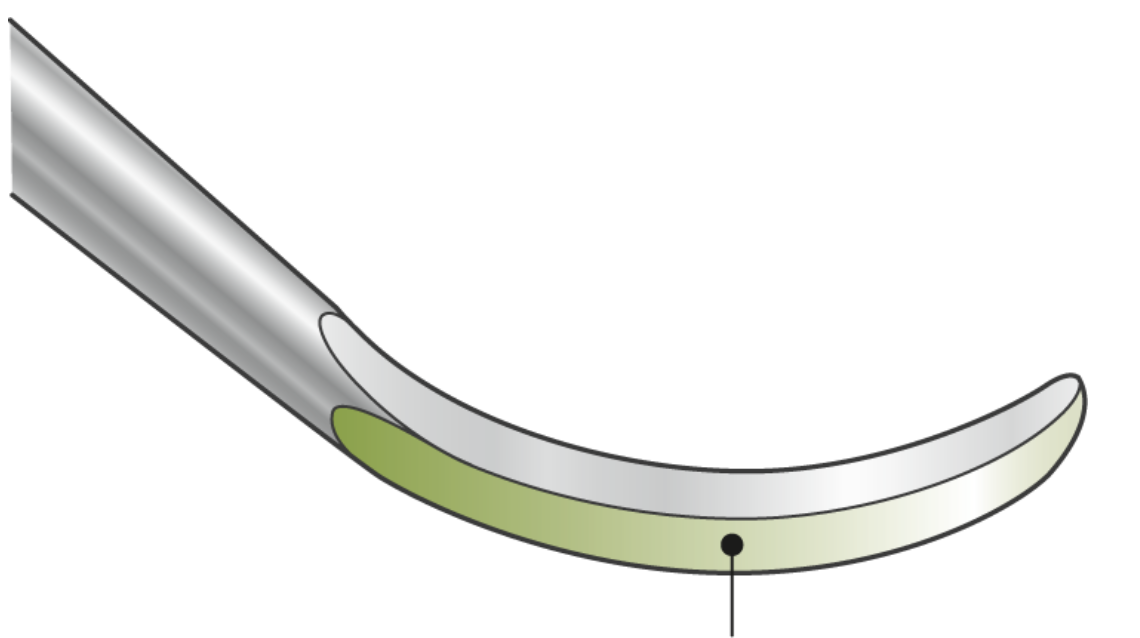
what surface is shaded in green?
lateral surface
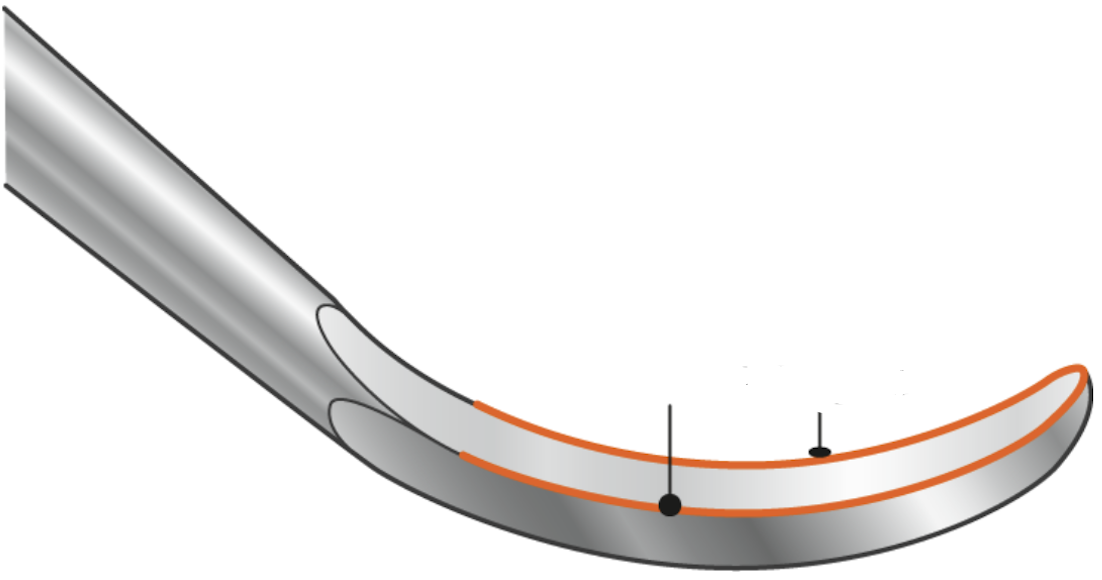
what is outlined in orange?
cutting edges
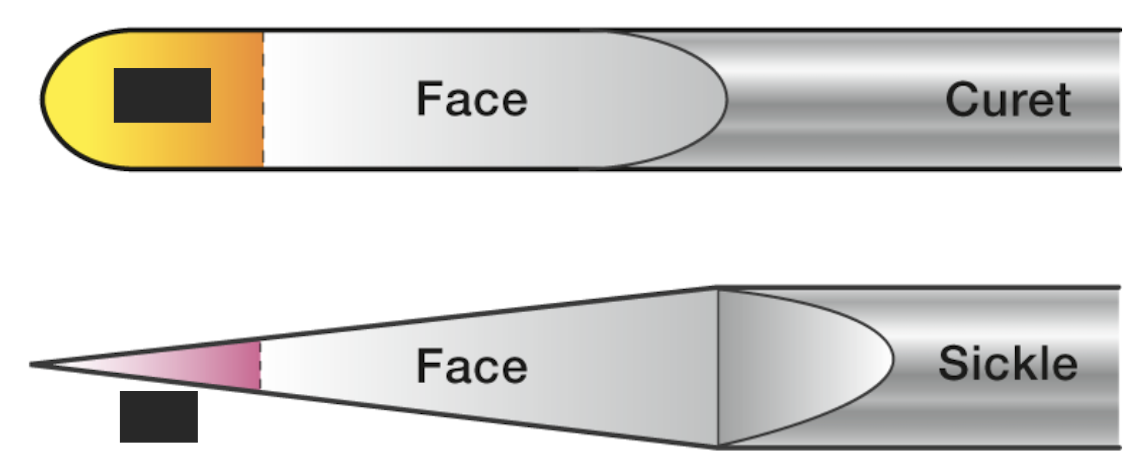
which instrument has a tip and which has a toe?
yellow: toe
purple: tip
what is a toe?
when the cutting edges of a curet meet to form a rounded surface called the toe
what is a tip?
cutting edges of a scaler meet in a point called the tip
What does the cross section of a working end determine?
whether it can be used subgingivally beneath the gingival margin or is restricted to supragingival use
what is the cross section of a curet?
semi-circular cross section
what does the working end of a curet look like?
has a rounded back and toe
what is the cross section of a sickle scaler?
triangular cross section
what does the working end of a sickle scaler look like?
pointed back and pointed tip
what are classifications of perio instruments based on?
the specific design characteristics of working ends
what are the two major classifications of perio instruments?
assessment instruments and calculus removal instruments
what are nonsurgical, hand activated perio instruments classified as?
perio probes, explorers, sickle scalers, perio files, curets, hoes, or chisels
what is the perio probe?
a slender assessment instrument used to evaluate the health of the perio tissues. probes have blunt, rod-shaped working ends that are circular or rectangular in cross section
what is an explorer?
an assessment instrument used to locate calculus deposits, tooth surface irregularities, and defective margins on restorations. explorers have flexible shanks and are circular in cross section
what is a sickle scaler?
a perio instrument used to remove calculus deposits from the crowns of the teeth. the working end of a sickle scaler has a pointed back, pointed tip, and is triangular in cross section
what is a curet?
a perio instrument used to remove calculus deposits from the crowns and roots of teeth. the working end has a rounded back, rounded toe, and is semicircular in cross section
what are the two curet subtypes?
universal curet and area specific curet
what is a periodontal file?
instrument used to crush large calculus deposits. each working end of a perio file have several cutting edges
what are hoes and chisels?
perio hand instruments that are rarely used in modern perio instrumentation

