Ch. 10 Sequences and Series - Precalculus (copy)
 Call Kai
 Learn
Learn Practice Test
 Spaced Repetition
 Match
Match Flashcards
 Knowt Play
1/22

Earn XP
Description and Tags
Name | Mastery | Learn | Test | Matching | Spaced | Call with Kai | Chat |
|---|
No analytics yet
Send a link to your students to track their progress
23 Terms
Convergent sequence
Has a limit such that the terms approach a unique number
Divergent sequence
The terms don’t approach a finite number
Series
Indicated sum of all the terms of a sequence
Finite & infinite
nth Partial Sum (Sₙ)
The sum of the first n terms of a series
Recursive formula for arithmetic sequence
aₙ = aₙ₋₁ + d
Explicit formula for arithmetic sequence
aₙ = a₁ + (n-1)d
Arithmetic sequence with 2nd differences
Quadratic
aₙ = an² + bn + c
nth Partial Sum of an Arithmetic Series
Sₙ = (ⁿ/₂)(a₁ + aₙ)
Sₙ = (ⁿ/₂)[2a₁ + (n-1)d]
![<ul><li><p>Sₙ = (ⁿ/₂)(a₁ + aₙ)</p></li><li><p>Sₙ = (ⁿ/₂)[2a₁ + (n-1)d]</p></li></ul>](https://knowt-user-attachments.s3.amazonaws.com/bd633138ebb2499ab9937a5bceb95eb2.jpeg)
Recursive formula for geometric sequence
aₙ = aₙ₋₁・r
Explicit formula for geometric sequence
aₙ = a₁・rⁿ⁻¹
nth Partial Sum of a Geometric Series
Sₙ = a₁[(1-rⁿ)/(1-r)]
Sₙ = (a₁-aₙr)/(1-r)
![<ul><li><p>Sₙ = a₁[(1-rⁿ)/(1-r)]</p></li><li><p>Sₙ = (a₁-aₙr)/(1-r)</p></li></ul>](https://knowt-user-attachments.s3.amazonaws.com/7505246f9a3a4af187cb0a31b5f3be7c.jpeg)
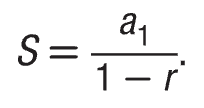
Sum of an Infinite Geometric Series
S = a₁/(1-r)
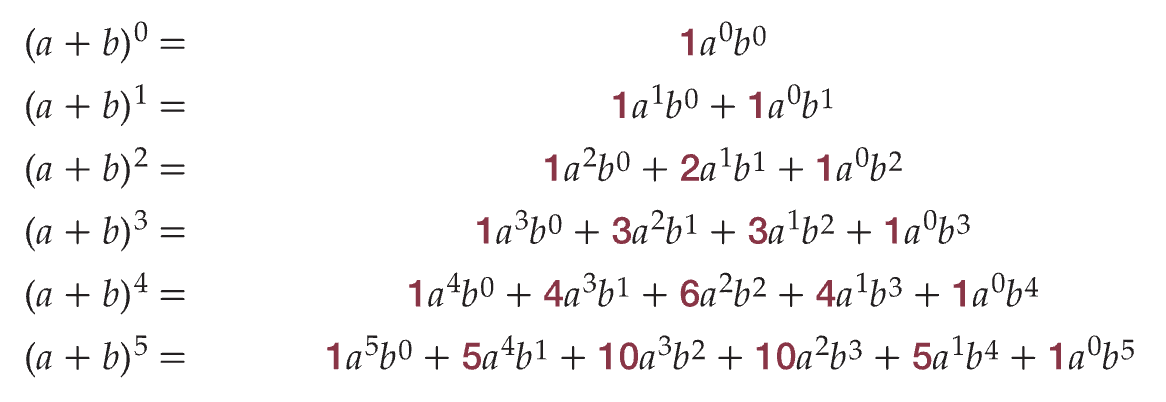
Pascal’s Triangle
A triangular arrangement of numbers that gives the coefficients in the expansion of any binomial expression, such as (x + y)ⁿ
Recursive: coefficients in the (n-1)th row can be added together to find coefficients in the nth row
Formula for Binomial Coefficients of (a + b)ⁿ
ₙCᵣ = n!/[(n-r)!r!]
For the aⁿ⁻ᣴbᣴ term
![<p>ₙCᵣ = n!/[(n-r)!r!]</p><ul><li><p>For the aⁿ⁻ᣴbᣴ term</p></li></ul>](https://knowt-user-attachments.s3.amazonaws.com/9afde3a9c3e2415193424ebcb75b7726.jpeg)
Formula for Binomial Experiments of (p + q)ⁿ
ₙCₓ・pˣ qⁿ⁻ˣ
x = successes
n = # of trials
Binomial Theorem
(a + b)ⁿ = ₙC₀ aⁿb⁰ + ₙC₁ aⁿ⁻¹b¹ + ₙC₂ aⁿ⁻²b² + … + ₙCᵣaⁿ⁻ᣴbᣴ + ₙCₙ a⁰bⁿ
r = 0, 1, 2, … , n

Power Series
Infinite
x & aₙ take on any values for n = 0, 1, 2, …

Exponential Series
Infinite
Represents eˣ

Power Series for cos x

Power Series for sin x

Euler’s Formula
eⁱᶿ = cos θ + i sin θ
Exponential Form of a Complex Number
a + bi = r × eⁱᶿ
r = √(a² + b²)
θ = tan⁻¹(b/a); a > 0
θ = tan⁻¹(b/a) + π; a < 0
Natural Logarithm of a Negative Number
iπ = ln (-1)
ln (-k) = ln [(k)(-1)]
ln (k) + ln (-1)
ln k + iπ