HR Exam 2 Matt Luke
 Call Kai
 Learn
Learn Practice Test
 Spaced Repetition
 Match
Match Flashcards
 Knowt Play
1/103

There's no tags or description
Looks like no tags are added yet.
Name | Mastery | Learn | Test | Matching | Spaced | Call with Kai | Chat |
|---|
No analytics yet
Send a link to your students to track their progress
104 Terms
Workforce Planning- What is it’s purpose? Identify and describe the 4 main purposes.
Overall: To meet workforce objectives and gain an advantage over competitors.
Specifically:
Identifies workforce requirements needed for strategic plan- (What are the KSAOs and core competencies needed?)
Discovers where/if competency gaps exist (determine if we have the staff we need with correct KSAOs)
Plans for internal and external factors
Implements workforce shortage and reduction strategies (Downsizing? Natural attrition? Hiring?)
Boeing HR Case. What were some of their issues, and how can HR fix this?
Boeing is in need of engineering talent. This need has been exacerbated by these issues:
Competition for Talent
Shortage of STEM workers in U.S
US immigration policy- limited number of work visas for specialized foreign workers
Aging Workforce
Damaged Brand
Environmental concerns
Unhealthy culture
How do we drive speed and agility:
Culture of transparency and openess
Remove layers,
conversations,
new talent, Education,
pay for degrees
Internal Considerations of Workforce Planning
Turnover
Employee development
Current workforce profile
Current engagement levels
Employee performance
Operations, process efficiencies
Technology improvements
External Considerations of Workforce Planning
Economy
Competitors
Threat of Substitution
Legislation
Labor Market
Globalization
Technology
Suppliers
Customer Demands
Geography
Societal changes
Leading Indicators
Objective measures that accurately predict future labor demand
Workforce Utilization Review
Objective measures that accurately predict future labor demand. Is associated with Affirmative Action
Forecasting
The attempts to determine the supply of and demand for various types of human resources to predict areas within the organization where there will be labor shortages or surpluses.
Trend Analysis
Constructing and applying statistical models that predict labor demand for the next year, given relatively objective statistics from the previous year.
A transitional matrix is an example of trend analysis
Ratio Analysis
Supplements trend analysis by adding new operational information into expected staffing level requirements
Example:
10M sales = 30 FTE is past ratio
Sales forecast is 30M sales = 90 FTE
Regression Analysis
Supplements ration analysis by adding multiple dimensions of information into expected staffing level requirement
Transitional Matrix- understand the logic, how to analyze patterns to determine future decisions
Used to predict availability on the basis of historical patterns of job stability and movement among employees
Type of trend analysis
Answers the questions:
Where are people now?
Where are people going?
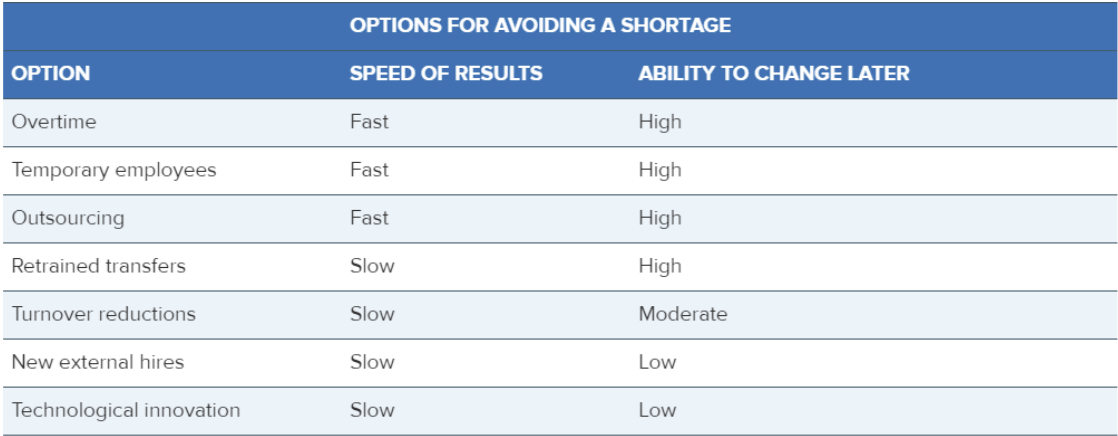
What ways could we use to avoid a labor shortage? What is the ability to changes these methods later?
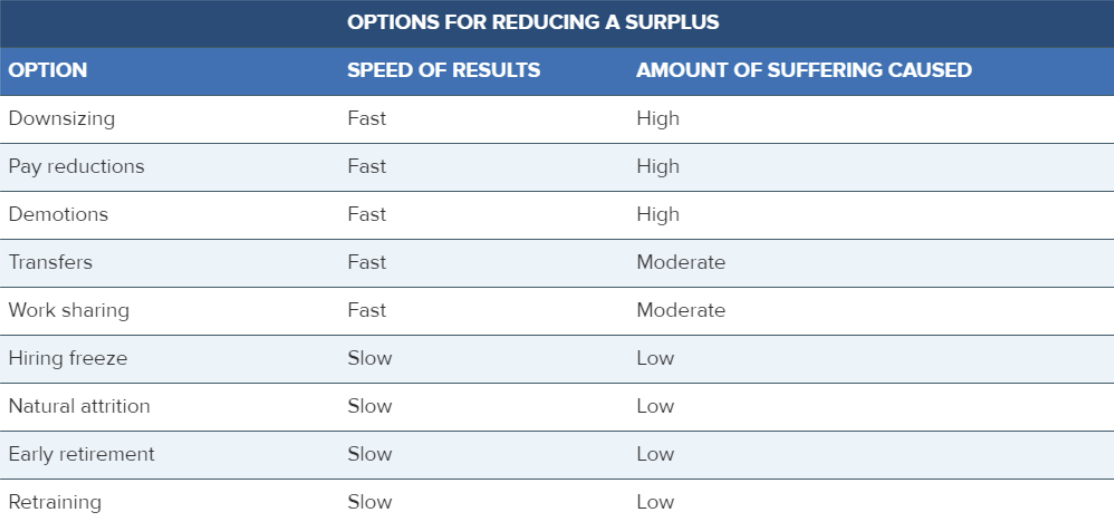
What ways could we use to reduce a labor surplus? What is the amount of suffering caused for each (low-high)?
Due Process Policies
Policies that formally lay out the steps an employee may take to appeal the employer’s decision to terminate that employee.
Direct Applicants
People who apply for a vacancy without prompting from the organization.
Referrals
People who apply for a vacancy because someone in the organization prompted them to do so.
Nepotism
The practice of hiring relatives
Yield Ratio
A ratio that expresses the percentage of applicants who successfully move from one stage of the recruitment and selection process to the next.
Cost per hire
The total amount of money spent to fill a vacancy. The number is computed by finding the cost of using a particular recruitment source and dividing that cost by the number of people hired to fill that type of vacancy.
What are the consequences of downsizing?
Can hurt long term organizational effectiveness, especially companies that emphasize research and development and where employees have extensive contact with customers.
Negative effects drastic in high-involvement work environments that use teams and performance pay incentives, reduces productivity of these employees.
Loss of talent, disrupts social networks that make people creative and flexible
Leads to employee confusion, demoralization, and less motivation to stay with the company.
Can hurt company’s image in the labor market
Scares employees, less risk taking = less innovation
Recruitment- Why is it important?
Recruitment is a form of business contest and it is highly competitive.
Just as corporations strategize to develop, manufacture, and market the best product or service, so they must also vie to identify, attract, and hire the most qualified people.
Person/Job fit
Has the right KSAOs
Is interested in the work and rewards
Employee perspective
Naturally interested in doing well on the job • People in jobs where they perform well will be more engaged • Good performers have more pay and advancement
Employer perspective
•Need to fulfill basic job functions • Appropriate KSAOs are strongly linked to performance • Engaged and satisfied employees will stay around longer
Person/Organization Fit
Understands and supports the core values of the organization as a whole
Employee perspective
Prefer to work with others who share their values • Working for a company where your values are represented fulfills sense of purpose • Fit with the organization means long-term development and advancement
Employer perspective
Capacity to develop makes filling future needs easier • People who fit organization values maintain the culture • Those who are genuinely engaged in the mission work harder and longer to achieve success
Internal Candidates
Employees who already hold another position with an organization.
How are they Recruited?- Job Postings, Company bulletin boards, employee publications, corporate intranets, managers identify candidates.
Advantages- Applicants are well known to the organization. Applicants usually have realistic expectations of the job. Generally cheaper and faster.
Disadvantage- Lack of diverse hiring to promote innovation and bring new ideas to the company.
External Candidates
Bringing in outside applicants into the recruitment process
How are they Recruited?- Referrals, websites, ads, employment agencies, colleges.
Advantages- More plausible for specialized upper level jobs. Can bring in more ideas and diverse perspectives into a company. Can give a competitive edge when the economy is slow by having the best talent.
Disadvantages- More expensive, not as fast as internal hiring.
What are important recruiter qualities?
Warm and approachable
Knowledgeable
Shouldn’t oversell or be too negative
Avoid offensive behavior (e.g. yawning, being late, saying inappropriate things)
Credible (e.g. teams with various functions represented)
Provide timely feedback
Realistic Job Interviews
Provide a look at a job's both positive and negative qualities.
Consequences of a bad hire
Lost Productivity, Lower Morale, Expense of Recruiting & training replacement, Worsened Client relations, lower sales
Selection Process
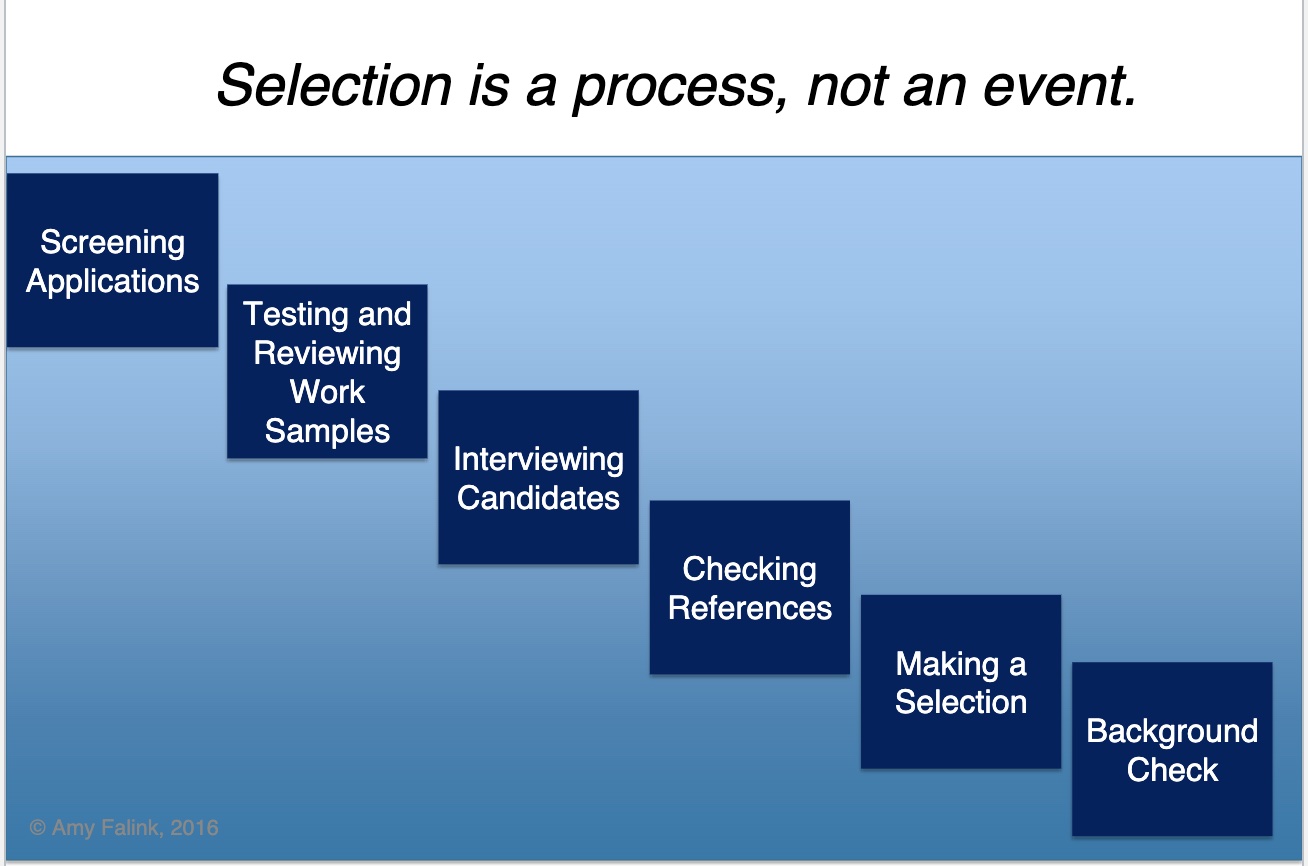
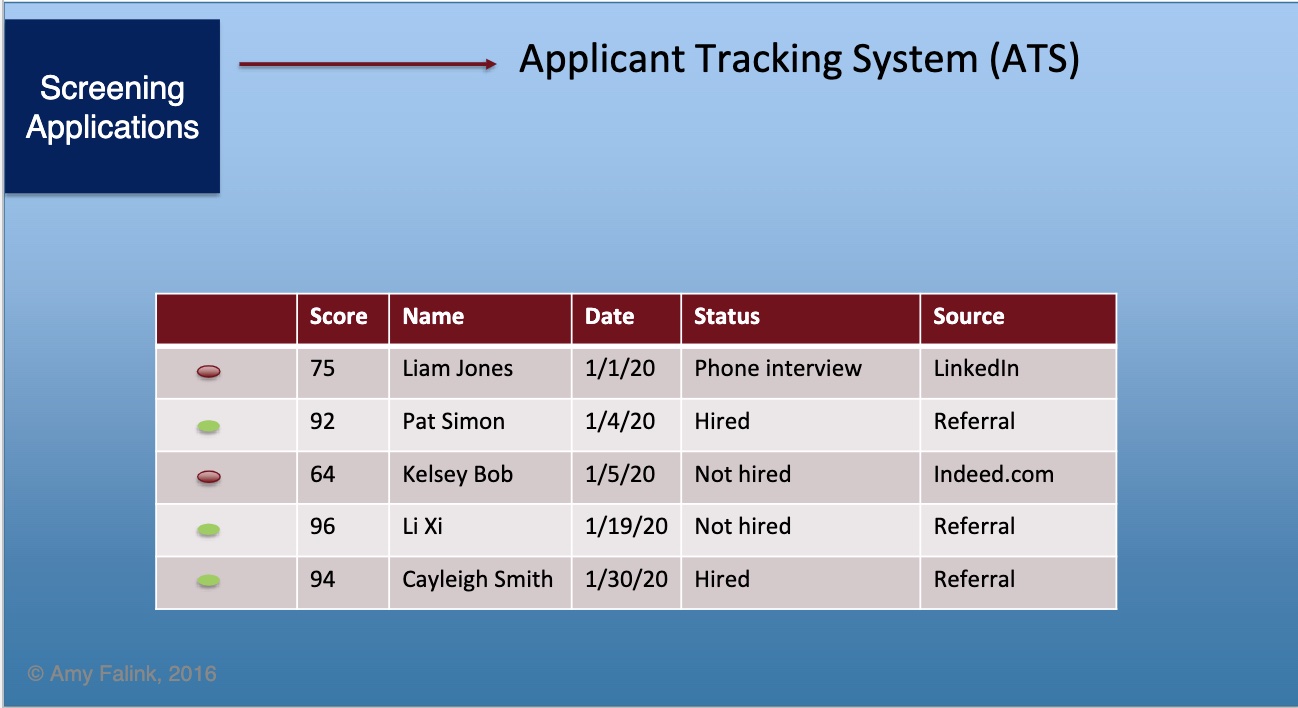
Screening Applications
The initial step in the selection process where resumes and applications are reviewed to identify candidates who meet the minimum qualifications for the job.
Testing and Reviewing Work Samples
Personality inventory cognitive ability test simulations assessment center
Interviewing Candidates
Phone screen in person team/panel virtual
Checking References
Personal professional
Making a Selection and Offer
Final candidate decision offer stage
Acceptance & Background Check
Background Check
Multiple Hurdle Model
A selection process that requires candidates to pass through several stages or tests before being considered for employment.
Compensatory model
A selection process that allows candidates to compensate for lower scores in one area with higher scores in another, ensuring a holistic evaluation.
Validity and reliability
are essential concepts in the selection process, ensuring that the methods used for hiring are consistent and accurately predict job performance.
Think of reliability as throwing darts at the same spot on a dart board. Consistency.
Think of validity as throwing darts at the bullseye repeatedly. For something to be valid, it also has to be reliable. Correlation.
Logic of reliable and valid methods in HR
1. The method provides statistically reliable information.
a. Are there consistent results? (IQ Test)
b. Is there a correlation? (vision test 1.0)
c. A test can be reliable, but not valid.
2. The method provides valid information.
a. Are you measuring something that matters? Is a degree in
biology needed to sell air purification filters?
b. Validity= the extent to which performance on the measure
(such as a test score) is related to what the measure is
designed to assess (such as job performance).
c. A test cannot be valid if it is not reliable.
The federal government's Uniform Guidelines on
Employee Selection Procedures accept three ways
of measuring validity:
1. Criterion
2. Content
3. Construct
Criterion-Related Validity
a measure of validity based on showing a substantial correlation between test scores and job performance scores.
Concurrent validation
This type of research administers a test to people who currently hold a job, then compares their scores to existing measures of job performance. If the people who score highest on the test also do better on the job, the test is assumed to be valid.
Predictive validation
This research uses the test scores of all applicants and looks for a relationship between the scores and future performance. The researcher administers the tests, waits a set period of time, and then measures the performance of the applicants who were hired
High predictors of job success
– Work Sample Test
– General Cognitive Ability (IQ test)
– Interviews: very structured
Low predictors of job success
– Age
– Interests
– GPA (after the first few years)
Content Validity
Consistency between the test items or problems and the kinds of situations or problems that occur on the job. A test that is “content valid” exposes the job applicant to situations that are likely to occur on the job
Construct Validity
Measuring intelligence, leadership ability, or other such “constructs,” as well as showing that mastery of this construct is associated with successful performance of the job
Generalization
Valid in other contexts beyond the context in which the selection method was developed. The test is valid in other organizations, jobs, applications etc.
Utility
The extent to which something provides economic value greater than its cost. Cost benefit analysis required.
Screening Tools
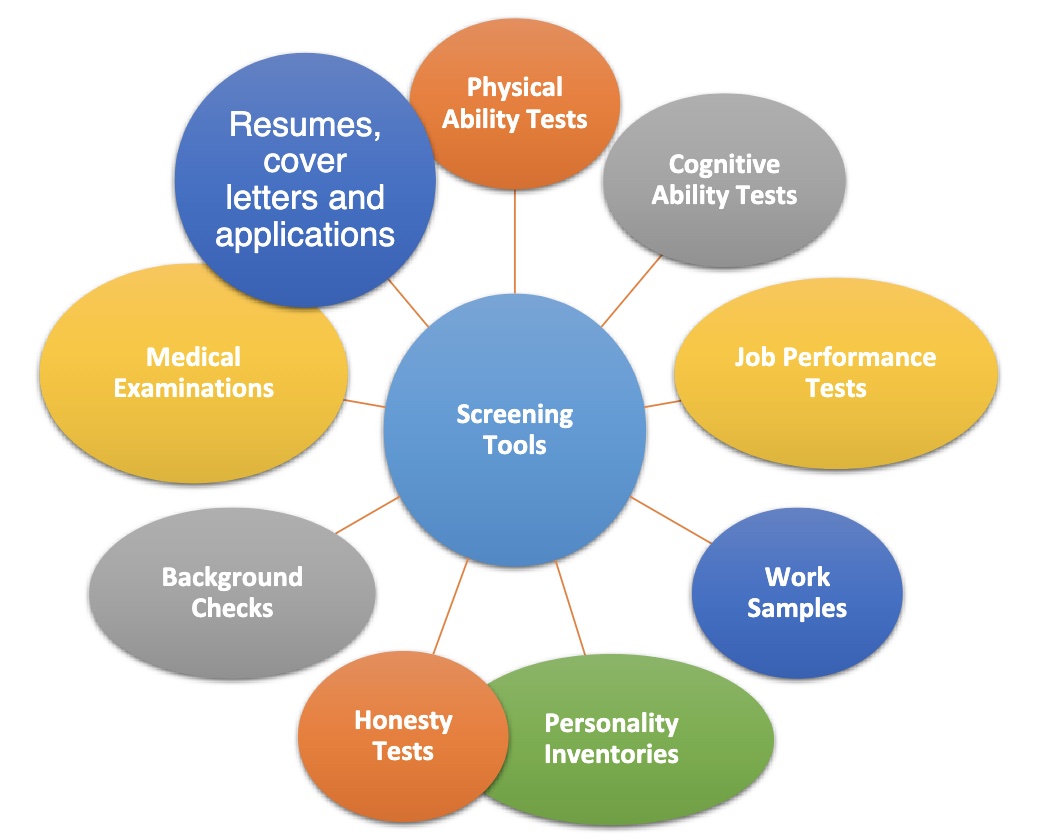
Three Steps in Creating Screening Tools
1. Make list of KSAOs required for job
2. For each KSAO, decide if it needs to be assessed in the selection process (how critical is it?)
3. Determine method of assessment to be used for each critical KSAO
Negligent hiring
Failure to obtain information that could have easily been accessed during the hiring process. Ex: taxi cab hiring a driver with history of DUIs
Background check options
Substance abuse
Employment history
References
Credit
Education
Driving record
Criminal history
Ban the Box
A policy that prohibits employers from asking about a candidate's criminal history on job applications aims to reduce discrimination against individuals with criminal records in the hiring process. Ended up hurting minorities that didn’t have a conviction as hirers tended to have bias when making hiring descisions
Same Qualifications, Different Rates of Response
Whites, Males, and Straights tend to have better callbacks and results than other races and genders.
Structured Interviews
Questions are related to the job and organization
• Prepared ahead of time
• Easily compare candidates
• More efficient and effective interview
• Each candidate is asked the same question, in same order
– Enables reliability
– Fairness
– Avoids bias
– Avoids discrimination
Behavioral Questions
Focuses on past behavior, tell me about a
Situational Questions
Hypothetical, what would you do if
Job-specific Questions
technical
General Questions
What are your long-term goals
Avoid Questions Related to:
Age
Marriage
Children
Religion
Any protected class
Is tell me about yourself a good question?
"Tell me about yourself" can be a good question in an interview, but it carries the risk that a candidate might voluntarily share personal details about their age, marital status, children, religion, or other protected characteristics.
Candidate Interview Evaluation
Interviews are qualitative, but we can quantify the results
Good documentation, complete an evaluation after each interview
Use weights and ratings for each dimension and an overall judgment of suitability
Don’t discuss candidates between interviews
Training
Planned efforts to help employees acquire job-related knowledge, skills, abilities, and behaviors.
Examples of training in the workplace
Formal classes
• Customer service classes • Conflict management seminars • Leadership and management workshops • Software classes • Sexual harassment prevention training • Safety training sessions • Workplace ethics, policies and procedures
Communities of Practice
• Professional development seminars (Lunch & Learns)
Mentoring • Formal and informal
ROI of Training
Linked to organizational needs
1. Better task behavior leading to successful operational outcomes
2. Reduced expenses, fewer mistakes, safer workers
3. Better employee retention, more motivation and commitment
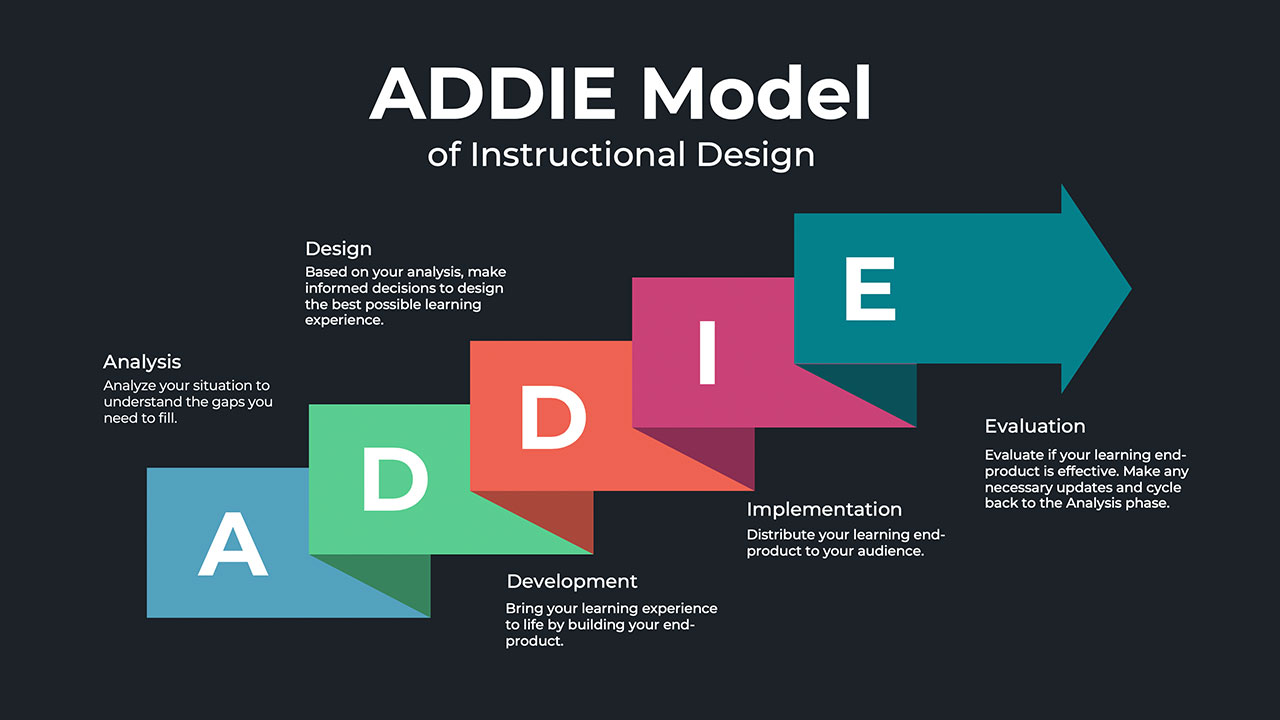
ADDIE model of instructional design
Analysis, Design, Development, Implementation, Evaluation
Needs Assessment
The process of evaluating the organization, individual employees, and employees’ tasks to determine what kinds of training, if any, are necessary.
The process of identifying what employees need to learn, To do their jobs successfully, To grow in their careers, For the organization to achieve its goals.
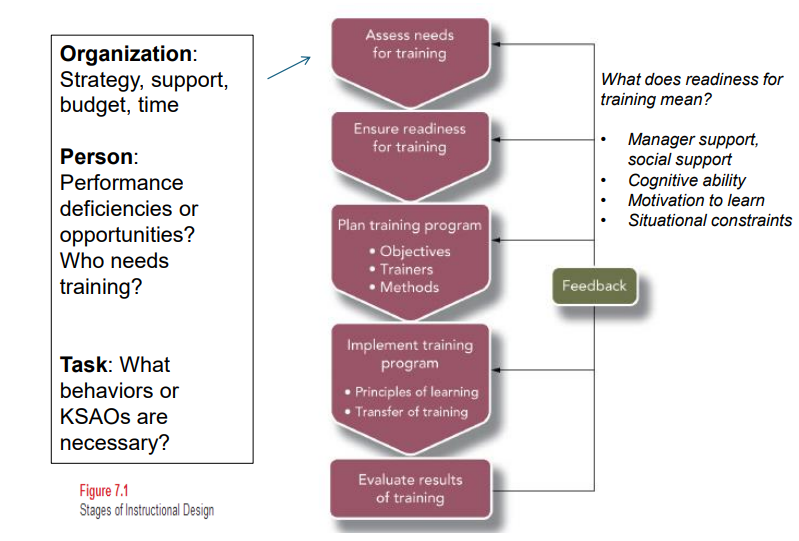
Linking Training to Organizational Needs: Instructional Design Process
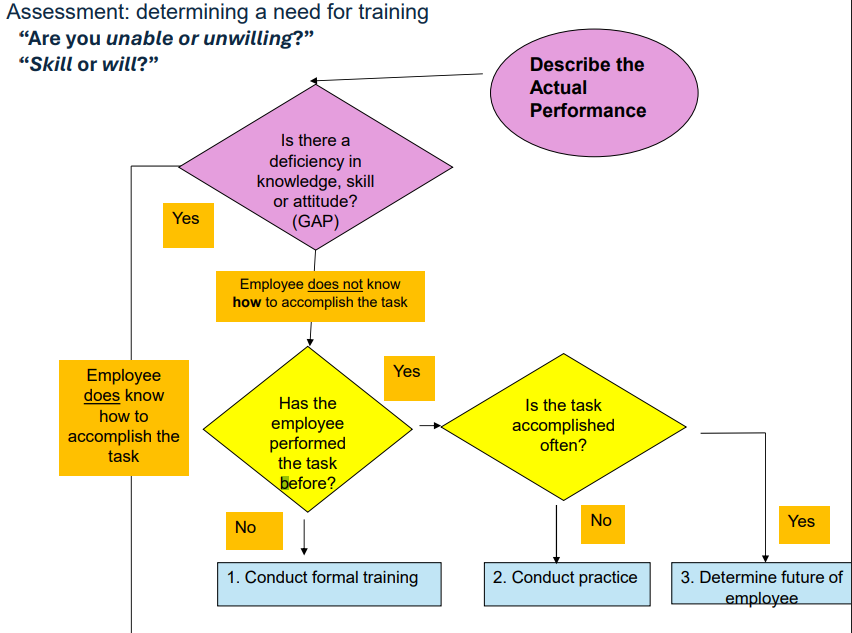
Assessment (aka gap analysis): determining a need for training / explain a performance deficiency
What does the assessment answer?
“Are you unable or unwilling?” “Skill or will?”
Diversity Training
Training designed to improve the competency of individuals in managing diverse work environments and to mitigate biases.
Diversity training is often ineffective. How to make if effective?
Social Accountability- Diversity task forces and diversity managers drive accountability. When people know they might have to explain their decisions, they are less likely to act on bias.
Contact- Working side-by-side breaks down stereotypes
Engagement- When managers actively help boost diversity in their companies, they begin to think of themselves as diversity champions. Mentoring is another way to engage managers.
Metrics- Collecting and analyzing data on diversity over time, comparing those numbers to the numbers at other organizations, and sharing them with key stakeholders/companies
Training needs assessment
The process of identifying what employees need to learn to perform their jobs effectively.
Learning Transfer
Learning transfer occurs when people apply concepts/skills learned in training to actual work situations • Transfer is the ultimate measure of training success • Without transfer, training investments fail to deliver value
Instructional Design Process
The systematic planning of training that aligns with organizational strategy and addresses performance deficiencies.
Gap Analysis
Assessing the difference between ideal performance and actual performance to identify training needs.
Goal of people management
To drive the right behaviors to achieve strategy and organizational goals
Instructional Design
A process of systematically developing training to meet specified needs.
Learning Management System (LMS)
An online application that automates the administration, development, and delivery of training programs.
Organization Analysis
A process for determining the appropriateness of training by evaluating the characteristics of the organization.
Person Analysis
A process for determining individuals’ needs and readiness for training.
Task Analysis
The process of identifying the tasks, knowledge, skills, and behaviors that training should emphasize.
Employee Readiness for Training
A combination of employee characteristics and positive work environment that permit training.
E-Learning
Receiving training via the Internet or the organization’s intranet.
Electronic performance support system (EPSS)
Computer application that provides access to skills training, information, and expert advice as needed.
On the Job Training (OJT)
Training methods in which a person with job experience and skill guides trainees in practicing job skills at the workplace.
Apprenticeship
A work-study training method that teaches job skills through a combination of on-the-job training and classroom training.
Internship
On-the-job learning sponsored by an educational institution as a component of an academic program.
Simulation
A training method that represents a real-life situation, with trainees making decisions resulting in outcomes that mirror what would happen on the job.
Classroom training
a trainer lecturing a group
Experiential Programs
training programs in which participants learn concepts and apply them by simulating behaviors involved and analyzing the activity, connecting it with real-life situations
Adventure Training
a teamwork and leadership training program based on the use of challenging, structured outdoor activities
Cross Training
team training in which team members understand and practice each other's skills so that they are prepared to step in and take another member's place
Team Leader Training
Training in the skills necessary for effectively leading the organization’s teams.
Coordination Training
team training that teaches the team how to share information and make decisions to obtain the best team performance
Action Learning
training in which teams get an actual problem, work on solving it and commit to an action plan, and are accountable for carrying it out
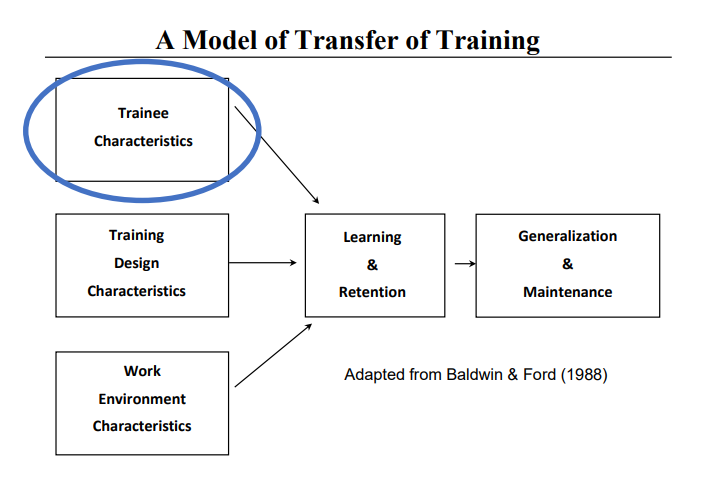
Transfer of Training
On-the-job use of knowledge, skills, and behaviors learned in training.
Communities of Practice
Groups of employees who work together, learn from each other, and develop a common understanding of how to get work accomplished.
Orientation
Training designed to prepare employees to perform their jobs effectively, learn about their organization, and establish work relationships.
Onboarding
Ongoing process that aims to prepare new employees for full participation in the organization.