FSA Terms
 Studied by 0 people
 Call with Kai
 Learn
Learn Practice Test
 Spaced Repetition
 Match
Match Flashcards
 Knowt Play
1/76

There's no tags or description
Looks like no tags are added yet.
Name | Mastery | Learn | Test | Matching | Spaced | Call with Kai |
|---|
No study sessions yet.
77 Terms
Financial Statement Analysis Framework
Step 1: State the objective and context.
Step 2: Gather data.
Step 3: Process the data.
Step 4: Analyze and interpret the data.
Step 5: Report the conclusions or recommendations.
Step 6: Update the analysis.
Standard-setting bodies
professional organizations of accountants and auditors
that establish financial reporting standards
Regulatory authorities
government agencies that have the legal authority to enforce compliance with financial reporting standards. such as the Securities and Exchange Commission (SEC) in the United States and the Financial Conduct Authority in the United Kingdom, are established by national governments
The two primary standard-setting bodies
Financial Accounting Standards Board (FASB) and the International Accounting Standards Board (IASB). In the United States, the FASB sets forth the U.S. Generally Accepted Accounting Principles (U.S. GAAP). Outside the United States, the IASB establishes the International Financial Reporting Standards (IFRS)
Most national authorities belong to
International Organization of Securities Commissions (IOSCO). IOSCO is not a regulatory body, but its members work
together to improve cross-border cooperation and make national regulations and
enforcement more uniform around the world. The IOSCO Objectives and Principles of
Securities Regulation are based on three main objectives:
1. Protecting investors
2. Ensuring markets are fair, efficient, and transparent
3. Reducing systemic risk
Proxy statements
issued to shareholders when there are matters that require a
shareholder vote. These statements, which are also filed with the SEC, are a good source
of information about the election of (and qualifications of) board members,
compensation, management qualifications, and the issuance of stock options
Financial statement notes
include disclosures that provide further details
about the information summarized in the financial statements.
business segment (operating segment) is
a portion of a larger company that
accounts for more than 10% of the company’s revenues, assets, or income. An operating
segment should be distinguishable from the company’s other lines of business in terms
of the risk and return characteristics of the segment.
Geographic segments
identified when they meet the size criterion given
previously and the geographic unit has a business environment that is different from
that of other segments or the remainder of the company’s business
management discussion and analysis [MD&A])
For publicly held firms in the United States, the SEC requires management commentary
to discuss trends and identify significant events and uncertainties that affect the firm’s
liquidity, capital resources, and results of operations. Management must also discuss
the following:
Effects of inflation and changing prices, if material
Impact of off-balance-sheet obligations and contractual obligations, such as purchase
commitments
Accounting policies that require significant judgment by management
Forward-looking expenditures and divestitures
What is an audit
an independent review of an entity’s financial statements. Public
accountants conduct audits and examine the financial reports and supporting records.
The objective of an audit is to enable the auditor to provide an opinion on the fairness
and reliability of the financial statements
standard auditor’s opinion
1. Whereas the financial statements are prepared by management and are its
responsibility, the auditor has performed an independent review.
2. Generally accepted auditing standards were followed, thus providing reasonable
assurance that the financial statements contain no material errors.
3. The auditor is satisfied that the statements were prepared in accordance with
accepted accounting principles and that the accounting principles chosen and
estimates made are reasonable. The auditor’s report must also contain additional
explanation when accounting methods have not been used consistently between
periods.
unqualified opinion
(also known as an unmodified opinion or clean opinion)
indicates that the auditor believes the statements are free from material omissions and
errors
qualified opinion
If the statements make any exceptions to the accounting principles, the auditor
may issue a qualified opinion and explain these exceptions in the audit report
adverse opinion
The
auditor can issue an adverse opinion if the statements are not presented fairly or are
materially nonconforming with accounting standards
disclaimer of opinion
if the
auditor is unable to express an opinion
modified opinion
Any opinion other than unqualified
What are internal controls in FS preparation
processes by which the company ensures that it presents
accurate financial statements. Internal controls are the responsibility of management. For publicly traded firms in the United States, the auditor must express an opinion on
the firm’s internal controls. The auditor can provide this opinion separately, or as the
fourth element of the standard opinion.
Significant Differences Between IFRS and U.S. GAAP
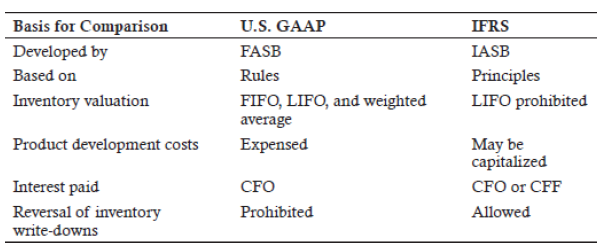
When a firm constructs an asset for its own use (or, in limited circumstances, for resale), the interest that accrues during the construction period is Expensed/Capitalized
Capitalized
Once construction interest is capitalized, the interest cost is allocated to the income statement through
depreciation expense (if the asset is held for use) or cost of goods sold (if the asset is held for sale)
Firms reporting research and development under IFRS must
Expense research costs as incurred but may capitalize development costs (costs incurred after technological feasibility and the intent to use or sell the completed asset have been established).
What are identifiable intangible assets, provide examples
can be acquired separately or are the result of rights or privileges conveyed to their owner. Examples of identifiable intangibles are patents, trademarks, and copyrights.
What are Unidentifiable intangible assets, provide examples
cannot be acquired separately and may have an unlimited life. The best example of an unidentifiable intangible asset is goodwill.
Are purchased intangible assets amortized or expensed?
Intangible assets that are purchased are reported on the balance sheet at historical cost less accumulated amortization.
Are internal intangible assets expensed or capitalized?
Except for certain legal costs, intangible assets that are created internally, including research and development costs, are expensed as incurred under U.S. GAAP and are not shown on the balance sheet
Goodwill
an unidentifiable intangible asset created when a business is purchased for
more than the fair value of its assets, net of liabilities.
Is goodwill ammortized
Goodwill is not amortized, but it
must be tested for impairment (a decrease in its fair value) at least annually
IFRS has three categories for securities held as assets
Securities measured at amortized cost
Securities measured at fair value through other comprehensive income (OCI)
Securities measured at fair value through profit and loss
U.S. GAAP has three categories that mostly correspond to the IFRS treatments:
Held-to-maturity securities
Available-for-sale securities
Trading securities
Debt securities that a firm intends to hold until maturity, notes receivable, and unlisted securities for which fair value cannot be reliably determined are all measured at what on the BS?
at (amortized) historical cost.
Debt securities for which a firm intends to collect interest payments but may sell before maturity are measured at
fair value through OCI under IFRS and classified as
available for sale under U.S. GAAP.
Equity securities, derivatives, and other financial assets that do not fit either of the other two classifications are measured a
fair value through profit and loss under IFRS
and are classified as trading securities under U.S. GAAP.
under IFRS Interest and dividends received may be classified as pick from the following (CFO/CFI/CFF)
CFO or CFI
Interest and dividends paid to shareholders and interest paid on debt may be classified as pick from the following (CFO/CFI/CFF)
CFO or CFF
FCFF (Free cash flow to the firm)
Same as unlevered which adds back interest
FCFE (Free Cash Flow to Equity)
Same as levered
How is inventory reported under IFRS
At the lower of cost or net realizable value. If NRV is less than the balance sheet value of inventory, the inventory is “written down” to NRV, and the loss is recognized in the income statement either as a separate line item or by increasing COGS.
How is inventory reported under GAAP
Under U.S. GAAP, companies that use LIFO or the retail method value inventories at the lower of cost or market. Market is usually equal to replacement cost, but it cannot exceed net realizable value or be less than net realizable value minus a normal profit margin
When are inventory writeups allowed?
Under IFRS Inventory “write-up” is allowed, but only to the extent that a previous write-down to net realizable value was recorded. Write downs are permitted under both IFRS and GAAP but reversals and writeups are only permitted under IFRS.
LIFO vs FIFO Profitability
Lower with LIFO because of higher COGS under the assumption of rising prices
LIFO vs FIFO Liquidity Ratio for short term inventory
LIFO results in lower inventory because newer more expensive inventory is out first while older cheaper is still on BS. Hence lower liquidity from current ratio.
LIFO vs FIFO regarding activity inventory turnover
inventory turnover (COGS / average inventory) is higher for firms that use LIFO compared to firms that use FIFO.
Reversal of write down is permitted under
IFRS if the Net Realizable Value increases
What are purchased intangible assets
Do not have a physical substance but have finite lives (patent / franchises) are reported on the balance sheet at their fair values, which are reduced over their economic lives by amortization (like depreciation of a . physical asset).
internally developed intangible assets
are not reported on the balance sheet.
Values of intangible assets that do not have finite lives (e.g., goodwill) and of those that
can be renewed at minimal cost (e.g., trademarks) are not amortized, but they must be
checked periodically for impairment.
Under U.S. GAAP, R&D is typically expensed except for:
Cost to develop Software for sale to others. Costs are expensed as incurred until the product’s technological feasibility has been established, after which the costs of developing a salable product are capitalized.
Software for internal use. Costs must be expensed until it is probable that the firm will complete the project and use the software as intended
impairment
An asset is impaired when its carrying value (original cost less accumulated depreciation) exceeds the recoverable amount.
Recoverable amount of an impaired asset
The recoverable amount is the greater of its fair value less any selling costs and its value in use.
What is an asset’s value in use
The value in use is the
present value of its future cash flow stream from continued use and disposal.
Determining an impairment and calculating the loss potentially involves two steps.
.In
the first step, the asset is tested for impairment by applying a recoverability test. If the
asset is impaired, the second step involves measuring the los
The advantages of leasing rather than purchasing an asset may include the following
Less initial cash outflow. Typically, a lease requires only a small down payment, if any.
Less costly financing. Because a lease is effectively secured by the leased asset if the
lessee defaults, the interest rate implicit in a lease contract may be less than the
interest rate would be on a loan to purchase the asset.
Less risk of obsolescence. At the end of a lease, the lessee often returns the leased
asset to the lessor, and therefore, does not bear the risk of an unexpected decline in
the asset’s end-of-lease value.
Under IFRS and U.S. GAAP, any lease in which both the benefits and the risks of ownership are substantially transferred to the lessee is classified as
finance lease
Under IFRS, for both finance and operating leases (except those that are short term or of low value), the lessee records what on BS?
right-of-use (ROU) asset and a lease liability both equal to the present value of the lease payments
What is the loan reduced by in each lease payment under IFRSE
The lease liability is reduced each period by the principal portion of
the lease payment. So, while the asset and liability both begin with the same value and
reach zero at the end of the lease, their values can differ during the life of the lease, as
the amortization of the ROU asset will exceed the principal portion of the lease
payment in the early years of a lease
Under U.S. GAAP, how does a lessee accounts for finance leases
Same as just as under IFRS.
Under U.S. GAAP, how does a lessee accounts for operating leases
The lessee reports both the
Interest portion of the lease payment (Essentially the entire lease payment is interest because it is operating lease).
&
The amortization of the ROU asset (which is equal to the interest portion of the lease payment, not straight-line as under IFRS)
On the income statement as a single expense. Because the amortization of the lease liability and the amortization of the ROU asset are equal each period, the asset and liability will have equal values over the life of the lease.
The change in a net pension asset or liability has five components under U.S. GAAP. The
first three are recognized in the income statement each period, while the last two go to
other comprehensive income
1. Service costs for the current period.
2. Interest expense or income.
3. The expected return on plan assets.
4. Past service costs.
5. Actuarial gains and losses.
discontinued operation
management has decided to dispose of, but
either has not yet done so, or has disposed of in the current period after the operation
had generated income or losse
How are discontinued operations reported
Income and losses from discontinued operations are reported
separately in the income statement, net of tax, after income from continuing operations
Unusual or infrequent items
recorded for events that are either unusual in nature or infrequent in occurrence. Unusual or infrequent items are included in income from continuing operations.
retrospective application to Financial Statements
any prior-period financial statements presented in a firm’s current financial statements must be restated, applying the new policy to those statements as well as future statements.
prospective application to Financial Statements
prior statements are not restated, and the new policies are applied only to future financial statements
Can an impaired asset be recovered?
Under IFRS, the loss can be reversed if the value of the impaired asset recovers in the future. However, the loss reversal is limited to the original impairment loss
How are impairments treated under US GAAP?
Under U.S. GAAP, an asset is tested for impairment only when events and circumstances indicate the firm may not be able to recover the carrying value through future use.
Determining an impairment and calculating the loss potentially involves two steps. In the first step, the asset is tested for impairment by applying a recoverability test. If the asset is impaired, the second step involves measuring the loss.
How is recoverability tested under US GAAP
an asset is considered impaired if the carrying value
(original cost less accumulated depreciation) is greater than the asset’s future
undiscounted cash flow stream.
Formula for net revenue
Revenues less any returns and allowances
Quality of financial reports may be ranked from best to worst
1. Reporting is compliant with GAAP and decision useful; earnings are sustainable and adequate.
2. Reporting is compliant with GAAP and decision useful, but earnings are not sustainable or not adequate.
3. Reporting is compliant with GAAP, but earnings quality is low and reporting choices and estimates are biased.
4. Reporting is compliant with GAAP, but the amount of earnings is actively managed to increase, decrease, or smooth reported earnings.
5. Reporting is not compliant with GAAP, although the numbers presented are based on the company’s actual economic activities.
6. Reporting is not compliant and includes numbers that are fictitious or fraudulent.
Is straight-line depreciation conservative or aggressive form of accounting?
aggressive
Three factors that typically exist in cases where management provides low-quality
financial reporting are
motivation, opportunity, and rationalization
channel stuffing
Overloading a distribution channel with more
goods than would normally be sold during a period
bill-and-hold transaction
the customer buys the goods and receives an invoice but requests that the firm keep the goods at their location for a period of time. The use of fictitious bill-and-hold transactions can increase earnings in the current period by recognizing revenue for goods that are actually still in inventory
Overconfidence bias
having too much faith in one’s own work. underestimating forecasting errors and having narrower confidence intervals than warranted);
Illusion of control bias
creating overly complex models
This is related to overconfidence, but refers specifically to overestimating what an analyst can control and trying to control things an analyst cannot control. This bias is manifested in two primary ways: seeking “expert” opinions to justify a forecast, and making a model more complex
Conservatism bias
insufficiently changing forecasts when new information arrives
representativeness bias
overreliance on known classifications
confirmation bias
seeking out data that affirms an existing
opinion and disregarding information that calls it into question
 Note
Note  Flashcards (23)