2.5: Biological membranes
 Studied by 1 person
 Call Kai
 Learn
Learn Practice Test
 Spaced Repetition
 Match
Match Flashcards
 Knowt Play
1/85

There's no tags or description
Looks like no tags are added yet.
Name | Mastery | Learn | Test | Matching | Spaced |
|---|
No study sessions yet.
86 Terms
What is the fluid mosaic model?
a model proposed to describe the structure of cell membranes with proteins embedded in a sea of phospholipids
What does the fluid part of the fluid mosaic model mean?
Phospholipids form a bilayer in which the phospholipid molecules are constantly moving.
What does the mosaic part of the fluid mosaic model mean?
There are proteins of different sizes and shapes embedded in the phospholipid bilayer (so it looks a bit like a mosaic)
What are some of the key components of cell membranes?
phospholipid bilayer
cholesterol
proteins
glycoproteins
glycolipids
What are phospholipids?
they form the basic structure of the membrane (the phospholipid bilayer)
hydrophilic phosphate head with a charge
hydrophobic fatty acid tails
What two structures can phospholipids form when exposed to water?
micelle - circular with hydrophilic tails on the inside
bilayer - water-soluble substances can’t pass through but lipid-soluble substances can
What two categories can proteins in the cell membrane be categorised into?
intrinsic proteins
extrinsic proteins
What are intrinsic proteins?
(or integral) proteins are embedded through both sides of the phospholipid bilayer e.g channel and carrier proteins which transport large molecules and ions across the membrane
What are extrinsic proteins?
(or peripheral) proteins are present on only one side of the phospholipid bilayer. These proteins provide support to the membrane or may be involved in cell signalling
What are the two types of transport proteins and what do they do?
Transport proteins create hydrophilic channels to allow ions and polar molecules to travel through the membrane and control which substances enter or leave
Carrier proteins change shape to transport a substance across the membrane in both directions(ATP usually required for active transport)
Channel proteins allow charged particles to move down their concentration gradient through a hydrophilic pore
What does cholesterol do to the cell membrane?
it gives it mechanical strength and flexibility and controls membrane fluidity (hexagonal chain)
How does cholesterol increase the fluidity of the membrane?
cholesterol stops the phospholipid tails from packing too closely together at low temperatures
How does cholesterol stop the membrane from becoming too fluid?
Cholesterol molecules bind to the hydrophobic tails of phospholipids, stabilising them and causing phospholipids to pack more closely together at higher temperatures
What are glycoproteins?
they consist of intrinsic proteins attached to a carbohydrate chain
What are glycolipids?
they consist of lipids attached to a carbohydrate chain
What are glycolipids and glycoproteins involved in?
Cell adhesion - This is the attachment of cells to one another.
Cell recognition - This allows cells to recognise one another.
Cell signalling - This is communication between cells.
What is the glycocalyx?
all the carbohydrate molecules on the exterior of a cell surface membrane, formed by carbohydrate chains attached to lipids or proteins (glyco-)
What is the role of the glycocalyx in the membrane?
regulates the movement of fluids between the endothelial cells and functions as barriers to macromolecules
What are the roles of the cell membrane?
isolating
controlling what enters and exits
act as a barrier
communication - cell signalling
cell recognition
allows transport of substances
site of chemical reactions
Describe the role of the cell membrane in isolating
isolating organelles from the rest of the cytoplasm allows cellular processes to occur separately
Describe the role of the cell membrane in terms of controlling what enters and exits it
proteins in the membrane allow the passage of large, charged water-soluble substances
ions that are too large can be transported by carrier or channel proteins
Describe the role of the cell membrane in acting as a barrier
hydrophilic head and hydrophobic tail forms a bilayer (micelle in water)
small non-polar molecules e.g O2 diffuse across rapidly
small polar molecules e.g water diffuse slower
What is a liposome?
a bilayer that has twisted on itself to make a spherical 3D structure
Describe the role of the cell membrane in cell to cell communication
cells can signal to each other via messengers e.g hormones
some can enter easily, others that are too large use cell membrane receptors
Describe the role of the cell membrane in cell recognition
glycoproteins and glycolipids are restricted to the outside surface
they help a cell recognise itself as ‘self’ cells rather than ‘foreign’ cells
Describe the role of the cell membrane in fluidity
it is fluid due to its phospholipid bilayer and it allows its components to move and flow, which is necessary for its function
Why does the cell membrane need to be fluid?
to allow diffusion
exocytosis and endocytosis
phagocytosis and shape change
What happens to the phospholipids at high temperatures in the membrane?
phospholipids get more kinetic energy, so increase in fluidity
proteins drift around so become ineffective
cell signalling phagocytosis affected
What happens to cholesterol at high temperatures in the membrane?
reduces the increase in fluidity so buffers the effect of the heat
What happens to phospholipids at low temperatures in the membrane?
phospholipids pack closely and tightly together
What happens to cholesterol at low temperatures in the membrane?
maintains membrane fluidity and prevents it from freezing
What is the effect of heat on the proteins (+permeability)?
too much heat denatures proteins along with the cytoskeleton increasing the number of permeable holes in the plasma membrane
membrane bound organelles will no longer function as they are denatured
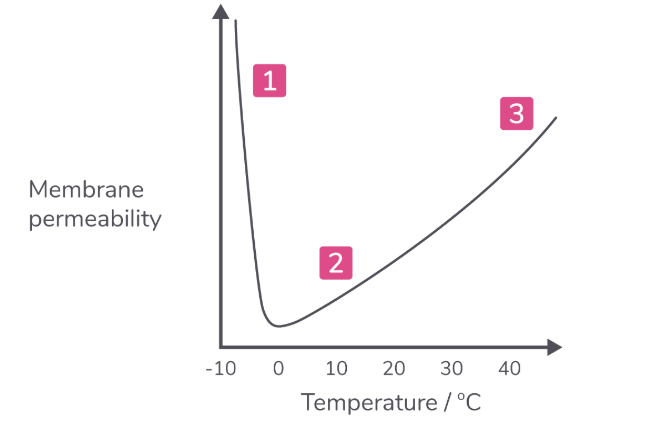
What is happening at point 1 of this graph?
At low temperatures (below 0°C) - Phospholipids do not have much kinetic energy. They are packed closely together to form a rigid cell membrane, decreasing the permeability of the membrane.
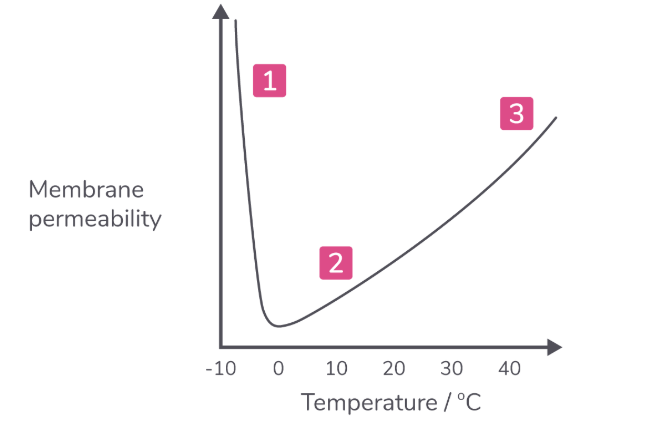
What is happening at point 2 of this graph?
At medium temperatures (0 - 40°C) - As temperature increases, phospholipids have more kinetic energy so they move faster and aren't packed as closely together. This increases the permeability of the membrane.
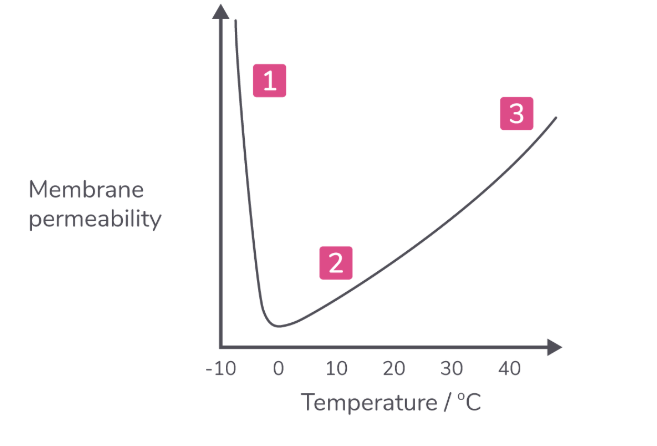
What is happening at point 3 of this graph?
At high temperatures (above 40°C) - The phospholipid bilayer breaks down. Channel and carrier proteins denature, meaning they cannot control what enters or leaves the cell. These effects increase the permeability of the membrane.
What effect do solvents have on the permeability of membranes?
When cells are placed in a solvent such as ethanol, the phospholipids dissolve, causing the membrane to become more fluid. This disrupts the structure of the cell membrane to make it more permeable.
Increasing the concentration of the solvent will further increase the permeability of the cell membrane.
What is the composition of cell membranes in neurones?
myelin sheath - formed by flattened cells wrapped around them several times giving several layers of cell membrane
protein channels and carriers allow the entry and exit of ions to bring about the conduction of electrical impulses
What is the composition of the plasma membrane in white blood cells?
they contain special protein receptors that enable them to recognise the antigens on foreign cells
What is the composition of the membrane of root hair cells?
they have carrier proteins to actively transport nitrate ions from the soil into the cells
Define diffusion
the net movement of particles from an area of higher concentration to an area of lower concentration (maybe across a membrane), not requiring energy
What are the two types of diffusion?
simple diffusion and facilitated diffusion
What is simple diffusion?
Some molecules can diffuse directly across cell membranes in this process
Give an example in the body of simple diffusion?
oxygen and carbon dioxide diffuse into cells via simple diffusion. Carbon dioxide diffuses down the concentration gradient from the blood to the alveoli whilst oxygen diffuses from the alveoli into the capillaries
What about particles allows simple diffusion?
This is because they are:
Small - This means that they can pass through the spaces between phospholipids.
Non-polar - This means that they can dissolve in the hydrophobic core of the cell membrane.
What is facilitated diffusion?
when large or polar molecules can cross the cell membrane via carrier and channel proteins
Why can only one or two molecules pass at a time during facilitated diffusion?
because each carrier or channel protein is highly specific
What do carrier proteins usually transport across the membrane?
large molecules
How do carrier proteins carry these molecules across the membrane?
a large molecule attaches to a carrier protein
this causes the carrier protein to change shape
the carrier protein releases the molecule on the opposite side of the membrane
What do channel proteins mainly transport across the cell membrane?
ions
How do channel proteins carry transport these molecules across the membrane?
These proteins form pores in the cell membrane, which ions can travel through.
What factors affect the rate of diffusion?
surface area
concentration gradient
thickness of membrane
temperature
size of diffusing molecule
number of carrier or channel proteins
How does the surface area affect the rate of diffusion?
Larger surface areas mean more particles can cross the membrane at once, making diffusion faster
How does the concentration gradient affect the rate of diffusion?
The steeper the concentration gradient, the faster the rate of diffusion
How does the thickness of membrane affect the rate of diffusion?
The particles travel shorter distances through thin exchange surfaces, so diffuse faster
How does the temperature affect the rate of diffusion?
At higher temperatures, particles have more kinetic energy and diffuse faster
How does the size of the diffusing molecule affect the rate of diffusion?
the smaller the molecule, the faster it diffuses across a surface
How does the number of channel or carrier proteins affect the rate of diffusion?
The more of these proteins, the faster the rate of facilitated diffusion
Define osmosis
the net movement of water molecules from an area of higher water concentration to an area of lower water concentration, through a partially-permeable membrane
Define water potential
a measure of the tendency of water molecules to diffuse from one region to another
How do water molecules move in terms of water potential?
they always move from a region of higher water potential to a region of lower (more negative) water potential
What is water potential measured in?
kilopascals (kPa), (Ψ)
What has the highest water potential?
pure water - 0kPa
Hypotonic solutions in plant cells
solution has a higher water potential than the cell
Water molecules move into the cell.
The cell swells and becomes turgid (cell wall protects)
Isotonic solutions in plant cells
solution has the same water potential as the cell
There is no net movement of water into or out of the cell
The cell stays the same size
Hypertonic solutions in plant cells
solution has a lower water potential than the cell
Water molecules move out of the cell
he cell shrinks and becomes plasmolysed - flaccid
Hypotonic solutions in animal cells
solution has a higher water potential than the cell
Water molecules move into the cell
The cell swells and bursts (no cell wall) - cytolysis
Isotonic solutions in animal cells
solution has the same water potential as the cell
There is no net movement of water into or out of the cell
The cell stays the same size
Hypertonic solutions in animal cells
solution has a lower water potential than the cell
Water molecules move out of the cell
The cell shrinks - crenation
What happens in normal CFTR channel?
water potential becomes lower as chloride ions move out of the cell
this causes water molecules to move out of the cell, causing a running liquid mucus
What happens in a mutated CFTR channel?
chloride ions can’t pass through
thus means that water molecules can’t pass through either and so mucus will sit on the top
Define active transport
the movement of particles from an area of lower concentration to an area of higher concentration. This process requires energy from respiration in the form of ATP
What proteins does active transport use?
carrier proteins
How do these proteins transport molecules across membranes?
The molecule or ion binds to the carrier protein
ATP binds to the carrier protein
Hydrolysis of ATP to ADP and phosphate (Pi) causes the carrier protein to change shape. This releases the molecule or ion on the opposite side of the membrane
The phosphate (Pi) is released from the carrier protein, causing the carrier protein to return to its original shape, ready to be used again
What additional factor affects the rate of active transport?
Rate of respiration - The more respiration, the more ATP available for active transport
How do large molecules such as enzymes that can’t be transported through channel or carrier proteins move into and out of cells?
via bulk transport
What are the two types of bulk transport?
Endocytosis - This transports materials into cells.
Exocytosis - This transports materials out of cells.
What happens in endocytosis?
a segment of the plasma membrane surrounds and encloses the particle and brings it into the cell, enclosed in a vesicle
What are the two forms of endocytosis?
Phagocytosis - The uptake of solid materials.
Pinocytosis - The uptake of liquid materials.
What happens in exocytosis?
Vesicles move towards and fuse with the cell-surface membrane where materials are released outside the cell
Why is beetroot used in permeability investigations?
Beetroot contains betalain pigment in vacuoles; damage to membranes causes pigment to leak out, so permeability can be easily measured
What variable is typically measured in the beetroot practical?
Absorbance of leaked pigment using a colorimeter
What does a high absorbance mean?
lots of pigment leaked out = high membrane permeability
What are the independent variables in membrane permeability experiments?
Temperature, solvent concentration (e.g., ethanol)
What are key controlled variables in the beetroot experiment?
Size/shape of beetroot cylinders, washing beetroot, pH, volume of solution, time left in solvent, temperature (if not being tested)
What trend is expected when temperature increases?
Absorbance increases due to more pigment leakage; sharp increase at high temperatures from protein denaturation
What trend is expected when ethanol concentration increases?
Membrane permeability increases; more pigment leaks out → higher absorbance
 Note
Note  Flashcards (30)