empathy & altruism
 Studied by 0 people
 Call Kai
 Learn
Learn Practice Test
 Spaced Repetition
 Match
Match Flashcards
 Knowt Play
1/48

There's no tags or description
Looks like no tags are added yet.
Name | Mastery | Learn | Test | Matching | Spaced | Call with Kai |
|---|
No analytics yet
Send a link to your students to track their progress
49 Terms
definition of sociality
Sociality: the tendency or capacity to engage in social interaction and live within social structures
reasons for sociality:
vigilance
resources
reproduction
Irrespective of pro or anti social behaviour there is a need to understand what someone else is doing which is why understanding the actions of others is necessary as we need to predict behaviour
crudest way we do this is looking to see what someone is doing - is this something we need to or pay attention to?
Understanding the actions of others helps us understand the mental states of others
Observing actions are critical when interpreting others
(PART 1) the mirror neuron system (MNS) basics
MNS is part of the motor system which:
Does more than generate movement
Contributes to perceive and understand others actions
the discovery of the MNS was an incidental finding - just wanted to look at how neurons link to motor movements
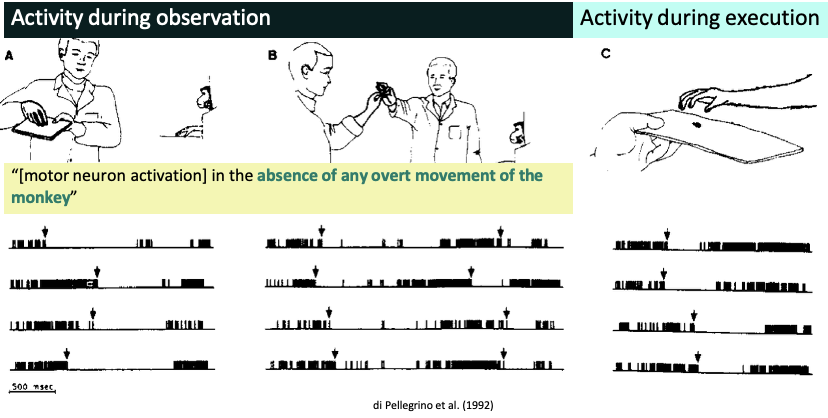
Specific motor neurons are activated during action observation, even without actual movement
Found some neurons activated even when the monkey was not doing any motor movements so the neurons were doing something unexpected
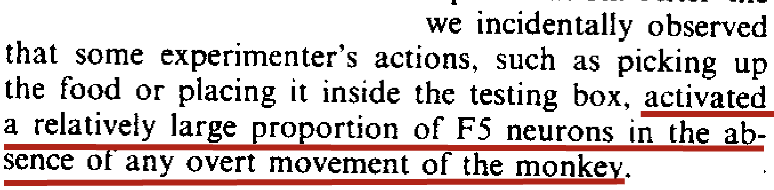
F5 neurons and KEY CONCEPT MN definition
When the monkey was still and just observing there was firing from the same motor neurons which overtime was termed MNs
mirror neurons: newly discovered set of F5 neurons ('mirror neurons') all of which became active both when the monkey performed a given action and when it observed a similar action performed by the experimenter
Action observation-execution neural overlap
How might this neural mechanism support empathic understanding?
Useful for perspective taking because your neurons are firing while seeing someone in emotional pain
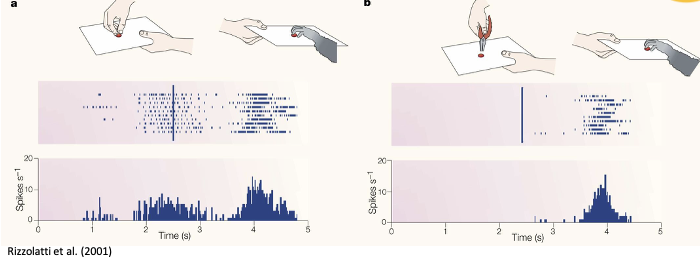
the selectivity of mirror neurons
difference between panel a and panel b:
no activity in neurons when experimenter used a plier to grasp, but MN activate when experimenter used their hands
Suggests this motor system is selective and specific
The object use has no clear objective, so less likely to respond
The monkey has also never done this before - MN more activity when the action being observed is something they have done before
Single cell recordings on macaque monkeys in F5 (analogous to premotor area in humans)
Direct recording of neurons in response to behavioural tasks
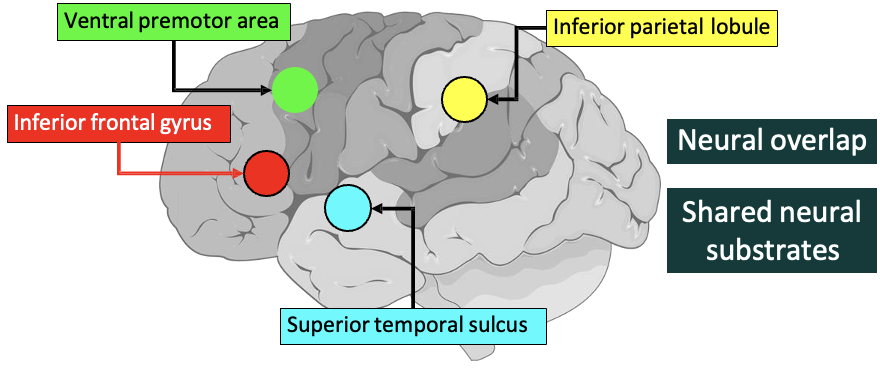
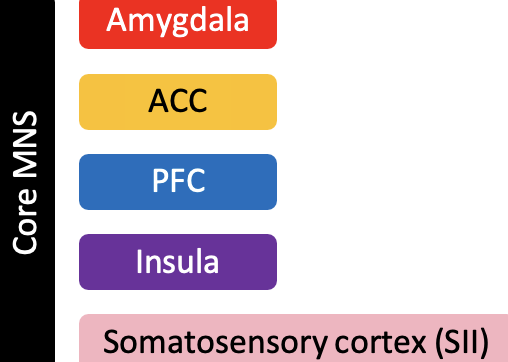
core MNS
MNS: Action execution- observation matching neural network thought to facilitate action understanding
MN found in these core areas
selective attention
activation bias for biological motion in the ventral premotor cortex (left) and meaningful goal-directed action sequences (right)
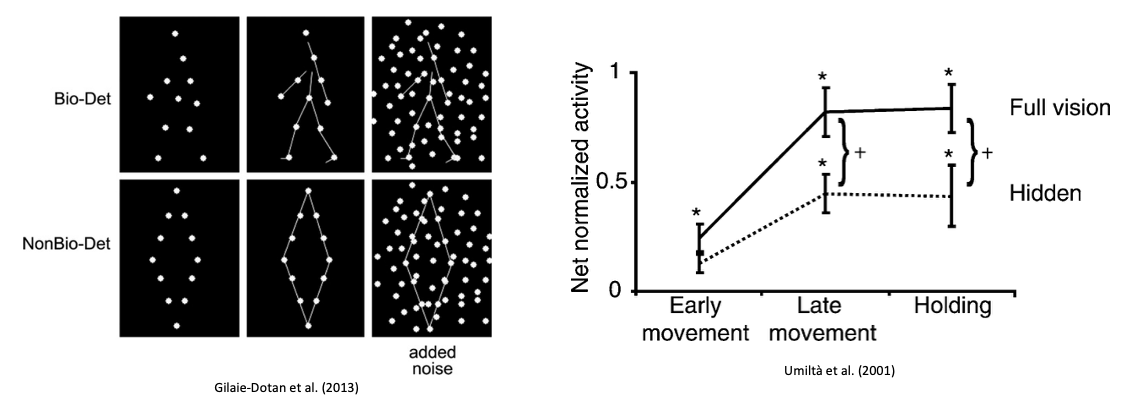
one way we can think about the MNS
generative models
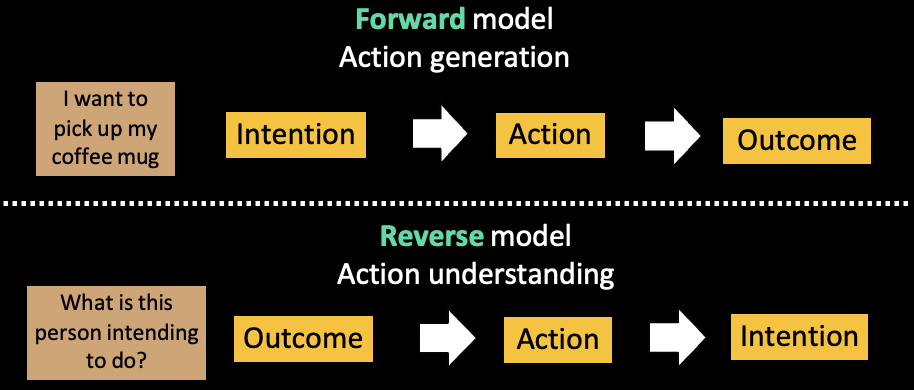
KEY CONCEPT action understanding and the MNS
MNS contributes to action understanding - but which level?:
Muscle level understanding - specific muscle activations producing movement
Kinematic understanding - visible movement
Goal understanding - short-term steps needed to achieve aim
Intention understanding- long-term purpose behind an action
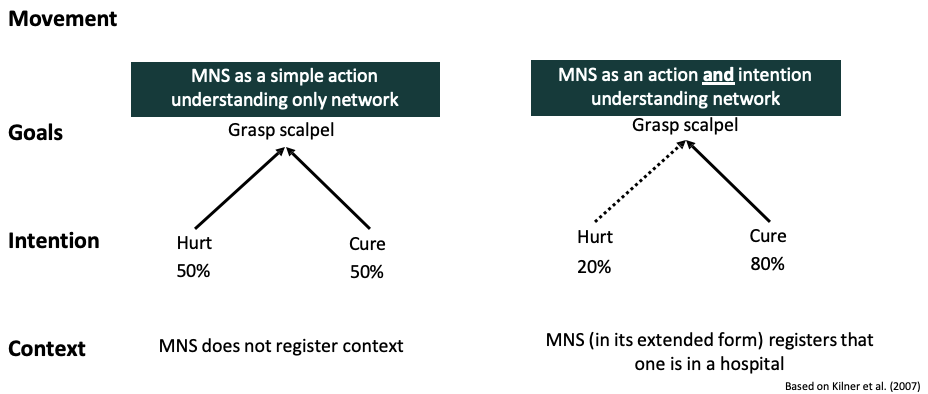
action intention and MNS
If the MN system is action dependent, may be able to understand the goal
Believed the MNS does not understand context so needed to understand how much the MNS is helping us in understanding action intentions
Found it also understands intention. We could work out the context through the MNS extended form where it is connected to other regions
E.g. alley vs hospital helps us understand that a scalpel will be used to kill rather than cure us
beyond basic understadning - fMRI evidence
Wicker et al (2003) in fMRI
Execution phase: Participants provided odorants to sniff
Observation phase: Participants observed videos of other people sniffing the odorants
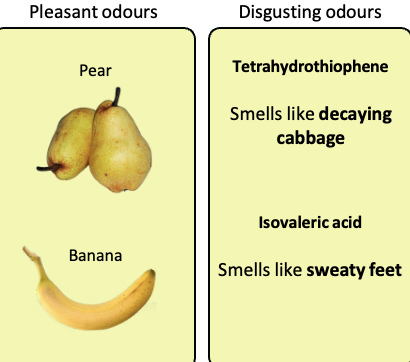
findings - disgust monitoring in the insula
Found areas that only activated during execution (red dots)
Also found certain regions that only activated while watching
And revealed areas in the brain where they saw the neural overlap- neurons fired when smelling and observing
This finding is important for empathy as just watching something is enough to make you feel the way someone else is feeling
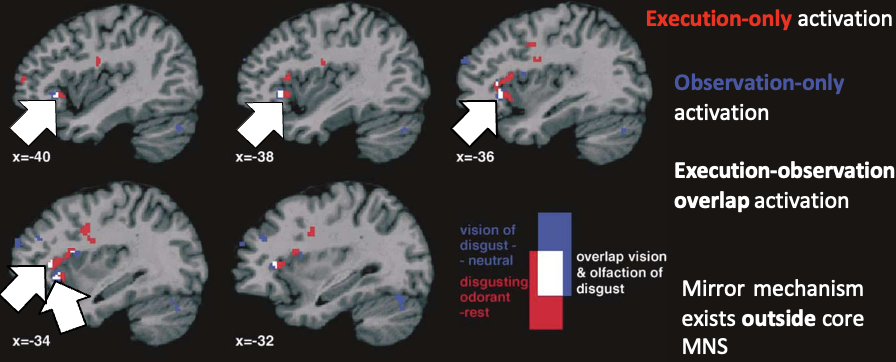
is the MNS connected to other brain regions?
connections to the core MNS are sometimes termed the ‘extended MNS’
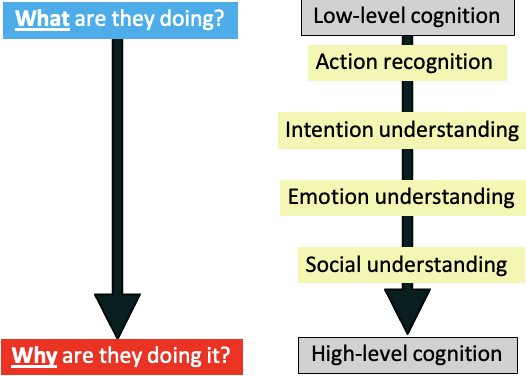
low to higher level cognition
Disgust specific neural overlap may indicate MNS involvement in higher-level cognitive processors
The social understanding notion led to stimulation theory
KEY CONCEPT what is the stimulation theory (ST)?
stimulation theory: we replicate another person’s external state (e.g., their observable actions) within our own internal systems to generate understanding of their behaviour
Empathy, ToM, perspective taking, imitation
why has interest in the MNS declined in recent years?
the ‘magic cell’ narrative
'cells that read minds' and 'shape civilisation'
Validity: relatively little evidence supporting sole involvement in higher-level cognition
Saying the neurons do this and that but there is not really enough evidence to show that the MNS only is involved in social understanding
Reliability: inconsistent evidence surrounding their sole link to social communication
Specifically with autistic people- suggested they have reduced MN activation but they often showed increased or normal activation
“Mirror neurons should not be tarnished; they are yet to fulfil their true promise.” - Heyes & Catmur (2021)
Is the MNS real?
YES BUT
Scientists should practice caution with interpretation
Please note that scientists sometimes use different names to refer to the system (or the core mechanism of the system)
rebuilding our understanding
what we know:
support low level processing, not high level action understanding
more reliably involved in imitation behaviours
mirroring mechanism is flexible, not specialised social system
what we should do next:
focus on low-level motor and perceptual processes, not grand cognitive explanations
sensorimotor learning in social contexts (e.g., parent–infant interaction) builds these neural mappings
use causal and computational approaches (e.g.,predictive coding)
what are the core criticisms of the MNS?
Recurring misattribution
If we understand others by simulating their actions, why do we so often misinterpret them?
Simulation inhibition
If we are always simulating others, how do we stop (i.e. control) ourselves from overidentifying with them? - there has to be more to the MNS
(1) more about recurring misattribution
Interpersonal misattributions
Misinterpreting someone’s emotional state (e.g., mistaking fatigue for anger) can distort understanding and reactions in social exchanges
Systemic misattributions
On a societal scale, people may be surprised or shocked by acts of state-sanctioned violence, which reflects a mismatch between their expectations of fairness and the reality of institutional behaviour
this misattributions happen due to:
(core criticism) Projection-and-correction account
We first project our own state onto others, then refine this model through minimising prediction errors until it matches what we observe
recap of predictive coding and KEY CONCEPT the different systems in predictive coding
predictive coding: (in the context of rewards) the brain makes predictions about the world and updates the model if there is a difference between predictions and actual sensory data
the brain is constantly generating and updating predictions about incoming sensory information. When there is a mismatch between what is predicted and what is actually sensed (i.e., a PE), the brain adjusts its internal model to minimise that difference.
Prediction error (PE): Difference between expected reward and actual outcome
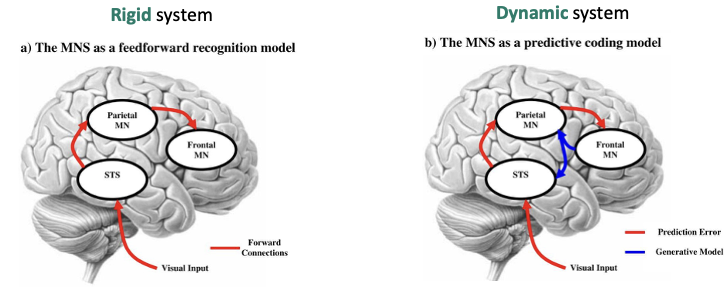
KEY CONCEPT the plastic system of the MNS
Sensorimotor expertise in basketball, dancing and musical training has been shown to modulate MNS activity
The MNS responds to what you do - (e.g. the way that dancers mirror someone who is dancing is different to a non dancer due to sensorimotor training)
(2) stimulation inhibition - how do we control stimulation?
If we are always simulating others, how do we stop (i.e. control) ourselves from overidentifying with them?
We need to inhibit overidentification so we can function to prevent compassion fatigue (e.g. nurses, carers)
PFC and stimulation inhibition
Traumatic brain injury to frontal lobes, particularly to the PFC, has been associated with difficulties in controlling automatic imitative movement - find it difficult to stop yourself
Involuntary imitative movement (echopraxia) or speech (echolalia) may be related to atypical PFC activity
from this we can suggest that PFC activity is important in regulating how we copy others
influence of frontal regions
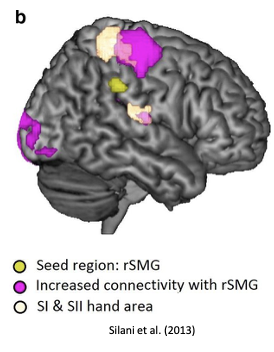
controlling stimulation via connections to frontal regions and networks
default mode network (DMN): supports self-other distinction, which allows the brain to separate one’s own internal states from those of others during social cognition
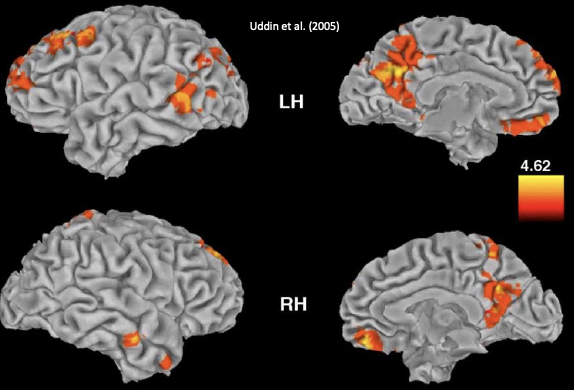
KEY CONCEPT what is the self-other distinction
self-other distinction: The ability to distinguish between one’s own internal and external states (e.g., emotions, intentions and behaviour) from another individual’s internal or external states
areas of the brain involved in S-O distinction go beyond the PFC to the TPJ and supramarginal gyrus (SMG)
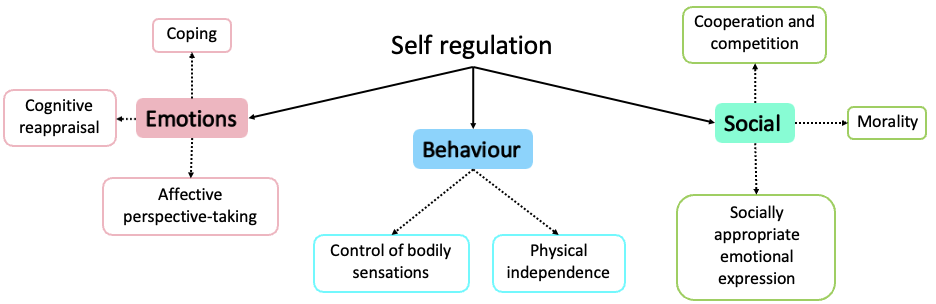
Santiesteban et al (2012) study
Stimulation of the right TPJ led to better control of imitation tendencies (i.e., self- other distinction) and visual perspective taking - found when processing the 'other' the area is more activated (anodal = self)
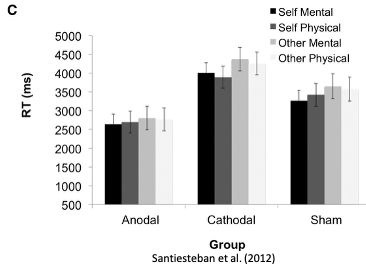
more evidence from silani et al (2013)
Low-frequency repetitive transcranial magnetic stimulation (i.e., disruption) of rSMG increased emotional egocentricity - thinking more about yourself than other people
(PART 2) empathy - definitions
prosocial behaviour: behaviours motivated or intended to benefit another individual or group
Excluding humans, limited number of animals show consistent pro social behaviour (e.g. dolphins, elephants and other primates)
Sociality vs prosociality (there is a difference!)
Sociality is about being in a social structure
Prosociality is about being kind or helpful within social context (e.g. bees are social as they live in social groups but are not prosocial because they don't outwardly go out of their way to help another bee)
Both sociality and prosociality require making inferences (i.e., understanding) another individual
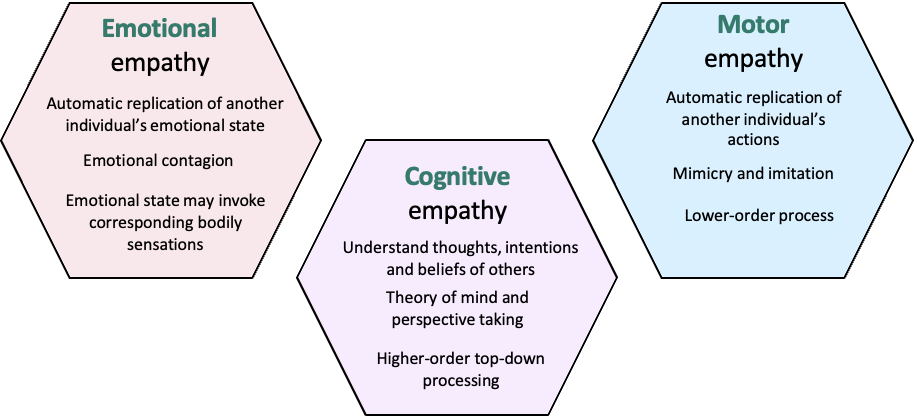
multifaceted nature of empathy and a defintion
empathy: The integrated replication of another individual’s emotional, cognitive, and motor states, generated from their observed or inferred internal and external cues
how is emotional and cognitive empathy represented in the brain? - pain empathy
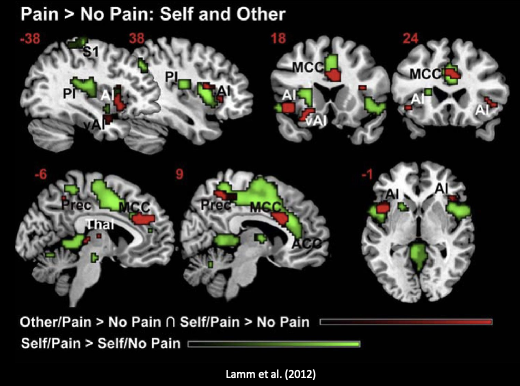
Meta-analysis assessing neural substrates involved in pain empathy
consistent execution-observation neural overlaps found in insula cortex and cingulate cortex (red dots)
Exemplifies the idea of mirroring - we tend to replicate and reproduce the emotional state upon ourselves to understand what someone is going through
stimuli dependent pain empathy responses
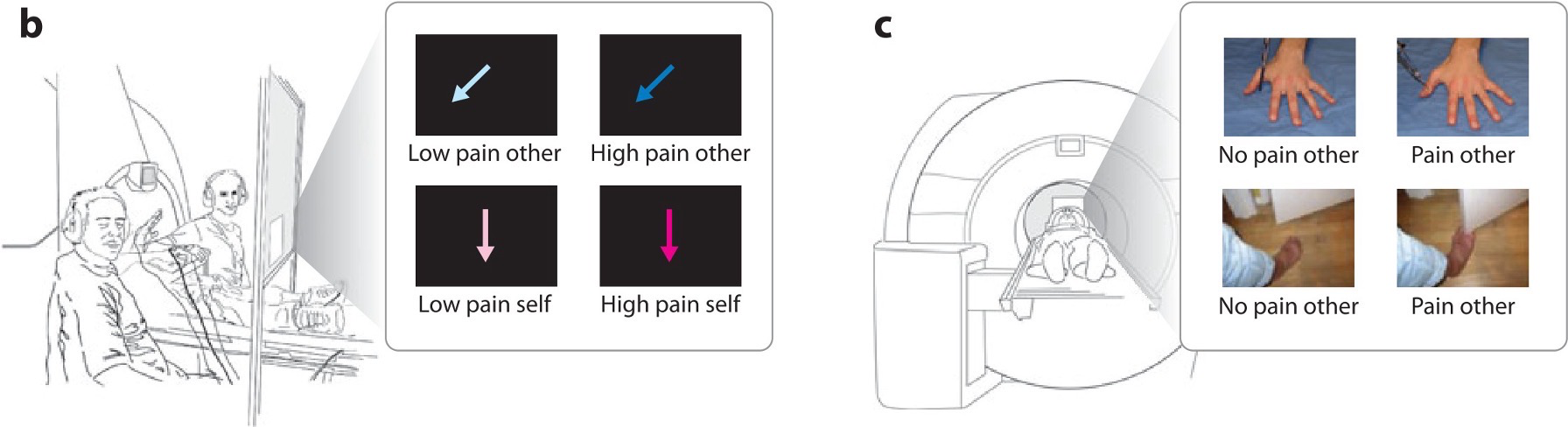
cue based stimuli vs picture based stimuli
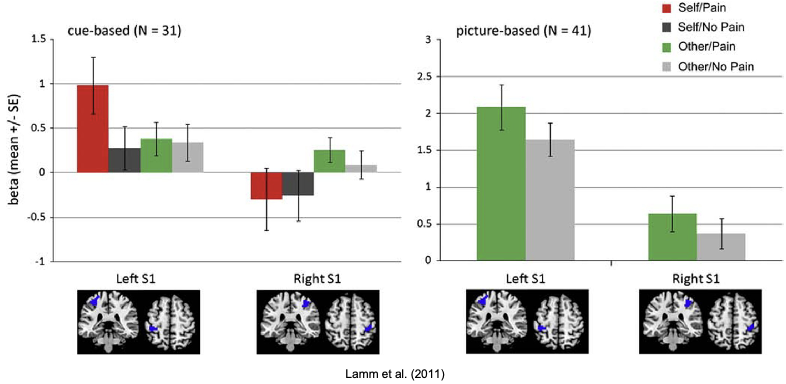
primary somatosensory cortex (SI) responses to others’ pain was greater for bodily-related stimuli (relative to over non-bodily-related stimuli)
Need to compare cues to know whether a picture changes how you experience pain compared to just a cue
SI other response selectivity
Seeing the pictures with actual bodies there was a lot more activation relative to cue based
Stronger effects in left than right hemisphere which is confusing as right is more to do with emotion
empathy in the brain
participants watched videos of emotional story and rated how emotional the person was while telling their emotional story
Can tell how emotional people are
brain correlates of the empathic accuracy task shows repeated patterns
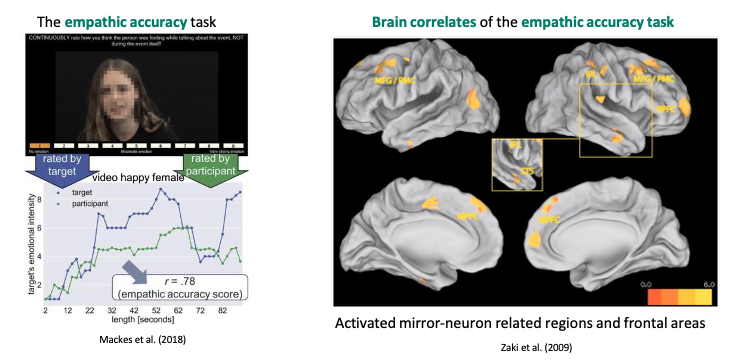
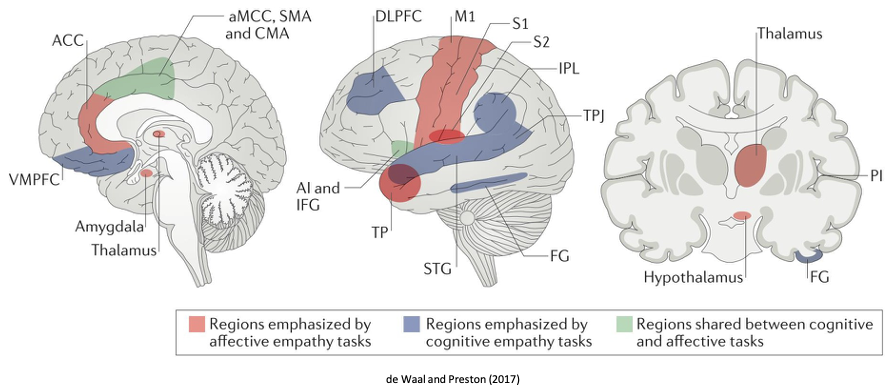
emotion vs cognitive empathy in the brain
Insula, ACC, SMA and IFG activated for both
Suggests special pathways in the brain for different types of empathy but most likely not static
what is motor empathy? - unconscious and unintentional mimicry
mimicry: In its automatic form, mimicry is an umbrella term describing the subconscious copying of body language and actions (e.g., gestures and facial expressions, eye gaze) of another person
AKA chameleon effect
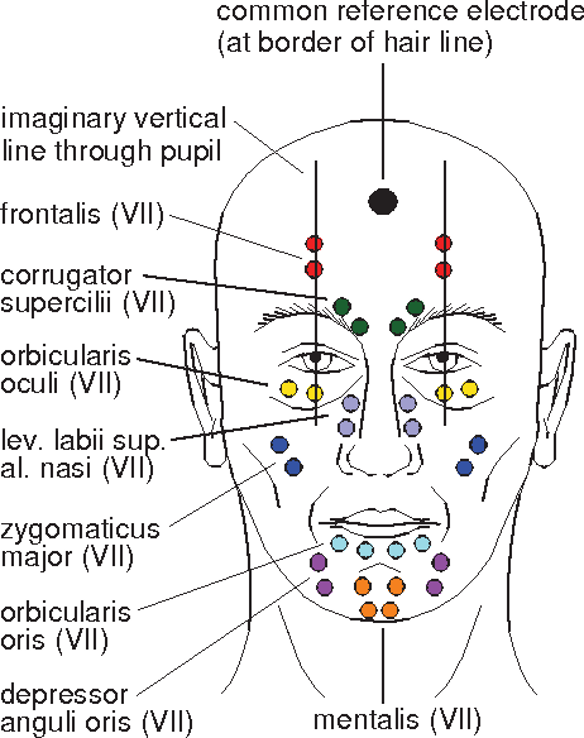
spontaneous facial mimicry: automatic and unconscious activation of facial muscles associated with an observed facial movement (e.g., emotional facial expressions). SFM can be measured with fEMG - your face subconsciously mimics someone else's facial muscles!
some facial movements are not visible to the naked eye
fEMG can detect small and subtle micro voltage differences in muscles
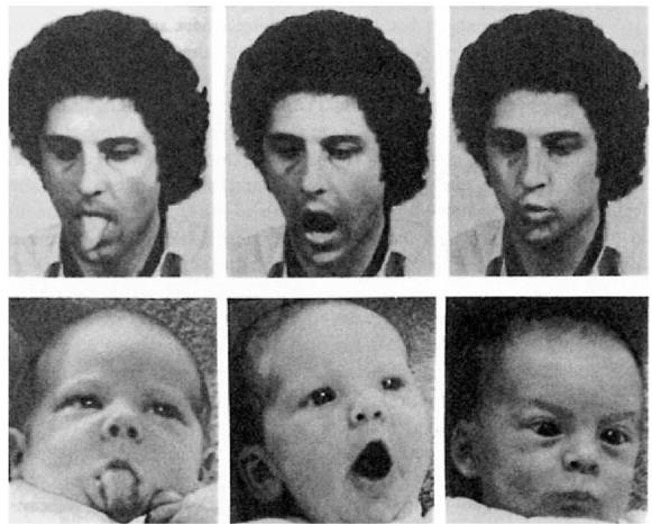
neonatal mimicry of human faces
Facial mimicry as one of many building blocks for social interaction (innate mechanism?)
Within the first months of life neonates mimic human faces suggesting it may be important for social communication
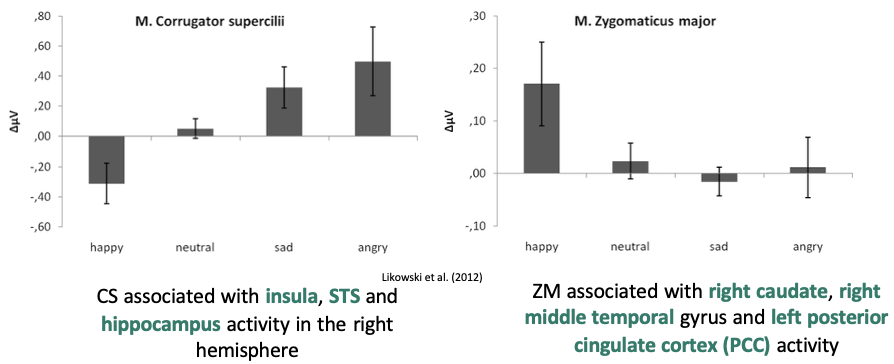
emotion-selective facial muscles
CS = frowning muscle in forehead (associated with negative emotions)
ZM = smiling muscle in cheek
In a study, participants looked at avatars with different facial expressions and measured their facial expressions
Happy faces = CS showed negative reflections relative to neutral but CS increased in response to sad faces
May be a link between the facial muscles and the brain as activated negative brain regions
ZM increased activation for happy, no response neutral, sad and angry little activation
These specific muscles are activated not to every facial expression but are dependent on what someone else's face is doing
brain correlates of emotion-selective muscles
CS and ZM significantly correlated with right IFG, right SMA and left cerebellum (look at ss)
TBI and emotion-related mimicry
McDonald et al (2011)
20 control, 20 TBI (range of damaged areas)
TBI injury had occurred at least 8 months prior to study participation (mean time = 11.9 years)
TBI affecting many areas, such as frontal lobe, frontotemporal regions, occipital lobe and parietal-occipital regions
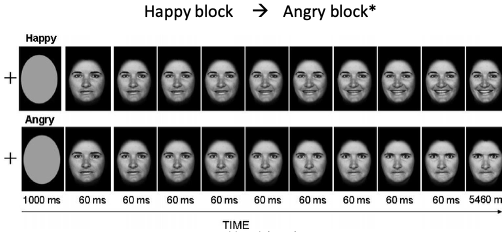
Participants did a passive emotional face viewing task for static and dynamic emotional facial expressions (with fEMG) - faces went from happy to whatever emotion, some saw pictures and some saw videos
findings for static faces from fEMG
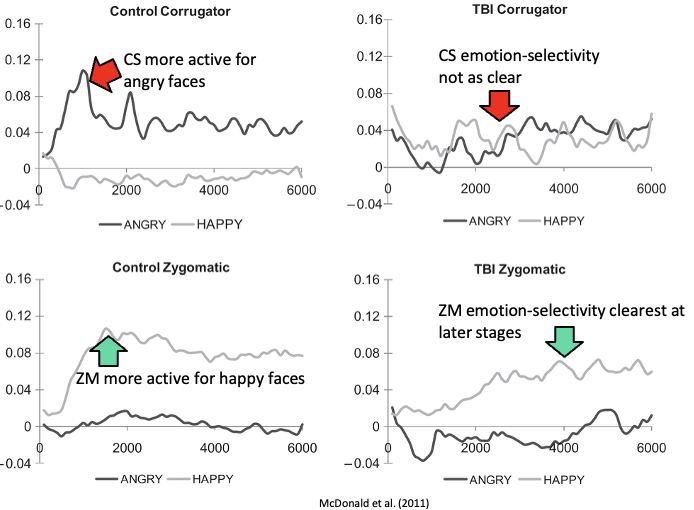
Clearer emotion-selective distinction from muscles in controls (particularly at earlier stages)
Clearest emotion-selective distinction from ZM in TBI participants
C says: the frowning muscle more active when looking at angry faces (think there is an animation on the graph) but saw the flip pattern in ZM
Angry faces should have elicited more CS activity but did not find this in TBI
May be finding these because of static faces so need to look at dynamic
findings from dynamic faces
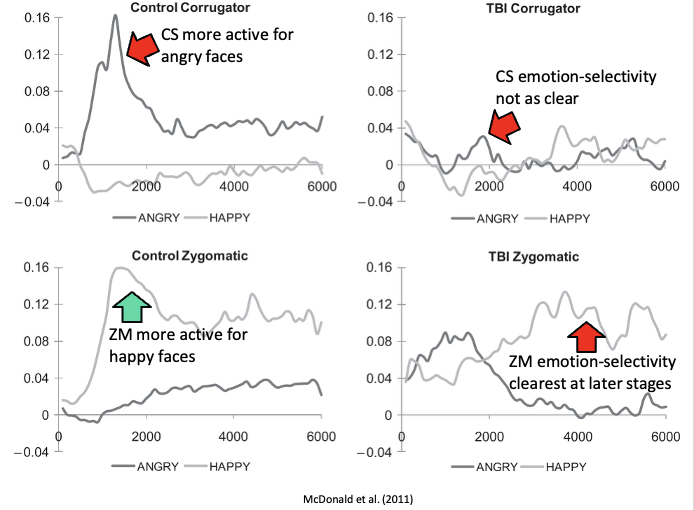
Same as above but did not find relationship between TBI mimicry and emotion matching
Same unclear trend with the TBI group - emotion selectivity was not clear
TBI not mimicking faces the way control group did
Do these issues make a negative impact in their ability to recognise faces
They concluded facial mimicry not essential for empathy
(PART 3) altruism definition
altruism: behaviours associated with improving the welfare of another even if disadvantaging the altruist (e.g., risking safety, nutritional resources etc.) or without providing a benefit for the altruist
what are altruistic behaviours:?
Empathy can motivate altruism however, sharing affective states does not always elicit altruistic behaviours - empathy and altruism are related but distinct
targeted helping: In rats targeting helping to someone/something that is distressed
2 rats, 1 is trapped, other rat attempts to help trapped rat even without reward
risky helping: helping someone else despite risk
what are the origins of altruism? - defensive altruism
offspring care: lactation considered an adapted trait due to the corresponding psychological and
behavioural adaptations: wanting to help is an evolutionary mechanisms related to offspring care
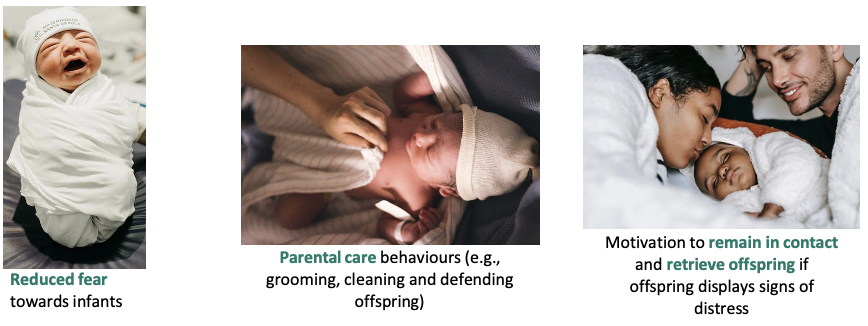
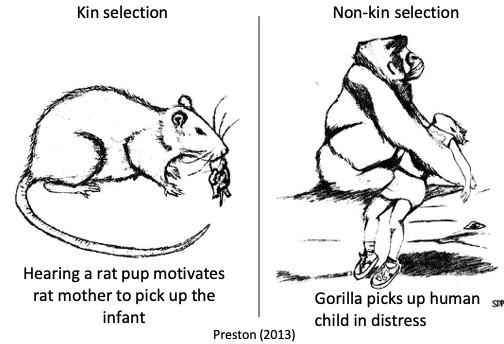
kin selection
sometimes we go out of whats expected and start helping other species - we are open with our altruistic care - this is due to the notion that it takes a village
alloparenting: adults and older children providing parental care to young non-biological offspring (older siblings, aunties, uncles, grandparents, teachers, social workers etc)
The want to take care of people is explained by an increase in OXT (social bonding hormone involved in parental care) so we get that motivation to help others when OXT is released
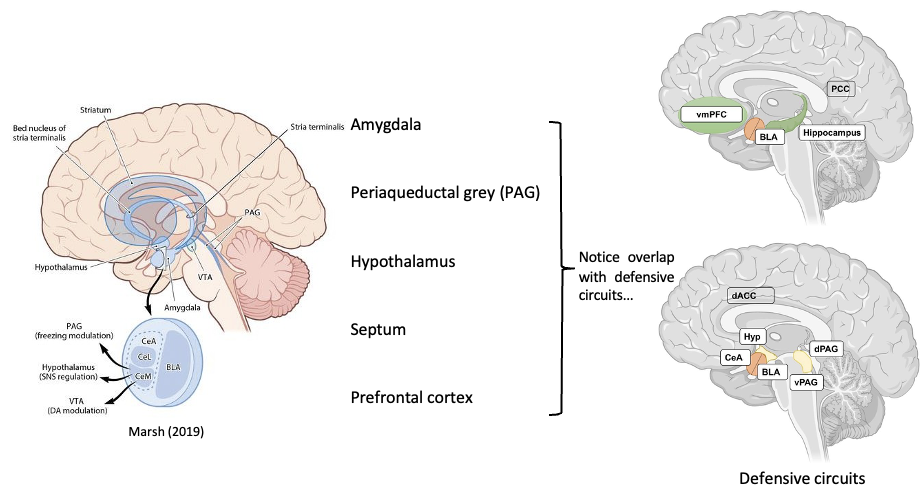
brain basis of altruism
These brain areas are also associated with defensive responses / circuits
Assumes we help people that are vulnerable due to wanting to defend motivated by these circuits involved in wanting to defend oneself
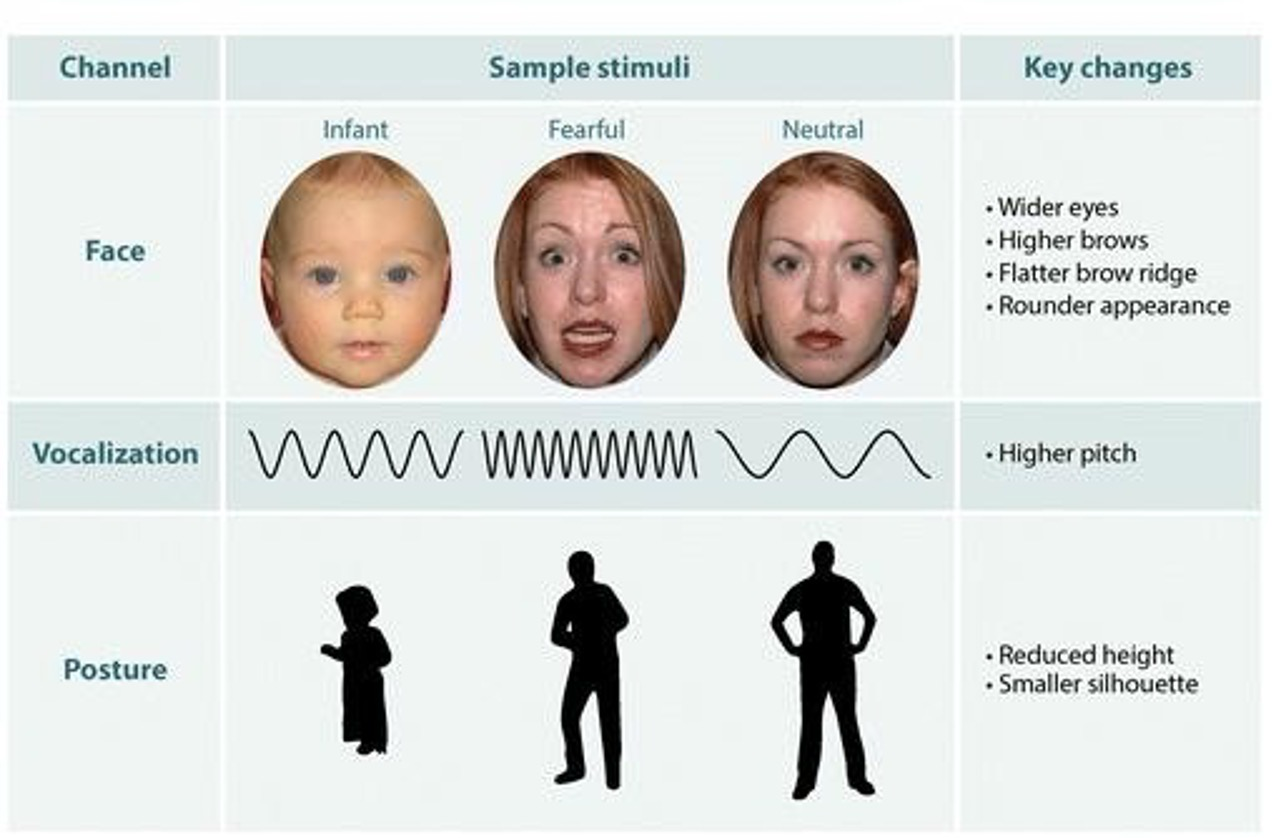
This idea comes from what fear looks like
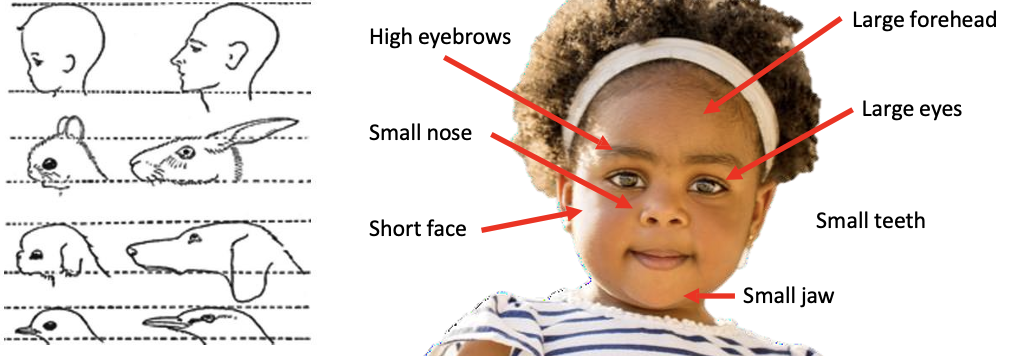
infantile features and altruism
Infantile features may be associated with less aggression and social tolerance
these infantile features are what signal that something or someone are vulnerable and if we think they are vulnerable, we are motivated to protect and help
appearance of vulnerability in adults can also elicit altruistic behaviours
infantile features and expression of fear
Marsh (2019)
Adults can demonstrate infantile features when expressing fear which can prompt altruistic behaviours from others
Our vocalisation when fearful is in a higher pitch voice, like an infant
Simiarly, when fearful our posture makes us smaller like a child
This is what evokes these fear circuits!
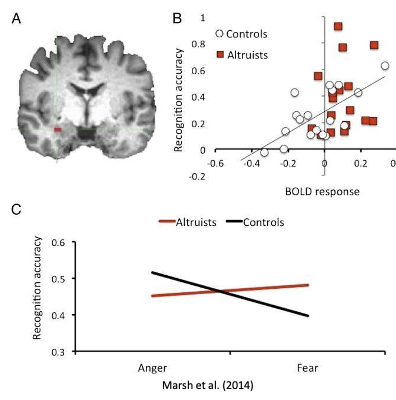
individual differences
Altruistic kidney donors showed greater activity in the right amygdala in response to fearful faces - gives precedence to the idea that altruism is elicited due to the need to defend oneself
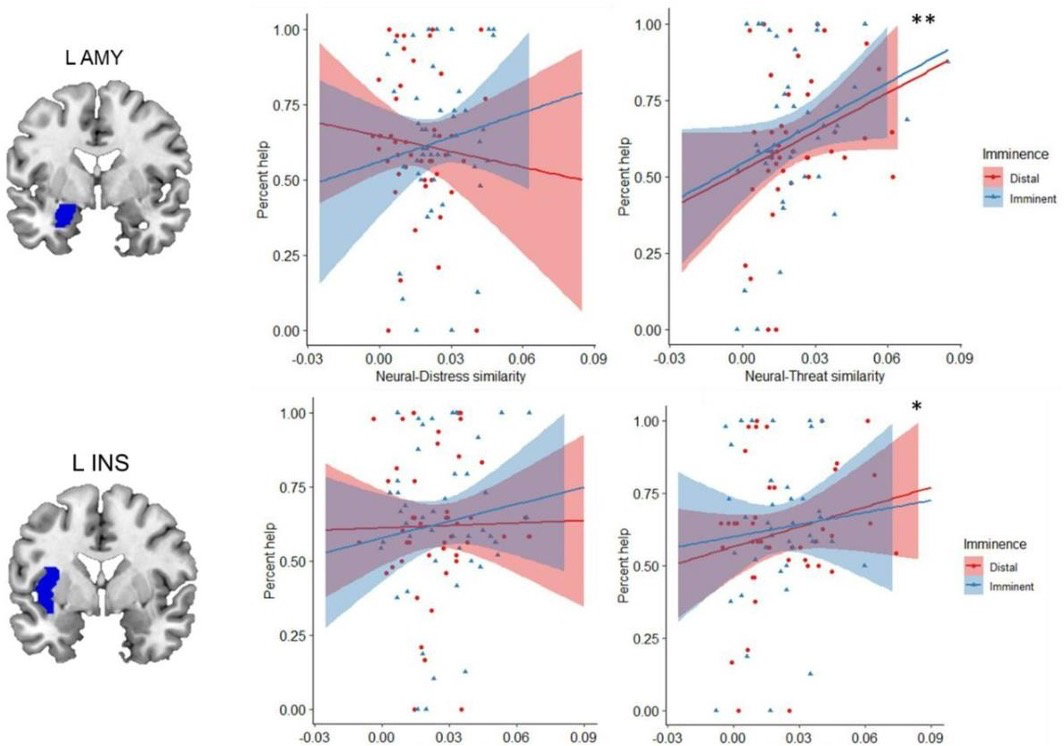
brain basis of altruism
the amygdala and insula
Participants had to decide whether to:
Help another person avoid aversive shock BUT the participant would receive shocks when attempting to help the other person
findings
Self-related defensive circuits are implicated in altruistic behaviours
Neural correlates of helping others to our detriment
Just seeing someone distressed does not impact need to help that much but if you see someone in distress and also feel distressed that there is fear to you enhances amygdala and insula activity
The more you feel fear, the more likely we are able to help
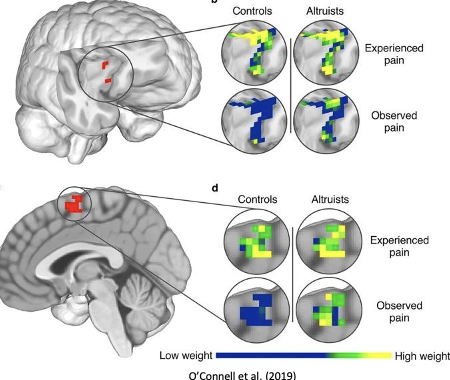
neural correlates of trait altruism
Anticipate or experience pain to themselves or others
Relative to controls, altruists showed increased cross-classification during the observing and experiencing pain in the right anterior insula and supplementary motor areas
are these the mirroring regions?
 Note
Note  Flashcards (56)