10.3 part 1 Demand as Seen by a Purely Competitive Seller
 Call Kai
 Learn
Learn Practice Test
 Spaced Repetition
 Match
Match Flashcards
 Knowt Play
1/12

There's no tags or description
Looks like no tags are added yet.
Name | Mastery | Learn | Test | Matching | Spaced | Call with Kai |
|---|
No analytics yet
Send a link to your students to track their progress
13 Terms
Why is a purely competitive firm a price taker?
Because it is one tiny seller among thousands and produces only a tiny fraction of total output, so it cannot influence price. It must accept the market price
One wheat farmer out of thousands
One seller of a stock in a giant stock market
One oil producer in a global market
The intersection of demand and supply set the market price
What does “perfectly elastic demand” mean for a competitive firm?
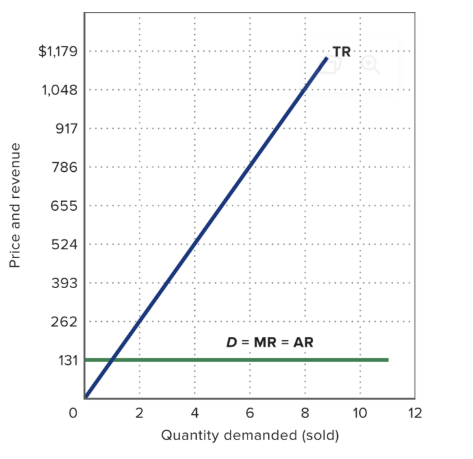
The firm can sell as much as it wants at the market price, but nothing above it. The demand curve is a horizontal line.
Because:
The firm can sell as much as it wants at the market price
But it cannot sell anything above the market price
And it has no reason to sell below the market price
If the market price is $131, then:
At $131 → the firm can sell unlimited units
At $131.01 → the firm sells zero
At $130 → the firm is just losing money
So the firm’s demand curve is a flat line at $131
Why can’t a competitive firm charge more than the market price?
Buyers will instantly switch to other sellers offering the identical product at the market price.
Why doesn’t a competitive firm charge less than the market price?
It can already sell all it wants at the market price, so lowering the price only reduces profit
What is the difference between market demand and firm demand in pure competition?
Market demand is downward‑sloping.
The whole industry can affect price by changing total output
When price goes down, people buy more
The individual firm’s demand is perfectly elastic (horizontal) because the firm is too small to affect price
Perfectly elastic (horizontal)
The firm is too small to affect price
The market has a normal demand curve
The firm has a flat demand curve
What does the firm’s demand curve look like in pure competition?
A horizontal line at the market price. It is also the MR and AR curve.
D = MR = AR
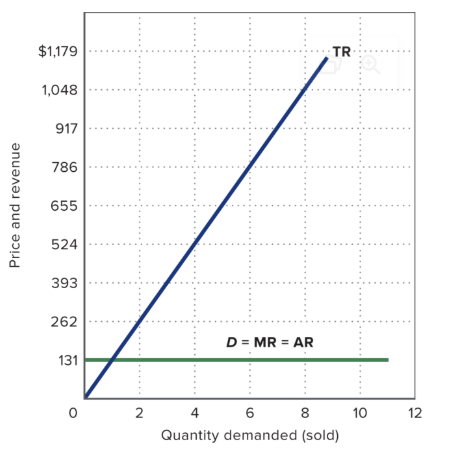
Average revenue = revenue per unit
In pure competition:
Price = AR
Because every unit sells for the same price.
If price is $131, then AR = $131.
Why is the firm’s demand curve also its MR and AR curve?
Because price is constant.
So:
AR = price
MR = price
Demand = price
All three are the same horizontal line.
How do you calculate Total Revenue (TR)?
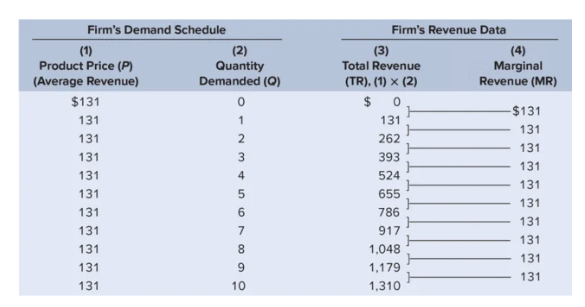
TR = Price × Quantity.
With a constant price, TR increases in equal steps.
So if price is $131:
1 unit → $131
2 units → $262
3 units → $393
10 units → $1,310
That’s why the TR curve is a straight upward line.
Why does TR rise in a straight line for a competitive firm?
Because each additional unit sold adds the same amount to revenue (the constant price).
What is Marginal Revenue (MR) in pure competition?
MR is the extra revenue from selling one more unit.
Since price is constant, MR = price.
Since each unit sells for $131:
Selling one more unit always adds $131
So MR = $131 every time
MR = Price = AR
And all three are the same horizontal line.
Why is MR constant in pure competition?
Because every unit sells for the same price, so each unit adds the same amount to total revenue.
What do the TR, MR, AR, and demand curves look like for a competitive firm?
TR: straight upward‑sloping line
Demand: horizontal
MR: horizontal (same line as demand)
AR: horizontal (same line as demand)
Explore top notes

Explore top flashcards
