S2 W5 - Interactions b/w Cell + Environment
 Call Kai
 Learn
Learn Practice Test
 Spaced Repetition
 Match
Match Flashcards
 Knowt Play
1/53

There's no tags or description
Looks like no tags are added yet.
Name | Mastery | Learn | Test | Matching | Spaced | Call with Kai |
|---|
No analytics yet
Send a link to your students to track their progress
54 Terms
Extracellular matrix
Network that provides structural support to surrounding cells
Where are epithelial cells found
Epithelial cell sheets form epithelium; cover external surfaces, organs, line internal body cavities
What are the five different junctions of epithelial cells in order from the apical to basal side (top to bottom)
Tight junctions
Adherens junction
Desmosomes
Gap junctions
Hemidesmosomes
Which of the junctions are cell-cell anchoring
Adhereins junctions and desmosomes - link cytoskeletons of neighbouring cells
Which of the junctions are cell-ECM anchoring
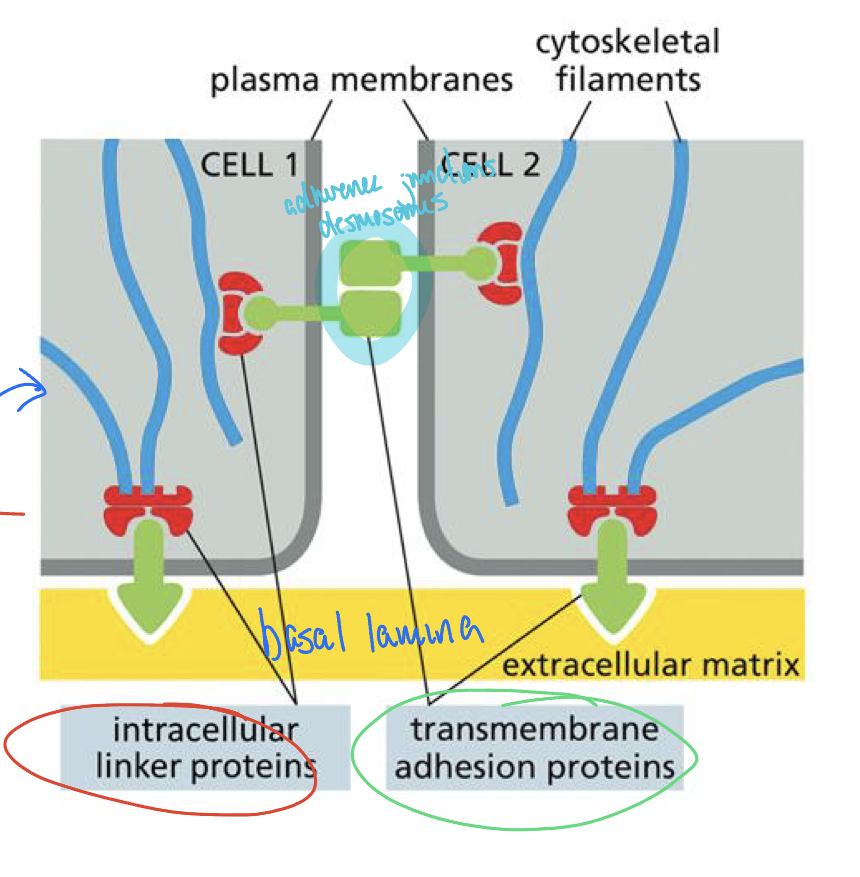
Hemidesmosomes - link cytoskeleton to basal lamina
Tight junction function
Prevents apical and basal membrane protein mixing
Recall:
Apical: Na+ - glucose symp
Basal: GLUT uniporter, Na+ K+ pump
Creates tight seal b/w cells
Forms sealing strands to prevent molecule movement
Tight junction structure
Two transmembrane proteins: Claudin + Occludin
Extracellular domain of one binds to extracellular domain of other
Homophilic binding (Cla-Cla, Occ-Occ)
Anchoring junctions
Provide mechanical strength to epithelium, includes adherents, desmosomes, hemidesomosomes
What forms anchoring junctions
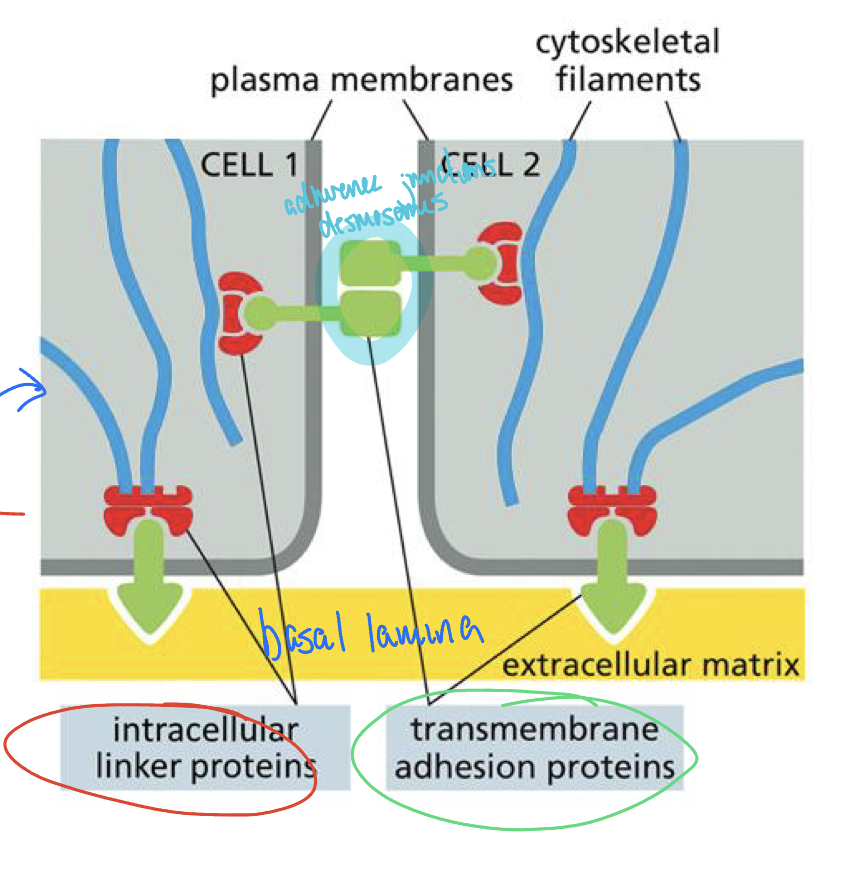
Adhesion proteins and linker proteins linked to the cytoskeleton
What are the two parts of transmembrane adhesion proteins
Extracellular domain
interact w/ adhesion proteins of neighbouring cell side or ECM
adheren junctions, desmosomes, hemidesmosomes
Intracellular domain
interact with linker proteins
Intracellular linker proteins
Proteins in cytosol that connect cytoskeleton and membrane proteins
Explain the general cell-cell anchoring junction pathway
Cell 1 cytoskeleton — linker protein — adhesion protein — adhesion protein of neighbouring cell — linker proteins — cell 2 cytoskeleton
Explain the general cell-ECM anchoring junction pathway
Cytoskeleton — linker protein — adhesion protein — ECM (basal lamina)
Anchoring junction protein specificity
Each anchoring junction has specific transmembrane adhesion proteins and intracellular linker proteins
What transmembrane adhesion proteins are involved at adherens junctions
Cadherens with hemophilic binding
What type of cytoskeletal filaments link to cadheren adhesion proteins through linker proteins
Actin filaments
What cytoskeletal filaments do desmosomes and hemidesmosomes link to
Intermediate filaments e.g. Keratin filaments
Desmosomes: KF w/ neighbouring cells
Hemidesmosomes: anchor KF to basal laminate
What transmembrane adhesion proteins are involved at desmosomes
Nonclassical cadherens proteins
desmogelin, democollin
thru homophilic and heterophilic binding
What transmembrane adhesion proteins are present at hemidesmosomes
Integrins
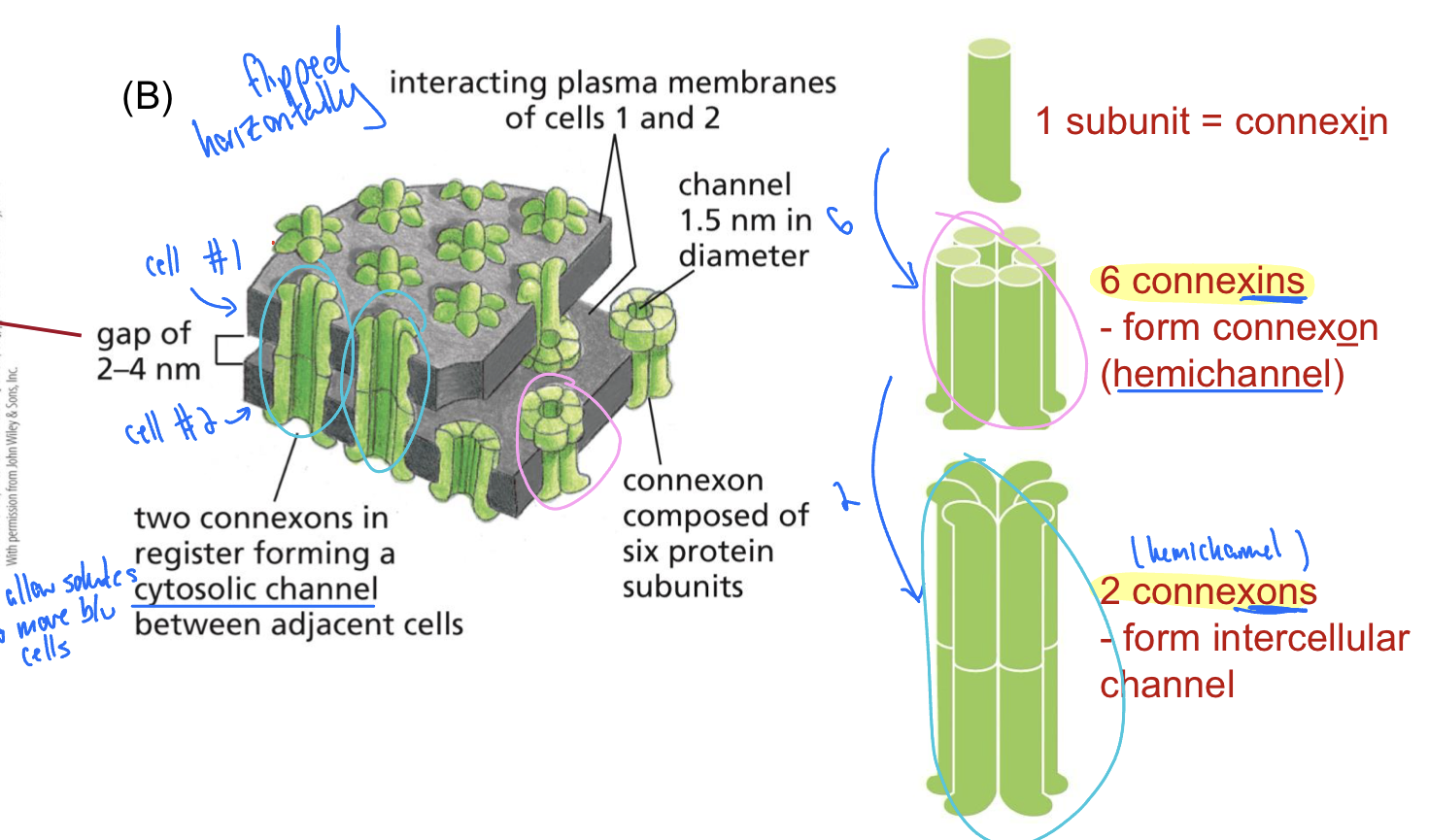
Gap function structure
Gap between cells with cytosolic channel running through
1 subunit = connexin
6 connexINS = connexON
2 connexons = channel
Function of gapjunctions
Couple cells tgt electrically and metabolically
allow ions + metabolites to pass thru
not very selective (small; <1000 daltons = pass)
Characteristic of gap junctions
Are gated; can be open or closed thru intra/extracellular signals
What are some examples of gap junctions opening / closing
Increase of cytosolic Ca2+ = close gap junction
Membrane damage = Ca2+ leak in = close gap junction so neighbour cell doesn’t lose metabolites too
Do plant cells have cell junctions
No, cell wall holds cells together and provides mechanical strength
Plasmodesmata
Intercellular junctions that allow for communication between cells in plants by crossing cell wall
What allows communication between cells in plants
Cytoplasmic channels in plasmodesmata that create continuous PM and ER across plasmodesmata
What is allowed through the cytoplasmic channels of the plasmodesmata
Small soluble molecules (< 1000 daltons)
Larger soluble molecules are trafficked by gates, proteins
What is an example of gating of the plasmodesmata
Callose is polysaccharide in plant that controls what passes thru by closing off plasmodesmata
What are animal tissues composed of?
Epithelial tissue cells
Connective tissue cells
Basal lamina
Examples of epithelial tissue
Intestinal lining, skin etc.
Characteristic of epithelial tissue cells
Closely attached to e/o
thin basal lamina (limited ECM)
Cytoskeletal filaments provide resistance to mechanical stress
Examples of connective tissue
Skin, bone, tendon, cartilage etc.
Characteristics of connective tissue cells
rarely connected
attached to matrix (plentiful ECM)
ECM provides resistance to mechanical stress
What are the 3 major classes of macromolecules in the ECM
Glycosaminoglycans (GAGs) + proteoglycans
Fibrous proteins
Glycoproteins
Structure of GAGs in connective tissue ECM
long, linear
repeating disaccharide
highly neg chg (attracts water)
What do GAGs form and why is it good
Forms hydrated gels, able to resist compression and fill space
What are proteoglycans (in connective tissue ECM)
subclass of glycoprotein
has one sugar side chain that is GAG
Collagen within connective tissue ECM
Fibrous protein that provides tensile strength and resists stretching
What is an example of a typical collagen found in connective tissue ECM
Fibril-forming collagen
—> 3 chains = triple helix = assemble into collagen fibril = pack into collagen fibre
What form is collagen secreted as?
Procollagen
Where is procollagen secreted from
Fibroblasts (skin, tendon, other connective tissue)
Osteoblasts (bone)
What binds to collagen in the ECM to organize?
Fibronectin and integral
Explain the binding of Fibronectin, integral, and collagen
Fibronectin binds to collagen and integrin — Integrin binds to adaptor proteins — Adaptor proteins connect to actin filaments
Function of elastin in connective tissue ECM
Give tissue elasticity, resilience, allow it to stretch
Function of basal lamina of epithelial tissue ECM
Separates epithelia from tissue underneath
Prevents fibroblasts from connective tissue from interacting with epithelial cells
allows passage of macrophages / lymphocytes
Characteristics of basal laminate of epithelia tissue ECM
Specialized type of ECM
Thin
Influences polarity
What contributes to basal laminate linkage
Where epithelia attatch
Basal laminate anchored by hemidesmosomes
Organized by laminin
Function of laminin
(blue) glycoprotein that organizes basal lamina
Links integrin (green) to type IV collagen (red)
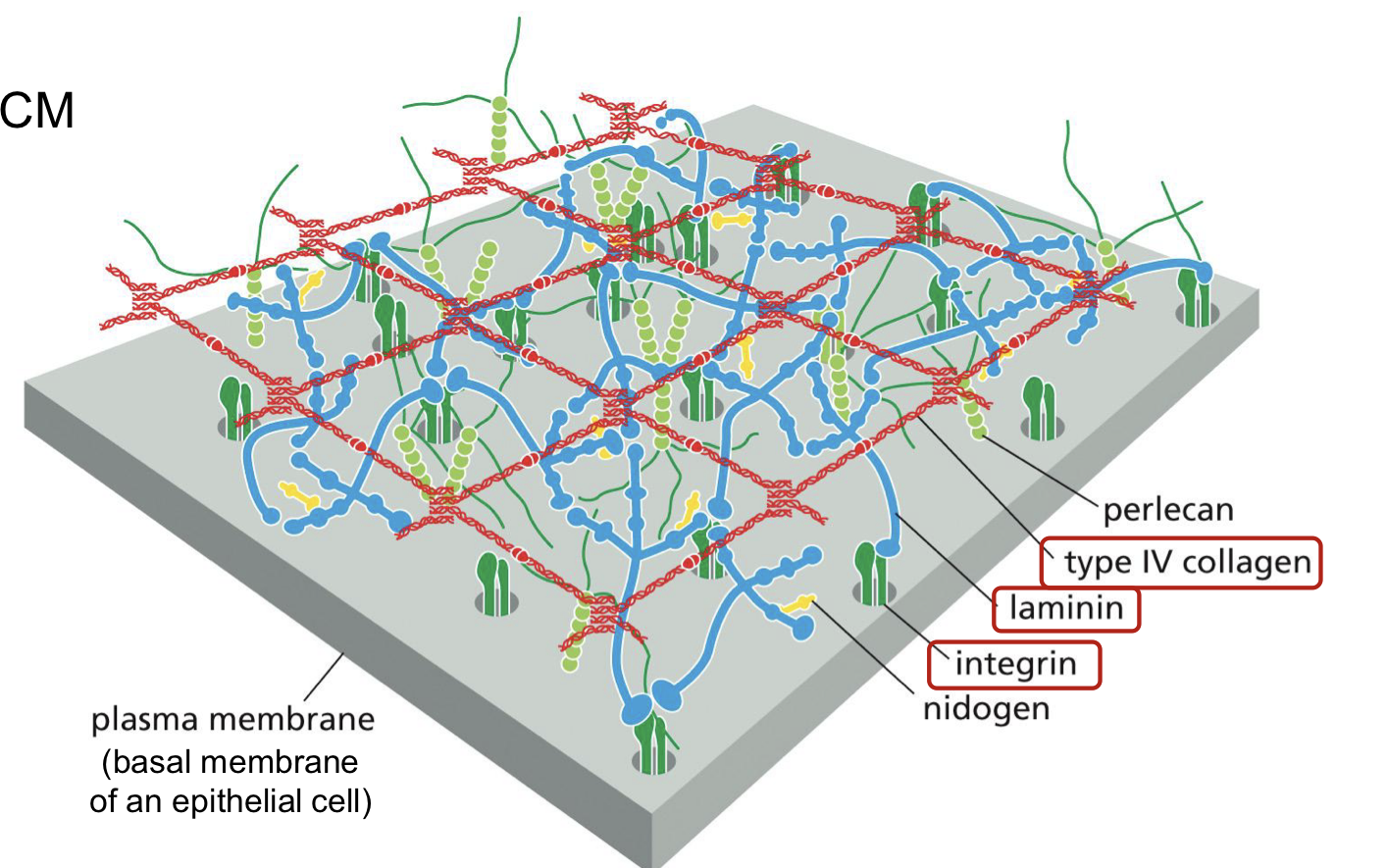
What transmembrane adhesion proteins are involved at hemidesmosomes
Integrins bind laminin (glycoprotein that organizes basal laminate) to the basal lamina
Main components of the plant cell wall
Cellulose, pectin
Function of cellulose in cell wall
Provide tensile strength
Function of pectin in cell wall
Fills space to provide resistance to compression
Where are cell wall components synthesized
Plasma membrane (e.g. cellulose synthase complex)
Golgi apparatus —> exported by exocytosis

