Topic 12- Eukaryotes
 Call Kai
 Learn
Learn Practice Test
 Spaced Repetition
 Match
Match Flashcards
 Knowt Play
1/24

There's no tags or description
Looks like no tags are added yet.
Name | Mastery | Learn | Test | Matching | Spaced | Call with Kai |
|---|
No analytics yet
Send a link to your students to track their progress
25 Terms
What are growth factors/ hormones
What would result in the mutation of growth factor
RECEPTION: proteins that bind to a receptor → TRANSDUCTION: phosphorylation cascade → RESPONSE: activates transcriptional activator →
DRIVE:
divide-promoting gene (can cause cancer)
growth-promoting gene (become smthg)
eg. FOPS mutation BMP (permanently on)
How do master regulators control cell fate?
Explain using MyoD and its repressor myostatin.
Master Regulators: transcription factors that can activate entire gene networks to determine cell fate
e.g.
MyoD- (master regulator of muscle cell differentiation)
It turns on genes required for muscle formation.
It can even convert non-muscle cells into muscle cells
Myostatin (MyoD Repressor)
inhibits muscle growth
Cell fate depends on the balance between activation (MyoD) and repression (myostatin).
What are tissue-specific enhancers?
how do they regulate gene expression?
DNA elements that increase transcription of a gene, but only in specific cell types or tissues.
Bind tissue-specific transcription factors.
Help recruit RNA polymerase and coactivators to the promoter.
Can act far from the gene (upstream, downstream, or in introns).
Key point: They ensure genes are only active where needed, e.g., liver-specific enhancers activate liver genes but not muscle genes.
How can loss of enhancers or alternative promoters contribute to human-specific traits, and how are reporter genes used to study this?
Loss of enhancers/alternative promoters:
Can reduce or eliminate expression of certain genes in specific tissues.
This can lead to human-specific traits (e.g., smaller jaw, loss of body hair, brain development changes).
Reporter genes:
Used to test enhancer activity in experiments.
A reporter (like GFP or LacZ) is placed under the control of the enhancer.
Active enhancer → reporter expressed, inactive enhancer → no signal.
How were ancient networks adapted to form mammal emotion?
Vasopressin & Oxytocin- ancient plieotropic peptide whos ancestor regulated urination & smooth muscle control
How do alternative promoters of oxytocin and vasopressin receptors influence emotional behavior?
Tissue-specific promoters allow the same hormone gene to have different emotional effects depending on which brain region expresses its receptor.
Oxytocin receptor
Tissue-specific enhancers/promoters drive expression in brain regions like the amygdala and nucleus accumbens.
This expression modulates social bonding, trust, and maternal behaviors.
Vasopressin receptor (AVPR1a/AVPR1b):
Alternative promoters enable expression in hypothalamus, amygdala, and other limbic areas.
Regulates aggression, social recognition, and stress responses.
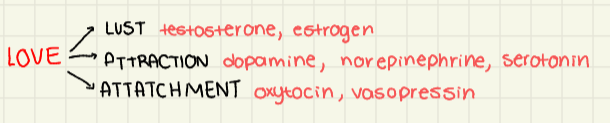
Explain the three components of LOVE and the associated hormones
What are the main emotional effects of
vasopressin
dopamine
oxytocin
Oxytocin: ↑ Social bonding, trust, maternal behaviors, and positive social emotions
Vasopressin: ↑ Aggression, territoriality, social recognition, and stress-related responses. TRIUMPH
Dopamine: ↑ Reward, MOTIVATION, pleasure, and reinforcement of goal-directed behavior.
Explain why Prairie & Meadow voles behave differently.
mention microsatellites
Prairie Voles: (monogamous)
oxytocin & vasopressin receptors in social recognition centers
LONGER MICROSATTELIE (+ leaky) = broader reward system
Can’t mate as much due to habitat → all eggs in one basket.
Meadow Voles: (promiscuous)
oxytocin and vasopressin receptors only in pleasure center
Can mate more due to habitat
Explain the “love instinct” through microsatellite length!
Monogamous voles have (microsatellite) promoter inserts → receptors expressed in more brain areas
During sex, oxytocin & vasopressin bind these receptors → activate reward circuits.
Result: associate pleasure with mate → promotes pair bonding.
in monogamous vole- longer microsatellites are selected for
What is the effect if a human male is homozygous for microsatellite 334?
less empathetic/ generous
“commitment phobia”
+ divorce
Higher Entrepreneurship and sexual opportunism maybe higher.
What is Epigenetics?
Why is it important?
Lamarck
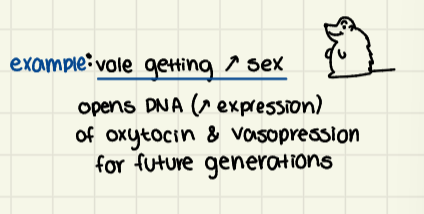
give player vole example
Traits inherited independently of DNA sequence.
methylation of DNA caused by experience → can be inherited!
Epigenetics PRE-adapts children for environment (occurs faster than evolution)
Lamarck: characteristics you acquire CAN be passed on
What is the “Histone Code”
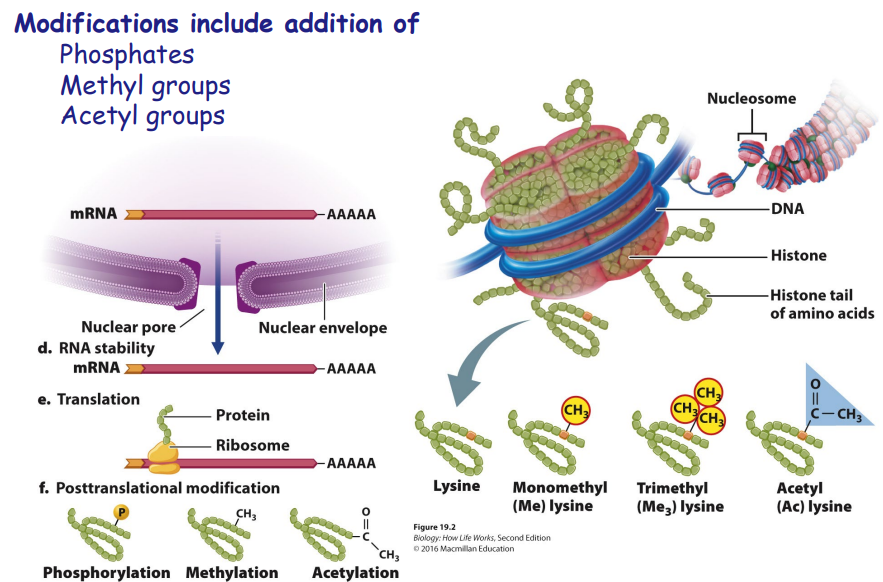
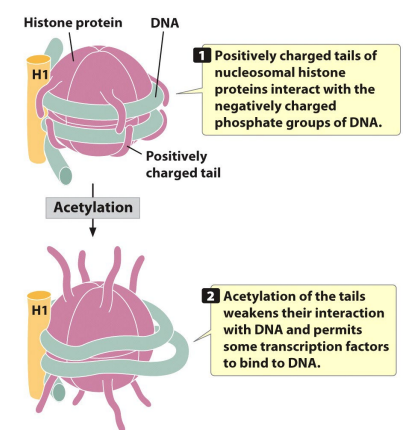
100 different posttranslational modifications of histone tails that control activity of nearby genes.
e.g. addition of methyl, acetyl, phosphate groups
Methylation
Addition of methyl groups to histone tail → silences genes
Done by Polycomb Complexes (PRC2, PRC1)
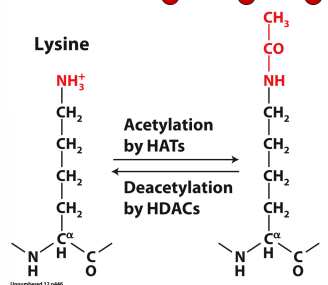
remodel chromatin via trimethylation of lysine 27 in histone 3 that recruits HDACS (Histone deacytlase)
Acetylation
Addition of acetyl groups to histone tails increases gene expression
What are Pioneer Factors?
give example
Bind condensed chromatin
Recruit Chromatin Remodelers (HATS)
AND/ OR kick of H1
neutralize charge (initiates the opening of folded DNA)
e.g. transcriptional activator FoxP2
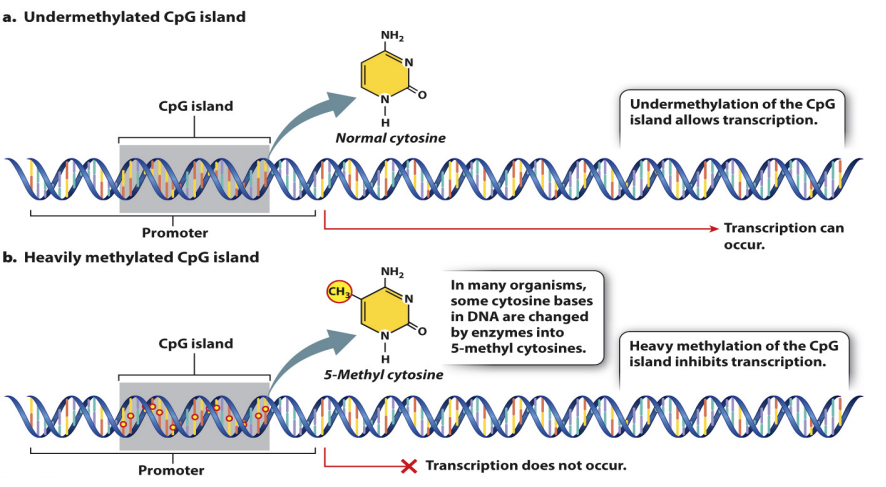
CPg islands
Transcription of inappropriate genes blocked by methylation at “CpG islands” found near transcription start sites
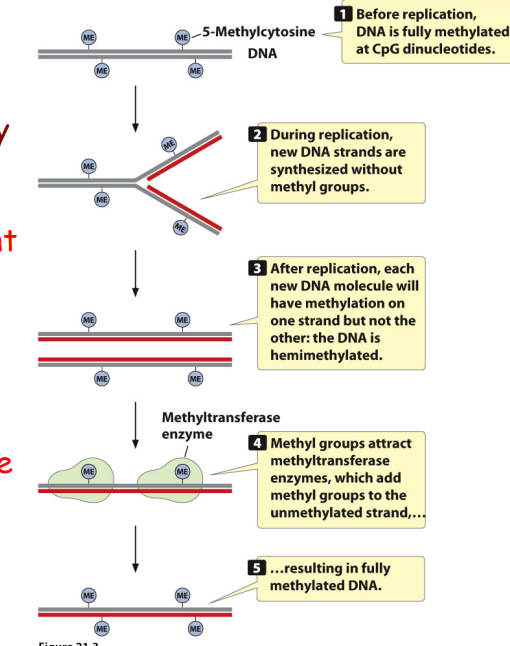
How is methylation maintained during replication?
Methyltransferase enzyme adds methyl to hemimethylated DNA
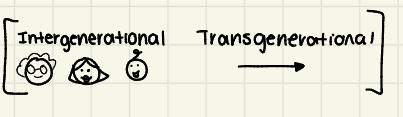
Intergenerational vs transgenerational change
Endocrine Disruptors
what effect can they have?
*can result in TRANSgenerational changes*
Chemicals that mimic, block, or alter hormones, disrupting normal body regulation and development.
cause heritable epigenetic changes (like altered DNA methylation or histone modification in germ cells
What is the missing heritability problem?
genetic variations cannot account for all the heritability of diseases, behaviors, and other phenotypes
EPIGENTICS EXPLAIN THIS
What is Nutrigenomics?
give example
The study of how genes and nutrition interact. Allelic differences predict how your body will likely respond to certain nutrients.
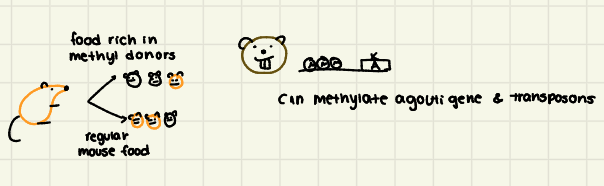
How does Epigenetics explain the Phenotypic difference between Queen and Worker bees.
“Royal Jelly” → surpresses Dnmt3 (usually methylates queen characteristics → expression of QUEEN genes.
What is the “thrifty phenotype" hypothesis?
When a baby develops in a nutrient-poor environment, it programs its metabolism to hold on to carbs, nutrients, etc
Helps survival short-term but increases risk of diseases like diabetes later

