(Exam 3) Pt. 1 Cardiovascular System: Structure & Function
 Call Kai
 Learn
Learn Practice Test
 Spaced Repetition
 Match
Match Flashcards
 Knowt Play
1/31

There's no tags or description
Looks like no tags are added yet.
Name | Mastery | Learn | Test | Matching | Spaced | Call with Kai |
|---|
No analytics yet
Send a link to your students to track their progress
32 Terms
The cardiovascular system:
1) [...] - nutrients, O2, CO2, enzymes, hormones, ions, metabolic wastes, leukocytes
2) [....]of body temperature
Transports and Stabilization
Works with the [....] system
• Cardiopulmonary or cardiorespiratory system
pulmonary
Two major adjustments of blood flow during exercise:
• Increased [....]
• [...] of blood flow from inactive organs to active muscle
cardiac output and Redistribution
[....]:
- releases pump
- creates pressure to pump blood
Heart
[....]:
- carry blood away from the heart
- Arteries and Arterioles
[....]:
- exchange of O2, CO2, and nutrients with tissues
Capillaries
[....]:
- carry blood toward the heart
Veins and venules
The heart:
- beats [....]
- pumps ~ 1.5 million gallons of blood per year
- [....]
- 4 chambers - 2 [...] and 2 [....]
- Pumps blood into 2 circuits:
[...]
- 100,000 times per day (~70 beats/min);
- 5 - 30 liters per minute
- atria and ventricles
- pulmonary circuit and systemic circuit.
Pulmonary circuits:
o [....] side of the heart
o Pumps [....] blood to the lungs via pulmonary artery
o Returns [....] blood to the left side of the heart via pulmonary veins
Right; deoxygenated; oxygenated
Systemic circuit:
o [...] side of the heart
o Pumps [....] blood to the whole body via [...]
o Returns [...]blood to the [....]side of the heart via veins
Left; oxygenated; arteries; deoxygenated; right
The pericardium:
- The heart is near the [....] chest wall and directly posterior to the sternum in the pericardial cavity
- Pericardium is the serous membrane lining the [....] cavity
- forms 2 layers:
[....]
- also called the epicardium
[....]
- reinforced by a layer called the fibrous pericardium (external sac)
- Between the visceral and parietal is the [....] there is fluid that act as lubricated that reduces against the two layers to help the heart contract.
anterior; pericardial; Visceral and parietal pericardium; pericardial cavity
The myocardium:
- Receives blood supply via [....]
-- high demand for [...]
- [....]
-- Blockage in coronary blood flow results in cell damage/ death
coronary arteries; oxygen and nutrients; Myocardial infarction (MI)
- heart attack is damaged to the myocardium.
Exercise training protects the heart:
- Regular exercise is [....]
-- Reduces incidence of [....]
-- improves survival from a heart attack
- Exercise reduces the amount of [....] from heart attack
-- improvement in heart's [...] capacity.
cardioprotective; heart attacks; myocardial damage; antioxidant
How does cardiac muscle communicate with cardiac muscles?
- The desmosomes connects the membrane of two adjacent cardiac cells
- the gap junction communication allows passage of small ions to generate cardiac muscle cells.
[....]
- Originate at the base of the ascending aorta
o Supply the cardiac muscle tissue
Coronary arteries
The Cardiac Cycle:
- Alternate periods of contraction & relaxation
- [....]:
o Describe the blood being ejected into the ventricles
o Blood is ejected into the ventricles
o Blood is ejected into the pulmonary trunk and the ascending aorta
- [....]:
o Describes relaxation of heart
o Chambers are filling with blood.
Systole; diastole
Step 1 of cardiac cycle:
- Both atrial contract and send blood to the ventricles.
Step 2 of cardiac cycle:
- Aortic valve will only open if the pressure in the ventricles exceeds the pressure in the aorta. This is called isometric volume.
Step 3 of cardiac cycle:
- Ventricular systoles and ventricular diastoles both have 2 phases.
Step 4 of cardiac cycle:
- Ventricular systole first phase: ventricular contraction pushes the AV valve closed but does not create enough pressure to open the semilunar valve.
Step 5 of cardiac:
- The second phase is ventricular pressure rises and exceeds the pressure in the arteries; the semilunar valves open and blood is ejected.
- FINISH THE CYCLE
Arterial blood pressure:
- Expressed as systolic/diastolic
o [...]
- Systolic pressure
o Pressure generated during [...]
- Diastolic pressure
o Pressure in the arteries during [....]
- Pulse pressure
o [....] between systolic and diastolic
- Mean arterial pressure (MAP)
o Average pressure in the [...]
Normal is 120/80 mmHg; ventricular contraction; cardiac relaxation; Difference; arteries
Hypertension:
- Blood pressure above[....] (hypertension)
o Cause unknown [...]
- [....] hypertension
o Result of some other disease process
- Risk factor for:
o Atherosclerosis and heart attack
o Kidney damage
o [...]
130/80 mmHg; (multifactorial); Secondary; Stroke
Factors that influence arterial blood pressure: [...]
Determinants of mean arterial pressure (MAP), Short term regulation, and long term regulation
Determinants of mean arterial pressure (MAP):
• [....]
• Total [...]
- MAP = [....]
- Diameter of the vesicle plays a huge part because if we decrease the diameter, we will have an increase in blood flow because there is not a lot of space.
Cardiac output; vascular resistance; cardiac output × total vascular resistance
Short term regulation:
o [....] nervous system
o Baroreceptors in [....]
§ Increase in BP = [...] SNS activity
§ Decrease in BP = [....] SNS activity
Sympathetic; aorta and carotid arteries (pressure receptors); decreased; increased
Long term regulation:
- [....]
§ Via control of [....]
- kidney; blood volume
Electrical activity of the heart:
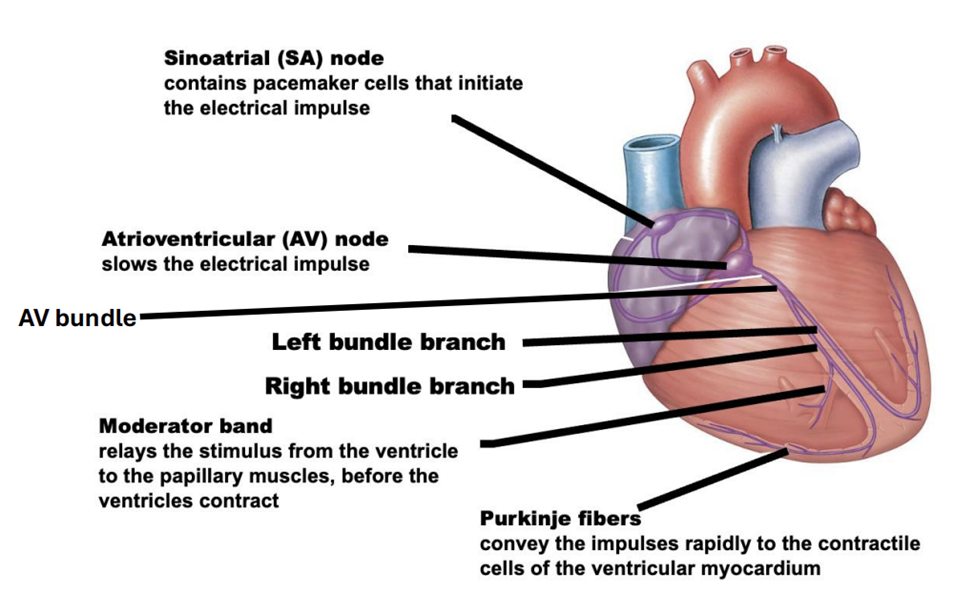
- The cardiac cycle is coordinated by conducting cells: [...]
Nodal cells and conducing fiber
Nodal Cells:
- [....] (pacemaker of the heart)
· Establish the rate of contractions
- [....]
- Has pacemaker cells and creates electrical impulses sent to [....] nodes; the atrium will then contract and then a little delay when signals reaches AV node; this happens because we allow [....] to fill with blood; from AV node the impulses travels down to left and right bundle branch and then go to the [....].
Sinoatrial (SA) node; Atrioventricular (AV) node
-AV; ventricular; Purkinje fibers
Conducting fibers:
[....]
- Distribute the contractile stimulus to the myocardium
Electrocardiogram:
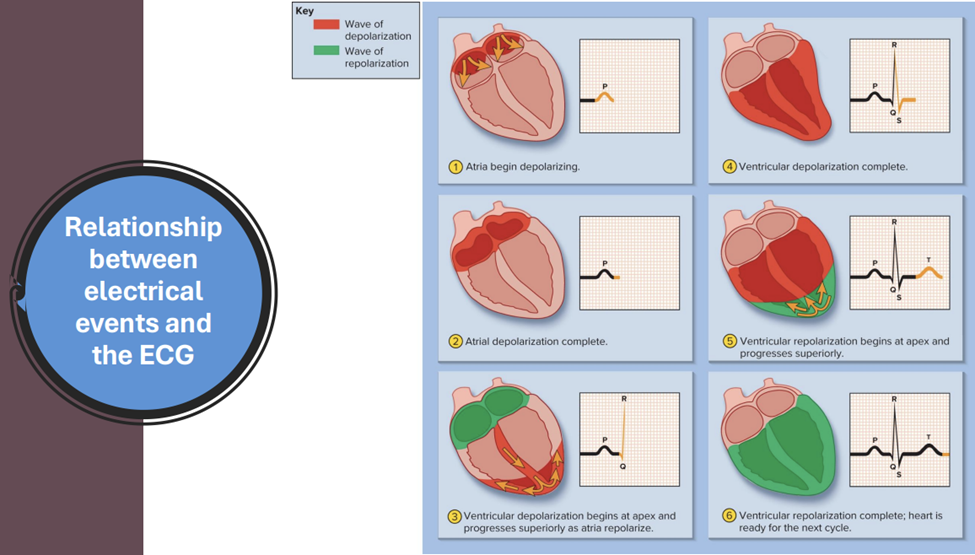
- Records the heart's activity
o [...]
§ Atrial depolarization
§ Atrial systole
o [....]
§ Ventricular depolarization and atrial repolarization
§ Atrial repolarization is concealed by the QRS complex.
o [...]
§ Ventricular repolarization
o ECG abnormalities may indicate [....]
§ ST- segment depression can indicate myocardial ischemia
P wave; QRS complex; T wave; coronary heart disease
Diagnostic use of the ECG during exercise:
- Graded exercise test to evaluate cardiac function
o Observe ECG during exercise
o Also observe changes in [....]
- [...]
o Fatty plaque that narrows coronary arteries
o Reduce blood flow to myocardium
§ Myocardial ischemia
- S-T segment depression
o Suggest [....]
blood pressure; Atherosclerosis; myocardial ischemia

