Fiszki: Plant and Animal Responses - OCR A-Level Biology | Quizlet
 Studied by 0 people
 Call with Kai
 Learn
Learn Practice Test
 Spaced Repetition
 Match
Match Flashcards
 Knowt Play
1/64

There's no tags or description
Looks like no tags are added yet.
Name | Mastery | Learn | Test | Matching | Spaced | Call with Kai |
|---|
No study sessions yet.
65 Terms
What are the roles of auxins?
Control cell elongation
Prevents leaf fall
Maintains apical dominance
Involved in tropisms
Stimulates release of ethene
Inhibit Fruit ripening - high conc. of auxins means fruit is not ripe - antagonistic to ethene which promotes fruit ripening
What are the roles of gibberellin?
Stem elongation - increase legnth of internodes
Triggers mobilisation of food stores in a seed at germination - can end the dormancy period of seeds and cause germination
Stimulates pollen tube growth
Delays senescence in citrus fruits.
what is the role of cytokinins?
stimulate cell division and differentiation by producing the proteins needed for mitosis and cytokinesis, and delay ageing of fruits and leaves
Promote cell division, delay leaf senescence, overcome apical dominance and promote cell expansion.
- A high level of auxin causes cytokinins to move to the shoot apex - when the apex is removed cytokinins spread evenly around the plant and cause bud growth.
What are the roles of ethene?
Fruit ripening
- more dark = less auxin = more ethene
Promotes abscission-stimulates abscissiom zone
Synergism
When two hormones work together
abscision zone
enzymes stimulated - digest weak end of the leaf - deposits fat to prevent pathogens entering
What are the roles of ABA?
Abscisic acid
Maintains dormancy of seeds and buds - opposite of giberellins - antoginistic
Stimulates cold protective responses - with antifreeze or stomatal closure
Stimulates stomatal closure - if not enough water
- high auxin levels means high ABA when auxin removed ABA removed - lateral shoots grow
How are plant hormones involved in seed germination?
Seed absorbs water; embryo activated and produces gibberellins(synthesised - acts as a TF); turn section of DNA on to be translated into protease which stimulate production of enzymes to break down food stores in seed (amylases and proteases); ATP produced; ABA acts as an antagonist to gibberellin
What is the experimental evidence for gibberellins controlling seed production?
Mutant seeds bred with lack of gene that enables gibberellin production; do not germinate; if gibberellins applied externally, germinate
If gibberellin inhibitors applied, seed does not germinate
How do auxins stimulate the growth of the main, apical shoot?
Affect the plasticity of cell wall (stretches more easily) - auxin binds to receptor sites; fall in pH (optimum pH for enzymes needed to keep walls flexible); as cells mature, auxins are destroyed; ph rises and makes enzymes inactive
How do auxins suppress the growth of the lateral shoots?
Because higher auxin production at tip of main apical shoot, auxin conc at lateral shoots are low
When apical shoot removed, lateral shoots grow faster as auxins removed
If auxins applied to cut apical shoot, apical dominance reoccurs
How do auxins affect root growth?
In small concentrations - up to certain conc, the more auxin which reaches roots, the more that they grow
What causes leaf loss in a deciduous plant?
Photoperiodism - plants are sensitive to lack of light; results from phytochrome which comes in two forms and absorbs different types of light
Falling light levels lead to lower auxin concentrations; leaves produce ethene; at abscission zone, ethene initiates production of enzymes which weaken the cell walls in outer layer (separation layer); vascular bundles sealed off; fatty material deposited stem side (protection scar from infection); cells in separation zone retain water and swell, putting strain on outer layer; leaf falls
How is the opening and closing of the stomata controlled by ABA?
Leaf cells release ABA under abiotic stress, causing stomatal closure
Levels of soil water fall; roots produce ABA; travels to leaves and binds to receptors on guard cells
ABA activates ionic conc of guard cells, reducing the water potential and turgor of guard cells; close and water loss reduced
why do plants need to be able to respond to their environment?
To help cope with the changing conditions
- avoid abioitc conditions - avoid stress
-make sure conditions maintained to maximise photosynthesis
- avoid grazing - herbivory
-ensure germination is suitable
-obtain more light, water, minerals
general list of plant hormones
- production of pheremones to protect from pheremones
-increase lignification - windy environments
-more wax on leaves in high temp
-chemical defences
in higher temp thicker layer of wax to prevent water loss
What are plants' physical defences to herbivory?
Thorns, barbs, spikes etc
What are plants' chemical defences to herbivory? - where are they found?
Tannins - bitter taste; toxic to insects; present in tea and red wine - found in the upper epidermis
tannins in the Leaf make it taste bad and tannin in the roots prevents infiltration of pathogenic microorganisms.
Alkaloids - bitter tasting; affect animals metabolism; include caffeine, nicotine, morphine, and cocaine - found in growing tips and flowers.
Terpenoids - toxic to insects and fungi; insect repellents
How do pheremones defend plants?
Pheromone - a chemical which affects the social behaviour of other members of the same species or physiology
e.g. maple tree attacked, releases pheromones to leaves on other branches; make callose which protects them if they're attacked.
e.g. root systems 'tell' each other when they're under water stress
How do volatile organic compounds defend plants?
VOC - act like pheromones between themselves and other organisms
e.g. when cabbages attacked by caterpillars, produce signal which attracts parasitic wasp; insect lays eggs in caterpillar, and eats it alive; signal deters butterflies from laying eggs
e.g. when apple trees attacked by spider mites, predatory mites signalled
How does the Mimosa pudica plant protect itself through folding in response to touch?
Occurs due to chemical changes in walls at bases of leaves; when leaf touched active movement of potassium ions into upper side of pulvinus (joint) whilst potassium ions moved out under it; water follows potassium ions; leaf bends down
Frightens herbivores and dislodges small insects
What is phototropism?
Growth response too light.
Result of movement of auxins across shoot or root if it is exposed to light that is stronger on one side than the other
Shoots/(stems) are positively phototropic - bend towards light
Roots are negatively phototropic - bend away from light
Light causes auixns to accumulate on other side, promoting cell growth and allowing it to bend towards light
Why do plants grow more rapidly in the dark?
Grows rapidly to try and find light - etoilation
Gibberellins responsible - extreme elongation of internodes
What is geotropism?
Growth repsonse to gravity
Shoots are negatively phototropic
roots inhibit cell division
side of root with less gravitational pull - roots grow downwards
Roots are positively phototrophic - grow towards the pull of gravity - needed for support - anchored in soil - for turgidity
What is thigmotropism?
a plant's response to touch
e.g shoots of climbing plants such as ivy - cling to physical structures - positive tropism
What is chemotropism?
Directional growth response to chemicals - on a flower, pollen tubes grow down the style, attracted by chemicals, towards the ovary where fertilisation can take place.
Positive = towards the stimulus
negative = away from the stimulus
What is a nastic response?
Non directional response to external stimuli
How does ethene affect the ripening of fruit?
Ethene triggers the rapid ripening of fruit
People collect unripe fruit (easier to transport) and when needed for sale, exposed to ethene gas
Prevents wastage
-more dark = less auxin = more ethene
What is the commercial use of hormone rooting powders?
When auxins added to cut shoots stimulates root production; easier to propagate new plants from cuttings
What are the commercial uses of hormonal weedkillers?
Uses synthetic auxins - crops are normally narrow-leaved monocot plants and weeds are broad-leaved dicot plants; synthetic dicot auxins added, broad-leaved plants absorb it and affects their metabolism
Increases growth rate
What is the structural organisation of the nervous system?
Central nervous system - brain and spinal cord
Peripheral nervous system - neurones
What is the functional organisation of the nervous system?
Somatic nervous system - conscious control; voluntary
Autonomic nervous system - subconscious control; involuntary; divided into sympathetic (to increase activity for survival) and parasympathetic (to decrease activity)
What is the gross structure of the brain?
Cerebrum - controls voluntary actions
Cerebellum - controls unconscious functions
Medulla oblongata - autonomic control
Hypothalamus - regulatory centre for temp and water balance
Pituitary gland - stores and releases hormones
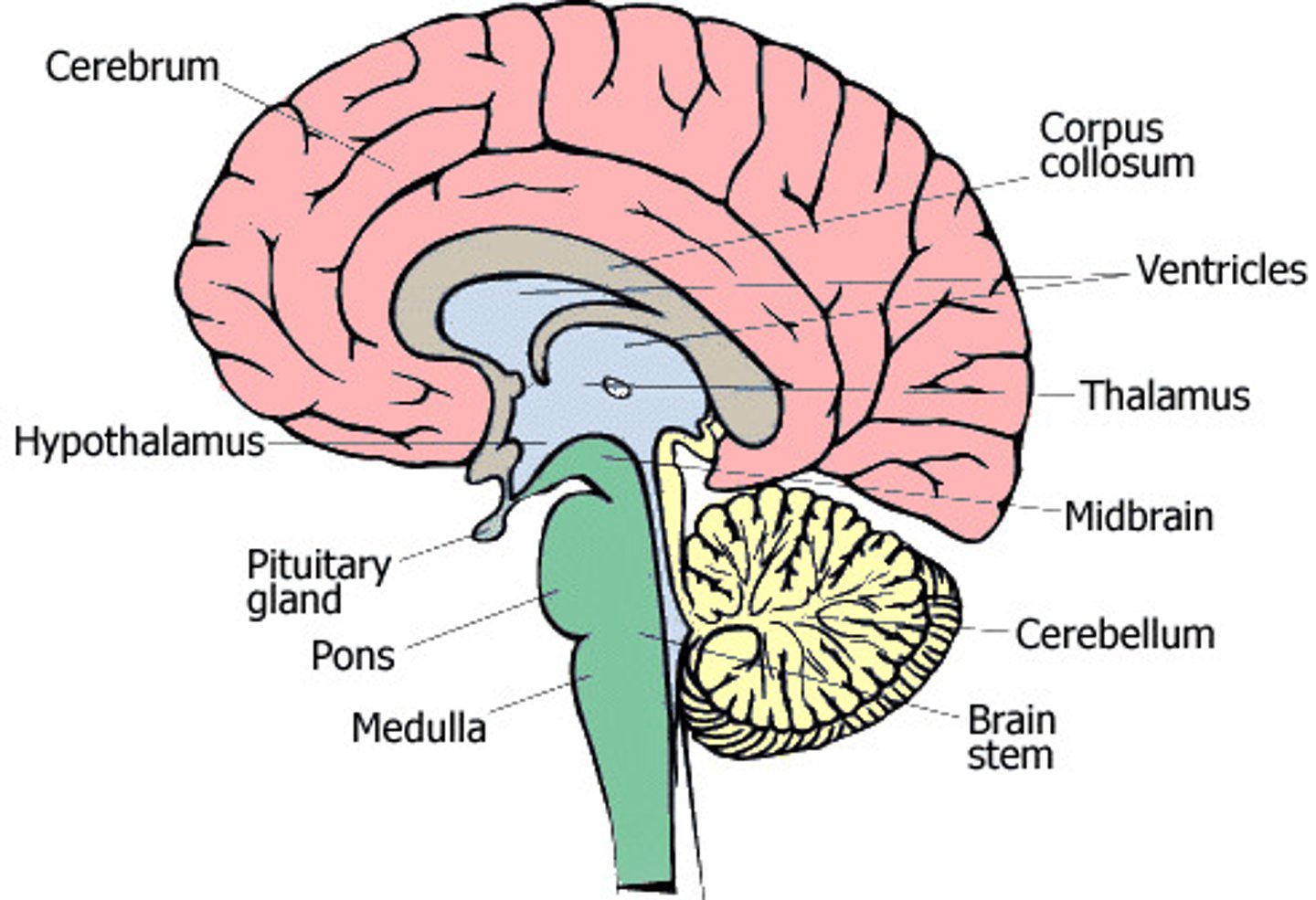
What is the function and structure of the cerebrum?
Functions - receives sensory info, interprets it in respect to past events, and sends impulses to effectors
Structure - highly convoluted (increases SA and capacity for activity); split into two hemispheres (left controls right side of body, right controls left side of body); outer layer is cerebral cortex (reasoning and decision making); size of sensory area is proportionate to number of receptor cells present in its allocated body part, and info passed to association areas
What is the function and structure of the cerebellum?
Function - control of muscular movement, body posture, and balance; receives info from organs of balance and info about muscle tone; relays info to cerebral cortex
What is the function and structure of the medulla oblongata?
Contains many regulatory centres of autonomic nervous system; control reflex activities
What is the function and structure of the hypothalamus?
Main controlling system for autonomic nervous system; two centres (one for sympathetic, the other for parasympathetic)
Controls complex patterns of behaviour
Monitors composition of blood plasma
Produces hormones
What is the function and structure of the pituitary gland?
Anterior pituitary - produces 6 hormones involved in reproduction and growth hormones
Posterior pituitary - stores and releases hormones produced by hypothalamus
What is a reflex?
An involuntary response to a sensory stimulus
What is the reflex arc?
Receptor - detects stimulus and creates action potential
Sensory neurone - carries impulse to spinal cord
Relay neurone - connects sensory neurone with motor neurone in spine or brain
Motor neurone - carries impulse to effector to carry out response
What is the knee-jerk reflex?
Spinal reflex
Leg tapped below knee cap at patella; patellar tendon stretches and acts as stimulus; initiates reflex arc causing thigh to contract; leg kicks
Absence reflects nervous problems and multiple oscillation may be cerebellar disease
Helps maintain posture and balance
What is the blinking reflex?
Occurs when cornea is stimulated; impulse travels down sensory neurone to relay neurone in lower brain stem; motor neurone initiates blinking
Keep cornea safe from damage
Cranial reflex
Tested in unconscious patients - if present, lower brain stem functioning
How do reflexes increase your chances of survival?
Involuntary - decision-making sections of brain uninvolved
Don't have to be learnt
Very fast
What is the flight or fight response?
Potentially dangerous situation triggers series of physical responses; intended to keep animals alive
Threat detected by autonomic > hypothalamus communicates with SNS (impulses to glands and smooth muscle to tell adrenal medulla to release adrenaline and noradrenaline) and adrenal-cortical system (stimulates pituitary gland to secrete ACTH to adrenal cortex to activate release of stress hormones) - mixture of neuronal and hormonal response
What is the role of adrenaline in the fight or flight response?
Trigger liver cells o undergo gylcogenolysis (release glucose)
Binds to receptor on liver cell membrane; activates adenyl cyclase; triggers conversion of ATP into cAMP on inner surface membrane; increase in cAMP molecules activates protein kinases which activate enzymes
Second messenger model - hormone is first messenger and cAMP is secondary messenger
How is heart rate controlled?
Through autonomic nervous system
Medulla oblongata - two centres linked to SAN (one increases heart rate by sending impulses through SNS through accelerator nerve; the other decreases heart rate by sending impulse down the PSNS through the vagus nerve)
Info provided by: baroreceptors (pressure; change in blood pressure; too low, increase rate) and chemoreceptors (chemical; located in aorta, carotid artery and medulla)
How do chemoreceptors control heart rate?
Sensitive to pH; if carbon dioxide level increases, pH of blood decreases because carbonic acid formed
pH decreases; response triggered to increase heart rate; blood flows more quickly to the lungs; carbon dioxide exhaled; when return to normal, frequency of nerve impulses decrease
How do baroreceptors control heart rate?
Blood pressure too high; impulse sent to medulla oblongata to reduce heart rate; blood pressure returns to normal
What are the types of muscle?
Skeletal - striated fibres; voluntary; regular arrangement; rapid short contractions; tubular and multinucleated
Cardiac - found in heart; specialised striated; involuntary; branched an uninucleated
Involuntary - non-striated; uninucleated
What is the structure of skeletal muscle?
Muscle fibres - enclosed within a plasma membrane (sarcolemma); result of many individual embryonic muscle cells fusing together (stronger); sarcolemma folds inwards to help spread electrical impulses; shared cytoplasm is sarcoplasm; lots of mitochondira and specialised sarcoplasmic reticulum
Myofibrils - protein organelles specialsed for contracting; made up of actin (thinner) and myosin (thicker)
Why do myofibrils have a striped appearance?
Light band - actin and myosin don't overlap
Dark bands - thick myosin filaments; edges dark as overlapped with actin
Z-line - centre of light band; distance between is sarcomere (shortens when contracts)
H-zone - lighter area at centre of dark band; only myosin
What is the structure of myosin?
Globular hinged heads; on head, binding site for actin and ATP; tails align to form myosin filament
-Two identical strands
-made of aa/myosin proteins
-Thick filament
What is the structure of actin?
Complimentary binding sites for myosin heads (often blocked by tropomyosin which is held in place by troponin); when contracted, myosin heads form bridges with actin.
-Thin filament
- Two actin proteins wrapped around each other
-aa
where are filaments found?
In Myofibrils - which are found in fibres - which are found in a bundle of muscle cells which are found in muscle.
Name for the membrane on skeletal muscle cells
sarcolemma
neuromuscular junction
point of contact between a motor neuron and a skeletal muscle cell
How contraction is set up at neuromuscular junctions
Action potential reaches junction, stimulates calcium ion channels to open, calcium ions diffuse into synaptic knob, synaptic vesicles fuse with presynaptic membrane, ACh released into synapse, binds to receptors on sarcolemma, opens sodium ion channels, depolarisation, spreads into muscle fibre down T tubules, calcium ion channels in the sarcoplasmic reticulum open, calcium ions flood into sarcoplasm
How does muscle contraction occur?
- Action potential arrives at neuromuscular junction (a lot of them to ensure simultaneous contraction);
- acetylcholine attaches to receptors on sarcolemma; sodium ion channels open; causes depolarisation which spreads through T-tubules (connected to sarcoplasmic reticulum);
- calcium ion channels open, releasing calcium ions which flood sarcoplasm; calcium ions bind to troponin which moves tropomyosin away from actin-myosin binding site as it changes shape causing it to be released;
- myosin head with ADP and P attaches forming cross bridge - called an actomyosin bridge - ADP and P released when it attaches
- This then flexes, then pulls actin filament along- called a power stroke; ADP on myosin head replaced by ATP, causing the head to detach; head reattaches further along, shortening sarcomere and causing contraction; calcium ions activate ATPase (ATP to ADP + phosphate + energy)
- eventually the myosin head will go back to starting position and by ATP hydrolysis
Label a sarcomere
M-Line: line in the middle of the thick filament
- contains A band: area with overlapped thick and thin filament - appears darker on microscope
-contains H zone - unoverlapped thick filament - appears slighlty lighter on microscope then A
Z-line: line in the middle of the thin fillament - Contains I zone - this appears lighter - consists of thin filament only as it lets more light in.
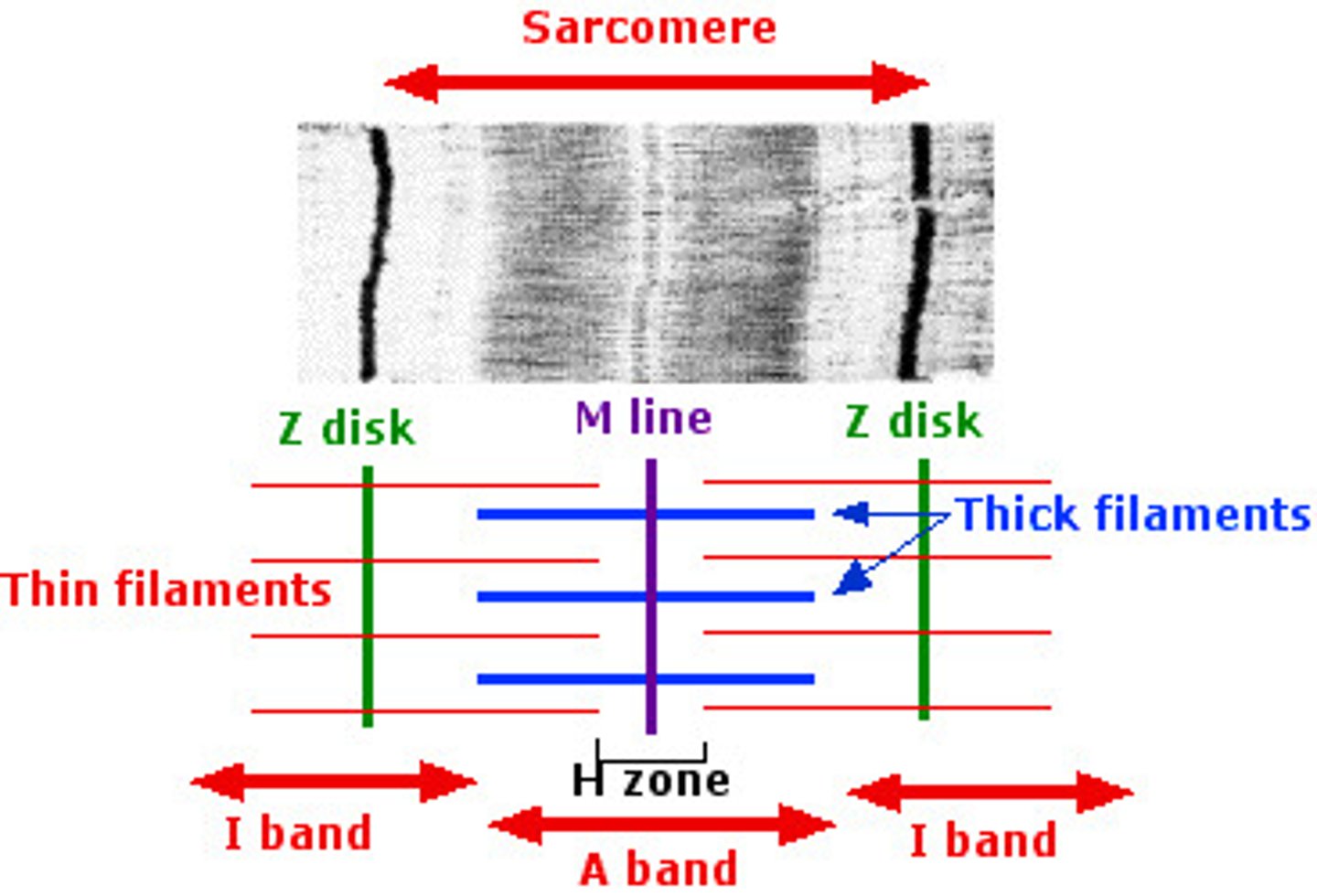
How to measure two sarcomeres
Two I bands
How is ATP produced in muscle contraction?
Aerobic respiration, anaerobic respiration, creatine phosphate
How is the supply of ATP maintained in muscles by creatine phosphate?
Reserve supply of phosphate which makes ATP from ADP
Structure of skeletal muscle that you can see with a microscope:
I bands contain just actin, A bands contain myosin and actin, H zone contains just myosin, Z lines are at the centre of each I band, M line is in centre of H zone
affect of sliding filament contraction:
When the muscle contracts, I band becomes very narrow, z lines become closer together, sarcomere shortens, H zone completely disappears/ more narrow/shorter
-more compact as actin filaments overlap with myosin filaments
Evidence for the sliding filament mechanism
I-band becomes narrower;
Z-lines move closer together (sarcomere shortens);
H-zone becomes narrower
BUT
A band and M-Line is the same length - it does not shorten
 Note
Note  Flashcards (56)