Formed Elements Review
 Call Kai
 Learn
Learn Practice Test
 Spaced Repetition
 Match
Match Flashcards
 Knowt Play
1/9

There's no tags or description
Looks like no tags are added yet.
Name | Mastery | Learn | Test | Matching | Spaced | Call with Kai |
|---|
No analytics yet
Send a link to your students to track their progress
10 Terms
erythrocytes
5.2 million microliter (4.4 - 6.0 million)
flattened biconcave disk; no nucleus; pale red color
transport oxygen and some carbon dioxide between tissues and lungs
lifespan approx 120 days
leukocytes (white blood cells)
7000 microliter; (5000-10,000)
obvious dark-staining nucleus
all function in body defenses
exit capillaries and move into tissues; lifespan to usually a few hours or days
granulocytes
abundant granules in cytoplasm; nucleus normally lobed
nonspecific (innate) resistance to disease
neutrophils
eosinophils
basophils
agranulocytes
lack abundant granules in cytoplasm; have a simple-shaped nucleus that may be indented
body defenses
lymphocytes
monocytes
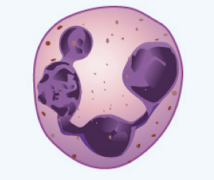
neutrophils
4150 microliter; (1800-9950)
nuclear lobes increase with age; pale lilac granules
phagocytic; particularly effective against bacteria
release cytotoxic chemicals from granules
most common leukocyte; lifespan of minutes to days
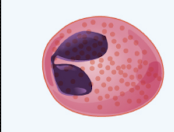
eosinophils
165 (0-700)
nucleus generally two-lobed; bright red-orange granules
phagocytic cells; particularly effective with antigen-antibody complexes. Release antihistamines. Increase in allergies and parasitic infections
least common leukocyte; lifespan unknown
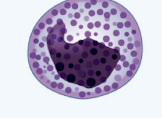
Basophils
44 (0-150)
nucleus generally two-lobed but difficult to see due to presence of heavy, dense, dark purple granules
promotes inflammation
least common leukocyte; lifespan unknown

lymphocytes
2185 (1500-4000)
spherical cells with a single often large nucleus occupying much of the cell’s volume; stains purple; seen in large (natural killer cells) and small ( B and T cells variants
primarily specific (adaptive) immunity; T cells directly attack other cells (cellular immunity); B cells release antibodies (humoral immunity); natural killer cells are similar to T cells but nonspecific
initial cells originate in bone marrow, but secondary production occurs in lymphatic tissue; several distinct subtypes; memory cells form after exposure to a pathogen and rapidly increase responses to subsequent exposure; lifespan of many years

monocytes
455 (200-950)
largest leukocyte with an indented or horseshoe-shaped nucleus
very effective phagocytic cells engulfing pathogens or worn out cells; also serve as antigen-presenting cells (APCs) for other components of the immune system
produced in red bone marrow; referred to as macrophages after leaving circulation
platelets
350,000 (150K-500K)
cellular fragments surrounded by a plasma membrane and containing granules; purple stain
hemostasis plus release growth factors for repair and healing of tissue
formed from megakaryocytes that remain in the red bone marrow and shed platelets into circulation

