Neurophysiology & How Local Anesthetic Works
 Studied by 0 people
 Call Kai
 Learn
Learn Practice Test
 Spaced Repetition
 Match
Match Flashcards
 Knowt Play
1/66

There's no tags or description
Looks like no tags are added yet.
Name | Mastery | Learn | Test | Matching | Spaced | Call with Kai |
|---|
No analytics yet
Send a link to your students to track their progress
67 Terms
Our nervous system is comprised of two main parts:
central nervous system (CNS)
peripheral nervous system (PNS)
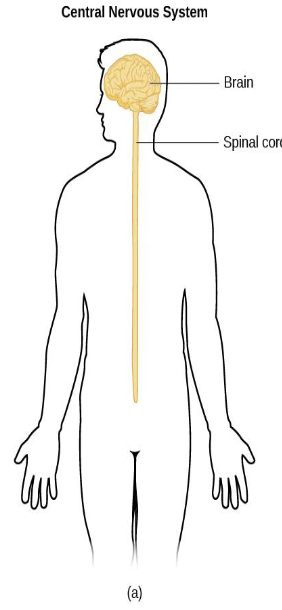
Central Nervous System (CNS):
our brain and spinal cord. Can be thought of as the central “hub”. This is where information from our surroundings is sent and processed, as well as instructions to other parts of our bodies such as muscles is sent out from
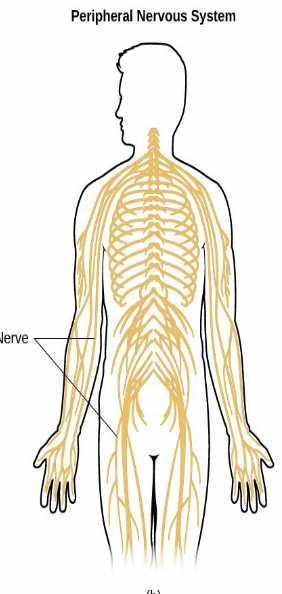
Peripheral Nervous System (PNS):
all other parts of our body that receive information (stimuli) and send them back to the CNS for processing
The PNS can further be divided into:
somatic nervous system (SNS)
autonomic nervous system (ANS)
Somatic Nervous System:
involves things you can consciously sense and do. They include sensory and motor nerves
Autonomic Nervous System:
works without any conscious input from you. It includes nerves that supply your heart, respiration, and digestion
Nerves are the “_______” that allow our CNS (brain) and PNS (periphery) to communicate with each other
o Just like a computer has cables in order to transmit information from one part to another, nerves serve the same purpose
highways
"Information" such as pain, temperature, pressure, etc is transmitted along nerves as electrochemical signals. Once it reaches the CNS, the brain interprets these electrochemical signals
The CNS also controls _____ _______. Our brain sends a signal to our motor nerves (which communicate with muscles) and causes them to contract and leads to muscle movement
muscle movement
Sensory Nerves:
are part of the somatic nervous system and are responsible for detecting and sending information such as pain, pressure and temperature from the periphery back to our brain
▪ Importantly for us, sensory nerves are what we want to block in order to "numb" our pts
Note that sensory and motor nerves (nerves that control muscle movement) often run in close proximity to one another, however it is often NOT in our interest to anesthetize ____ nerves in dentistry
motor
The functional unit (cell) of a nerve is a ______
neuron
Many thousands to millions of neurons are bundled together to make up a ______
nerve
The physical and chemical makeup of a neuron is what allows a nerve to transmit ….
electrochemical signals to the brain
The sensory neuron is comprised of what main parts:
dendritic process
axon
cell body
Dendritic Process:
The most distal and terminal end of the sensory neuron that communicates with receptor cells throughout our body
Axon:
forms the length of the neuron and conducts
Cell Body:
contains the nucleus. Responsible for metabolic support of the entire neuron
Making up most of the structure of a neuron is ___, which can be thought of as a long “tube” along which a nerve impulse is sent through the length of the neuron
axon
A neuron cell membrane is throughout the length of the axon that separates the inside of the neuron with the _______ ___________
outside environment
The neuron cell membrane is composed of a bilipid layer of _________, much like many other cells in our body
phospholipids
Dotted throughout the cell membrane are various ______, pumps and carrieres largely made from different proteins
channels
The neuron cell membrane is where a nerve "impulse" occurs and how the nerve sends an….
electrochemical signal from one end to another
The nerve “impulse” travels down the neuron cell membrane as an…
electrical action potential to the axon terminal
The neuron cell membrane is also where local anesthetics that we use work to….
block pain signals
While at rest, different ions group together on the inside and outside of the neuron cell membrane. Can they move freely?
no
Ions :
are atoms that have either lost or gained electrons and thus have either a positive or negative electrical charge.
At rest, the inside of the neuron cell membrane is more ________ charged than the outside due to an excess of Na+ outside the cell and relatively few K+ ions inside the cell
negatively
Na+ channels are _______ when the neuron is at rest, not allowing Na+ to flow inside the cell
closed
The inside of the cell has a voltage of ______ at rest
70mV (millivolts)
Volt:
a measure of electrical potential and can be thought of as electrical “pressure”
Because the voltage inside the neuron at rest in negative, this means there is negative electrical "pressure" inside the cell and if allowed to do so, Na+ (and other positively charged ions) would want to move INSIDE the cell but are blocked from doing so by ___ channels that do not allow Na+ from entering the cell at rest
Na+
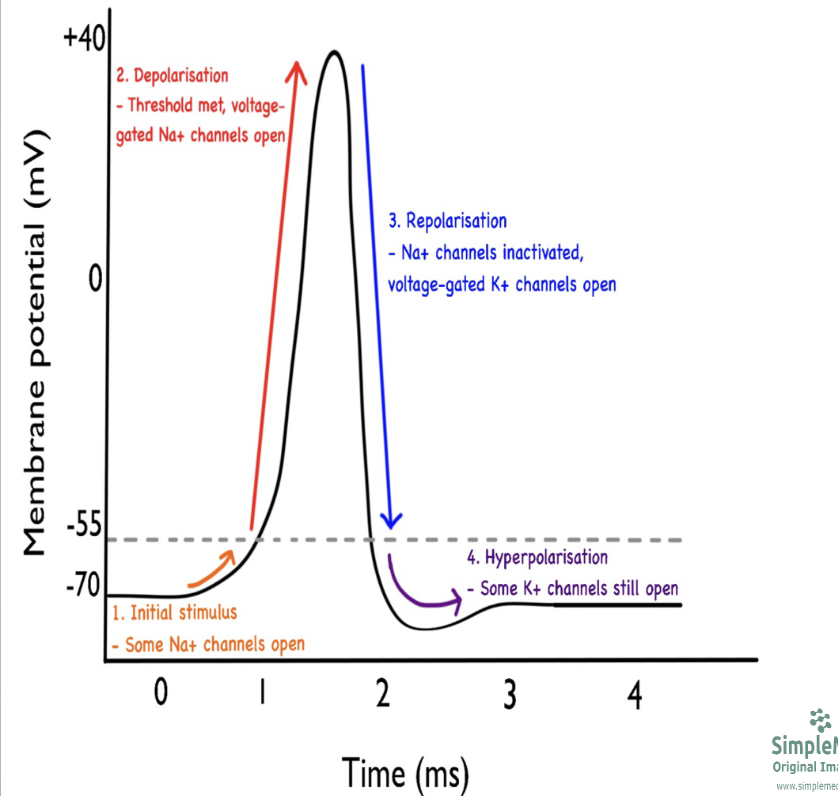
Some initial stimulus from the periphery (pain, pressure, etc) opens a few of the Na+ channels on the cell membrane and Na+ begins to enter the neuron. This is called
SLOW DEPOLARIZATION
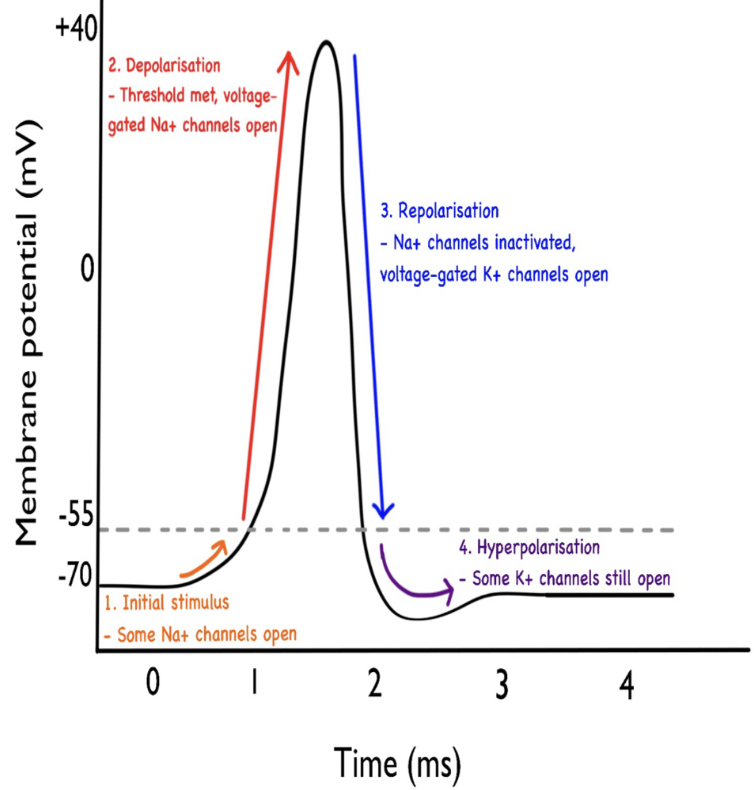
Once a threshold is reached (and inside voltage of the cell reaches –55 mV), all Na+ channels open and Na+ rushes into the cell, raising the mV inside the cell drastically. This is called
DEPOLARIZATION
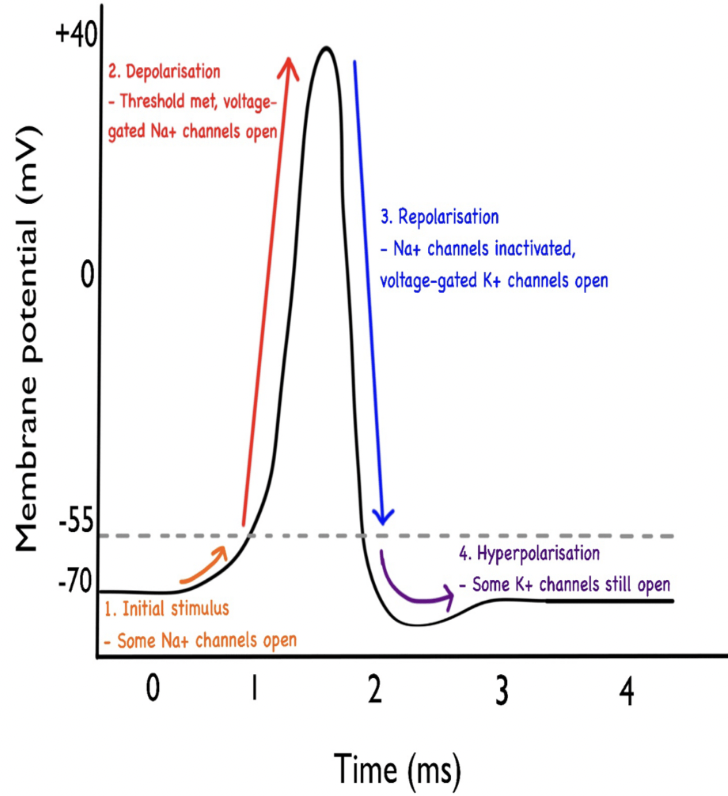
Na+ channels close and K+ channels open, causing K+ to leave the cell membrane. This decreases the voltage inside the neuron back to its normal value of –70 mV. This is
REPOLARIZATION
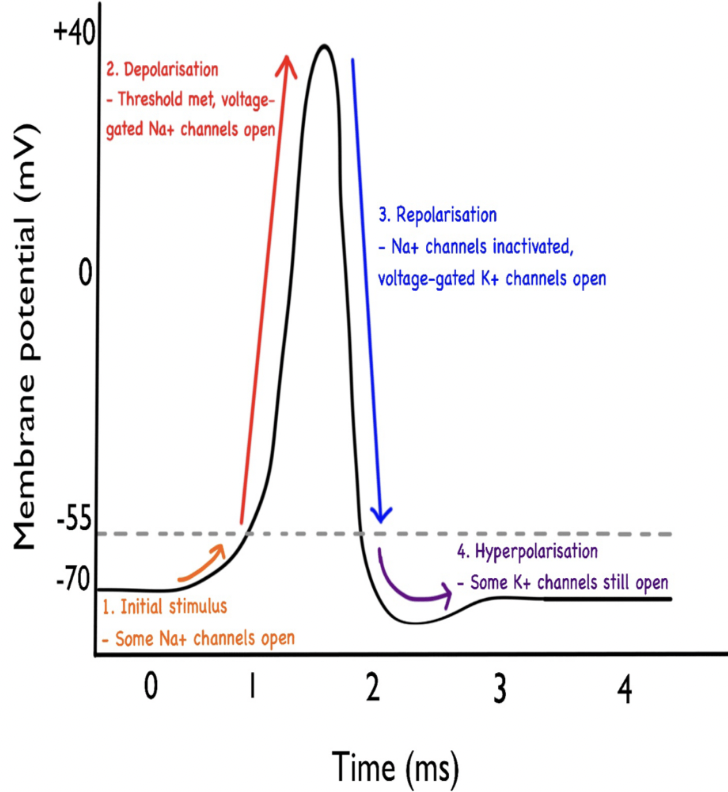
K+ channels are slow to close and the inside of the neuron is ___________. The K+ channels eventually close and Na+ is actively transported out of the cell until the resting –70 mV is reached
HYPERPOLARIZED
Typical Sequence of Events: Nerve Conduction
1.) You stick your finger on a hot stove
2.) Sensory (afferent) temperature receptors on your fingertip detect heat
3.) SLOW DEPOLARIZATION occurs as a few Na+ channels open which allows some Na+ ions to enter the neuron cell membrane. The temperature is hot enough to sufficiently excite the neuron to fire above its THRESHOLD
4.) DEPOLARIZATION of the axon begins by quickly opening all Na+ channels in the cell membrane and an influx of Na+ occurs inside the neuron
5.) The inside of the neuron is now positively charged. Na+ channels close and K+ channels begin to open
6.) REPOLARIZATION occurs as K+ leaves the neuron and the inside of the neuron falls back to being negatively charged
7.) K+ continues leaving the neuron because the K+ channels are slow to close. The charge inside the neuron is now more negative that it is at rest. It is now HYPERPOLARIZED
8.) ATP (energy) is used to remove excess Na+ from within the neuron. The voltage rises back to its resting state (-70 mV)
Impulses travelling along the neuron membrane differ depending on if the….
neuron is myelinated or not
Myelinated neurons are wrapped in myelin sheaths composed of _______ cells
Schwann
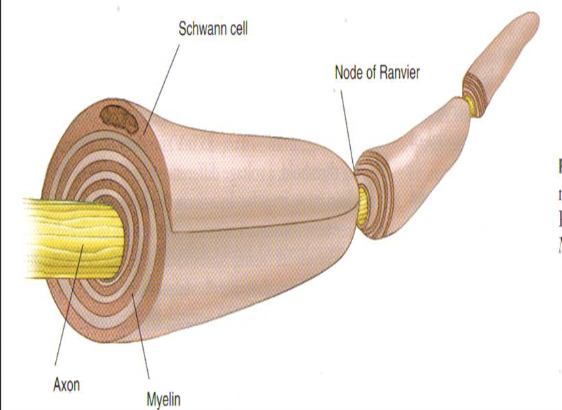
Impulse conduction on myelinated nodes can "jump" from node to node where there are no myelinated sheets which increases the speed of nerve conduction (this is called
_______ ______)
saltatory conduction
Sensory neurons are usually ________
myelinate
Unmyelinated neurons:
no outer myelin sheath
nerve impulse propagation is relatively slower in unmyelinated neurons
these types of neurons are mostly motor
A minimum of __ - __ mms of nerve must be covered by anesthetic solution to ensure adequate blockage of impulse spread because of this jumping action of myelinated neurons
8-10
Local anesthetic works particularly well on small, myelinated sensory neurons. However, on motor neurons….
a much greater amount of local anesthetic must be used to cover a wider area of these unmyelinated neurons
local anesthetic blocks pain and temperature, but does not block the sensation of pressure
Local anesthetic blocks pain and pressure but does not block the sensation of ________
pressure
o Sensory fibers that detect pressure are much more difficult to anesthetize than receptors for pain & temperature (which are usually smaller and easier for local anesthetic to inhibit)
How Do Local Anesthetics Work
Several theories have been studied throughout the years, however the most widely accepted is the specific receptor theory
Specific Receptor Theory:
local anesthetics act by binding to a specific receptors on the Na+ channel insde the cell membrane; preventing Na+ ions from crossing into the neuron cell membrane and halting depolarization from occurring
When can local anesthetics block Na+ channels:
only once they are inside the neuron
Therefore, LA molecules must first pass through the cell membrane of the neuron before it can work to block Na+ from entering the cell, and hence block _________ from occurring and an action potential from forming
depolarization
If no action potential forms, the signal cannot progress down the neuron and reach the brain, therefore we experience…
no pain
Local Anesthetic Mechanism of Action Summary
Since local anesthetics block voltage gated Na+ channels from opening, Na+ cannot enter the nerve cell
If no Na+ enters, the firing threshold of the neuron is not reached and therefore NO DEPOLARIZATION CAN OCCUR. The nerve remains in a POLARIZED state
With NO DEPOLARIZATION, NO ACTION POTENTIAL (IMPULSE) OCCURS
A nerve block produced by local anesthetic is called a nondepolarizing nerve block
All Local anesthetics are comprised of three main parts:
1.) Lipophilic Part (aromatic ring)
2.) Intermediate Chain (ester or amide)
3.) Hydrophilic Part (ethyl alcohol/acetic acid)
The intermediate chain of a LA contains either an _____ or _____ group.
This differentiates LAs into ester or amide categories. Esters and amides are pharmacologically processed differently in our bodies. Most modern synthetic anesthetics that we use belong to the amide group (i.e. Lidocaine, Articaine, etc)
ester, amide
How do local anesthetic (LA) molecules enter the neuron in the first place?
Due to their chemical structure
Majority of local anesthetics are _______ amines
tertiary
All local anesthetics are _________ i.e. have both lipophilic and hydrophilic parts which allow them to pass through the bilipid layer cell membrane
amphipathic
Local anesthetics WITHOUT a ________ portion are NOT suitable for injection but are good topical anesthetics i.e. Benzocaine
hydrophilic
Intermediate hydrocarbon chain contains the amide or ester linkage. All injectable local anesthetics used today are ______
amides
Due to the ampithatic (lipophilic&hydrophilic) nature of LAs, they can more easily pass through a….
neuron's cell membrane to reach Na+ channels in order to block t`hem ***
All local anesthetics are ______ to some degree in order to preserve and prolong shelf life
acidic
The lower the pH the _______ an acid it is.
stronger
The higher the pH the more ______ it is.
basic
A neutral pH:
around 7.0
LAs we administer have a pH of ___ if they contain no epinephrine
6
LAs we administer have a pH of ___ if they do contain epinephrine
3.5-4.5
The lower the pH…
the more of a burning sensation may be felt during administration of a local anesthetic
In the presence of active infection, local anesthetics often work very _______
poorly
o Active infection often involves acidification of diseased tissue
o At normal physiological pH, healthy tissue "buffers" local anesthetic that is injected and raises it's pH which allows it to more easily diffuse through neuron cell membranes
o In the presence of diseased, acidified tissue (lowered pH), local anesthetic has a difficult time diffusing through a neuron in order to block depolarization ***
 Note
Note  Flashcards (56)