Neurophysiology
 Studied by 0 people
 Call with Kai
 Learn
Learn Practice Test
 Spaced Repetition
 Match
Match Flashcards
 Knowt Play
1/53

Earn XP
Description and Tags
Lectures 4, 5, 6, 7
Name | Mastery | Learn | Test | Matching | Spaced | Call with Kai |
|---|
No study sessions yet.
54 Terms
What is the fundamental unit of the nervous system
Neurons
3 structural classes of neurons
multipolar
bipolar
unipolar / pseudounipolar
Multipolar neuron
multiple processes from cell body, multiple dendrites and one axon
“normal”
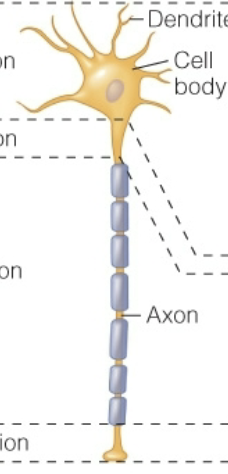
Bipolar neuron
two main processes
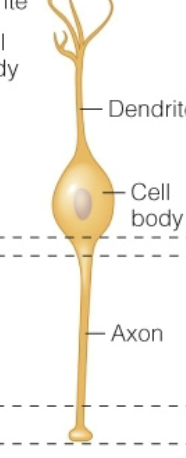
Unipolar or pseudounipolar neuron
one main process from cell body
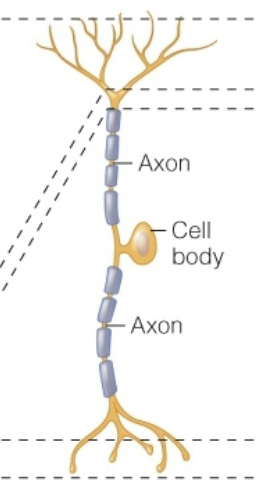
3 functional classes of neurons
sensory (afferent - “away")
interneuron
motor (efferent - “enter”)
Sensory neurons
• Transmit information about sensory stimuli from receptors to CNS
• Specific structure and function depends on sensory system
Interneurons
• Connects neurons to one another- sensory to motor
• Often short, unmyelinated axons and complex dendrites
Motor neurons
• Transmits info from CNS to effector organ (muscle or gland)
• Initiates muscle contractions or gland secretions
• Cell bodies located in CNS with long myelinated axons to reach distant targets
Neuronse use ______ to transmit _____
electricity, signals
Additional; Neurons are specialized to use changes in membrane potential to communicate signals across long distances
Excitable cells maintain a ______
membrane potential
Membrane Potential
voltage difference across cell memrbane
measured in V or mV
inside of cell negative relative to outside of cell
How do membrane potentials arise
from unequal distribution of ions across the membrane
How does the cytoplasm function in membrane potentials?
Cytoplasm has a net neutral charge, separated charges accumulate along membrane surfaces
How does the plasma membrane function as a capacitor?
a component that stores electrical energy by accumulating electric charges on two closely spaced surfaces that are insulated from each other
Ions move across membranes according to __________
electrochemical gradients
Equilibrium potential of an ion
• The membrane potential at which an ion reaches equilibrium (i.e. the net flow of an ion is zero)
• It also determines the membrane potential at which the direction of ion flow reverses (i.e. the electrical gradient exceeds the concentration gradient)
How can equilibrium potential be calculated?
Use Nernst equation
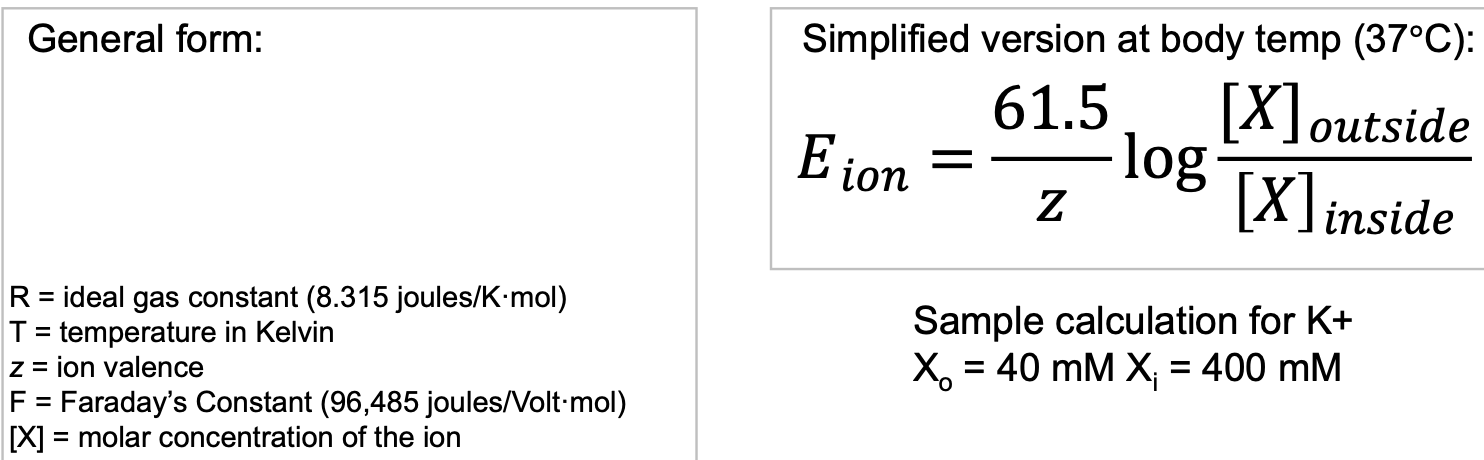
How can ion movement be predicted
Compare Eion (equilibrium potential for that ion) and Vm (membrane potential)
How is membrane potential calculated?
Goldman equation
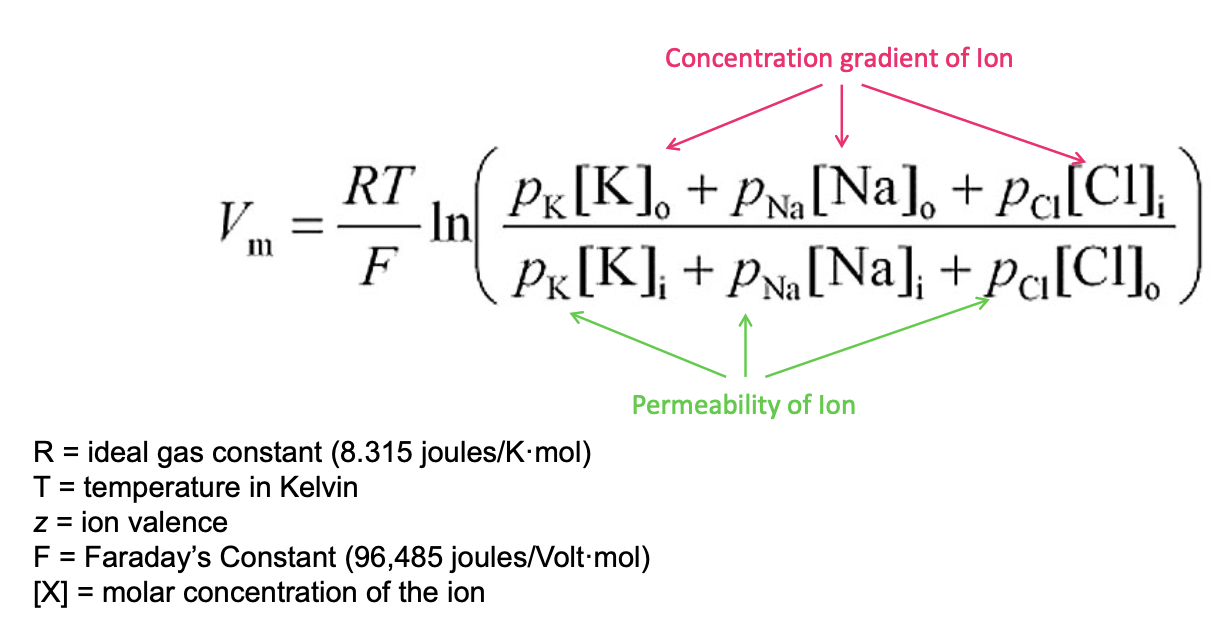
What is typical resting membrane potential
-70 mV, this is actively maintained thru dynamic equilibrium
What factors contribute to maintaining -70 mV RMP (3 main ones)
Distribution of ions near plasma membrane
more (+) outside; more (-) inside (especially large, impermeable anions)
Na/K Pump
Direct effect = Between -2 and -5 mV
Indirect effect = Maintains ionic gradients by active transport
Leaky channels – Predominant determinant of RMP
What are “leaky channels”
constitutively active channels that allow facilitated diffusion
Does the RMP ever reach Ek?
no it approaches it, but NEVER reaches it
What does changes in membrane permeability cause
electoral signals
When ion channels open and close, what happens to membrane potential?
rapid changes in membrane potential
3 main ways to describe changes in potential relative to resting potential
depolarization
hyperpolarization
repolarization
Depolarization
membrane potential becomes LESS negative
(+) ions enter, and (-) ions exit
Hyperpolarization
membrane potential becomes MORE negative
(+) ions exit, (-) ions enter
Repolarization
membrane potential returns to RMP
What id driving force, and what does it determine
difference between the membrane potential (Vm) and the ion equilibrium potential (Eion), determines ion flow.
larger the difference, stronger the driving force, the higher the rate of ion movement
Signal path (IMAGE)
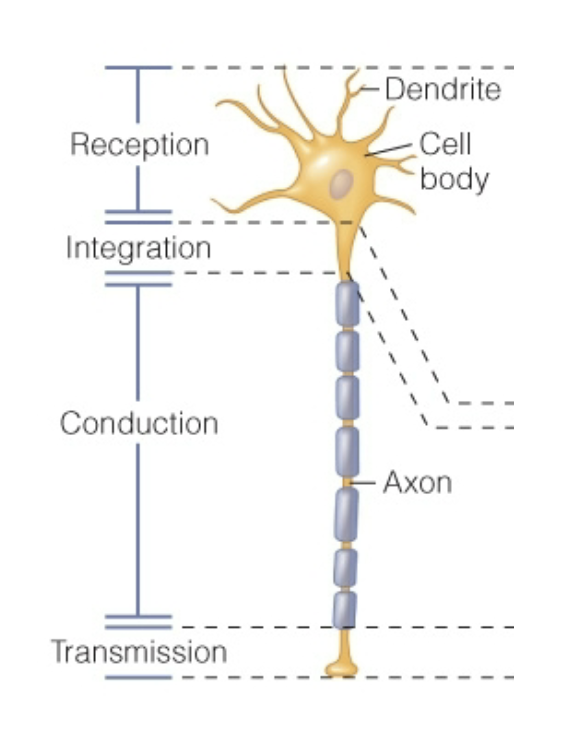
What can signal reception lead to
Grade potentials
• Occur in dendrites and cell bodies
• Vary in magnitude and duration - Proportional to strength of stimulus
• Transient changes that occur locally
• Short distance signals
• Can be excitatory or inhibitory
Graded potentials decay over short distances, why?
Electrotonic: passive current due to electrical interactions within the cell
Threshold potential
membrane potential required to initiate an action potential
depolarization required to activate NaV channels
usually around -55 mV
@ axon hillock
EPSP - excitatory post synaptic potential
increased likelihood of reach threshold
ligand gated Na+ channels
IPSP - inhibitory post synaptic potential
decreases likelihood of reaching threshold
ligand gated Cl- channels
Action Potential
• All-or-none mentality
• Long distance signals - Maintain amplitude
• Same magnitude and duration for a given cell
• Occur in axons
• Caused by opening and closing of voltage-gated channels
FOR EXAM KNOW HOW TO DRAW
Gating of voltage-gated Na+ channels is determined by what two mechanisms?
Activation gate
voltage sensor
opens @ threshold
inactivation gate
closes from cytoplasmic side
Voltage-gated Na+ channels display intrinsic inactivation (shut off after usage)
What does depolarization of membrane do?
activates voltage gated K+ channels
2 types AP refractory periods
Absolute and relative
Absolute refractory period
time during which another AP CANNOT be triggered
No matter the stimulus strength
Occurs from onset of AP until the end of Na+ channel inactivation
Relative refractory period
time during which a stronger stimulus is necessary to trigger an AP
More depolarizing current is required to reach threshold
Due to hyperpolarization
 Note
Note  Flashcards (68)