Lesson 10: Ω-Verbs- Imperfect Active Indicative; Correlatives
 Call Kai
 Learn
Learn Practice Test
 Spaced Repetition
 Match
Match Flashcards
 Knowt Play
1/7

There's no tags or description
Looks like no tags are added yet.
Name | Mastery | Learn | Test | Matching | Spaced | Call with Kai |
|---|
No analytics yet
Send a link to your students to track their progress
8 Terms
how many secondary (or historical/past) tenses does GK have?
3; imperfect is one
what is imperfect tense in indicative mood?
indicative imperfect shows an action that was occurring at some time in the past (not completed action—imperfect aspect=the action is perceived as a process that continued or was repeated over time)
in engl= “was/were ____-ing”
ex: “we were studying for years”
or in engl (simple past)= “___-ed”
ex: “we studied for years”
imperfect tense always has imperfective aspect
what stem is the imperfect tense built on?
built on present stem (1st principal part supplies stem for both the present and imperfect tenses)
but present tense doesn’t have augment while imperfect does
what is augment?
augment= a prefix that increases (“augments”) the length of the word
signals that the verb is in a secondary tense
if present stem begins w consonant, an epsilon with smooth breathing (ἐ-) is prefixed to it (e.g., παιδευ- becomes ἐπαιδευ-). This is called a syllabic augment because it adds another syllable to the word.
When a verb begins with ῥ, a second rho is always inserted after the syllabic augment (e.g., ῥῑπτ- becomes ἐρρῑπτ-).
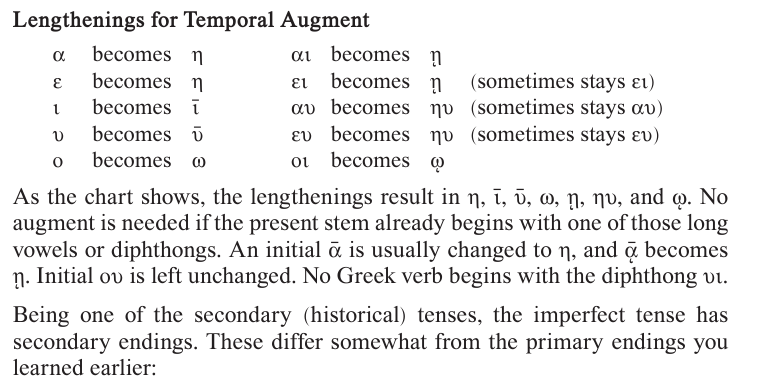
if present stem begins with a vowel or diphthong, then the vowel or diphthong at the start of the stem is lengthened. This is called a temporal augment because it increases the time (tempus = Latin word for “time”) it takes to pronounce the first syllable.
Lengthenings for Temporal Augment:
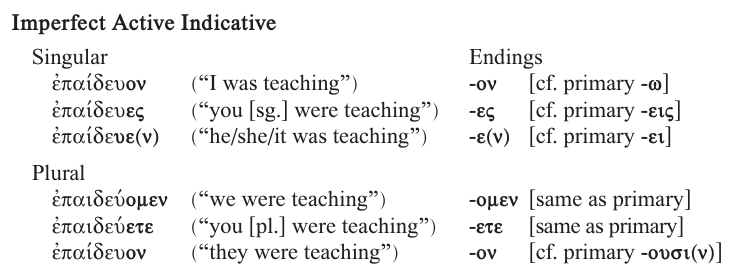
Paradigm for Imperfect Active Indicative:
what happens to the augment in a compound verb?
in compound verbs the augment usually comes between the prefix and the stem; last letter of the prefix (if vowel) generally drops out
ex: imperfect of ἀπολείπω is ἀπέλειπον
what are μὲν…δέ?
they are both postpositives so they prefer not to be the first word in their clause, so instead they come second
when used together they point out the parallelism of two ideas (“on the one hand…on the other hand”)
disregard the presence of μὲν or δέ when determining whether or not a word is in the attributive position
definite articles may combine with μὲν and/or δέ to mean “this one (he/she/it)…that one (he/she/it)” “the one…the other” or “some…others” ; no noun or adj is needed (the article suffices to show gender, number, and case, while the correlatives convey the idea of balance or contrast) ***ex in picture
common to leave out the verb in the second part of so as to avoid duplication of verb in the first part (3rd example in picture above)


