Exam 1 Micro
0.0(0)
 Studied by 8 people
 Call Kai
 Learn
Learn Practice Test
 Spaced Repetition
 Match
Match Flashcards
 Knowt Play
Card Sorting
1/134

There's no tags or description
Looks like no tags are added yet.
Last updated 6:13 AM on 9/6/23
Name | Mastery | Learn | Test | Matching | Spaced | Call with Kai |
|---|
No analytics yet
Send a link to your students to track their progress
135 Terms
1
New cards
what did leprosy quarantine in the bible prove?
that people knew that diseases were communicable but they did not know that leprosy could spread really fast so could’t contain it on time
2
New cards
what is the miasma theory?
the greeks believed that disease arises from bad air which are called “miasmatic odors”
3
New cards
who created sewers and why?
romans created sewer system to deal with waste which brought in fresh water and spilled sewage into the river of tiber, it helped protect them from waterborne illnesses
4
New cards
who is hippocrates and what did he do/contribute to microbiology?
\-he is the father of western medicine
\-he advocated for evidence-based analysis of cause-and-effect reasoning
\-said diseases were not caused by the supernatural
\-he advocated for evidence-based analysis of cause-and-effect reasoning
\-said diseases were not caused by the supernatural
5
New cards
who is thucydides and what did he do/contribute to microbiology?
\-father of scientific history
\-having survived the athenian plague he made the important observation that survivors did not get re-infected with the disease, even when taking care of actively sick people
\-early concept of immunity
\-having survived the athenian plague he made the important observation that survivors did not get re-infected with the disease, even when taking care of actively sick people
\-early concept of immunity
6
New cards
who is marcus terentius varro and what did he do/contribute to microbiology?
\-proposed that things we cannot see could cause disease (what we call now microorganisms)
\-in “res rusticae” he said that “precautions must also be taken in neighborhood swamps. . . because certain minute creatures \[*animalia minuta*\] grow there which cannot be seen by the eye, which float in the air and enter the body through the mouth and nose and there cause serious diseases.”
\-in “res rusticae” he said that “precautions must also be taken in neighborhood swamps. . . because certain minute creatures \[*animalia minuta*\] grow there which cannot be seen by the eye, which float in the air and enter the body through the mouth and nose and there cause serious diseases.”
7
New cards
what creation was the birth of microbiology?
\-the invention of the microscope
\-the creator is unknown
\-the creator is unknown
8
New cards
who is antonie van leuwenhock and what is he known as? and what did he do/contribute to microbiology?
\-”father of microbiology”
\-was the first to develop a lens powerful enough to view microbes
\-using a simple but powerful microscope, was able to observe single-celled organisms, which he described as “animalcules” or “wee little beasties,” swimming in a drop of rain water
\-was the first to develop a lens powerful enough to view microbes
\-using a simple but powerful microscope, was able to observe single-celled organisms, which he described as “animalcules” or “wee little beasties,” swimming in a drop of rain water
9
New cards
who started the golden age of microbiology?
louis pasteur and robert koch
10
New cards
who is louis pasteur and what did he do/contribute to microbiology?
\-showed that individual microbial strains had unique properties and demonstrated that fermentation and spoilage is caused by microorganisms
\-he also invented pasteurization, a process used to kill microorganisms responsible for spoilage
\-developed vaccines such as rabies
\-he also invented pasteurization, a process used to kill microorganisms responsible for spoilage
\-developed vaccines such as rabies
11
New cards
who is robert koch and what did he do/contribute to microbiology? what are his postulates?
\-established method for connecting pathogen with specific disease
\-ex: he discovered anthrax was caused by *bacillus anthracis*, cholera by *vibrio cholera*, and tuberculosis by m*ycobacterium tuberculosis*
\-koch’s postulates:
* the microorganism or other pathogen must be present in all cases of the disease.
* the pathogen can be isolated from the diseased host and grown in pure culture.
* the pathogen from the pure culture must cause the disease when inoculated into a healthy, susceptible laboratory animal.
\-ex: he discovered anthrax was caused by *bacillus anthracis*, cholera by *vibrio cholera*, and tuberculosis by m*ycobacterium tuberculosis*
\-koch’s postulates:
* the microorganism or other pathogen must be present in all cases of the disease.
* the pathogen can be isolated from the diseased host and grown in pure culture.
* the pathogen from the pure culture must cause the disease when inoculated into a healthy, susceptible laboratory animal.
12
New cards
who are the famous people in order that contributed to microbiology?
1. hippocrates
2. thucydides
3. marcus terentius varro
4. antonie van leeuwenhoek
5. louis pasteur
6. rober koch
13
New cards
what is taxonomy?
the classification, description, identification, and naming of living organisms
14
New cards
who are the famous taxonomy people in order of when they contributed to microbiology?
1. carolus linnaeus
2. ernst haeckel
3. robert whittaker
4. carl woese
5. george fox
15
New cards
who is carolus linnaeus and what did he do/contribute to microbiology?
\-developed a new way to categorize plants and animals (had mineral but later discarded it)
\-the names of the levels in linnaeus’s original taxonomy were kingdom, class, order, family, genus, and species. Species was, and continues to be, the most specific and basic taxonomic unit.
\-the names of the levels in linnaeus’s original taxonomy were kingdom, class, order, family, genus, and species. Species was, and continues to be, the most specific and basic taxonomic unit.
16
New cards
who is ernst haeckel and what did he do/contribute to microbiology?
\-wrote general morphology of organism, proposing 4 kingdoms
\-besides plants and animals he proposed protista, for unicellular organisms and later proposed a fourth kingdom, monera, for unicellular organisms whose cells lack nuclei, like bacteria
\-besides plants and animals he proposed protista, for unicellular organisms and later proposed a fourth kingdom, monera, for unicellular organisms whose cells lack nuclei, like bacteria
17
New cards
who is robert whittaker and what did he do/contribute to microbiology?
\-proposed adding a fifth kingdom called fungi
\-also proposed a super kingdom where he distinguished between eukaryotes and prokaryotes
\-monera was the only one in prokaryotes
\-also proposed a super kingdom where he distinguished between eukaryotes and prokaryotes
\-monera was the only one in prokaryotes
18
New cards
who created the phylogenetic tree?
ernst haeckel
19
New cards
what are the 3 branches of the phylogenetic tree? who implemented it? and by what criteria?
\-bacteria, archaea, and eukarya
\-woese and fox determined traits not by observable but by molecular techniques through small subunital ribosomal rna sequences
\-woese and fox determined traits not by observable but by molecular techniques through small subunital ribosomal rna sequences
20
New cards
what is horizontal gene transfer and why is it important when talking about microbial classification?
\-when a gene of one species is absorbed into another organism’s genome
\-horizontal gene transfer is especially common in microorganisms and can make it difficult to determine how organisms are evolutionarily related
\-horizontal gene transfer is especially common in microorganisms and can make it difficult to determine how organisms are evolutionarily related
21
New cards
what is the order of the taxonomy classification?
(from small to big) strain, species, genus, family, order, class, phylum, kingdom, and domain
22
New cards
what is meant by strain and why is it important in microbial classification?
\-a genetically distinct lineage separated from another strain by one or more mutations so a subtype of a certain organism that may contain a mutation
\-they can be used to indicate special biochemical features since molecular methods do not give the whole picture
\-they can be used to indicate special biochemical features since molecular methods do not give the whole picture
23
New cards
what are the rules for naming organisms?
\-through binomial nomenclature: it is a 2 word system based on genus and species
\-names generally have latin or greek roots
\-written in italics
\-genus is capitalized and species is lower case
\-ex: Homo sapiens → H. sapiens (pretend it’s italized)
\-names generally have latin or greek roots
\-written in italics
\-genus is capitalized and species is lower case
\-ex: Homo sapiens → H. sapiens (pretend it’s italized)
24
New cards
what is bergey’s manual of determinative bacteriology and systematic bacteriology used for?
standard references for identifying and classifying different prokaryotes or microbes on various methods for non-visual characteristics
25
New cards
what size in micrometers is visible by the naked eye?
100 micrometers
26
New cards
what is the average size of animal cells, bacterial cells, and viruses?
\-animal cell: 10 micrometers
\-bacterial cell: 1 micrometer
\-viruses: 1 nanometer
\-bacterial cell: 1 micrometer
\-viruses: 1 nanometer
27
New cards
what are the characteristics of microbes? CCHUM
\-colony structure
\-cellular vs acellular (cellular microbes are found in all 3 domains)
\-habitat
\-unicellular vs multicellular
\-metabolism
\-cellular vs acellular (cellular microbes are found in all 3 domains)
\-habitat
\-unicellular vs multicellular
\-metabolism
28
New cards
what microbes are considered prokaryotic? eukaryotic? and none?
\-prokaryotic: bacteria and archaea
\-eukaryotic: algae, protozoa, fungi, helminths
\-none aka acellular microbes: viruses
\-eukaryotic: algae, protozoa, fungi, helminths
\-none aka acellular microbes: viruses
29
New cards
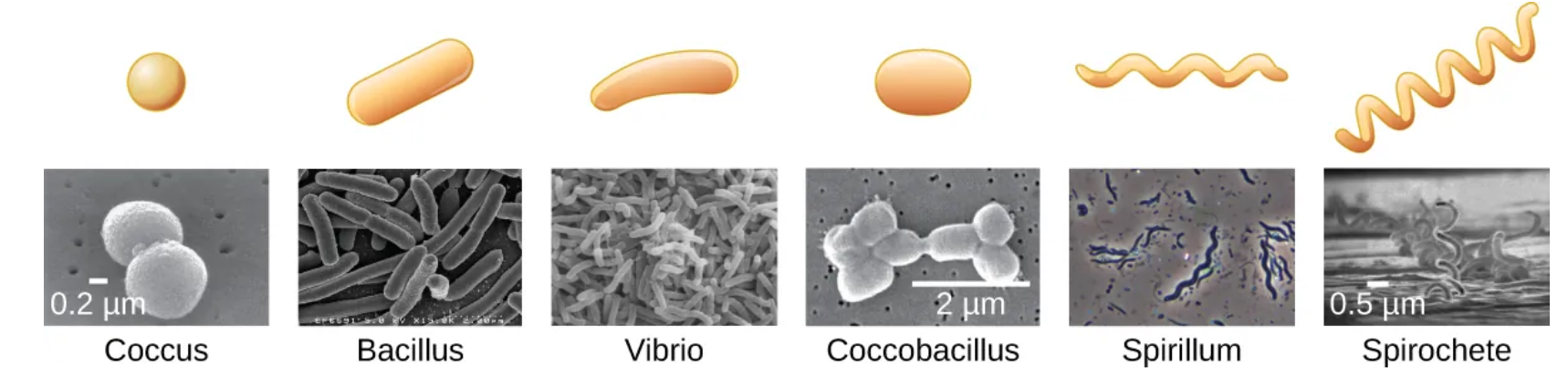
what are bacteria common shapes?
\-coccus (looks like a ball)
\-bacillus (looks like a long donut)
\-vibrio (looks like a long donut but slightly bent)
\-coccobacillus (looks like a shorter and rounder version of bacillus)
\-spirillum (looks like a wiggly snake)
\-spirochete (looks like a spiral)
\-bacillus (looks like a long donut)
\-vibrio (looks like a long donut but slightly bent)
\-coccobacillus (looks like a shorter and rounder version of bacillus)
\-spirillum (looks like a wiggly snake)
\-spirochete (looks like a spiral)
30
New cards
are archea multi or unicellular? how are they different from bacteria (cell wall)? where are they found? are they pathogenic or nonpathogenic?
\-they are unicellular prokaryotic organisms
\-unlike most bacteria archaeal cell walls do not contain peptidoglycan and instead contain pseudopeptidoglycan
\-they are found in every habitat in earth including extreme environments that are very hot, cold, basic, and acidic
\-nonpathogenic
\-unlike most bacteria archaeal cell walls do not contain peptidoglycan and instead contain pseudopeptidoglycan
\-they are found in every habitat in earth including extreme environments that are very hot, cold, basic, and acidic
\-nonpathogenic
31
New cards
are protists multi or unicellular? what is algae and why is it important? what is protozoa and why is it important?
\-unicellular eukaryotes(not plants, animals, or fungi)
\-algae is photosynthetic and is important in ecosystems and consumer products
\-protozoa make up the backbone of many food webs by providing nutrients for other organisms, and are very diverse; motility via cilia(hair like), flagella(whip like), and pseudopod(false feet through cell membrane)
\-algae is photosynthetic and is important in ecosystems and consumer products
\-protozoa make up the backbone of many food webs by providing nutrients for other organisms, and are very diverse; motility via cilia(hair like), flagella(whip like), and pseudopod(false feet through cell membrane)
32
New cards
are fungi multi or unicellular? are they photosynthetic? what are the cell walls made out of? are molds good or bad and why?
\-both multicellular (mushrooms) and unicellular (yeasts)
\-they are not photosynthetic and their cell walls are made out of chitin instead of cellulose
\-good→ yeast can cause bread to rise and beverages to ferment
\-bad→can cause food to spoil and even yeast infections
\-molds can also be good and bad: can help make penicilin or reduce chances of organ rejection but can also produce diseases
\-they are not photosynthetic and their cell walls are made out of chitin instead of cellulose
\-good→ yeast can cause bread to rise and beverages to ferment
\-bad→can cause food to spoil and even yeast infections
\-molds can also be good and bad: can help make penicilin or reduce chances of organ rejection but can also produce diseases
33
New cards
what are helminths and why are they considered microorganisms even though they are visible to the naked eye?
\-multicellular parasitic worms
\-because diseases caused by helminths involve microscopic eggs and larvae
\-because diseases caused by helminths involve microscopic eggs and larvae
34
New cards
what are viruses made of and what can they affect? are they cellular or acellular? do they need a host? what are prions?
\-**Viruses** are **acellular** microorganisms, which means they are not composed of cells.
\-made up of either DNA or RNA never both
\-can affect all types of cells like humans or other microorganisms
\-they need a host to reproduce
\-prions are proteinaceous disease causing agent
\-made up of either DNA or RNA never both
\-can affect all types of cells like humans or other microorganisms
\-they need a host to reproduce
\-prions are proteinaceous disease causing agent
35
New cards
what are the subfields of microbiology? PIMP BV
\-protozoology
\-immunology
\-mycology
\-parasitology
\-bacteriology
\-virology
\-immunology
\-mycology
\-parasitology
\-bacteriology
\-virology
36
New cards
how does light behave?
it behaves as electromagnetic waves and has the same properties of waves
37
New cards
what are the 3 properties of waves?
\-wavelength: length between peaks
\-amplitude: height of peaks
\-frequency: rate of peaks in time
\-the longer the wave = the lower the frequency
\-the shorter the wave = the higher the frequency
\-amplitude: height of peaks
\-frequency: rate of peaks in time
\-the longer the wave = the lower the frequency
\-the shorter the wave = the higher the frequency
38
New cards
what are the 6 types of light interactions?
1. reflection: wave bounces off material (based off of color like white)
2. absorbance: wave is captured (black)
3. transmission: wave travels through (the more opaque the more it travels through)
4. interference: interacts w/ another wave (same pattern + same pattern= greater amplitude and greater frequency) / (opposite patters together = cancel each other out)
5. diffraction: bent or scattered by object opening (the smaller the opening the more bending of light)
6. refraction: change direction and or/speed
39
New cards
what is refractive index and what is the formula?
\-degree of change in transmission speed
\-refractive index= speed of light in vacuum/speed of light through material
\-will bend more and slow down more
\-if light enters a substance with a higher (lower) refractive index it slows down (speeds up) and bends toward (away) the normal line, away from the boundary (toward the boundary)
\-refractive index= speed of light in vacuum/speed of light through material
\-will bend more and slow down more
\-if light enters a substance with a higher (lower) refractive index it slows down (speeds up) and bends toward (away) the normal line, away from the boundary (toward the boundary)
40
New cards
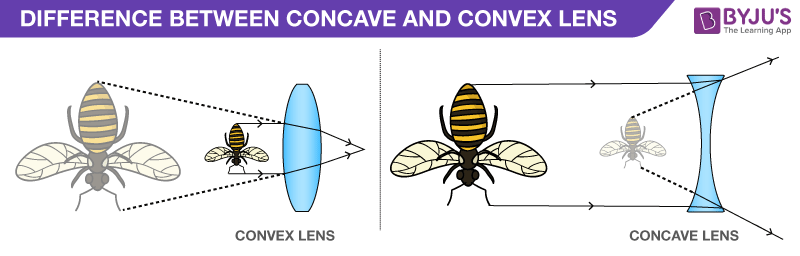
what is the difference between concave and convex lenses? and what does each do?
\-convex lens refraction occurs on a curved boundary to meet a focal point (microscope)
\-concave lens refracts light away from a focal point (flash lights)
\-concave lens refracts light away from a focal point (flash lights)
41
New cards
from where to where on the electromagnetic spectrum can we see? which area on the spectrum is harmful to humans and what could it cause?
\-400 nm to 750 nm
\-below 550: ultraviolet can alter genetic material, x-rays, gamma rays, and cosmic radiation will cause cancer in humans
\-below 550: ultraviolet can alter genetic material, x-rays, gamma rays, and cosmic radiation will cause cancer in humans
42
New cards
what is magnification, contrast, and resolution?
\-magnification: ability of lens to enlarge the image of an object (microscopes refract light to magnify images)
\-contrast: creation of stark difference in coloration (differentiate components that are hard to distinguish)
\-resolution: ability to tell that 2 separate points/objects are separate (clarity on tv)
\-contrast: creation of stark difference in coloration (differentiate components that are hard to distinguish)
\-resolution: ability to tell that 2 separate points/objects are separate (clarity on tv)
43
New cards
what is meant by higher and lower resolution? and how does this tie into light and electron microscopes?
\-shorter wavelengths = higher resolution (more clarity)
\-longer wavelengths = lower resolution (more pixelated)
\-electron microscopes have higher resolution than light microscopes since it uses an electron beam with a very short wavelength, as opposed to the long-wavelength visible light used by a light microscope
\-longer wavelengths = lower resolution (more pixelated)
\-electron microscopes have higher resolution than light microscopes since it uses an electron beam with a very short wavelength, as opposed to the long-wavelength visible light used by a light microscope
44
New cards
what is numerical aperture?
which is a measure of a lens’s ability to gather light. the higher the numerical aperture, the better the resolution
45
New cards
who used the first microscope? and what type was it?
antonie van leeuwenhoek utilized the 1st simple microscope (1 lens)
46
New cards
who is galileo galilei and what did he do?
he is an astronomer and used a compound microscope to look at insects (2 lens)
47
New cards
who is robert hooke? what term did he create?
\-first to describe “cells” using compound microscope and observing cork cells (plant cells)
\-Hooke described these structures as resembling “Honey-comb,” and as “small Boxes or Bladders of Air,” noting that each “Cavern, Bubble, or Cell” is distinct from the others
\-Hooke described these structures as resembling “Honey-comb,” and as “small Boxes or Bladders of Air,” noting that each “Cavern, Bubble, or Cell” is distinct from the others
48
New cards
who invented the microscope? who is thought to have created the microscope?
\-it is unknown
\-hans and zacharias janssen may have invented the simple and compound microscope
\-hans and zacharias janssen may have invented the simple and compound microscope
49
New cards
what are the 3 types of microscopes?
1. light microscopes
2. electron microscopes
3. scanning probe microscopes
50
New cards
what are the types of light microscopy? (6) / also learn all the parts of the microscope
1. brightfield
2. darkfield
3. phase-contrast
4. fluorescence
5. confocal
6. two-photon
51
New cards
what specimen can best be seen in a light microscope?
\-can look at bacteria, cells, or structures. You can look at dead organisms or live ones. If you use dyes on the microscope slide, you can look at cell structures
52
New cards
what is the pathway of light in a light microscope?
1. illuminator (light source)
2. condenser
3. specimen
4. objective lens
5. ocular lens
53
New cards
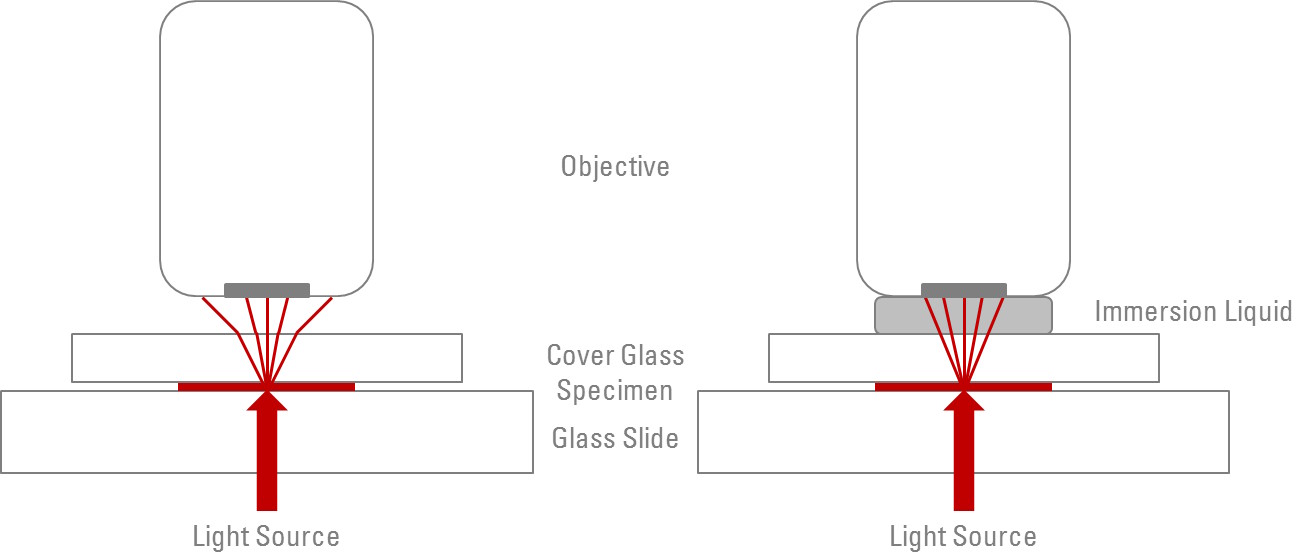
what happens when magnification is increased? how is it fixed?
the resolution decreases and is not the best, it is fixed with immersion oil because it resembles glass, it increases the maximum angle at which light leaving the specimen can strike the lens
54
New cards
what is the difference between a light and dark microscope, what part of the microscope changes the background? in what instance is dark microscope used?
\-darkfield has a dark background while light has a bright background
\-the condenser lens changes the background and light that is viewed through objective lens is reflected/refracted from specimen
\-good for visualizing living unstained specimen
\-the condenser lens changes the background and light that is viewed through objective lens is reflected/refracted from specimen
\-good for visualizing living unstained specimen
55
New cards
what is the difference between a dark microscope and phase contrast microscope? how does a phase contrast microscope work? what is best seen with this type of microscope?
\-phase contrast increases contrast without stain
\-good for viewing live specimens and organelles
\-features are highlighted based on refractive index
\-annular ring makes a cone of light that is focused on specimen, the specimen then reflects the light, then once the light travels through the objective and phase plates, the wavelengths either add or cancel each other out
\-good for viewing live specimens and organelles
\-features are highlighted based on refractive index
\-annular ring makes a cone of light that is focused on specimen, the specimen then reflects the light, then once the light travels through the objective and phase plates, the wavelengths either add or cancel each other out
56
New cards
what is the difference between differential interference contrast microscope and phase contrast microscope? what is best seen with this type of microscope?
\-two different wavelengths are passed thru specimen and combined for differential effects and are polarized
\-This results in high-contrast images of living organisms with a three-dimensional appearance. These microscopes are especially useful in distinguishing structures within live, unstained specimens.
\-This results in high-contrast images of living organisms with a three-dimensional appearance. These microscopes are especially useful in distinguishing structures within live, unstained specimens.
57
New cards
what is a fluorescent microscope? is direct or indirect better? what can they be used for?
\-uses fluorescent chromophores called **fluorochromes**, which are capable of absorbing energy from a light source and then emitting this energy as visible light
\-The microscope transmits an excitation light, generally a form of EMR with a short wavelength, such as ultraviolet or blue light, toward the specimen; the chromophores absorb the excitation light and emit visible light with longer wavelengths. The excitation light is then filtered out (in part because ultraviolet light is harmful to the eyes) so that only visible light passes through the ocular lens. This produces an image of the specimen in bright colors against a dark background.
\-can be used to identify pathogens
\-direct immunofluorescent uses conjugated antibody while indirect uses 2 different antibodies/ indirect is better because IFA increases the number of fluorescent antibodies attached to the specimen, making it easier visualize features in the specimen
\-The microscope transmits an excitation light, generally a form of EMR with a short wavelength, such as ultraviolet or blue light, toward the specimen; the chromophores absorb the excitation light and emit visible light with longer wavelengths. The excitation light is then filtered out (in part because ultraviolet light is harmful to the eyes) so that only visible light passes through the ocular lens. This produces an image of the specimen in bright colors against a dark background.
\-can be used to identify pathogens
\-direct immunofluorescent uses conjugated antibody while indirect uses 2 different antibodies/ indirect is better because IFA increases the number of fluorescent antibodies attached to the specimen, making it easier visualize features in the specimen
58
New cards
what is a confocal microscope? what is it best used for?
\-it uses lasers to produce scans of multiple z-planes
\-best used with thick specimens (ex: biofilms)
\-it has modified fluorescence to avoid “bleaching”
\-best used with thick specimens (ex: biofilms)
\-it has modified fluorescence to avoid “bleaching”
59
New cards
what is a two-photon microscope? what material does it view better?
\-a modified confocal scope with near infrared light (safer for tissues and will target specimen at the same time)
\-The low energy of the excitation light is less damaging to cells, and the long wavelength of the excitation light more easily penetrates deep into thick specimens. This makes the two-photon microscope useful for examining living cells within intact tissues—brain slices, embryos, whole organs, and even entire animals.
\-The low energy of the excitation light is less damaging to cells, and the long wavelength of the excitation light more easily penetrates deep into thick specimens. This makes the two-photon microscope useful for examining living cells within intact tissues—brain slices, embryos, whole organs, and even entire animals.
60
New cards
what is electron microscopy? what are the 2 types? what is resolution limited by?
\-uses electrons and have short wavelengths and do not use light to make the best resolution
\-the 2 types are transmission electron microscope (TEM) and scanning electron microscope (SEM)
\-resolution is limited by wavelength
\-the 2 types are transmission electron microscope (TEM) and scanning electron microscope (SEM)
\-resolution is limited by wavelength
61
New cards
how does a transmission electron microscope work? what type of specimens is it good to look at with a transmission electron microscope?
\-However, it uses an electron beam from above the specimen that is focused using a magnetic lens (rather than a glass lens) and projected through the specimen onto a detector. Electrons pass through the specimen, and then the detector captures the image
\-will look at internal organs that are cut super thin and use magnets to focus light
\-will look at internal organs that are cut super thin and use magnets to focus light
62
New cards
how does a scanning electron microscope work? what type of specimens is it best to look at?
\-electrons are bounced off specimen w coating such as heavy metals
\-it is best used to look at the surfaces of large items
\-ex: stepholocaccous on top of membrane
\-it is best used to look at the surfaces of large items
\-ex: stepholocaccous on top of membrane
63
New cards
what is scanning probe microscopy? what are the 2 types?
\-A **scanning probe microscope** does not use light or electrons, but rather very sharp probes that are passed over the surface of the specimen and interact with it directly.
\-scanning tunneling and atomic force
\-scanning tunneling and atomic force
64
New cards
how does scanning tunneling work? what does it best work with?
\-STM uses a probe that is passed just above the specimen as a constant voltage bias creates the potential for an electric current between the probe and the specimen.
\-works best for examining organic materials such as DNA
\-works best for examining organic materials such as DNA
65
New cards
how does atomic force work? what does it best work with?
\-AFMs have a thin probe that is passed just above the specimen. However, rather than measuring variations in the current at a constant height above the specimen, an AFM establishes a constant current and measures variations in the height of the probe tip as it passes over the specimen.
\-works best to see specimens at the atomic level
\-works best to see specimens at the atomic level
66
New cards
what is wet mount and what is it good for? what is fixed mount and what is it good for?
\-The simplest type of preparation is the **wet mount**, in which the specimen is placed on the slide in a drop of liquid. Good for viewing live specimens. ex: water is a wet mount
\-The “fixing” of a sample refers to the process of attaching cells to a slide. Fixation is often achieved either by heating (heat fixing) or chemically treating the specimen. it is good for staining
\-The “fixing” of a sample refers to the process of attaching cells to a slide. Fixation is often achieved either by heating (heat fixing) or chemically treating the specimen. it is good for staining
67
New cards
what are staining specimens made up of?
\-Stains, or dyes, contain salts made up of a positive ion and a negative ion. Depending on the type of dye, the positive or the negative ion may be the chromophore (the colored ion); the other, uncolored ion is called the counterion.
68
New cards
what is a basic stain? what are some examples of it? what is an acidic stain?
\-If the chromophore is the positively charged ion, the stain is classified as a **basic dye**
\-basic fuchsin, crystal violet, malachite green, safranin, methylene blue
\-if the negative ion is the chromophore, the stain is considered an **acidic dye**
\-basic fuchsin, crystal violet, malachite green, safranin, methylene blue
\-if the negative ion is the chromophore, the stain is considered an **acidic dye**
69
New cards
what is a positive stain? what is a negative stain?
\-stain is absorbed into the cell (most preferred)
\-stain is absorbed into the background
\-stain is absorbed into the background
70
New cards
what is a simple stain? and what are the types of simple stains?
\-a single dye is used to emphasize particular structures in the specimen. A simple stain will generally make all of the organisms in a sample appear to be the same color, even if the sample contains more than one type of organism.
71
New cards
what is a differential stain? and what are the types?
\-distinguishes organisms based on their interactions with multiple stains. In other words, two organisms in a differentially stained sample may appear to be different colors.
72
New cards
what is a gram stain? what are the steps to performing a gram stain?
\-distinguishes different cell wall components
\-
1. First, crystal violet, a **primary stain**, is applied to a heat-fixed smear, giving all of the cells a purple color.
2. Next, Gram’s iodine, a **mordant**, is added. A mordant is a substance used to set or stabilize stains or dyes; in this case, Gram’s iodine acts like a trapping agent that complexes with the crystal violet, making the crystal violet–iodine complex clump and stay contained in thick layers of peptidoglycan in the cell walls.
3. Next, a **decolorizing agent** is added, usually ethanol or an acetone/ethanol solution. Cells that have thick peptidoglycan layers in their cell walls are much less affected by the decolorizing agent; they generally retain the crystal violet dye and remain purple. However, the decolorizing agent more easily washes the dye out of cells with thinner peptidoglycan layers, making them again colorless.
4. Finally, a secondary **counterstain**, usually safranin, is added. This stains the decolorized cells pink and is less noticeable in the cells that still contain the crystal violet dye.
\-
1. First, crystal violet, a **primary stain**, is applied to a heat-fixed smear, giving all of the cells a purple color.
2. Next, Gram’s iodine, a **mordant**, is added. A mordant is a substance used to set or stabilize stains or dyes; in this case, Gram’s iodine acts like a trapping agent that complexes with the crystal violet, making the crystal violet–iodine complex clump and stay contained in thick layers of peptidoglycan in the cell walls.
3. Next, a **decolorizing agent** is added, usually ethanol or an acetone/ethanol solution. Cells that have thick peptidoglycan layers in their cell walls are much less affected by the decolorizing agent; they generally retain the crystal violet dye and remain purple. However, the decolorizing agent more easily washes the dye out of cells with thinner peptidoglycan layers, making them again colorless.
4. Finally, a secondary **counterstain**, usually safranin, is added. This stains the decolorized cells pink and is less noticeable in the cells that still contain the crystal violet dye.
73
New cards
what is the difference bw a gram positive and a gram negative? (cell walls)
\-The purple, crystal-violet stained cells are referred to as gram-positive cells, while the red, safranin-dyed cells are gram-negative
\-gram + → have thicker peptidoglycan
\-gram - → have thinner peptidoglycan
\-gram + → have thicker peptidoglycan
\-gram - → have thinner peptidoglycan
74
New cards
what is acid fast stain? what is the purpose? what are the steps?
\-An **acid-fast stain** is able to differentiate two types of gram-positive cells: those that have waxy mycolic acids in their cell walls, and those that do not.
1. heat fix smear
2. primary stain (carbolfuschin)
3. decolorizer
4. counter stain(methylene blue)
1. heat fix smear
2. primary stain (carbolfuschin)
3. decolorizer
4. counter stain(methylene blue)
75
New cards
difference between Ziehl Neelsen technique and Kinyoun technique?
Ziehl uses heat whereas Kinyoun does not
76
New cards
what is endospore stain? what is purpose? what are the steps?
\-Endospores are structures produced within certain bacterial cells that allow them to survive harsh conditions.
\-**Endospore staining** uses two stains to differentiate endospores from the rest of the cell.
1. heat fix smear
2. primary stain (malachite green)
3. decolorizer (water)
4. counter stain (safranin)
\-**Endospore staining** uses two stains to differentiate endospores from the rest of the cell.
1. heat fix smear
2. primary stain (malachite green)
3. decolorizer (water)
4. counter stain (safranin)
77
New cards
what is flagella stain? what is the purpose? what are the steps?
\-Because they are so thin, flagella typically cannot be seen under a light microscope without a specialized **flagella staining** technique. Flagella staining thickens the flagella by first applying mordant (generally tannic acid, but sometimes potassium alum), which coats the flagella; then the specimen is stained with pararosaniline (most commonly) or basic fuchsin
78
New cards
what is capsule stain? what is the purpose? what are the steps?
\-Capsules do not absorb most basic dyes; therefore, a negative staining technique (staining around the cells) is typically used for **capsule staining**. The dye stains the background but does not penetrate the capsules, which appear like halos around the borders of the cell.
1. no heat smear
2. primary stain (india ink) / will stain background
1. no heat smear
2. primary stain (india ink) / will stain background
79
New cards
what is spontaneous generation?
ancient belief brought in by aristotle stating that life can arise from non-living matter at any moment
80
New cards
who were the key scientists that spoke on spontaneous generation?
\-Francesco Redi
\-John Needham
\-Lazzaro Spallanzi
\-John Needham
\-Lazzaro Spallanzi
81
New cards
what experiment did francesco redi perform? what were his findings?
\-he did the meats and maggots experiment
\-one was covered and the other was uncovered
\-he said life did not happen spontaneously
\-one was covered and the other was uncovered
\-he said life did not happen spontaneously
82
New cards
what experiment did john needham perform? what were his findings?
\-broth was boiled to kill microbes but they still grew
\-said life must originate from a life force
\-said life must originate from a life force
83
New cards
what experiment did lazzaro spallanzi perform? what were his findings?
\-boiled the broth correctly and nothing grew
\-de disproved john needham
\-de disproved john needham
84
New cards
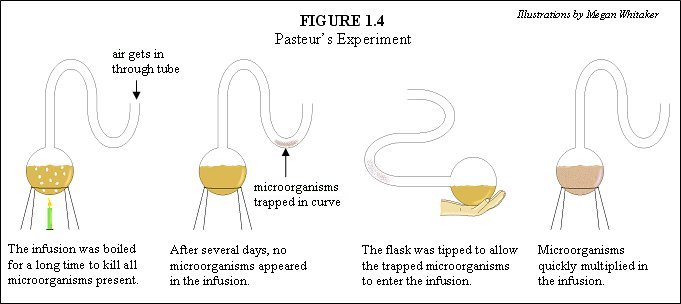
what experiment did louis pasteur perform? what were his findings?
\-swan neck experiment
\-he disproved spontaneous generation bc no microbes entered the flask unless the neck were to be tilted
\-he disproved spontaneous generation bc no microbes entered the flask unless the neck were to be tilted
85
New cards
what are the 2 tenets of modern cell theory?
1. cell is basic unit structure
2. all cells come from existing cells (recall spontaneous generation)
86
New cards
who contributed to cell theory tenet #1? what did each say?
1. robert hooke and his cork tissue
2. matthias schleiden and his plant tissue
3. theodor schwan compared plant and animal cells
87
New cards
who contributed to cell theory tenet #2? what did each say?
1. robert remak-cells come from other cells (i.e. cell division)
2. rudolf virchow-published “cellular pathology” -”all cells arise from other cells” (stole remak’s idea)
88
New cards
what is the endosymbiotic theory?
mitochondria and chloroplasts were originally prokaryotic cells that established a symbiotic relationship within a eukaryotic host
89
New cards
who contributed to the endosymbiotic theory? what did they conclude on the endosymbiotic theory?
1. Konstantin Mereschkowski- chloroplasts could reproduce independently and must have lived outside plant cell
2. Ivan Wallin-showed mitochondria outside of cell (but likely contamination) // modern technology shows molecularly that mitochondria are likely unable to be independent
3. Lynn Margulis - argued that mitochondria and chloroplasts are of prokaryotic origin, used DNA, fossil, biochem, organelle etc. evidence to support theory
90
New cards
steps of endosymbiotic theory?
1. plasma membrane folded and became nucleus and endoplasmic reticulum
2. ancestral eukaryote consumed aerobic bacteria that turned into mitochondria
3. then the early eukaryote consumed photosynthetic bacteria that evolved into chloroplasts
4. modern eukaryote at last
91
New cards
what is the germ theory?
diseases may result from microbial infection
92
New cards
who contributed to the germ theory? what did they discover?
\-girolamo fracastoro: seed-like spores may be transferred between individuals through direct contact, exposure to contaminated clothing, or through the air
\-ignaz semmelweis: he said that lots of mothers would die bc “contaminated” physicians transferred causative agents to patient, he promoted handwashing as a solution
\-john snow: he tracked the cholera outbreaks to 2 wells in london and ultimately proved that disease can also come from the environment
\-ignaz semmelweis: he said that lots of mothers would die bc “contaminated” physicians transferred causative agents to patient, he promoted handwashing as a solution
\-john snow: he tracked the cholera outbreaks to 2 wells in london and ultimately proved that disease can also come from the environment
93
New cards
who established a causative agent in the germ theory of disease?
\-louis pasteur: proved that fermentation made food spoil and that if organisms could spoil food they can also spoil people
\-joseph lister: he implemented the use of carbolic acid in his surgery for disinfection plus handwashing which then became a common practice
\-robert koch: a specific microbe can cause a specific disease
\-joseph lister: he implemented the use of carbolic acid in his surgery for disinfection plus handwashing which then became a common practice
\-robert koch: a specific microbe can cause a specific disease
94
New cards
what organelles does a generic cell contain?
1. cytoplasm
2. plasma membrane
3. chromosomes
4. ribosomes
95
New cards
\-what domains are considered prokaryotic? why
\-what domains are considered eukaryotic?
\-what domains are considered eukaryotic?
\-bacteria and archaea ( no membrane bound organelles)
\-eukarya bc of membrane bound organelles
\-eukarya bc of membrane bound organelles
96
New cards
what are the unique elements of prokaryotic cells? what is the function of each?
1. nucleoid : central region with DNA that contains all genetic material
2. inclusions: storage structures (ex: PHB, volutin, magnetosomes, etc.)
3. plasmids\*: carry a small number of non-essential genes and are copied independently of the chromosome inside the cell. They can be transferred to other prokaryotes in a population, sometimes spreading genes that are beneficial to survival.
4. pili\*:fewer, longer appendages aid in attachment; sex pilus
5. fimbrae\*: allow prokaryotes to stick to surfaces in their environment and to each other
6. endospore\*: dormant, hardy structures; clinically important
\*= not all cells have it
97
New cards
what are common prokaryotic cell arrangements?
1. coccus
2. diplococcus
3. tetrad
4. streptococcus (chain of coccus)
5. staphylococcus (cluster of coccus)
6. bacillus
7. streptobacillus (chain of bacillus)
98
New cards
what is a cell wall? where is it found?
\-aids in protection against osmotic pressure changes
\-can be found in eukaryotes and prokaryotes
\-found outside the cell membrane
\-can be found in eukaryotes and prokaryotes
\-found outside the cell membrane
99
New cards
what is osmosis? how does it work? what are the 3 kinds of tonicity?
\-osmosis is the diffusion of water from an area of low concentration to an area of high concentration
1. isotonic: equal movement of water, no net movement, cell membrane is attached to cell wall
2. hypertonic: water moves outside the cell, and it shrivels up (crenation), instead cell wall maintains shape and rigidness (plasmolysis)
3. hypotonic: water moves inside the cell, cell wall counteracts osmotic pressure to prevent swelling and lysis
1. isotonic: equal movement of water, no net movement, cell membrane is attached to cell wall
2. hypertonic: water moves outside the cell, and it shrivels up (crenation), instead cell wall maintains shape and rigidness (plasmolysis)
3. hypotonic: water moves inside the cell, cell wall counteracts osmotic pressure to prevent swelling and lysis
100
New cards
what is a nucleoid? is it found in eukaryotes or prokaryotes? what does it contain?
\-only in prokaryotic cells
\-central region of cell with DNA and DNA associated proteins
\-chromosomes are circular and haploid
\-central region of cell with DNA and DNA associated proteins
\-chromosomes are circular and haploid
 Note
Note  Flashcards (46)