INTB 3080 - Exam 4 (Ed Imm)
 Call Kai
 Learn
Learn Practice Test
 Spaced Repetition
 Match
Match Flashcards
 Knowt Play
1/64

There's no tags or description
Looks like no tags are added yet.
Name | Mastery | Learn | Test | Matching | Spaced | Call with Kai |
|---|
No analytics yet
Send a link to your students to track their progress
65 Terms
International Monetary System
Institutional arrangements countries adopt to govern exchange rates
Floating Exchange Rate
The foreign exchange market such as supply and demand determines the relative value of a currency, hard currencies such as the dollar, yen, pound, and euro
Pegged Exchange Rate
The value of the currency is fixed relative to a reference currency, such as the US dollar, and then the exchange rate between that currency and other currencies is determined by the reference currency exchange rate, China yuan until 2005
Managed-Float or Dirty-Float System
Try to hold the value of currency within some range against an important reference currency such as the US dollar or a basket of currencies, currency moves freely, but the country's central bank will manipulate it, to maintain the value of its currency
Fixed Exchange Rate
The values of a set of currencies are fixed against each other at some mutually agreed-on exchange rate
European Monetary System (EMS)
EU system designed to create a zone of monetary stability in Europe, control inflation, and coordinate exchange rate policies of EU countries.
Dollarization
A country abandons its own currency and instead adopts another currency (typically the US dollar)
The Gold Standard
The practice of pegging currencies to gold and guaranteeing convertibility.
Gold Par Value
the amount of a currency needed to purchase one ounce of gold
Balance-Of-Trade Equilibrium
the income a country's residents earn from exports is equal to the money its residents pay to other countries for imports
The Bretton Woods System
-1944 -US dollar is central currency -established the IMF (maintain order) and world bank (promote general economic development)-called for a system of fixed exchange rates policed by the IMF
Role of the IMF
- helps maintain currency value and discourage manipulation
- impose monetary discipline
Role of the World Bank
- sell bonds in capital markets, to lend to underdeveloped countries
- sell subscriptions, to wealthy nations (US, Japan, Germany, France) then donate that money to poor countries
Currency Board
a country commits itself to converting its domestic currency on demand into another currency at a fixed exchange rate by holding reserves of foreign currency equal to at least 100% of the domestic currency issued
Currency Crisis
speculative attack on the exchange value of a currency results in a sharp depreciation in the value of the currency or forces authorities to expend large volumes of international currency reserves and sharply increase interest rates to defend the prevailing exchange rate.
Banking Crisis
A loss of confidence in the banking system that leads to a run on banks, as individuals and companies withdraw their deposits.
Foreign Debt Crisis
Situation in which a country cannot service its foreign debt obligations, whether private-sector or government debt.
Moral Hazard
people behave recklessly because they know they will be saved if things go wrong
Chapter 11 video
The guy sold bicycles
Value Creation
Performing activities that increase the value of goods or services to consumers.
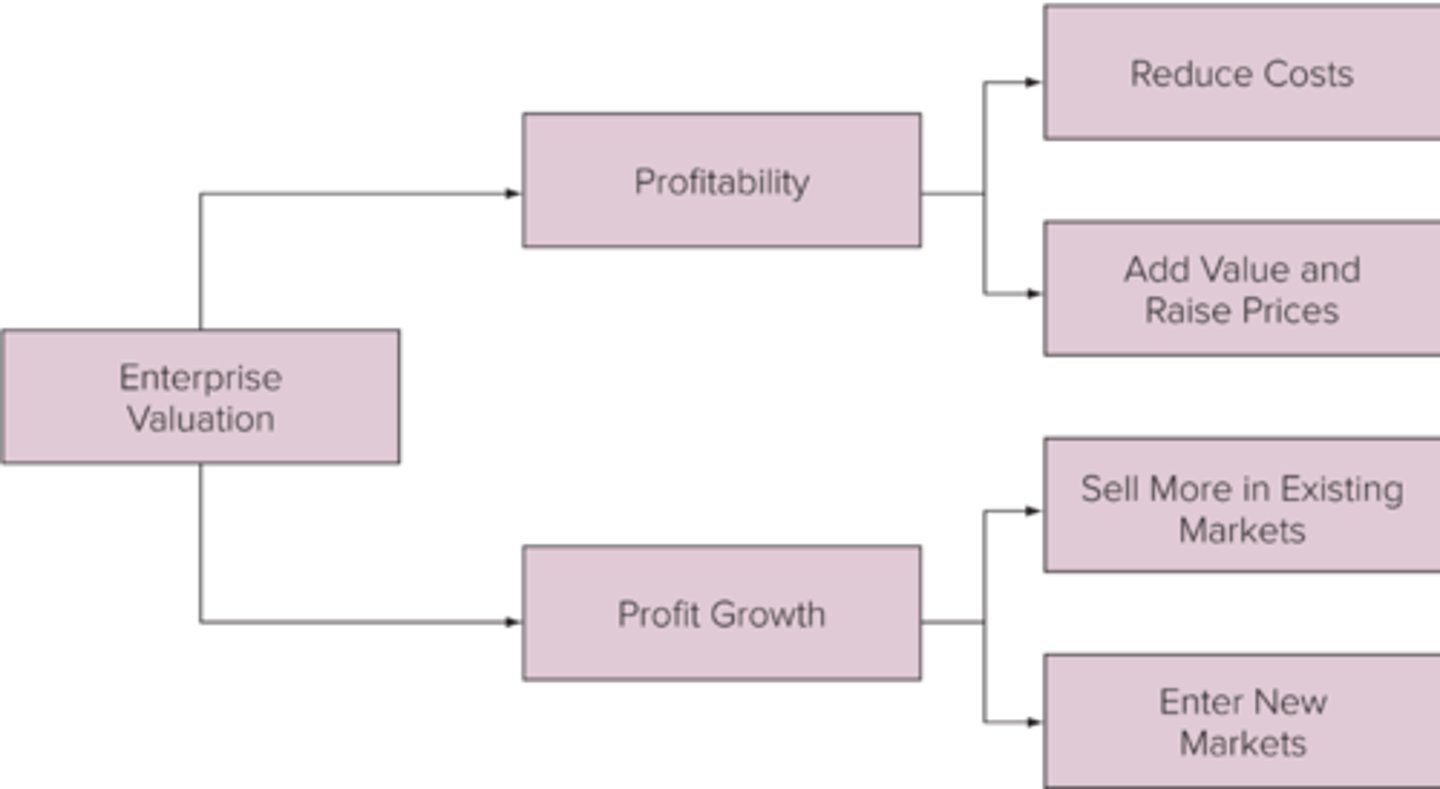
Enterprise Valuation
profitability and profit growth
Low-Cost Strategy
A strategy that focuses primarily on lowering production costs
Differentiation Strategy
A strategy that focuses primarily on increasing the attractiveness of a product
Strategy
The actions that managers take to attain the goals of a firm such as to maximize the value of a firm for shareholders
Value Creation Equation
Value - Cost
- must either add value, reduce price, or lower costs to gain more profit
Consumer Surplus Equation
Value - Price (customer captures some of the value)
Profit Equation
Price - Cost
Profit Growth
the percentage increase in net profits over time, sell more to existing market or enter new market
1: window air-conditioning unit
2: stove top stuffing
2 Items of Greatest Value
Hershey's
- Went bankrupt 6 times
- Reduce cost without damaging value
- The competitor coded a cheaper product
- They realized they weren't in the chocolate bar industry they were in the chocolate industry
Walmart shoes
from Walmart, best product because they were lightweight and cheap by driving down costs by removing the box
Operations
The various value creation activities a firm undertakes.
Primary Activities
R&D, Production, Marketing/Sales, Customer service
- Value chain leads core competency
Support Activities
Information systems, Logistics, HR
Location Economics
Economies that arise from performing a value creation activity in the optimal location for that activity, wherever in the world that might be;
government, labor, and culture
Core Competence
Skills within the firm that competitors cannot easily match or imitate
Global Web
When different stages of value chain are dispersed to those locations around the globe where value added is maximized or where costs of value creation are minimized.
Global Standardization Strategy
- i.e. industrial good (chlorine, sodium, ammonia, penicillin)
increasing profitability and profit growth by reaping economies of scale. Zero customization, zero local responsiveness, exact same in every place
- Low-cost strategy on a global scale
Localization Strategy
- Create added value by responding to local preferences
- i.e. pickup trucks in southwest USA, open pit BBQ
Increasing profitability by customizing the firm's goods and services so that they provide a good match to tastes and preferences in different national markets
Transactional Strategy
- best of both worlds
- i.e. CAT company - sells diggers/trucks, if part breaks down then gets replaced within 24 hours no matter where in the world
- i.e. make it accessible anywhere
Trying to simultaneously achieve low costs through location economies, economies of scale, and learning effects; differentiate their product offering across geographic markets to account for local differences; and foster a multidirectional flow of skills between different subsidiaries in the firm's global network of operations
International Strategy
- stay at home, sell abroad
- very little customization
- i.e. Xerox, Microsoft, P&G
Taking products first produced for their domestic market and selling them internationally with only minimal local customization
1. Which foreign market?
- over 200 countries of different size, economy, political, proximity
- can you create value?
2. Timing?
- first mover advantage
- pioneering costs
3. Scale of Entry?
- how big/small or how many for your operations
3 Decisions When Entering Developed and Emerging Markets
Timing of Entry
Entry is early when a firm enters a foreign market before other foreign firms and late when a firm enters after other international businesses have established themselves.
First-Mover Advantages
The ability to preempt rivals by establishing a strong brand name, the ability to build up sales volume and ride down the experience curve ahead of rivals and gain a cost advantage over later entrants, the ability to create switching costs that tie customers into products or services making it difficult for later entrants to win business
First Mover Disadvantages
You get stuck with pioneering costs
Pioneering Costs
Costs an early entrant bears that later entrants avoid, such as the time and effort in learning the rules, failure due to ignorance, and the liability of being a foreigner.
- the costs you incur when figuring out the kinks in a new market
Pizza and Wine
2 things McDonald's wants to sell you but they cant (they want to sell this because it's a bigger profit)
- people won't think its fresh
- They don't want to incur the pioneering costs it would take to market this
Six Modes of Entry
1. Exporting
2. Turnkey projects
3. Licensing
4. Franchising
5. Establishing join ventures
6. Wholly owned subsidiary
Spaghetti Scissors
Ed created a utensil for pasta that was also scissors, went to Robert Hoick, who produced can openers, to produce his, tried to import from China but couldn't because their product didn't work, all 6 options didn't work
Jam story
trying to expand but had to focus on core competency, not being the best product (Clearbrook Farms)
Exporting Definition
Sale of products produced in one country to residents of another country
Exporting Advantages/Disadvantages
+ Avoids the often substantial costs of establishing manufacturing operations in the host country. Firm achieves experience curve and location economies.
- Very expensive; transport costs, tariffs, taxes
Turnkey Definition
A project in which a firm agrees to set up an operating plant for a foreign client and hands over the "key" when the plant is fully operational.
Turnkey Advantages/Disadvantages
+ less risky than FDI
- may create a competitor
Licensing Agreement Definition
Arrangement in which a licensor grants the rights to intangible property to a licensee for a specified period and receives a royalty fee in return.
Licensing Agreement Advantages/Disadvantages
+ less risk and avoids development costs
- firm can lose control over their know-how to their partner and now that firm has lost their competitive advantage
Franchising
A specialized form of licensing in which the franchiser sells intangible property to the franchisee and insists on rules to conduct the business.
- similar to licensing but for longer
- sell the intangible brand
Franchising Advantages/Disadvantages
+ less risk and avoids development costs
- quality control is hard to maintain across different regions
Joint Venture Definition
Establishing a firm that is jointly owned by two or more otherwise independent firms.
Joint Venture Advantages/Disadvantages
+ partners have local knowledge
+ shared cost/risk
- conflicting objectives or ideas
- sharing control of ones technology
Wholly Owned Subsidiary Definition
A subsidiary in which the firm owns 100 percent of the stock.
Wholly Owned Subsidiary Advantages/Disadvantages
+ tight control
+ maintain trade secrets
+ location economies
- most costly
- highest risk
Airline story
They reduced their cost by eliminating lettuce and saved millions (pressure for cost reduction)
Walmart Can Openers story
They were willing (and didn't care) to sell a product that didn't work, just to get people into the store because they made more money that way
Example of Exporting
Company manufactures cars in Europe and sells them in the US
Explore top notes

Explore top flashcards
