BIO WEEK 8: Behavioral Ecology: Communication & Sexual Selection (Part 1)
 Call Kai
 Learn
Learn Practice Test
 Spaced Repetition
 Match
Match Flashcards
 Knowt Play
1/17

There's no tags or description
Looks like no tags are added yet.
Name | Mastery | Learn | Test | Matching | Spaced | Call with Kai |
|---|
No analytics yet
Send a link to your students to track their progress
18 Terms
What Is Behavior?
how and why organisms respond to stimuli in their environment.
Two key components:
Response
Environmental stimulus
Examples studied:
Finding food
Choosing habitat
Navigation
Communication
Sexual selection
Cooperation & altruism
Proximate Causation
“HOW”
Mechanistic explanation.
Example:
How does a pigeon find its way home?
Possible mechanisms:
Infrasound detection
Magnetic compass
Visual landmarks
These are immediate physiological or neurological mechanisms.
Ultimate Causation
“WHY”
Evolutionary explanation.
Why does a pigeon return to the same place?
Because:
Returning increases survival
Increases reproductive success
Natural selection favored individuals that homed successfully
Important:
Behavioral choices are usually not conscious evolutionary decisions — they are shaped by natural selection over generations.
Communication
exchange of information between organisms.
Can occur:
Within species
Between species
networks evolve.
Communication Network Model
Three components:
Sender
Receiver
Environment
The environment influences how signals travel and how they are perceived.
Honest vs Deceptive Communication
Example from slides:
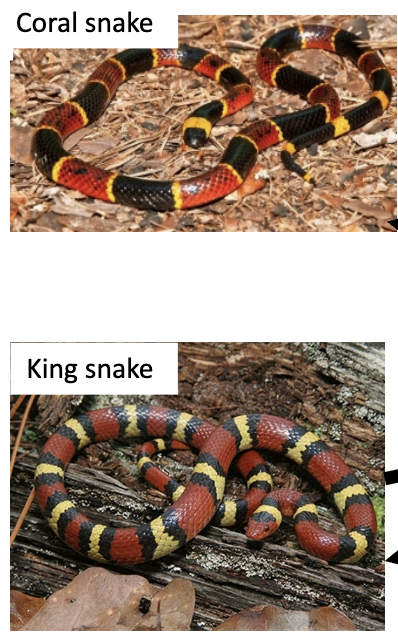
Coral snake (poisonous)
King snake (harmless mimic)
Predator (e.g., red-tailed hawk)
This is Batesian mimicry
Definition:
A harmless species mimics a harmful one.
Honest Message:
“I am poisonous.” (Coral snake)
Deceptive Message:
“I am poisonous ;)” (King snake)
Receiver responds:
Leaves snake alone.
Important concept:
Not all communication is truthful.
Does Communication Benefit Both Parties?
Not always.
Sometimes:
Sender benefits
Receiver benefits
Both benefit
Or one is manipulated
Signal
A trait that evolved specifically to convey information.
Maintained by natural selection because:
It affects receiver behavior
It increases sender fitness
Can be:
Behavioral
Morphological
Physiological
Example:
Bird song
Bright coloration
Courtship displays
Cue
Information that is:
Present
Useful to receiver
But did NOT evolve for communication
Example:
Predator smells prey.
Prey did not evolve scent for predator benefit.
Which benefits the sender?
Signal
Cue primarily benefits the receiver.
Honest Signal
Provide accurate information.
Example:
Bright coloration that truly signals toxicity.
Deceptive Signals
Provide misleading information.
Example:
Batesian mimic.
can evolve if:
It increases fitness
It is not too common (otherwise predators stop responding)
Communication Evolves
systems shaped by:
Natural selection
Receiver psychology
Environmental constraints
Conflict of interest between sender and receiver
Cost–Benefit Analysis
In behavioral ecology, this evaluates whether a behavior’s benefits outweigh its costs (energy, risk, time).
Anisogamy
A reproductive system where gametes are different sizes:
Small, mobile sperm
Large, nutrient-rich eggs
This difference drives many patterns of sexual selection.
Intrasexual Competition
Competition between individuals of one sex for access to mates of the opposite sex.
Commonly refers to members of one sex competing to be chosen by the other.
(Usually male competition for female choice.)
Frequency-Dependent Selection
The fitness of a trait depends on how common or rare it is in the population.
Sometimes rare traits have an advantage
Can help maintain variation in a population
Eavesdropping (in animal behavior)
When an individual observes interactions between others and uses that information to guide its own behavior.
Example: A male watching two rivals fight and choosing whether to challenge the winner.

