ACTIVITY 13 THE INVERTEBRATES: GAS EXCHANGE AND INTERNAL TRANSPORT
 Call Kai
 Learn
Learn Practice Test
 Spaced Repetition
 Match
Match Flashcards
 Knowt Play
1/21

There's no tags or description
Looks like no tags are added yet.
Name | Mastery | Learn | Test | Matching | Spaced | Call with Kai |
|---|
No analytics yet
Send a link to your students to track their progress
22 Terms
invaginated; tracheal; book lung
Gases like oxygen and carbon dioxide enter and exit the invertebrate body through involutions of the outer surface called ____________ systems. There are two types of invaginated systems: the _____________ and the ____________ system.
tracheal; book lung; spiders
Insects have a ______________ system for facilitating gas exchange while arachnids like tailless whip scorpions have a _______________ system. Some invertebrates make use of both systems. In fact, most __________ rely on both the tracheal and lung systems for gas exchange.
open; hemolymph
closed
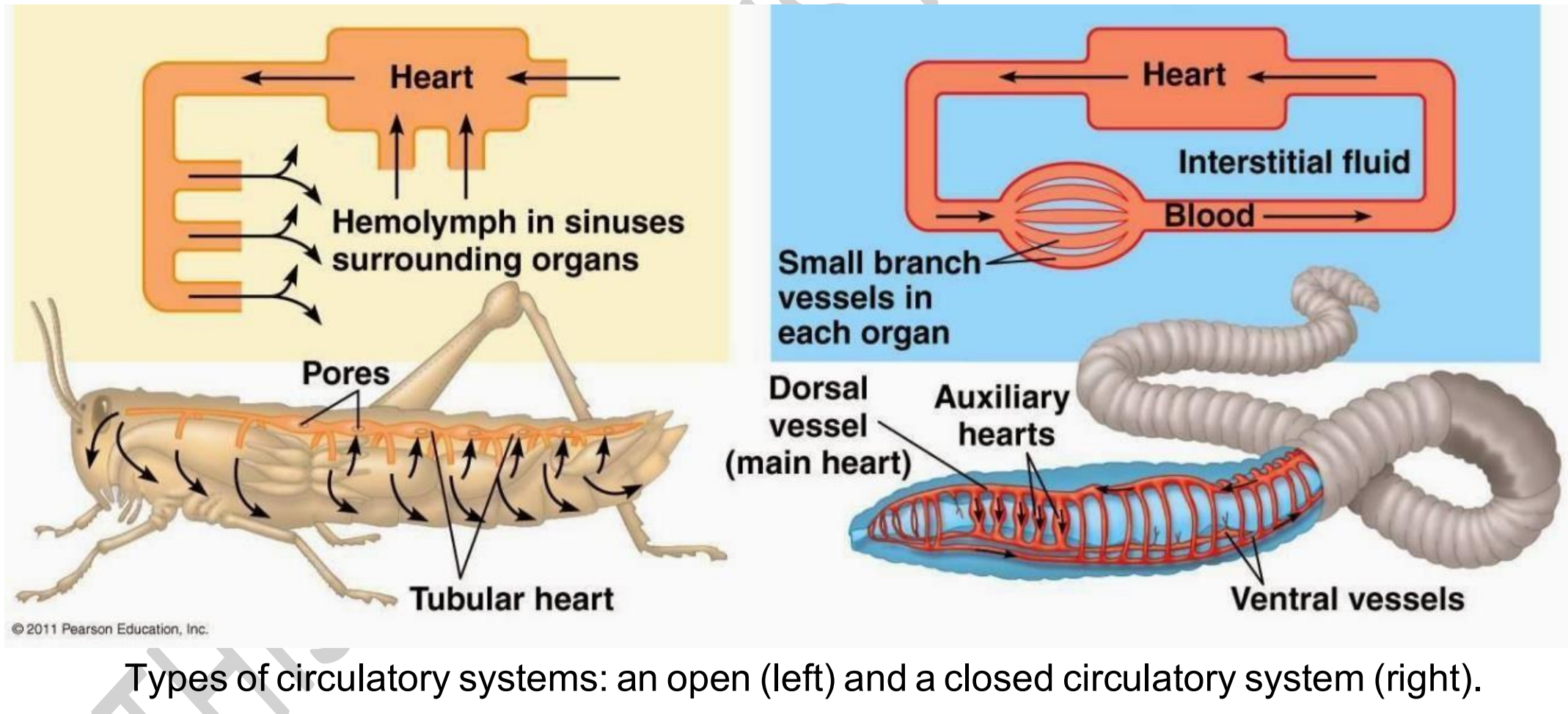
On the other hand, nutrients are delivered to target cells from the environment through internal transport systems in invertebrates.
There are two types of circulatory systems found in invertebrates:
1) ________ type- hemoglobin-free blood called the _____________ is circulated though the activity of a dorsal longitudinal vessel composed of a posterior heart and an anterior aorta; and
2) ________ type -blood is circulated through welldefined blood vessels.
open; closed
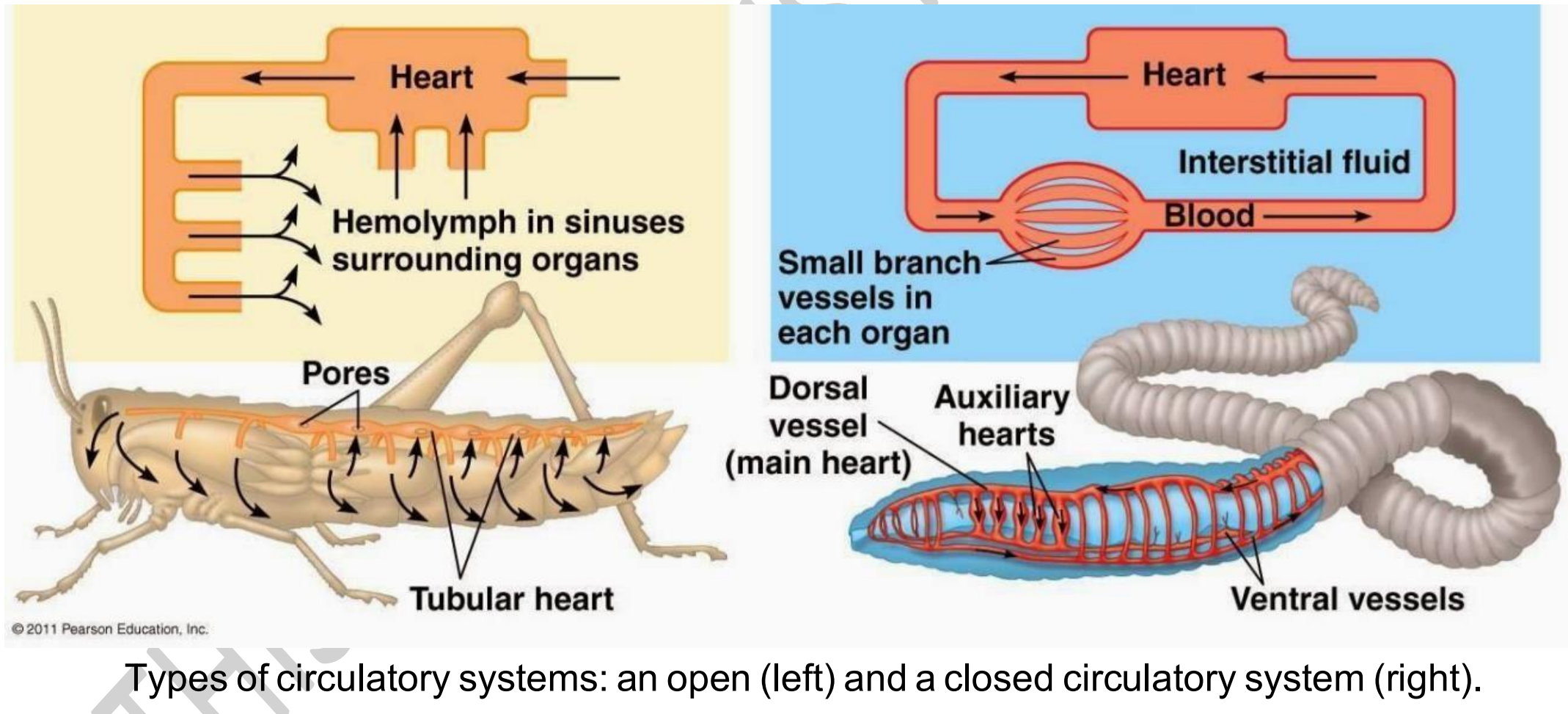
Arthropods like insects and spiders have an __________ type circulatory system while annelids such as earthworms, characteristically possess a __________ type of circulatory system.
OBJECTIVES
At the end of this exercise, the student is expected to:
compare the types of gas exchange and internal transport mechanisms in invertebrates
explain the function of the spiracle in terrestrial insect respiration
diagram tracheal respiration and circulation in invertebrates (i.e. insects)
OBJECTIVES
At the end of this exercise, the student is expected to:
compare the types of gas exchange and internal transport mechanisms in invertebrates
explain the function of the spiracle in terrestrial insect respiration
diagram tracheal respiration and circulation in invertebrates (i.e. insects)
trachea; book lungs; gills
Gas Exchange in Invertebrates
Respiratory structures are designed to acquire of oxygen from the animal’s external environment. The organs of invertebrates involved in gas exchange are ___________, ________________, and ___________.
Tracheal
____________ System. The nature of this gas exchange system is that it is composed of branching tubes that deliver oxygen to, and remove carbon dioxide from, the tissues. Consequently, this system does away with the need for a circulatory system to transport the respiratory gases.
spiracles
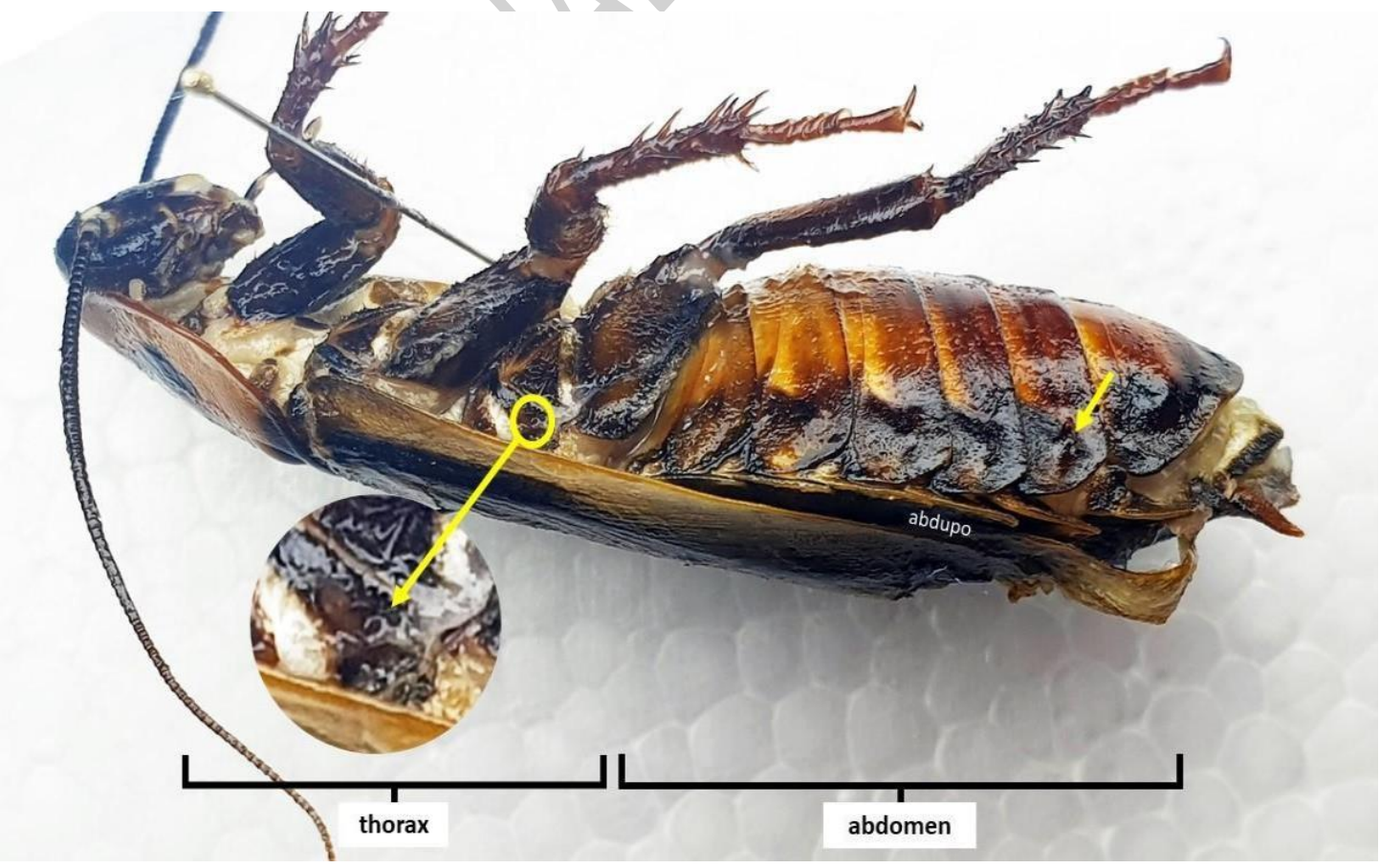
The pores associated with the tracheal system are situated outside the body. These are called __________.
trachea;
taenidia;
tracheoles;
tracheoles
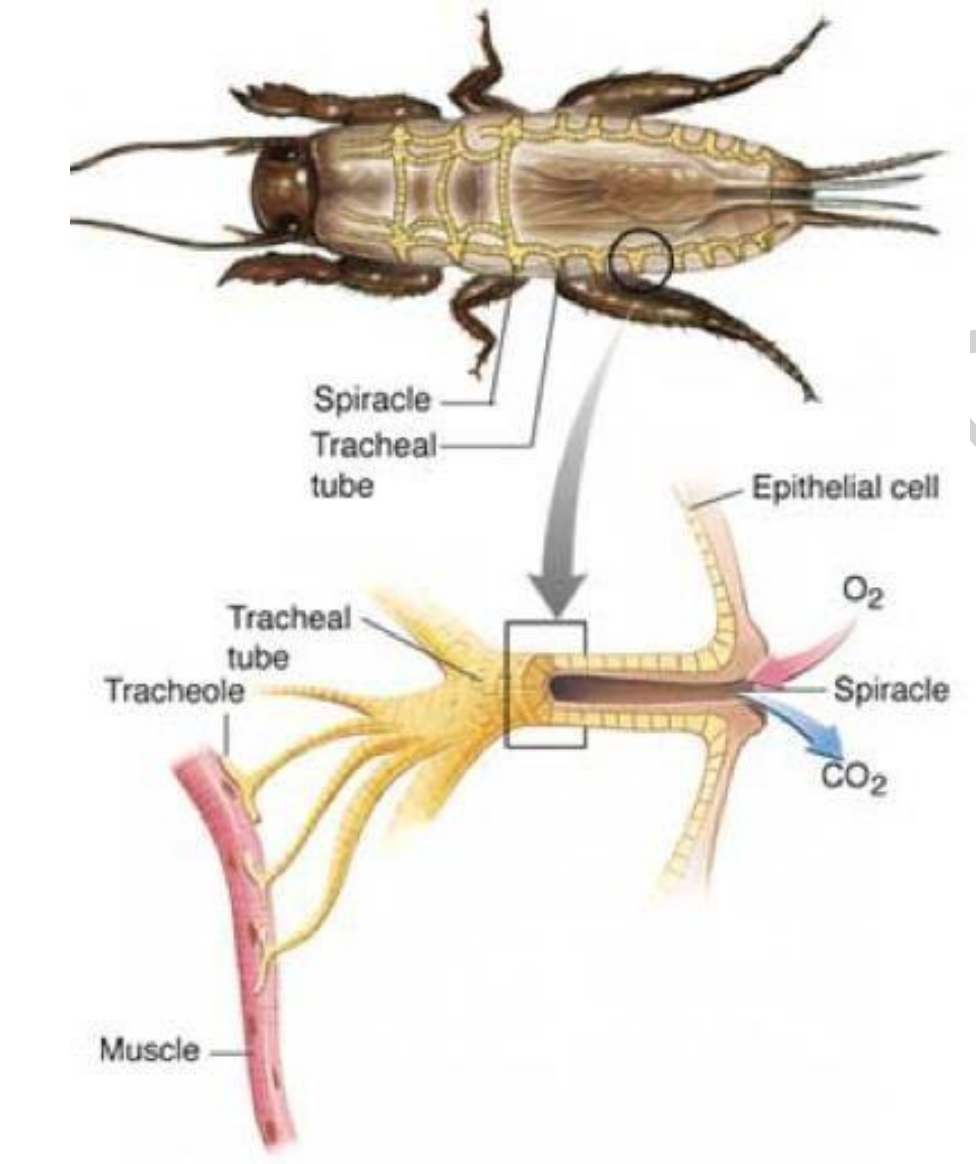
The spiracles in insects are connected to a system of branched elastic air tubes called the ____________.
The trachea is reinforced with circumferential thickenings of the cuticle called ____________ to prevent these tubes from collapsing.
These tubes then re-branch into finer ones, commonly referred to as _____________.
The _____________ facilitate gas exchange by delivering and removing respiratory gases from the cells.
The tracheoles contain a fluid where oxygen dissolves before reaching the cells.
compressible gas gill; plastron; hemelytra
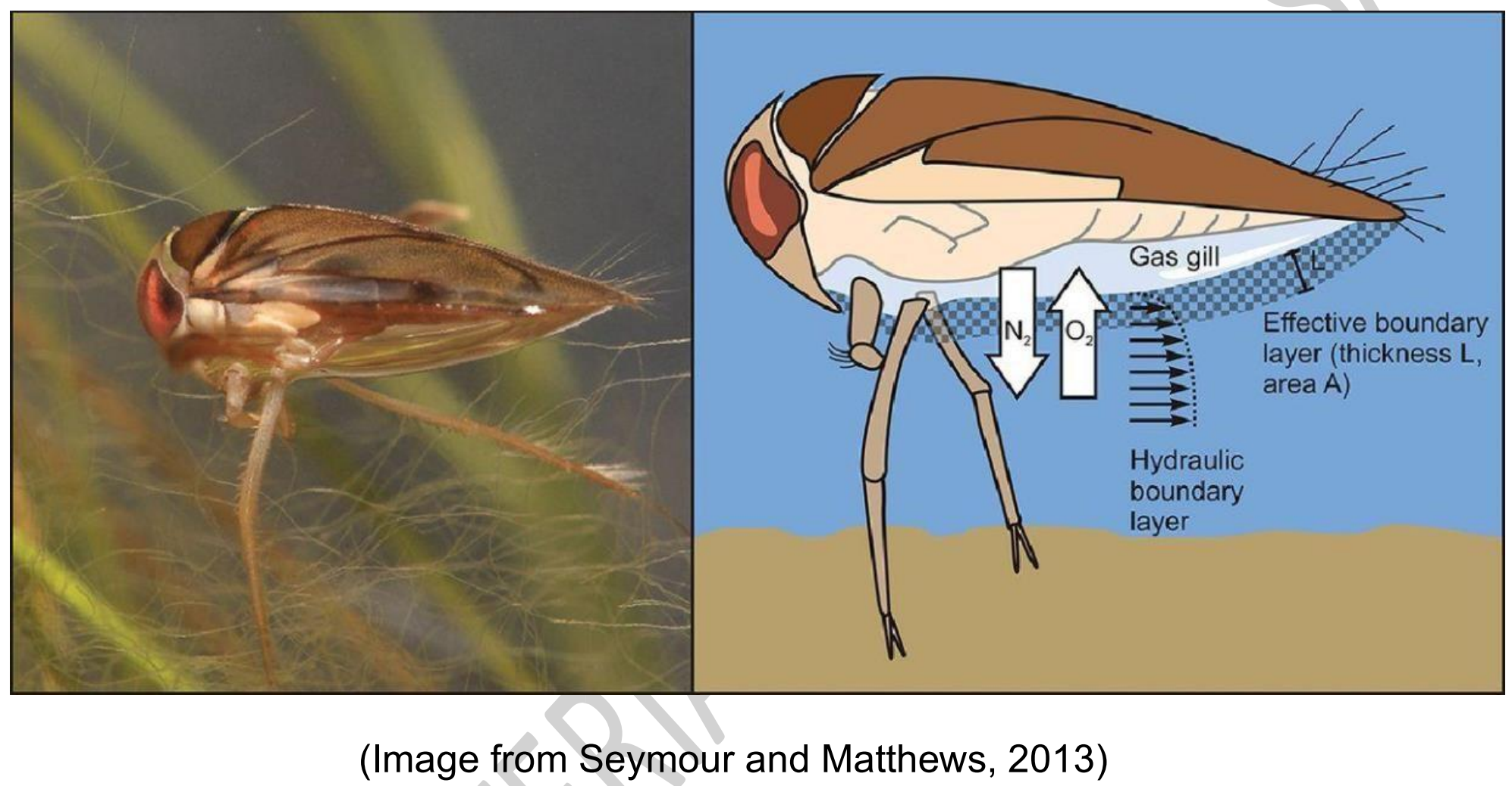
White arrows on the image below shows the direction of oxygen and nitrogen diffusion between the bubble and the surrounding water. Such an air bubble system allows for tracheal gas exchange to continue even after the insect submerges in water. As oxygen inside the air bubble is used, the partial pressure of oxygen within the bubble falls below that in the water. Oxygen from the water later diffuses into the bubble to replace what was consumed. On the other hand, carbon dioxide respired by this beetle would diffuse through the tracheal system into the bubble and subsequently into the water
Although tracheal systems are primarily designed for terrestrial living conditions, certain aquatic insects have modifications that allow the tracheae to serve for gas exchange under aquatic conditions.
Corixid bugs, for instance have a _________________________ or _____________ on the ventral surface and edges of its _____________.
siphon; spiracle
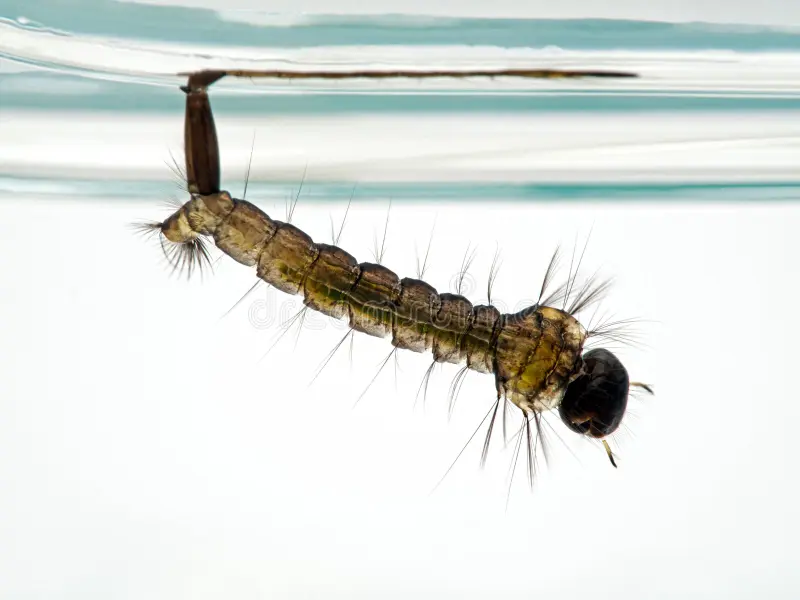
Other aquatic insects like mosquito wrigglers, tabanid larvae, and other aquatic dipteran larvae thrive in water and breathe through a tubular organ referred to as the _____________ and terminal to this, is the ____________.
The siphon functions close to how a diver makes use of a snorkel.
Book Lung; book lungs
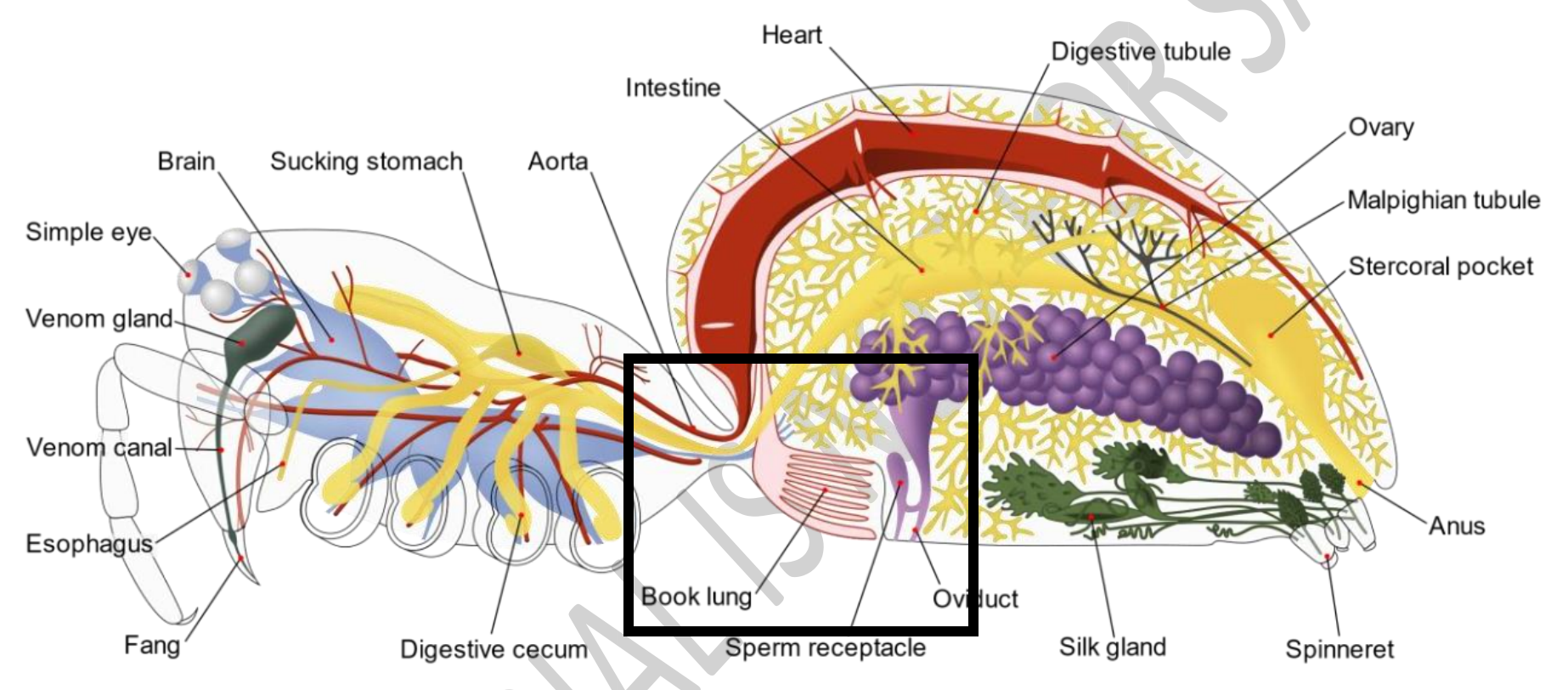
_____________ System. The respiratory structures of arachnids like spiders and amblypygids consist of _____________ or leaf-like stacks plates over which air circulates through slits on the abdomen.
In addition to these structures, spiders also make use of a tracheal system as with those found in insects.
light blue hemolymph;
hemolymph
Book Lung System
The number of hollow disks stacked depends on the species.
Book lungs are saturated in ____________ _______________.
Air bathes the outer surface of the plates and the ______________ circulates within them, facilitating gas exchange.
The hemolymph is like blood for spiders and tailless whip scorpions.
hemocyanin;
The hemolymph carry iron-rich nutrients but instead of hemoglobin, these invertebrates have _____________.
hemocyanin;
light blue; copper
_____________ works like red blood cells. They bind to oxygen and deliver it in areas with low oxygen concentrations and the _______________ coloration is attributed to the ____________ atoms it carries as well.
It transport waste carbon dioxide to areas where it can diffuse out into the atmosphere.
All these is facilitated by an internal transport system.
Open;
hemocoels; sinuses
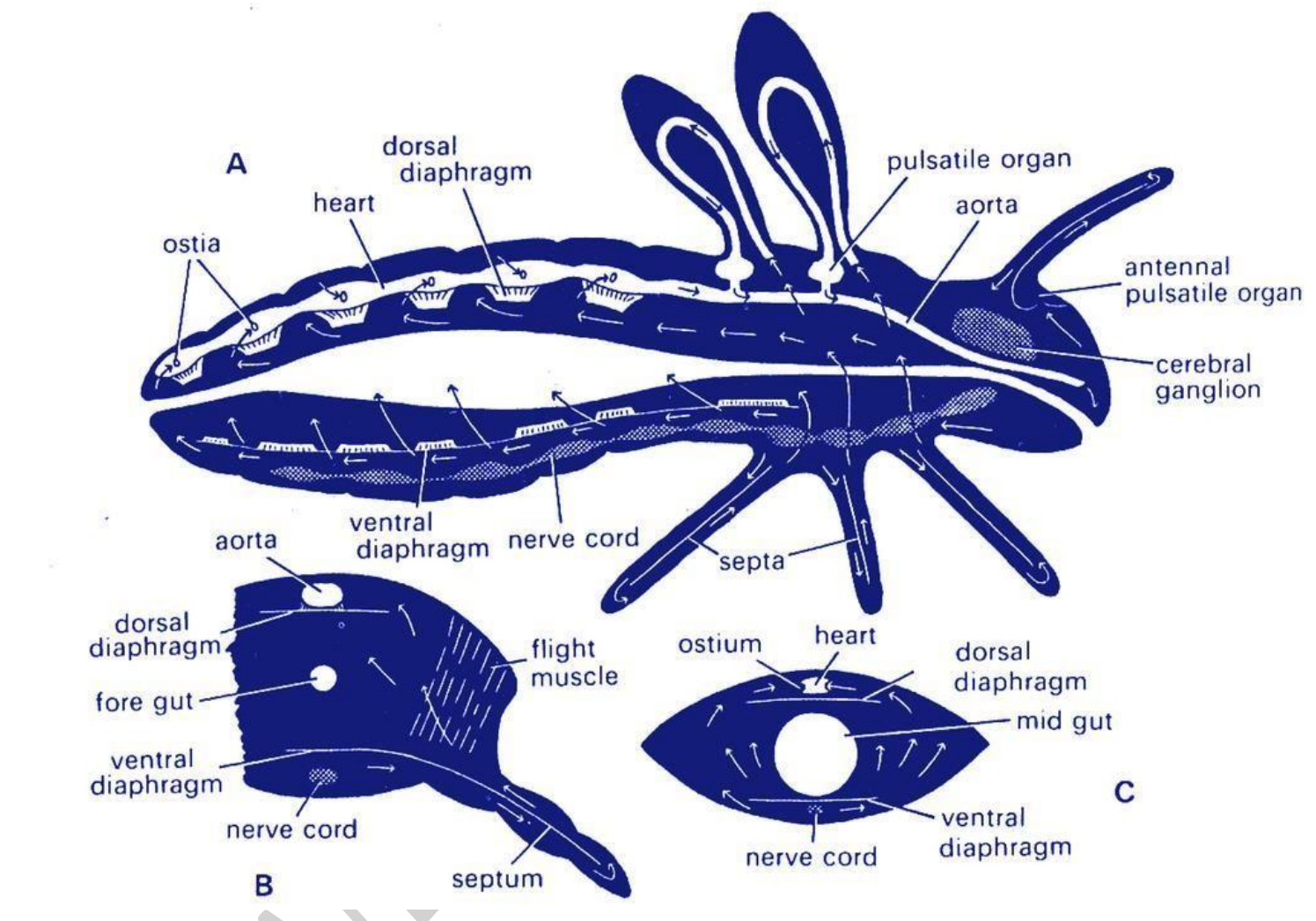
Invertebrates such as insects and spiders have an __________ type of circulatory (A).
Characteristic to this type of internal transport system is the absence of blood vessels. Here, the hemolymph or blood is pumped by a heart into the body cavities called ______________ or ____________.
Tissues are then bathed by the hemolymph.
three; dorsal; ventral
pericardial sinus;
perivisceral sinus;
perineural sinus
The body of the cockroach is divided into _________ hemocoels or sinuses by the porous _________ and _________ diaphragms (B and C).
Dorsally located is the ______________, which contains the heart.
Meanwhile, the gut is in the _______________; a cavity delimited by the dorsal and ventral diaphragms.
Lastly, the ______________ can be found ventrally and contains the nerve cords.
13; three; 10;
ostia; alary muscles
The heart of the insect has __ chambers: _ thoracic and __ abdominal.
Every chamber opens into the other present in front of it.
In front of each chamber is a pair of openings known as the ________ and a pair of _______________.
Ostia; alary muscles;
posterior; anterior; aorta
________ have valves that permit the hemolymph flow into the heart and prevents backflow while _____________ expand and contract to facilitate the flow of hemolymph through the heart.
In addition, the chambers of the heart have the ___________ end closed while the ____________ end is continued forward as the anterior __________.
The aorta receives blood from the heart and empties into the heart.
aorta;
ostia;
perineural; perivisceral
When the alary muscles contract, the hemolymph is forced through the _________ into the head.
Upon relaxation, the hemolymph enters the heart through the _______.
Once the hemolymph leaves the aorta, it fills the ___________ and ____________ sinuses, bathing the internal organs at the same time.
closed;
aortic arches; dorsal blood vessels; ventral blood vessels
Earthworms are invertebrates with a ___________ type of circulatory system.
It circulates blood exclusively through vessels.
There are three main vessels that supply the blood to organs within the earthworm: ____________, ______________, and __________________.
front; back
The closed type circulatory system of earthworms:
The aortic arches pump blood into the dorsal and ventral blood vessels.
The dorsal blood vessels are responsible for carrying blood to the _________ of the earthworm’s body while ventral blood vessels are responsible for carrying blood to the _________ of the earthworm’s body.

