The Krebs Cycle
 Studied by 0 people
 Call Kai
 Learn
Learn Practice Test
 Spaced Repetition
 Match
Match Flashcards
 Knowt Play
1/4

There's no tags or description
Looks like no tags are added yet.
Name | Mastery | Learn | Test | Matching | Spaced |
|---|
No study sessions yet.
5 Terms
Where does the Krebs cycle take place?
In the mitochondrial matrix.
What is the function of the Krebs cycle?
It is a means to liberate energy from the carbon bonds to provide ATP and reduced NAD (and FAD), with the release of carbon dioxide.
How many times does the Krebs cycle take place?
Twice- each molecule of glucose produces two molecules of pyruvate, so the Krebs cycle takes place twice for each glucose molecule.
Describe the key steps in the Krebs cycle.
The acetate fragment from the acetyl co-enzyme A combines with a 4C compound to produce a 6C compound – the co-enzyme A is regenerated in the process.
The 6C compound undergoes reactions during which hydrogen and carbon dioxide are removed. After the acetate fragment is broken down, the remaining 4C residue undergoes conversion to regenerate the 4C compound which combines with more acetyl coA.
2 steps involve decarboxylation, and 4 steps involve dehydrogenation.
The hydrogen atoms produced are collected by 2 different carriers, with the formation of 3 molecules of reduced NAD and 1 molecule of reduced FAD.
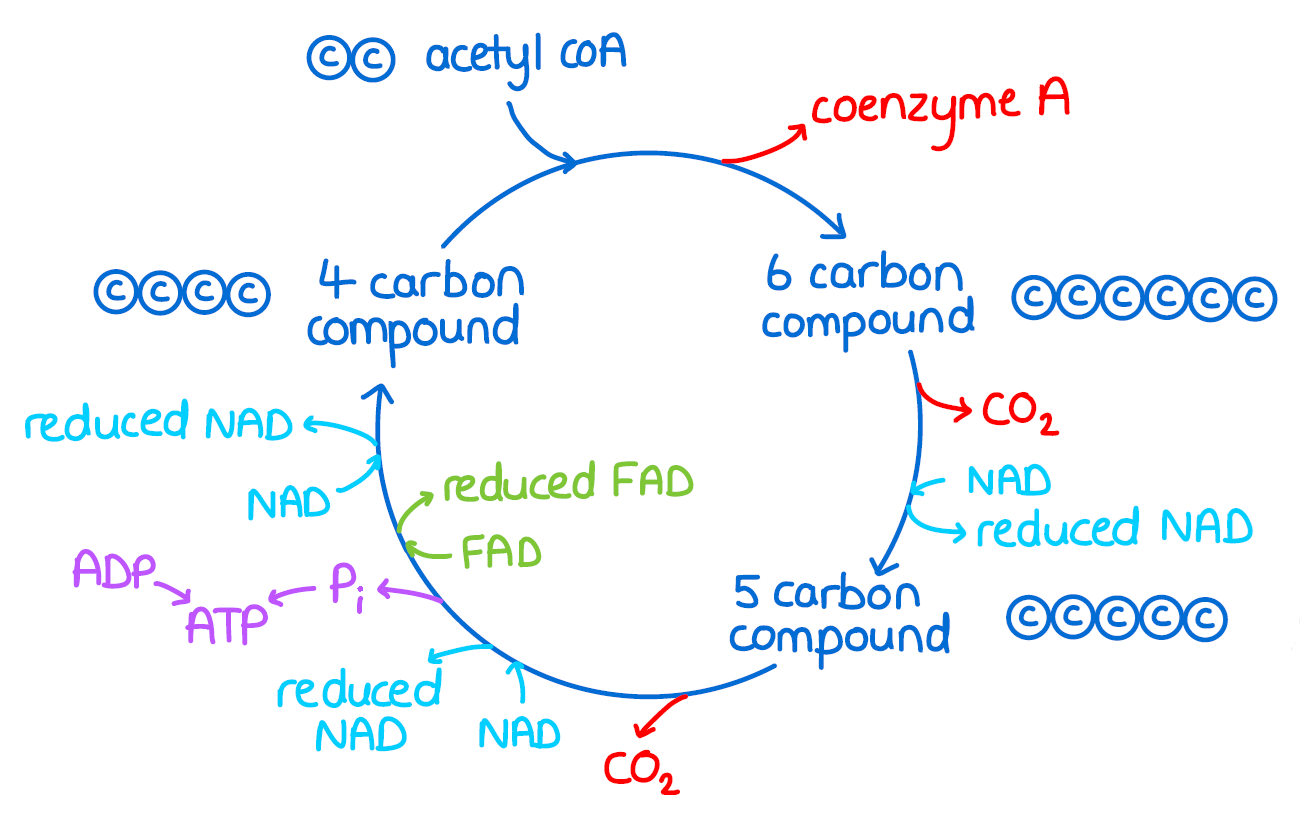
What is the production for each turn of the Krebs cycle?
One ATP (this occurs through substrate level phosphorylation).
3 reduced NAD and 1 reduced FAD.
2 molecules of carbon dioxide.
 Note
Note  Flashcards (45)