Retail Buying and Merchandising Exam #1
 Studied by 0 people
 Call with Kai
 Learn
Learn Practice Test
 Spaced Repetition
 Match
Match Flashcards
 Knowt Play
1/58

There's no tags or description
Looks like no tags are added yet.
Name | Mastery | Learn | Test | Matching | Spaced | Call with Kai |
|---|
No study sessions yet.
59 Terms
INTRODUCTION AND OVERVIEW
Doug McMillon's CES Keynote
"We're a people-led, tech-powered omnichannel retailer dedicated to helping people... we want to help people lives better."
Merchandising Overview
Merchandising Levers
- The actions you can take as a merchant to impact business results: Assortment selection and Channel Management, Pricing, Promotions and Displays, Modular Development and Category Management, eCommerce and Site Merchandising
Merchandising Functions
- The partners and activities that you will need to activate and align on as a merchant to execute business plans: Financial Planning & Business Analytics, Inventory, Replenishment & Supply Chain, Private Brands & Product Development, Supplier Relationships & Negotiation, and Merchant Administration & Strategy Development
Merchandising Resources
- The inputs you will leverage as a merchant to deliver business results: Data, Partners & Competencies
Functional Skills
Merchandising competencies define the role of a merchant and provide a basis for evaluation
Examples of functional merchandising competencies include (but are not limited to)
- Strategic acumen
- Financial management
- Supply chain management
- Analytics
- Item selection
- Assortment management
- Supplier negotiations
Soft Skills
Communication and Influence
Continuous Improvement
Personal Brand Development
BUSINESS-LEVEL AND GENERIC STRATEGIES
Definitions
Corporate
- C-level executives
- cyclical - annual or quarterly
- top-down from Mission and values
- strategic plan
Business
- division presidents, EVPs, GMMs
- cyclical - annual or quarterly
- top-down
- annual operating plan
Managerial
- managers and other employees
- continuous
- bottom-up
- value proposition
**buyers live between business and managerial
GAP example
Competitive Advantage
--> comes from the value that firms create for their customers that exceeds the cost of producing that value
- superior financial performance relative to competitors must be achieved for a company to have a competitive advantage
Porter's Five Forces
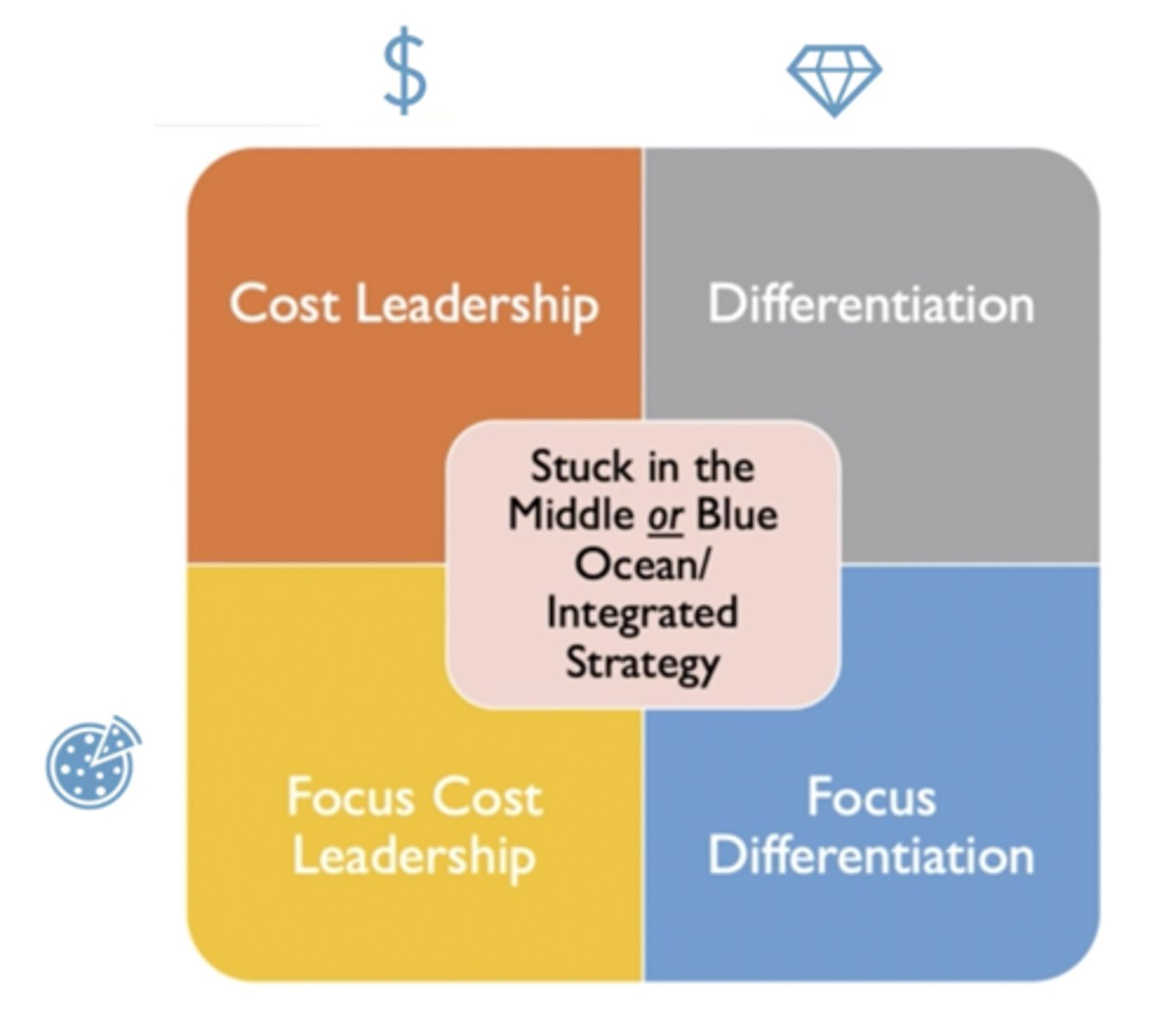
Cost Leadership
- It is not referring explicitly to the retail price point but the cost to produce
- Recognize that there are cost drivers associated with every business and a cost leadership approach is focused of producing at lower price than competitors
- It is all about MAXIMIZING the difference between value created for customer/consumer and cost to produce
Differentiation
- Value from the perspective of the customer/consumer
- A product or service is chosen over competitor offerings because it is unique, better, superior in some way. These are value drivers
- Factors of differentiation can be either tangible or intangible
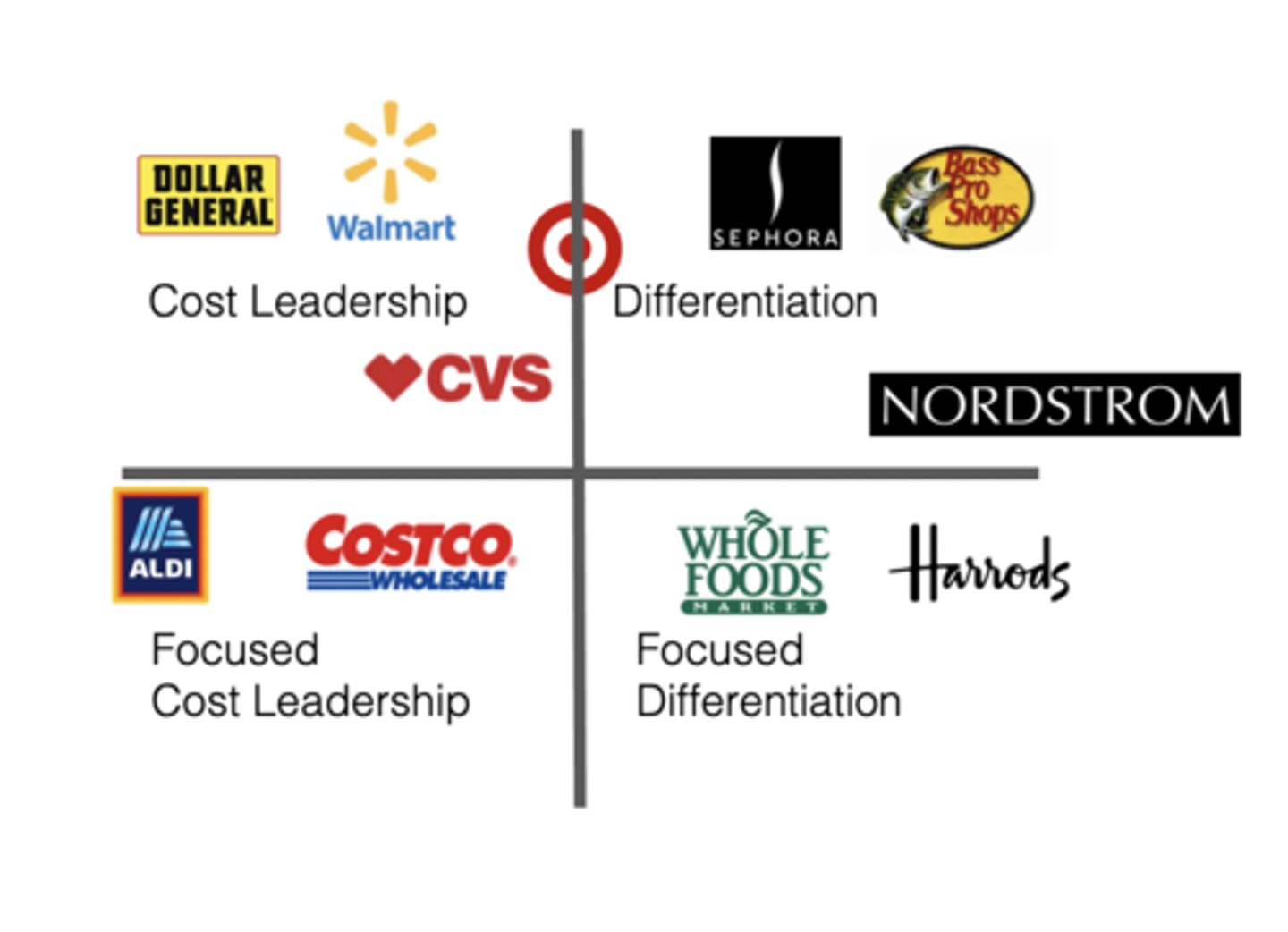
Porter's Five Forces Example
Being a Buyer at a Cost Leader
A LOT (!!) of the same levers as a buyer at a differentiated retailer
- Assortment Selection & Channel Management, Pricing, Promotions & Displays, Modular Development & Category Management, eCommerce
- Internal collaboration and coordination
- External collaboration and coordination
- BIG difference is on supply chain management and replenishment! Cost leaders rely on volume to achieve superior financial performance so inventory metrics and KPIs are critical!
- Product discovery to complement core cash cows that anchor your modular
CUSTOMER INSIGHTS AND CATEGORY SELECTION
Sources of Merchandising Data
- Financial Performance
- Industry Trends
- Competitor Research
- Customer Insights
Potential Sources of Insight
Secondary and Primary Data
BUYER-SUPPLIER AND BUYER-OPERATOR RELATIONSHIPS
The Many Relationships of the Buyer
External:
- Suppliers/Vendors
- Brokers
- Manufacturers
- Wholesalers
- "Rack Jobber"
**These can be buyer-initiated, vendor-initiated, or (the most likely) inherited
Internal:
- Private Brand
- Product Development
- Operations
- Transportation/Logistics
**Sometime these relationships are even trickier than your external suppliers! All about communication and and mutual gain.
Some of the Nearly Infinite Considerations
- The value their product offers your customer segments
- How this fits within you current assortment and when is your next line review and modular?
- Profit % and anticipated profit dollars (though there are exceptions for bringing something in that offers something other than profit)
- Their distribution network (if produced internationally, do they domestic warehouse???)- Their reputation, particularly for reliability
- Is your contact supporting other retailers, other channels?
- Their financial health
Terms offered:
- COGS (is this guaranteed for a certain period of time? duration of modular?)
- Minimum order quantity (MOQ)
- FOB shipping or FOB destination
- Co-op advertising commitment
- Markdown budget
- Payment terms and timing (Net 30 or Net 60 is common( (ex. 2/10 Net 30)
- Exclusivity or selective distribution (the model number game)
- Indemnification and liability protection
- Return threshold (what is the standard return rate within the product category?)
- Sales training offered
Distributive vs. Integrative Negotiaions
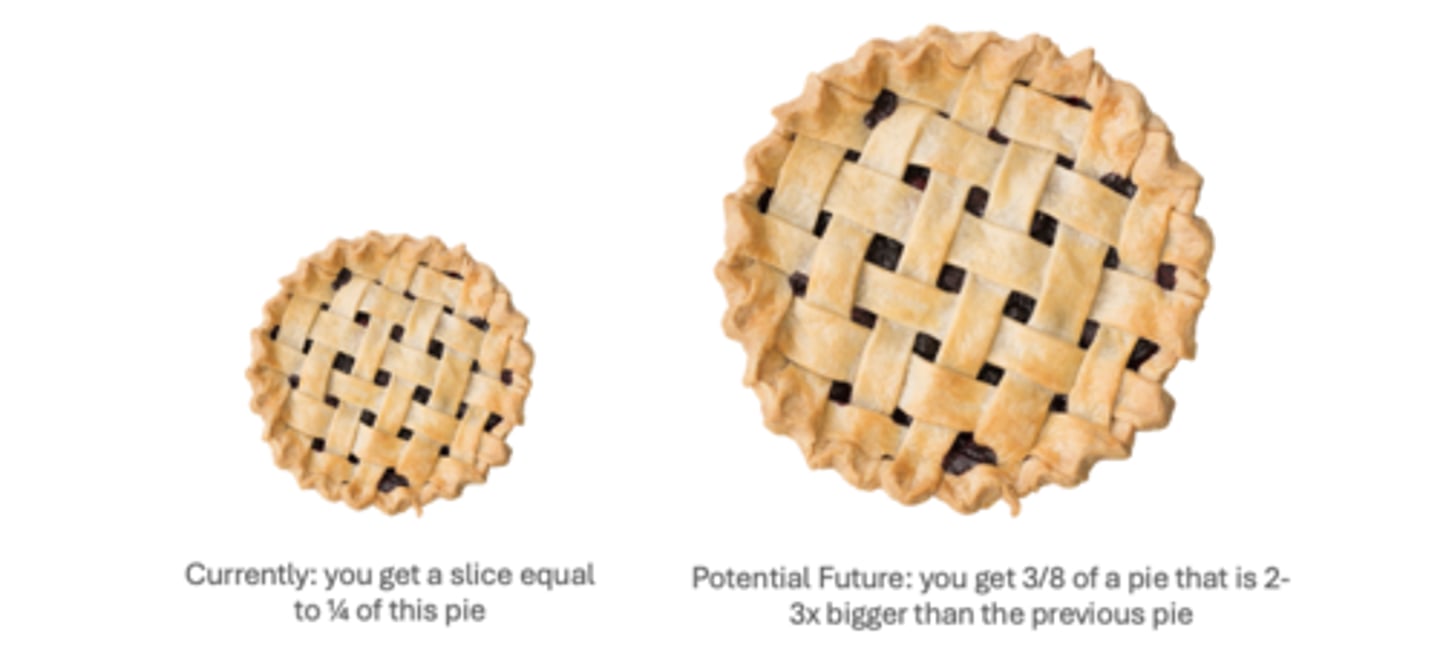
"Value" can be money, resources, or any type of reward that helps one reach his or her goals
Value stems from the importance of certain issues -- solving these issues can help us reach our goals
- In multi-issue negotiations, parties usually do not value issues the same!
- Some issues may be more important to one party than the other
- We put more "value" on issues that help us reach our goals
People Side of Strategy
- Heuristics, Biases, and Blind Spots
- Intelligence Quotient (Wonderlic - NFL uses this to measure IQ and problem-solving siutations)
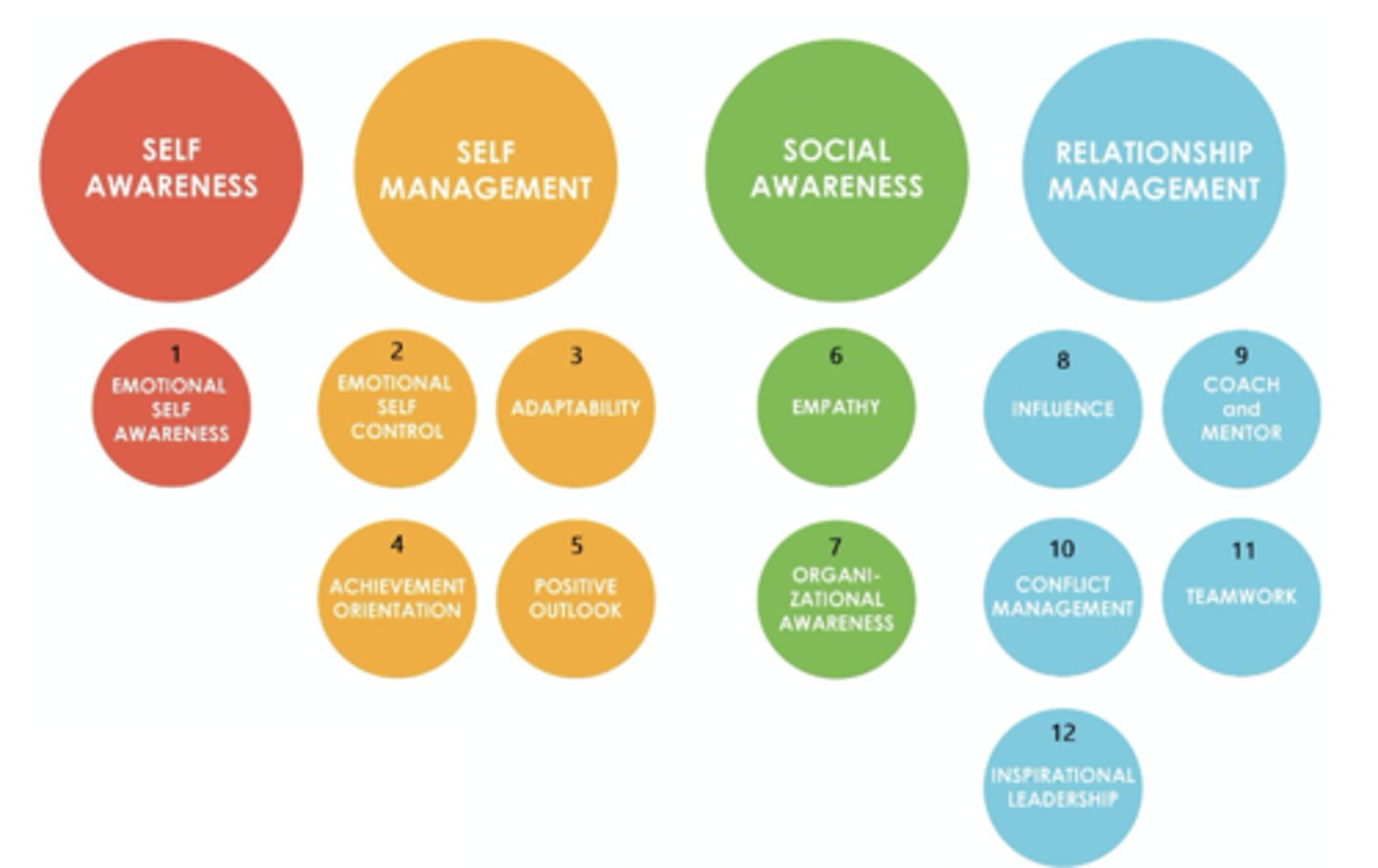
- Emotional Intelligence: a person's abilities to perceive, identify, understand, and successfully manage emotions in self and others (understanding others/exposure to more and diverse data/connecting the dots)
EQ Domains and Core Competencies
EQ and Social Exchange
Interpersonal relationships are a series of resource exchanges
- Complementary in that one's rights are another's obligations and vice versa
- Reciprocal in that each party has rights and duties
- In the long run, it all balances out...
Hierarchy of resources:
1. Love
2. Status
3. Information
4. Money
5. Goods
6. Servies
ASSORTMENT AND CHANNEL MANAGEMENT
Category Management
Terms:
Category: groups of products belonging to a similar family, either as substitutes for each other or as complementary to each other
Item roles within a category:
- "traffic builders"
- private brands
- trend/color/season
- retail brand image
- choice
Category management: the ongoing collaboration between retailer and supplier(s) to design offering and value chain to support consumer demand in most profitable way. Key tenets include:
- Suppliers are partners or allies
- Looks at processes/activities of the value chain, as well as the touchpoints of customer journey
- Category is defined by how the consumers/customers shop
Assortment Mistakes IRL
1. Super Fresh cut many of its low-selling dry grocery items to expand fresh offerings. But the eliminated products turned out to be essential to customers; when they couldn’t find them, they took their business elsewhere…
2. Following a survey in which customers said they’d like less cluttered stores, Walmart introduced Project Impact, in 2008, removing 15% of the SKUs it carried. Sales declined significantly (and swiftly!), and it was forced to roll back most of the changes.
3. Bed Bath & Beyond missed important cues from customers in terms of changing shopping behavior. And, generally, lost track of the building blocks of retail. Store-level buying one of most visible symptoms…
Assortment Strategy
What is an assortment strategy?
- The number and type of products that stores display for purchase by consumers
Considerations
- An assortment strategy is not one-size-fits-all; it needs to be customized to respond to a business's parameters.
- An assortment strategy can have many layers of sub and related strategies, as each retailer will need to tailor the strategy to address its own needs and goals
Assortment Components
Assortment Strategies Consist of Two Components
1. The depth of products offered, or how many variations of a particular product a store carries (i.e., how many sizes or flavors of the same product)
2. The width (breadth) of the product variety, or how many different types of products a store carries
Assortment Selection
Review the Item Financials
Sales Drivers
- Which items are outpacing the others in sales growth, both in store and Rest of Market (ROM)?
- Is there an opportunity to delete low sales or declining items?
- Is the supplier willing to invest in marketing tactics to increase the sales growth of an item?
Profit Drivers
- Are there Private Brand items that can be introduced or expanded to improve assortment profit? (Private Brand items are traditionally higher in profit % than big brands)
- Is there an opportunity to delete low margin (profit) items?
Other Considerations
Space
- Not all stores are designed the same, so the category space within a store can vary greatly.
- Space could be shared with other categories, the assortments should “flow” homogeneously into the other category. (i.e., fresh prepared meals flowing into seafood)
- Review the store blueprints. Is there is an obstruction, like a pole, blocking a portion of the assortment?
Operations
- How is the item arriving to the store? Does the associate need to hand-stack the item? or can it be pallet-driven?
- How heavy are the boxes for an associate to lift versus where they are placed on the shelf?
Determining the Assortment
Number of Items
- What is the retailer assortment strategy? (i.e., narrow assortment/narrow variety)
- How many items do the competitors offer in the category?
- What are the space limitations of each store?
Brand vs. Private Brand
- Do the customers in this category have a high affinity to certain brands?
- Are customers willing to try non-CPG (Consumer Packaged Good) brands and purchase from small brands or the Private Brand?
- Is the Private Brand recognized and credible enough to replace a branded product? Do the customers trust the Private Brand?
How to pick items...
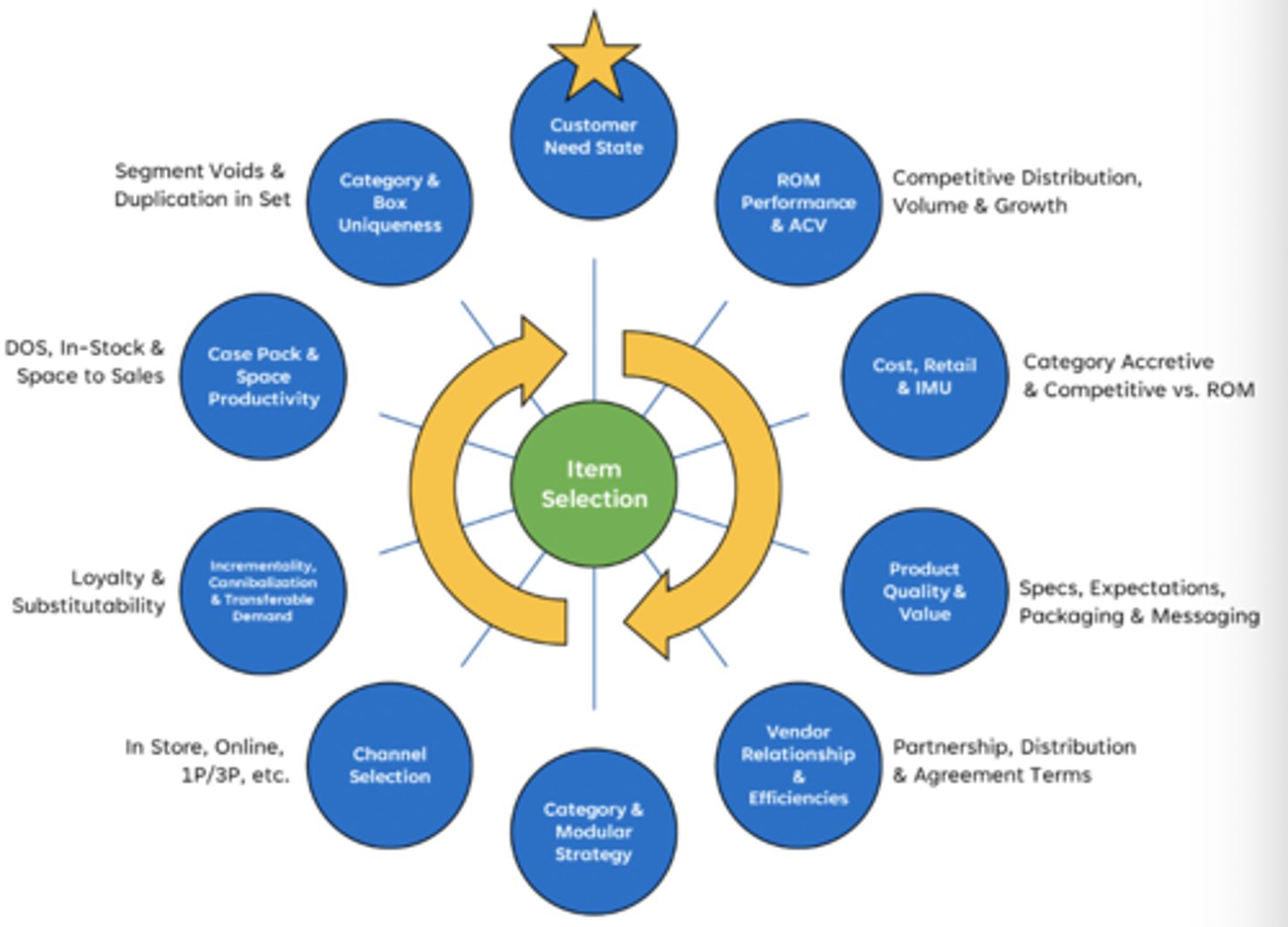
Product Quality & Value
Specs, Expectations, Packaging and Messaging
Incrementality, Cannibalization, and Transferable Demand
Loyalty and Sustainability
An incremental item means that when it is added to the assortment, it brings in new sales and/or new customers. It is not cannibalizing the existing sales of the category.
Transferable demand speaks to the likelihood that if one item is deleted, that the customer will shift to another item in the assortment. Brand loyalty and depth of assortment come into play.
Case Pack and Space Productivity
- Days of Supply
- In Stock
- Space to Sales
Assortment Success IRL
AutoZone has successfully defended their position in the face of Amazon by leveraging their incredibly deep assortment. Their hubs and mega hubs further deliver on their differentiation value proposition by ensuring that almost any item needed can arrive within 1 day.
PRICING, PROMOTIONS, AND DISPLAYS
Lines and Ladders
Line (horizontal)
- ex: flavors, features/claims, etc.
- benefits: display, consistency, shelf adjacencies
Ladder (vertical)
- ex: sizes, packaging, etc.
- benefits: encourage customer trade-up, price per UOM savings, etc.
Price Elasticity
The responsiveness of the quantity demanded of a good to a change in its price
- Elastic – very responsive
- Inelastic – not very responsive
Expandability
Consumption
- Use, occasion, impulsivity, marketing & sales support
Purchasing
- Stock-up, perishability, expensive vs inexpensive, size
Opening Price Point
Opening Price Point (OPP): the lowest price of a particular item in a certain product category
Goal: attract customers and establish the perception of value through higher price points for other products in the same category
Balance: Trade-down vs. engage new customers that would have otherwise been priced out of the market
Psychological Pricing
Customer Price Perception
- 99-cent Ending (aka “left digit effect”)
- Even vs. Odd Ending Prices (represents luxury)
Anchor Pricing
- before and after comparison
EDLP vs Promotion/High-Low
Pricing Strategies
definitions below
Cost-Plus Pricing: A Simple Markup
Cost-plus pricing, also known as mark-up pricing, is the easiest way to determine the price of a product. You make the product, add a fixed percentage on top of the costs, and sell it for the total.
Pros: The upside of cost-plus pricing is that it doesn’t take much to figure out. You’re already tracking production costs and labor costs. All you have to do is add a percentage on top of it to set the selling price. It can provide consistent returns should all your costs remain the same.
·
Cons: Cost-plus pricing doesn’t take into account market conditions such as competitor pricing or perceived customer value….
Competitive Pricing: Beating Out the Competition
As the name of this pricing strategy suggests, competitive pricing refers to using competitors’ pricing data as a benchmark and consciously pricing your products below theirs.
Pros: This strategy can be effective if you can negotiate a lower cost per unit from your suppliers while cutting costs and actively promoting your special pricing.
Cons: This strategy can be difficult to sustain when you’re a smaller retailer. Lower prices mean lower profit margins, so you’ll have to sell a higher volume than your competitors. And depending on the products you’re selling; customers may not always reach for the lowest-priced item on a shelf.
Price Skimming: Higher, Short-Term Profits
A price skimming strategy refers to when a business (usually ecommerce) charges the highest initial price that customers will pay, then lowers it over time. As demand from the first customers is satisfied and more competitors enter the market, the business lowers the price to attract a new, more price-conscious customer base.
Pros: Price skimming can lead to high short-term profits when launching a new, innovative product.
Cons: Price skimming isn’t the best strategy in crowded markets unless you have some truly incredible features no other brand can mimic.
Dynamic Pricing: Adjusting Price in Response to Variables
Ever try to get an Uber on a Friday night and notice the price is higher than normal? That’s dynamic pricing in action. Dynamic pricing is when a company continuously adjusts its prices based on different factors, such as competitor pricing, supply, and consumer demand. The goal is to increase profit margins for the business.
Pros: Dynamic pricing allows retailers and brands to price products and services at scale, automatically, using machine learning. They can customize prices to meet current market conditions, save time with automation, and maximize profits.
Cons: It can be difficult to manage as a small business and is a costly process. Dynamic pricing makes more sense for large retailers with thousands of SKUs across its ecommerce and retail stores. Consumers can also respond negatively to frequent price changes, which can lower revenue.
Promotions
- BOGO
- Buy in Bulk
-TPRs (temporary price reduction)
- Rollbacks
- Discounts
- Coupons
- Digital
- Loyalty Programs
Visual Merchandising
showing merchandise and concepts at their very best, with the end purpose of making a sale
Key Tenets of Visual Merchandising
1. Your Brand
2. Sensory Marketing
3. Displays
Planogram
a diagram or model that indicates the placement of fixtures throughout the store and the placement of retail products on shelves in order to maximize sales
- floor plan or "store layout"
- shelf space plans / modular or "mod"
Common Permanent Fixtures
- Gondolas
- Peg board
- Peg hooks
- Slat boards
- Flat brackets
- Shelves
- Kick boards
- Risers
- Various reefer cases
- Permanent bins
- Customized / non-standard
The Science (and Art) of Shelf Placement...
1. Eye-level dominance
2. Shop as we read...L to R
3. Product grouping
4. Visual hierarchy
5. Promotions and seasonality
6. Product sizing and shelving
7. Ongoing data analytics...
Display Defined
- Merchandise displayed outside of its home in aisle.
- Sometimes called a feature, the display is used for temporary product placement during a promotional period or for another strategic purpose.
Peestle/Steep
**know why we do study it - what other factors in society could affect our category/retail store?
Is this an attractive industry? (how does Porter's Five Forces tie into this)
“Attractive” = a competitive advantage is possible
- High profit potential
- Forces are weaker (meaning a lower threat)
- Growth is present
“Unattractive” = a competitive advantage is more difficult to attain
- Low profit potential
- Forces are stronger (meaning a higher threat)
- Stagnant or declining sales
PRIVATE BRANDS
History of Private Brands
Originated in the 19th century
Various terms for same/very similar concepts:
- House brand
- Store brand
- Own brand
- Control label
- X label
- Exclusive brand
Brooks Brothers and Macy’s were two of the first retailers to introduce private brands
Private Brands During the Pandemic
- The fact that private brands are frequently less expensive than national brands has helped financially strained consumers.
- These two advantages—high availability and low price—made private-brand products considerably more appealing to consumers during the pandemic.
**look through rest of private brand slides, but mostly common sense
 Note
Note  Flashcards (89)