chordates II
 Call Kai
 Learn
Learn Practice Test
 Spaced Repetition
 Match
Match Flashcards
 Knowt Play
1/94

There's no tags or description
Looks like no tags are added yet.
Name | Mastery | Learn | Test | Matching | Spaced | Call with Kai |
|---|
No analytics yet
Send a link to your students to track their progress
95 Terms
sharks
Vertebrates
Vertebrate
Eye
Cranium
Brain
Tongue
Gill arches
Gnathostomes
Mineralised teeth
First gill arch forms jaws
Paired fins
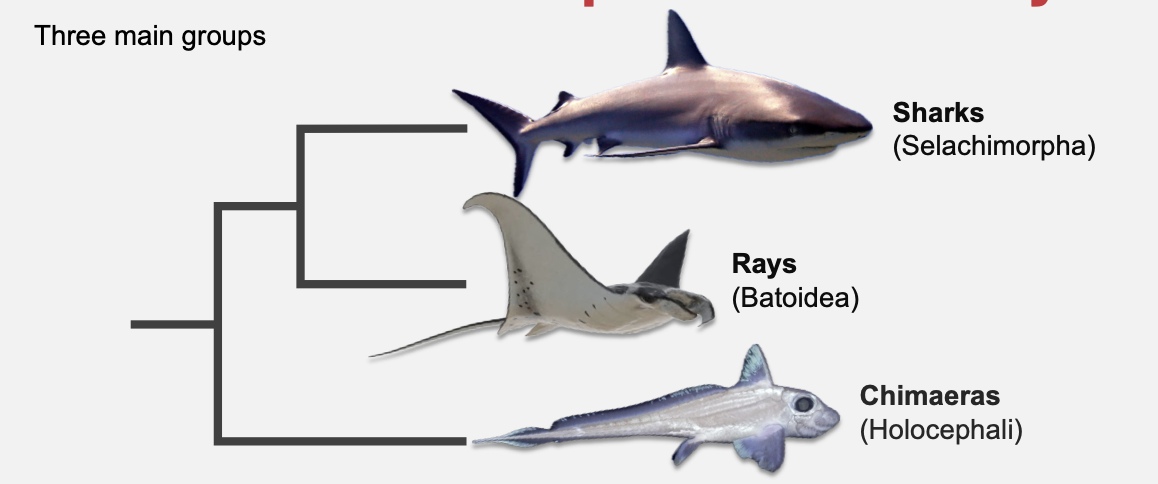
Osteichthyes (bony fish) and Chondrichthyes (sharks, rays and chimaeras)
Vertebrates and gnathostomes are united by adaptations for predation (or to resist predation)
parental investment
Some bony fish can lay millions of eggs
Sharks lay a few, large eggs with big yolks
Fewer, larger, well developed young
In many sharks, eggs are retained and hatch internally
They feed via the placenta or on other eggs
Different reproductive strategies
Oviparity (eggs enclosed in protective cases)
Ovoviviparity (eggs hatch inside the mother)
Viviparity (embryos receive nutrients directly from the mother)
intermittent organ and internal fertilisation
Bony fish use spray and pray approach to external fertilisation
This is messy and risky
Many eggs are not fertilised
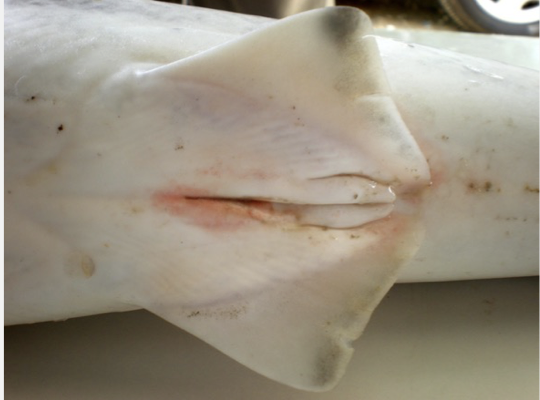
Sharks have claspers
Extensions of pelvic fins
Used to transfer sperm into the female
Inserted into the female cloaca
Male sharks fertilise eggs inside a female
High chance of successful fertilisation
Convergent on intromittent organ (specialised reproductive structure used to transfer sperm directly into the female reproductive tract) of amniotes
buoyancy
Sharks have a big oily liver
Helps them float
Still denser than water
Do not have a swim bladder
To stay up in water, sharks must swim
Heterocercal tail
Uneven tail (larger upper lobe) produces upward thrust
Lightweight skeleton
Ram-breathers
Some specialised pelagic species
Ventilate gills by forcing water through an open mouth
Means they must swim or they suffocate
reduced skeleton
Advanced jawless fish (placoderms) were armoured
Bony fish retain the bony cranium
Sharks lack bone internally (never evolved bony vertebrae)
Neutral buoyancy reduces the need to produce lift (lift-production creates drag, thus there is less hydrodynamic drag)
External bony plates of skull, jaws lost
No marrow filled bones
Bony scales reduced to tiny denticles
Enamel and dentine – like teeth
Reduce drag by around 10%
Parallel riblets control vortice formation
high speed
Lamnidae specialised for high speeds
Teardrop shaped body
Lunate tail
Elongate fins to reduce drag
Like marlin, dolphins and extinct ichthyosaurs
Strong myotomal muscles produce powerful swimming strokes
spines
Many sharks have fin spines
Lost in certain species
e.g. great white
Made of dentine like material
Covered by a thin enamel-like layer
Used for defence and deterrence
fast tooth replacement
Not unique to sharks
e.g. humans replace baby teeth
Have a high rate of replacement
Every 9-36 days
Important as fish bones/scales rapidly dull teeth
jaws
Jaw cartilage is not connected to the skull
Means jaws are flexible and can extend from the face to grab prey
Multiple rows of teeth
Wide gape
Can rapidly extend their jaws
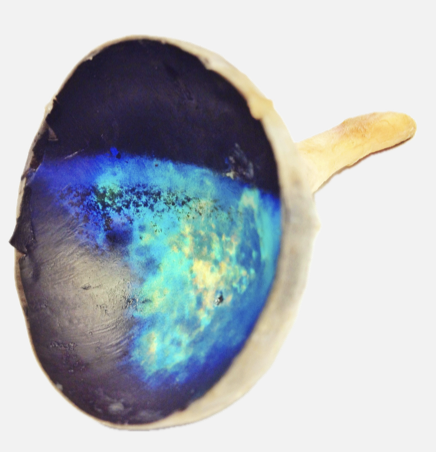
Eyeshine (reflective layer in retina) tapetum lucidum
Photons that go through the retina without hitting photoreceptors are bounced back by a shiny layer of guanine
Gives photoreceptors a second chance to detect light
Improves vision in low-light conditions
Widespread in mammals and some fish (coelacanth)
sharks are electroreceptive
Pitlike organs on the snout detect electric fields
Some fish (coelacanth, paddlefish) are also electroreceptive, suggesting that its an ancient feature
How does it work
Living organisms produce weak electrical fields from muscle and nerve activity
These are conducted through seawater
Ampullae of lorenzi on the head and snout detect tiny voltage differences
Uses
Locate hidden prey
Navigation
Hunting in low visibility
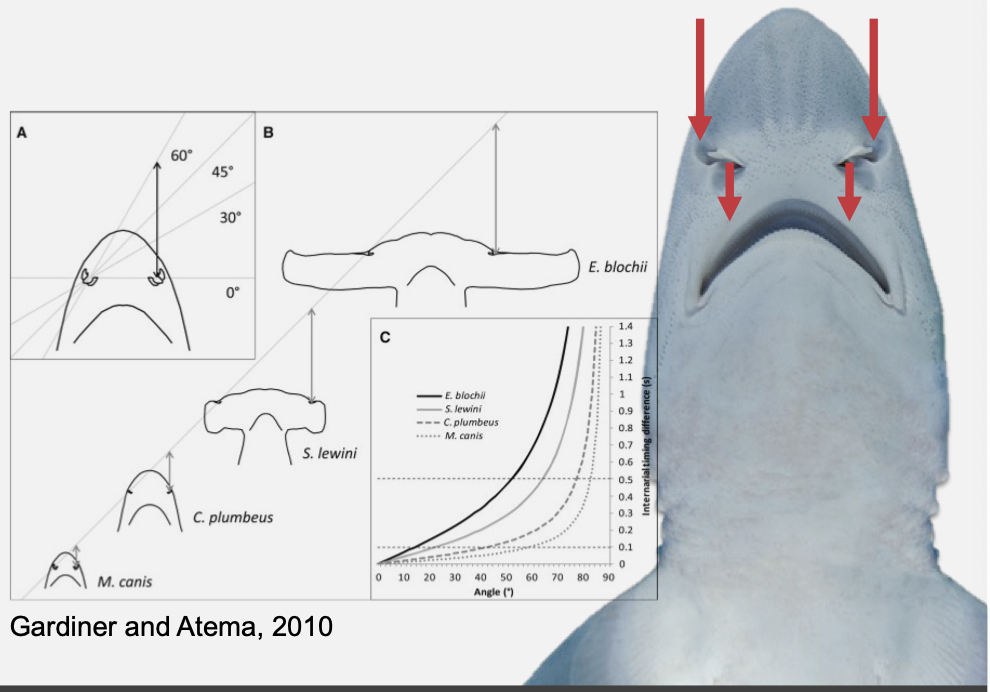
smell in sharks
Water goes over the folds of chemosensitive tissue
Can detect scents of 1 part per billion
Useful for long-distance prey detection
Bilateral arrival time differences can give useful directional information
Can compare input from left or right nares
relationships
chimaeras
e.g. ratfish, rabbirtfish, elephantfish, spookfish
Deepwater (200 m to over 8 km)
Large eyes
Single gill opening
Teeth fuse into toothplates
Inscisor-like structures for crushing prey
Modern species differ from fossils and each other
batoidea
Flat body glides over seafloor
Big pectoral fins go to head
Gills under head
Spiracles on head
To draw in water while resting on the seabed
Blunt teeth to crush hard food
Evolve in mesozoic
A few stingray spines known from late cretaceous
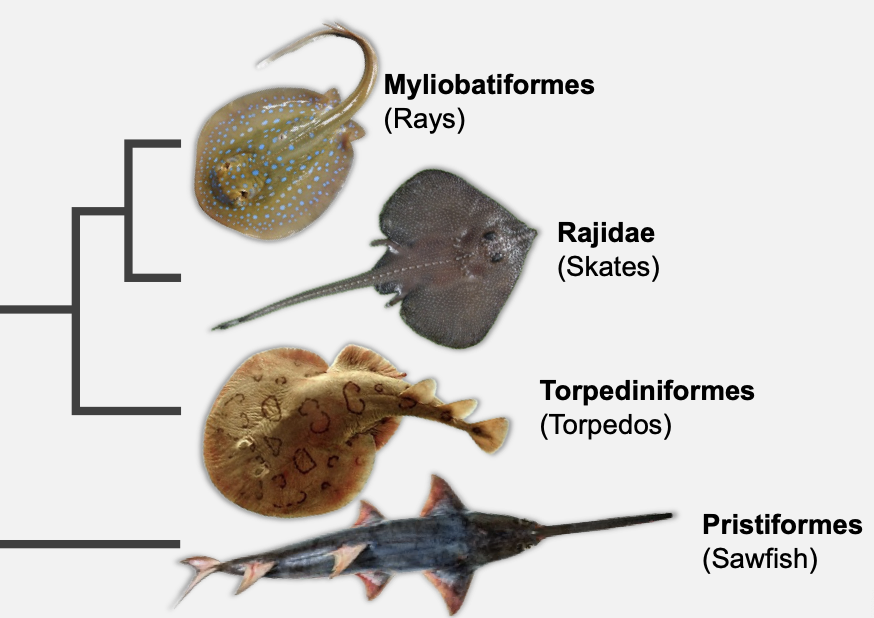
pristiformes
Swordfish
Denticles
Flattened body
Gill slits on underside
Large pectoral fins
torpendinformes
Flattened body
Short, thick tail
Large pectoral fins
Gill slits on underside
Electric rays
Modified muscle cells discharge electric pulses to stun prey (or predators)
rajidae
Skates
Long, slender tail
Gill slits on underside
Flattened body
Instead of swimming, they walk
Stumpy, fingerlike nubs on pelvic fins push against the seafloor
myliobatiformes
Rays
Fin spine modified into a long, serrated barb for defence
Often venomous
sharks
Squalomorphi (dogfish and kin)
Galeomorphi (requiem shark, mackerel sharks, catsharks)
squalomorphi (dogfish and kin)
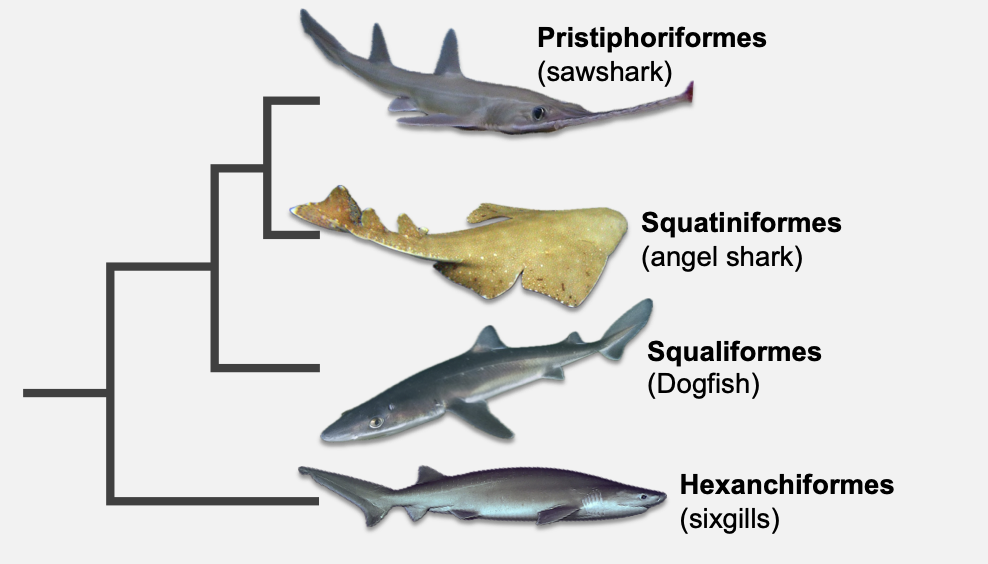
squalomorphi
Lantern shark
Bioluminescent photophores on stomach
Used for counterillumination and communication
Large eyes
Dark colouration
Sleeper shark
Slow moving
Dark colouration
Slow moving
Soft and flabby body
Cookie cutter shark
Small
Cylindrical
Bioluminescent photophores for camouflage via counterillumination
galeomorphs
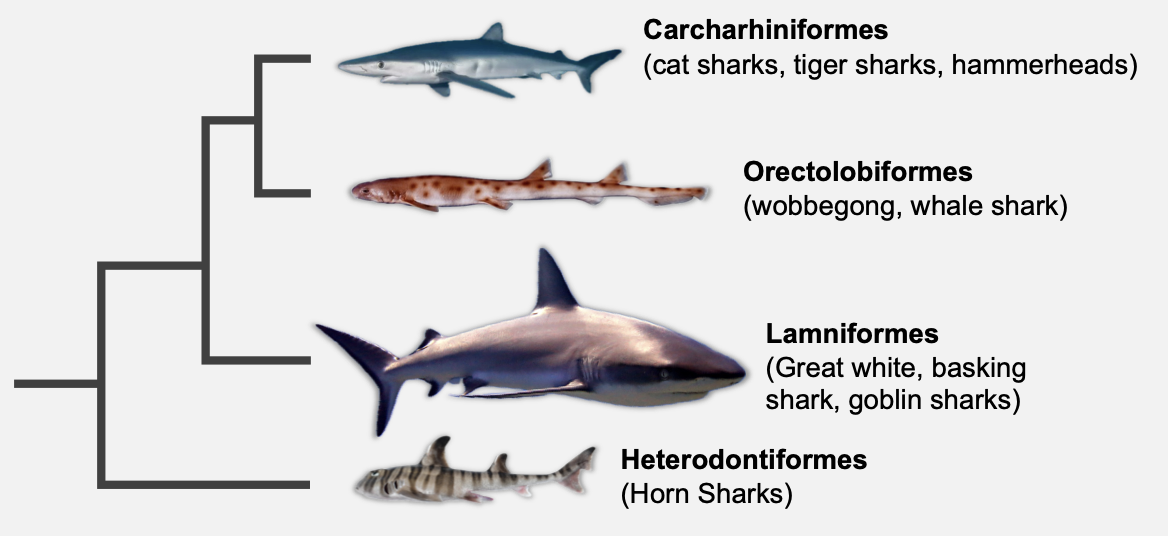
heterodontiformes
Horn sharks
Egg-case is spiral shaped
Screws into sediment
Molar-like teeth crush molluscs and crustaceans
Sharp front teeth for grasping
2 dorsal fins with spines
orectolobiformes
Carpet sharks
Small bodied
Benthic (bottom dwelling)
Cryptic (well hidden)
Often have camouflage markings
Whale sharks
12-18 m
Filter feeder
White spots and stripes for camouflage
carcharhiniformes
Ground sharks
Hammerhead
Tiger shark
Galapagos shark
Chain catshark
Nicitating membrane
Third eyelid
Anal fin
Five gill slits
Two dorsal fins
lamniformes
Large
Conical snout and large jaws
Two dorsal fins
Large gill slits
High oxygen demand
Goblin shark
Thresher shark
Megamouth shark
Thousands of tiny teeth
Mackerel sharks
Mako
Porbeagle
mackerel sharks
Streamlined, torpedo shaped body
Powerful tail
Large gill slits
No nictitating membrane
Regional endotherms
Heat is generated by active swimming muscles during movement
Uses countercurrent heat exchange
Warm blood leaving muscles runs next to cold blood returning from gills
Recycles heat and prevents it being lost at the gills
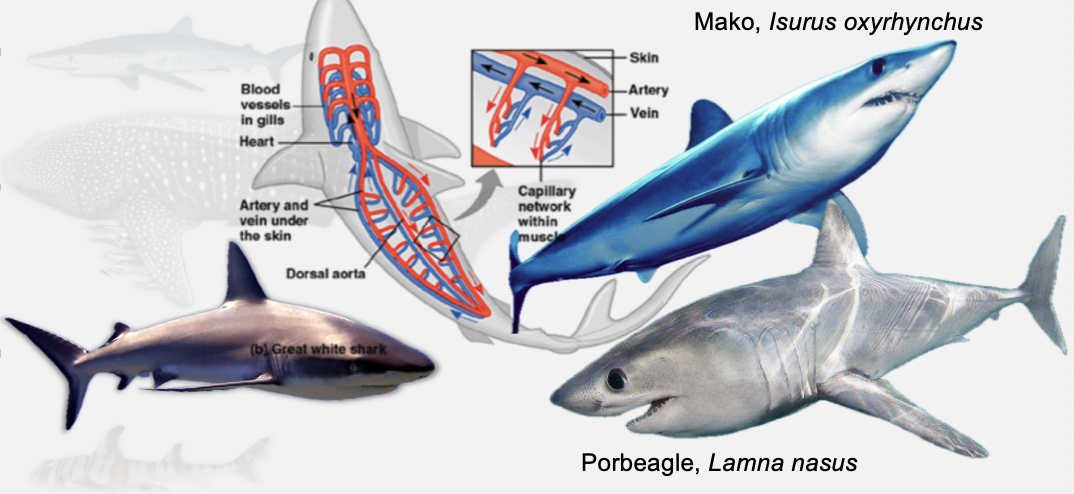
great white shark
Mackerel shark
To maintain high activity in cold water, eats marine mammals
Have rich fat reserves
Humans often mistaken for seals or sea lions
shark evolution
Oldest relative thought to be in late Devonian (360 million years old)
Had cartilage skeleton and no skull bones
Cladoselache
Acanthodians are recognised as shark relatives
Have dorsal fin spines
Scales resemble denticles
Retain bony skill
Paleozoic diversity
After evolution of sharks in the devonian, they continued to evolve
Most lineages no longer exist
e.g. helicoprion
Falcatus
are sharks living fossils
Implications
Physical limits are being hit
As long as it stays in the same predatory niche, it remains similar
No as suggests no evolution
Rapid evolution slows dramatically
Evolution eventually stops because you can't improve endlessly
Body plan has remained relatively similar over time
Are still innovations
Evolution of filter-feeder sharks in early Cenozoic, after dinosaur extinction
Follows extinction of giant filter feeder fish in cretaceous
Adapted as a new niche was available
Competitors prevent animals from expanding into new niches
If removed, rate of evolution would increase again
chordates
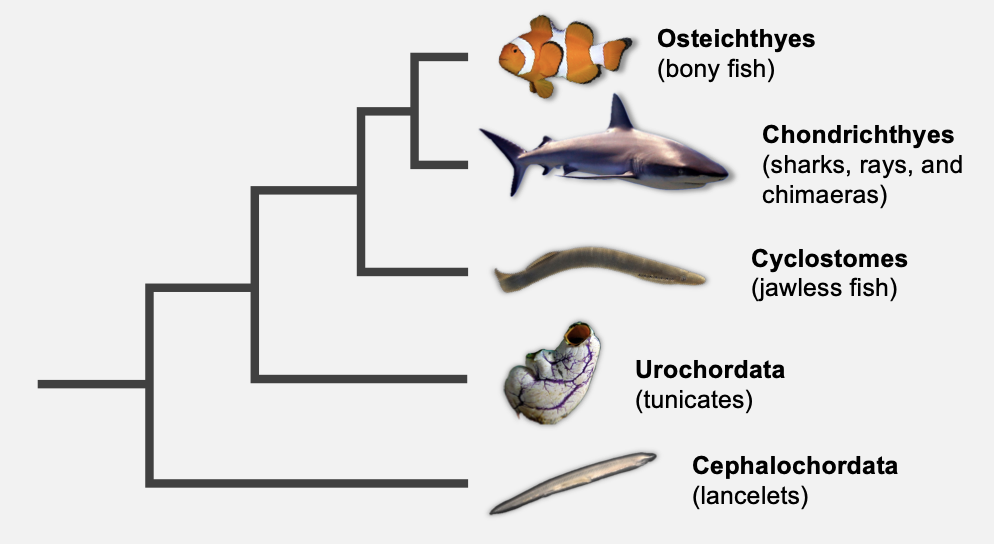
Osteichthyes
Bony fish
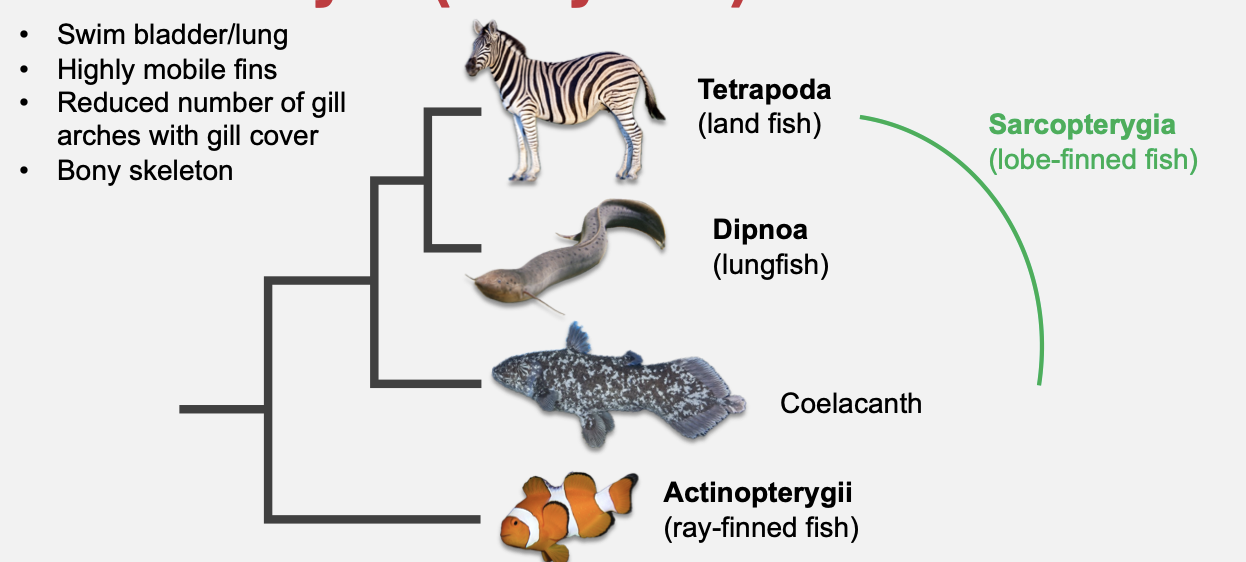
Distinguishing characteristics from cartilaginous fish
Swim bladder/lung
Highly mobile fins
Reduced number of gill arches with gill cover
Bony skeleton
lung/swim bladder
Many bony fish have air-filled chambers in the body
In lungfish and tetrapods, this chamber gets oxygen from air (lung)
In most fish this device is a float used for buoyancy
Negatively buoyant sharks swim to stay up in water
Ray-finned fish float
It's been long suspected lung is homologous with the swim bladder
Feature | Lungs | Swim Bladder |
Main function | Gas exchange | Buoyancy |
Location | Connected to respiratory system | Dorsal to gut |
Organism type | Terrestrial vertebrates, some fish | Bony fish |
Evolution | Likely ancestral | Derived from lungs |
polypterus
Most primitive living ray-finned fish
Have no swim bladder
Has lungs and breathes air
Useful for a freshwater tropical fish
Warm, stagnant water has little oxygen
Implies lungs first evolved for low oxygen in water, not life on land
Then lungs evolved into the swim bladder
mobile fins
In sharks, fins are used for steering and stabilisation, tail for propulsion or sometimes swimming
In bony fish, fins are highly mobile
Sarcopterygians and polypterus have a mobile fin base
Lets them move pectoral and pelvic fins, shoulder and hip joints
The fin itself is modified, bony struts supporting flexible membrane
Bony fish can fold and unfold fins, and change fin shape, using them for propulsion and maneuvering
Advanced ray-finned fish can tightly fold fins against the body to reduce drag
Mobile fin bases (along with lungs) let polypterus crawl up onto land
Mobility of pectoral and pelvic fins taken to the extreme in tetrapods
modified respiratory system
Sharks and lamprey have 5-7 pairs of gills. Hagfish have more!
Bony fish have 3 pair of gills, movable operculum (gill cover) pumps water. Lost in amniotes, retained in larval amphibians
Jawless fish have simple pumping mechanisms, many sharks are ram-breathers, swim to force water over gills, or have simple pumps
High-volume opercular pump of bony fish lets them oxygenate blood while stationary. May explain success in low O2 environments
bones
Skeleton supported by mineralised tissue
Skull
Jaws
Vertebrae
Fin rays
Shark ancestors had bony skulls and lost them
Bony fish extended mineralisation from the head to the rest of the skeleton
A bony internal skeleton allows complex bones and joints to be made
e.g. between vertebrae, limb bones and fingers
Complex body shapes
Complex movements
movement
Complex articulations & rigid struts make possible elaborate movement
Sharks have limited number of ways of moving
Bony fish have far more sophisticated movement of spine, fins, jaws, skull
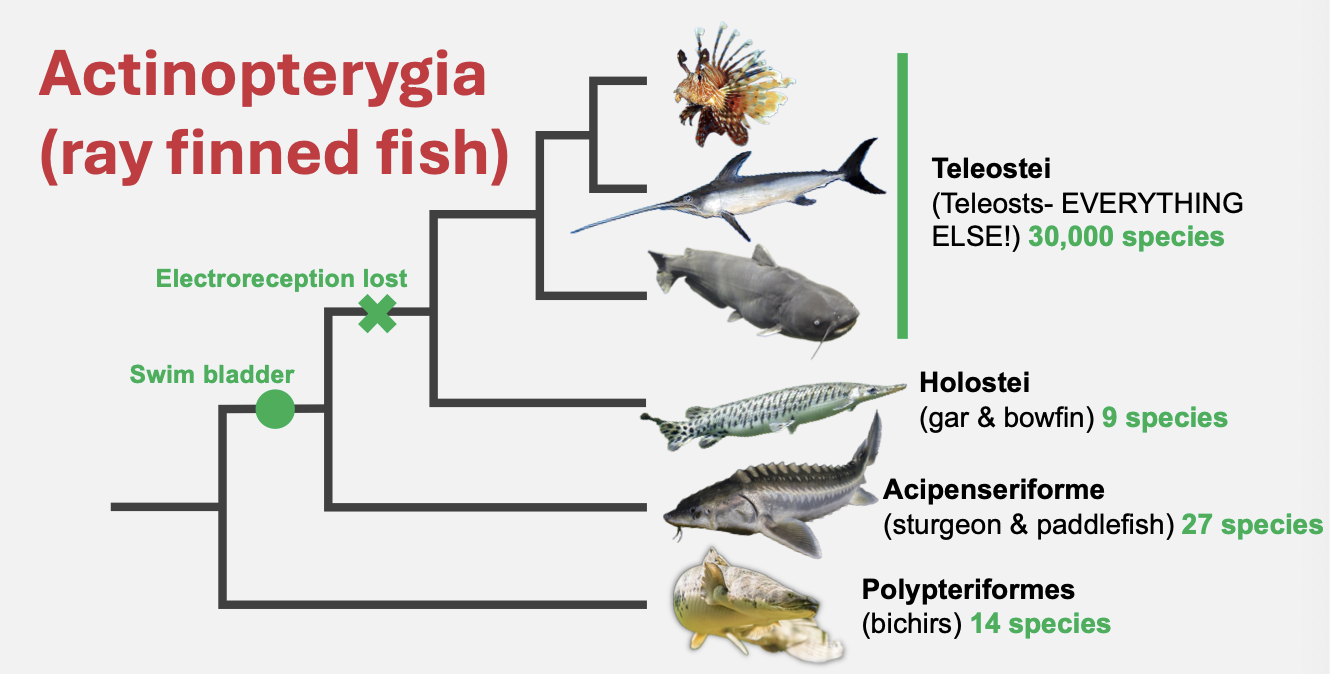
actinopterygia (ray-finned fish)
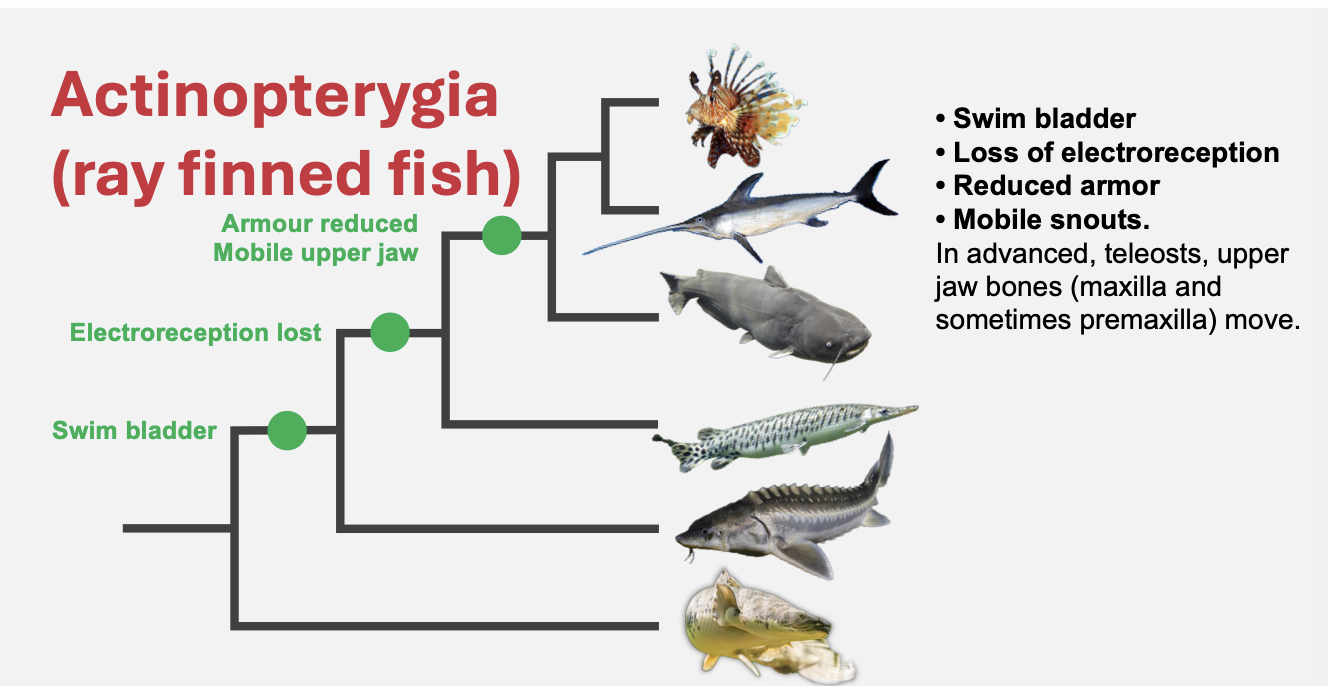
teleost tree
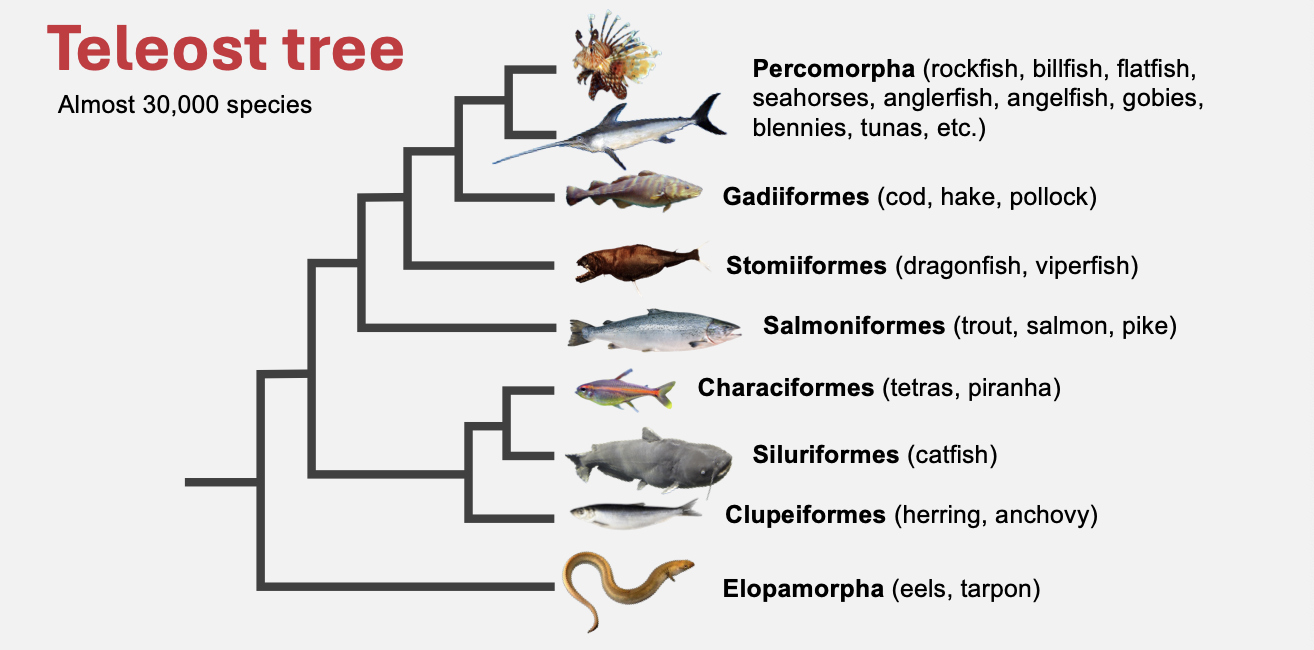
geologically recent
Sharks have been here forever- many modern groups go back to the Cretaceous
Teleosts first stage initial radiation in mid-Cretaceous.
Modern families appear in Paleocene and Eocene after K-Pg boundary when dinosaurs go extinct
e.g. flatfish, tuna, billfish, pufferfish, surgeonfish, moray eels- suggesting origin is driven by mass extinction of fish & marine reptiles end of Cretaceous
Explains weird relationships: adaptive radiations
sarcopterygia (lobe-finned fish)
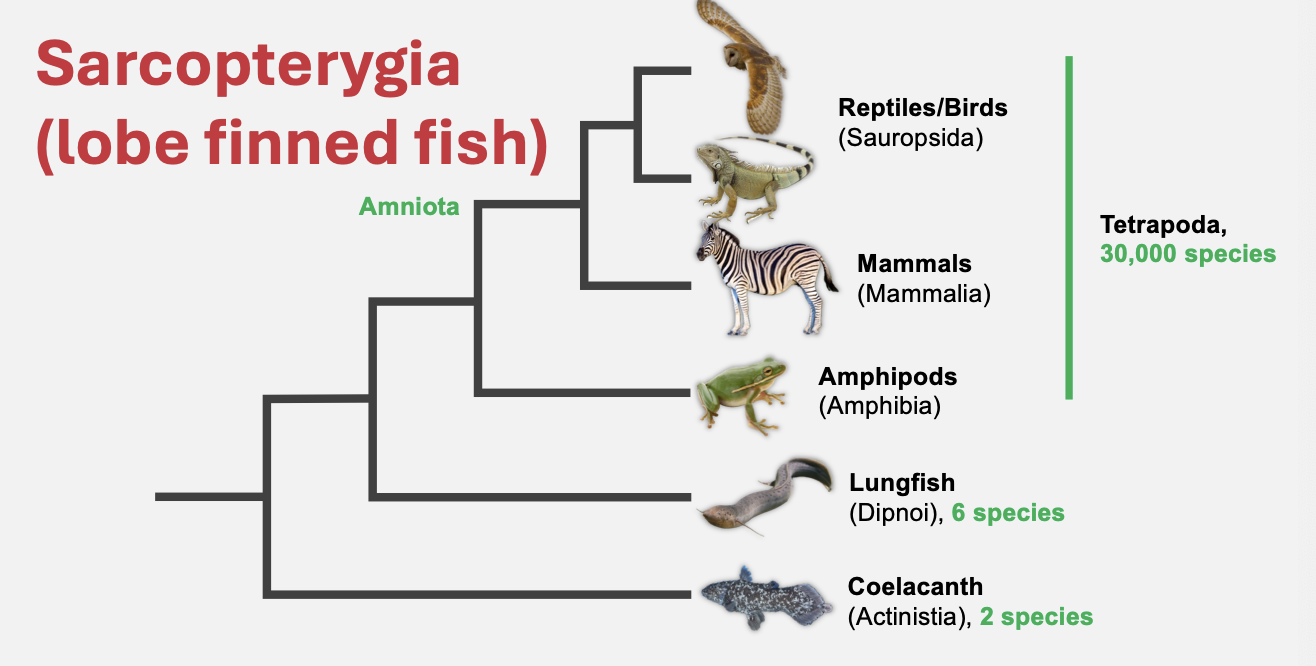
actinistia (coelacanth)
Two living species: Latimeria chalumnae from Indian Ocean, L. menadoensis from Indonesia
Deep-water predators, live in caves 100-500 m deep, emerge at night to feed along coral reefs.
Have electroreceptors (like sharks) to detect prey
Unusually for fish, have internal fertilization, give birth to live young
limb-like fins
Like tetrapods, coelacanths have mobile, limb-like finbases
Unlike in more primitive fish, one bone connects it to the
shoulder- a shoulder joint. A feature shared by lobe-finned fish incl. Tetrapods
living fossils
Fossil coelacanths found 1839, thought to go extinct with dinosaurs. Only known from fossils until 1938, when living coelacanth caught off of South Africa
Coelacanths once diverse, successful, but over time failed to compete against other fish
Resemble forms from 100s of millions of years ago- in some ways ‘living fossils’, but ecology (deepwater marine) is specialized, not like ancient coelacanths (evolution slows, doesn’t stop)
Deepwater, nocturnal ecology probably meant impact winter caused by Chicxulub didn’t affect them much
dipnoi (lungfish)
Like amphibians, larvae breathe through feathery external gills; adults breathe air
South American & African species obligate air-breathers
South American & African species aestivate: burrow into mud in dry season and enter dormancy
Evolve in the Devonian, once far more diverse, found on many continents, freshwater + marine environments
tetrapod evolution
Origin from Lobe-Finned Fish
Tetrapods evolved from lobe-finned fishes (Sarcopterygii)
Fins had bone structures similar to limbs
Transition to Land
Early forms lived in shallow water/swampy environments
Gradual shift from aquatic → semi-terrestrial → fully terrestrial life
Key Transitional Fossils
Tiktaalik – fish with limb-like fins and a neck
Acanthostega – had limbs but still aquatic
Ichthyostega – more adapted for land movement
Major Adaptations
Limbs with digits (replacing fins)
Stronger skeleton to support body weight
Lungs for air breathing
Development of a neck (head movement independent of body)
Later Diversification
Tetrapods gave rise to:
Amphibians
Reptiles
Birds
Mammals
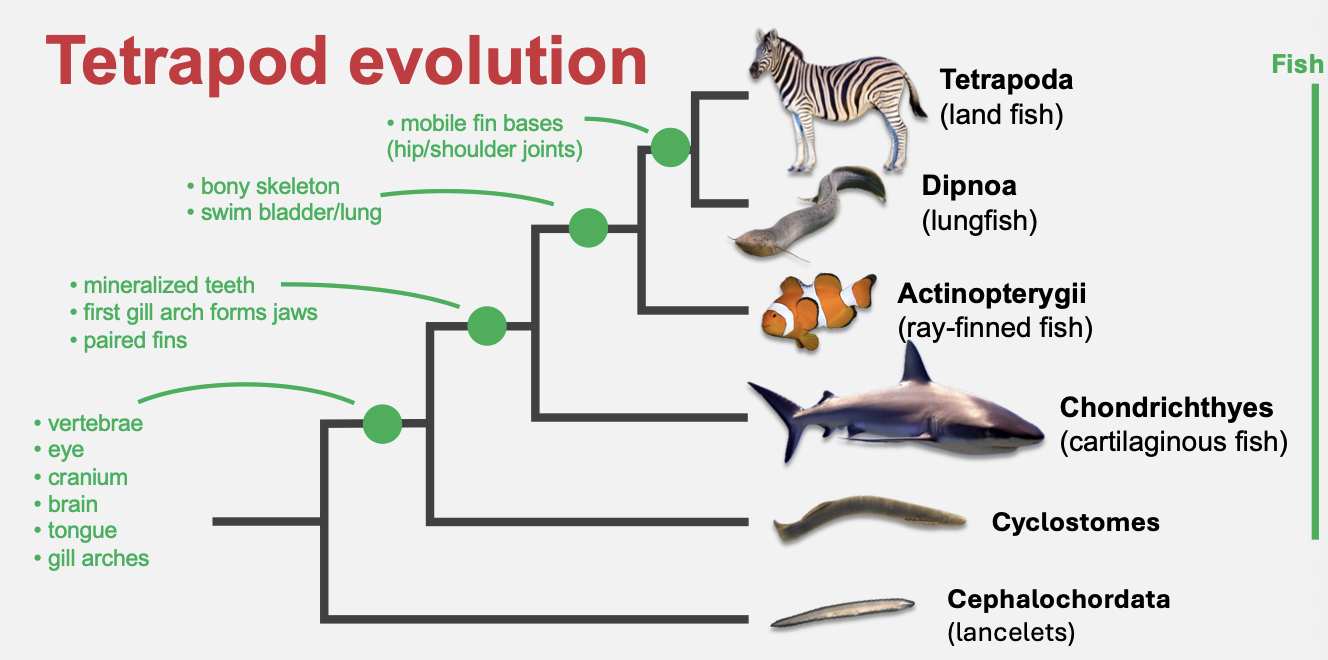
amphibians
Dual life
Land and water (for reproduction)
Highly diverse
9000 species
External ferilisation
Female lays eggs in water, male releases sperm which swim to eggs
Young develop in water and have tail fins
Some have external gills
Adults are terrestrial and grow limbs to walk or hop on land, hunt for insects and other prey
how did we get onto land
Fossils help understand the transition
Eusthenopteron foordi (lobe finned fish)
Panderichthys
flatheads
Tiktaalik roseae
Acanthastega gunnari
Eusthenopteron foordi (lobe finned fish)
Late devonian
Large, predatory fish
Recognised as a tetrapod releative, based on a well-developed fin skeleton
Evolves too late to be directly ancestral to tetrapods
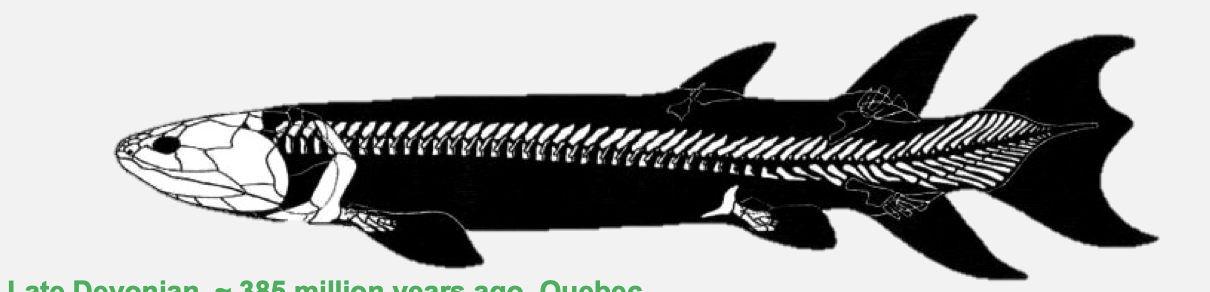
Panderichthys
Loss of midline fins (dorsal and anal fins)
Shared with tetrapods
Borad, flattened head
Eyes on top of the head
Still marine

flatheads
Flattened body plan
Typical of a bottom dwelling fish
Eyes on top of head
Typical of bottom dwellers
Benthic adaptation
Ancestors were bottom feeders and muck-dwellers
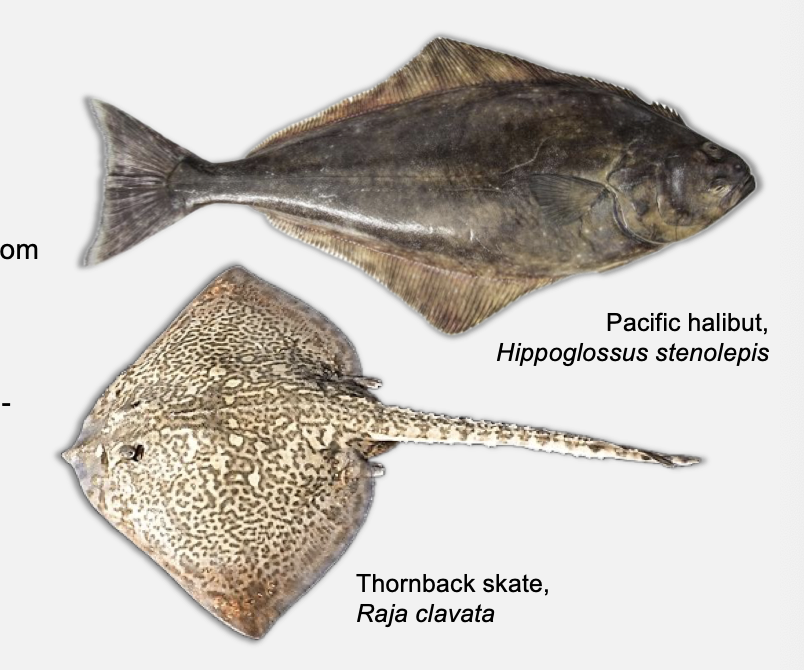
Tiktaalik roseae
Late devonian
Well developed limb bones
Encased in fin rays
Fin rays reduced
Functionality between limb/fin
Used for bottom crawling
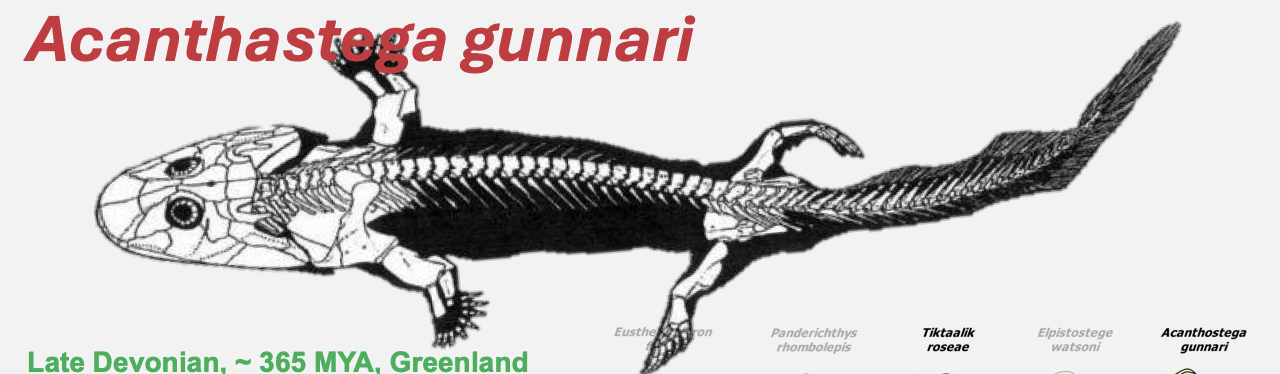
Acanthastega gunnari
Late devonian
8 fingers and toes
Hands and feet
Elongate limbs, weak wrist (not ossified)
Retains long, oarlike tail with fin rays for underwater propulsion
Retains gill arches for breathing underwater
Retains fish-like lateral-line system for detecting water movements
fins and limbs
Some fish use fins to walk
Limbs evolved for walking underwater
Limbs useful for many things, not just terrestrial walking
Walking along bottom may be easier than swimming against a stream or tidal current
May be useful for ambush predators- lets you move extremely slowly
At any rate, limbs (like lungs) don’t evolve for life on land, but to make life in water easier
Only later these adaptations become useful on land
why did aquatic animals come onto land
The end-Devonian mass extinction
Devastation of sarcopterygian fish and tetrapodomorph fish
Tetrapods evolve in the Devonian.
But only after extinctions at end of Devonian do they go onto land.
Colonization of land may be opportunistic response to extinctions
Terrestrial tetrapods appear
Have eyes facing to the side
To peer out over the land, not up from sea bottom
Powerful legs
Five strong toes
pentadactyl limb
Indicates common ancestry among tetrapods
Modified for different functions:
Running
Flying
Swimming
Grasping
Same underlying structure is found in many vertebrates → homologous structure
Common bone pattern:
Humerus (upper limb bone)
Radius and ulna (forearm)
Carpals (wrist bones)
Metacarpals
Five digits (phalanges)
adaptive radiation
Following move onto land, a major radiation
Partly driven by diversification of amphibians- including many extinct groups (plus one lineage that becomes modern amphibians) other group is amniotes- tetrapods that lay eggs on land. They are ancestors of reptiles, birds, mammals
First amniotes are tiny, but soon became larger and more specialized, dominate the land from end of the Carboniferous
tetrapods and amniotes
Tetrapods evolved for life on land:
Air breathing
Limbs with digits
Walking ability
Amniotes include:
Mammals
Birds
Reptiles
Total tetrapod diversity: >35,000 species
Amniotes are adapted to:
Live and reproduce on land
key amniote adaptations
Amniotic egg
Contains membranes:
Amnion, chorion, allantois
Functions:
Prevent drying out
Allow gas exchange (oxygen)
Internal fertilisation
Required because eggs are laid on land
Involves contact between male and female
Structures:
Penis (mammals, turtles, crocodiles)
Hemipenes (lizards & snakes)
May have evolved in water first (also seen in fish)
Direct development
No larval stage
Hatch as miniature adults
Already have:
Lungs
Limbs
Skin adaptations
Covered in keratinous skin
Waterproof → prevents water loss
Shed regularly
first amniotes
Appeared ~300 million years ago (Carboniferous)
Small (~1 foot long)
Split into:
Synapsids → mammals
Sauropsids → reptiles & birds
Example: Hylonomus
major evolutionary events
Permo-Triassic extinction (~252 MYA)
Massive volcanic eruptions
Wiped out many species (especially synapsids)
Mesozoic Era (252–66 MYA)
Known as the “Age of Reptiles”
Rise of:
Dinosaurs
Modern reptile groups
Mammals remained small and nocturnal
reptile classification (sauropsida)
Includes:
Lizards & snakes (Lepidosaurs) ~11,770 species
Turtles ~365 species
Birds ~10,000 species
Crocodilians ~27 species
“Reptiles” are not a natural group
Some reptiles are more closely related to birds than other reptiles
tuatara
Found in New Zealand
Nocturnal, prefers cool environments
Teeth fused to jaw
Only 1 living species
Diverged from lizards ~240 MYA
squamata (lizards and snakes)
Most diverse tetrapods (~11,700 species)
Includes:
Lizards (~7,751)
Snakes (~4,108)
Wide diversity:
Diets: insectivores, carnivores, herbivores
Habitats: terrestrial, arboreal, aquatic, burrowing
Activity: nocturnal & diurnal
geckos
Mostly nocturnal (some exceptions)
Excellent climbers:
Use Van der Waals forces to stick to surfaces
Some species:
Lost legs → snake-like bodies
Appear ~100 MYA (possibly earlier)
autonomy
Ability to drop tail to escape predators
Tail can regenerate
Ancestral trait in lizards
flying geckos
Have skin flaps
Can glide/parachute
iguanidae (iguanas)
Found mainly in the New World
Diet:
Insectivores, herbivores, omnivores
Example:
Marine iguana:
Basks to warm up
Feeds on algae in ocean
acrodonts (e.g. chameleons)
Found in Old World (Africa, Asia, Australia)
Include:
Chameleons
Frilled lizards
Flying dragons
Chameleon adaptations
Grasping:
Opposable digits
Prehensile tails
Vision:
Independent eye movement
Feeding:
Long sticky tongue
Camouflage:
Colour change
worm lizards (amphisbaenia)
Burrowing reptiles
Worm-like bodies
Move using accordion motion
Reduced:
Eyes
External ears
Detect prey via vibrations
anguimorpha
Includes:
Komodo dragon
Gila monster (venomous)
Slow worms
Some evolved limbless forms
Large extinct species:
Megalania (~6m)
cretaceous diversity
Very high reptile diversity
More lizard species than dinosaurs in some areas
Wide ecological roles
K-Pg extinction
around 83% of lizard species wiped out
snakes
General features
~4,000 species
Highly successful group
Lost limbs (despite being tetrapods)
Locomotion
Crawling
Burrowing
Swimming
Climbing
Some can glide
Feeding
All are predators
Eat:
Insects → mammals
Can consume large prey
Adaptations:
Flexible skull (multiple hinges)
Expandable rib cage
Prey capture
Methods:
Constriction (cut blood flow)
Venom (toxic chemicals)
Have hooked teeth
origin of snakes
Marine hypothesis
Snakes evolved from marine reptiles (mosasaurs)
Evidence:
Early snakes with small legs
Swimming adaptations
Burrowing hypothesis
Snakes evolved from burrowing lizards
Evidence:
Reduced eyes
No external ears
Long, narrow body
fossil evidence
Early snakes
Najash – had legs, burrowing traits
Coniophis – Cretaceous proto-snake
Tetrapodophis (possible “missing link”)
Had four legs
Snake-like features:
Skull
Spine (>150 vertebrae)
Scales
Feeding behaviour
Controversial:
Some scientists disagree it is a snake
evolution insights
Long bodies + reduced limbs evolved multiple times
Snakes are essentially:
Highly specialised lizards
tetrapods
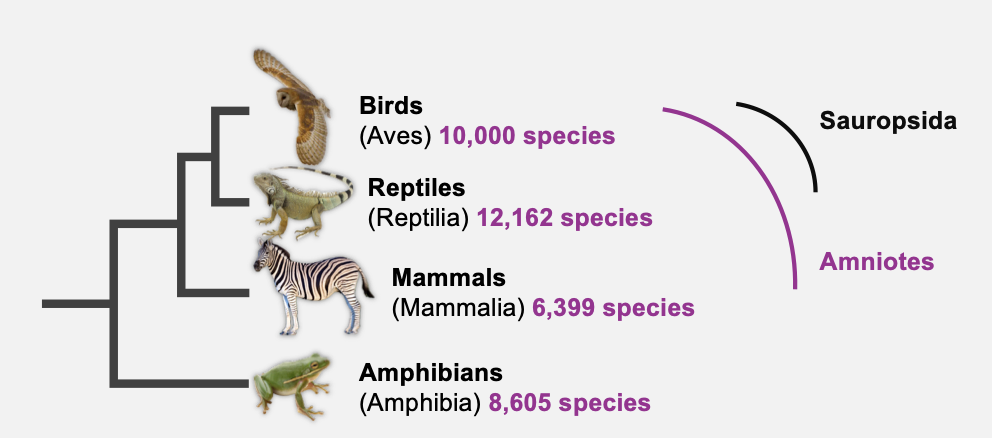
sauropsida
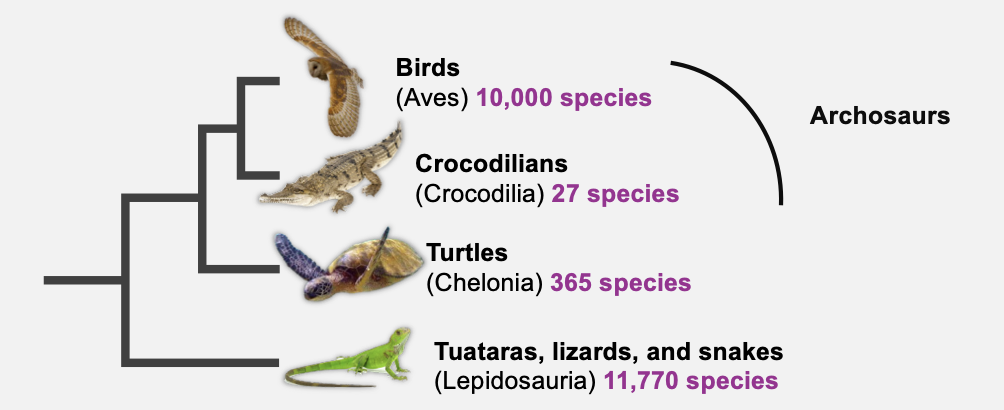
Chelonia (turtles and tortoises)
Freshwater, marine or terrestrial
Plant-eaters, carnivores or omnivores
356 species
14 families
Most evolved in the age of the dinosaurs
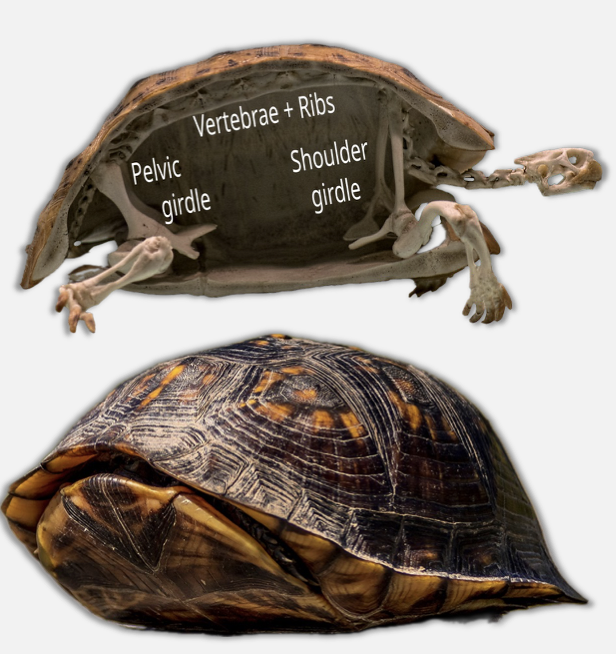
Armour
Top of shell (carapace) composed of rib cage, with additional bones around the edge
Big, tough scales cover bone
Bottom of shell composed of belly ribs (gastralia)
Arms, legs, tail, head can retract inside shell
Evolution
Initially terrestrial, evolving after the Permian-Triassic extinction
Turtles probably peak in diversity in the late cretaceous
Marine and terrestrial species hit hard but freshwater lineages survived the K-Pg impact (massive asteroid collision with earth around 66 million years ago between Cretaceous and Paleogene periods)
crocodila
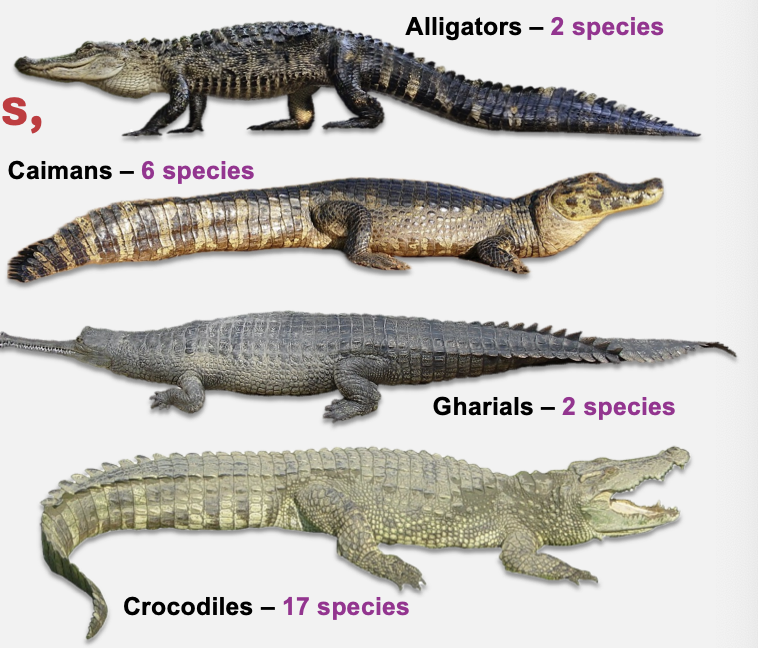
crocodiles, alligators, caimans, gharials
27 living species
Large
Living are relatively large bodies
Small species are around 6 ft (50 pounds)
Saltwater crocodile is around 21 ft (4000 pounds)
Semiaquatic
Specialised for aquatic lifestyle
Flattened, oarlike tail for sculling
Webbed feet for swimming
Massive bones act like a diver's weight belt, helping them sink
Eyes, nostrils sit atop head, lets crocodiles breathe and look for prey while the body is submerged
Dense bones, allowing them to sink
Apex predators
Wide range of prey (insects, crustaceans, fish, etc)
Large, heavily armoured and armed
Have few predators of their own
Long lifespans
Cannibalism
Biggest threat is another crocodilian
Primary cause of mortality for young is the elders
Cannibalism serves multiple purposes
Source of protein
Eliminates competitors for food
Eliminates offspring of others from gene pool
crocodila p2
Parental care
Females make nests of mud and vegetation. It rots to make heat to incubate eggs
Females guard the nest and when eggs hatch, they dig up hatchlings and carry them to water
Females guard offspring
Parental care seen in closest living relatives – birds
Suggests parental care inherited from a common ancestor
Used to be more diverse
Grew larger in the past
For example 40 ft Purrusaurus 4-20 million years ago
The warmer climate allowed them to grow to a larger size
Marine crocodilians
In Jurassic and early Cretaceous, marine Geosauridae-crocodilians with flippers and shark-like tail- were marine predators
Another group-Dyrosauridae- moderately successful in Late
Cretaceous, diversifies in early Cenozoic to exploit niches left vacant by extinction of mosasaurs
Marine crocodiles decline as ice ages begin
Terrestrial crocodilians
Aquatic crocs are one branch of a once diverse tree
In Late Cretaceous, cat-sized crocs prowled sands of the Gobi in Mongolia
As recently as the Eocene, 35 MYA, terrestrial, predatory crocs hunted Pampas of South America
Many were carnivores, others omnivores- even herbivores
Pug-snouted Simosuchus from Late Cretaceous had leaf-shaped teeth like iguanas- to eat leaves
Modern crocs a specialized offshoot of this diverse radiation
Triassic crocodilians
Crocodilians peak in the Triassic, 252-201 MYA, when they radiate to replace mammal-like reptiles
Evolve armored herbivores, bipedal, ostrich-like plant eaters, tyrannosaur-like meat eaters, agile, greyhound-like pursuit predators
Rivaled dinosaurs in diversity!
Massive eruptions 200 MYA- breakup of Pangaea and formation of the Atlantic- eliminate all but the pursuit predators
Dinosaurs take over terrestrial ecosystem in Jurassic-Cretaceous, while crocodilians launched a major radiation in water
Remaining terrestrial crocs largely wiped out by the asteroid
aves (birds)
Pellets
Some birds (including hawks and owls) regurgitate foods they cannot digest.
These ‘pellets’ may include bones, feathers, teeth, claws etc.
Pellets have historically been used to determine prey variation over time.
However, DNA-based approaches are more effective.
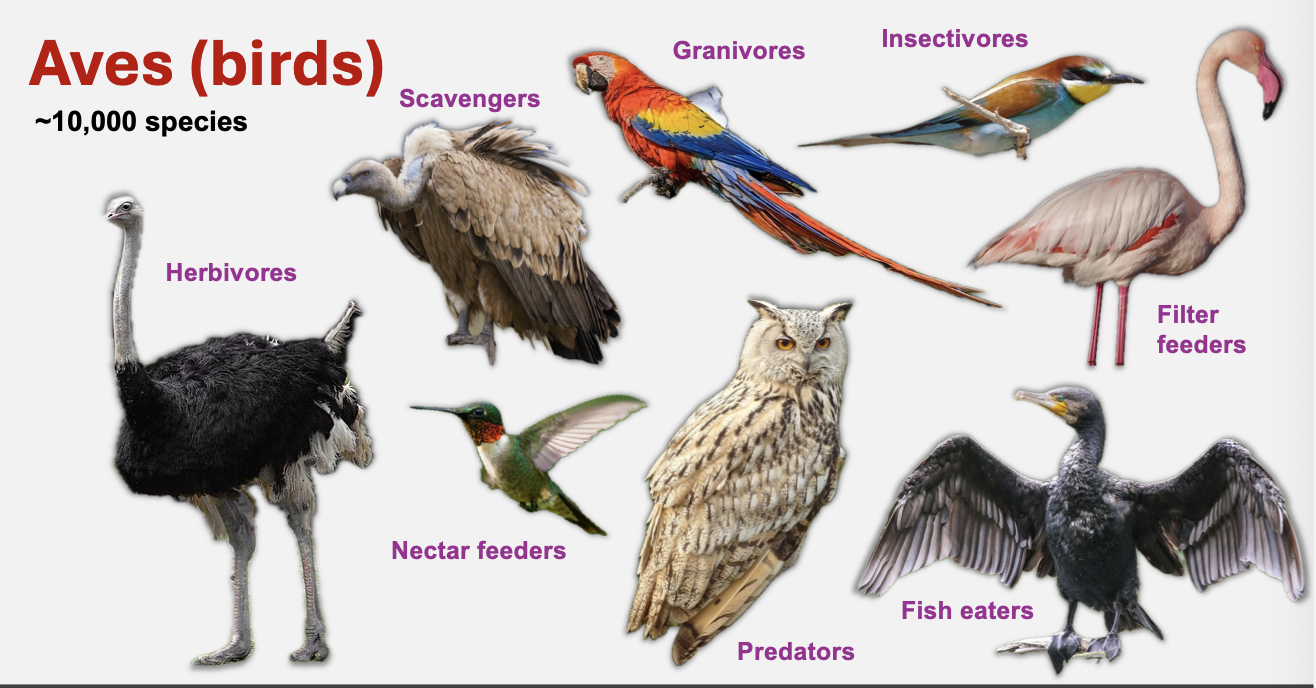
key features of birds
Insulatory feathers
Flight feathers
Warm blood (41 C)
No teeth
Sophisticated respiratory system: air sacs, air-filled bones
Upright limbs, bipedal, digitigrade
Intense parental care – brood eggs, guard young, many feed young
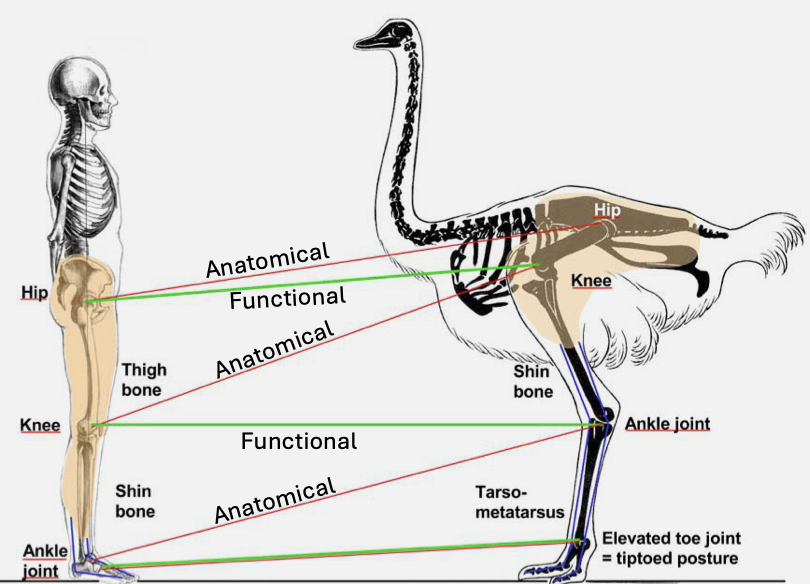
hindlimb
Uproght limbs, vs sprawling limbs of crocs and lizards
Short thigh hidden by feathers
Ankle held clear of the ground, run on tiptoes (digitigrade)
flight
Fast. Speeds up to 100 kph
Energetically efficient. Power intensive, but less energy to fly than to walk a given distance: high fuel/minute but low fuel/km
Direct. ‘As the crow flies.’ Can simply fly over obstacles
Access any environment. Treetops, cliffs, oceans, the air
Safe. Once airborne, invulnerable to most predators. Not coincidentally, birds have much longer lifespans than similarly-sized mammals
separate hindlimbs and wings
Bats and pterosaurs have hindlimbs bound into wings. Legs and arms work concert in flight, and in other modes of locomotion (climbing/walking)
Specialization of limbs for terrestrial/climbing/swimming locomotion tends to conflict with specialization for flight
Bird wings and legs are separate – 2 ways of getting around
evolutionary relationships of birds
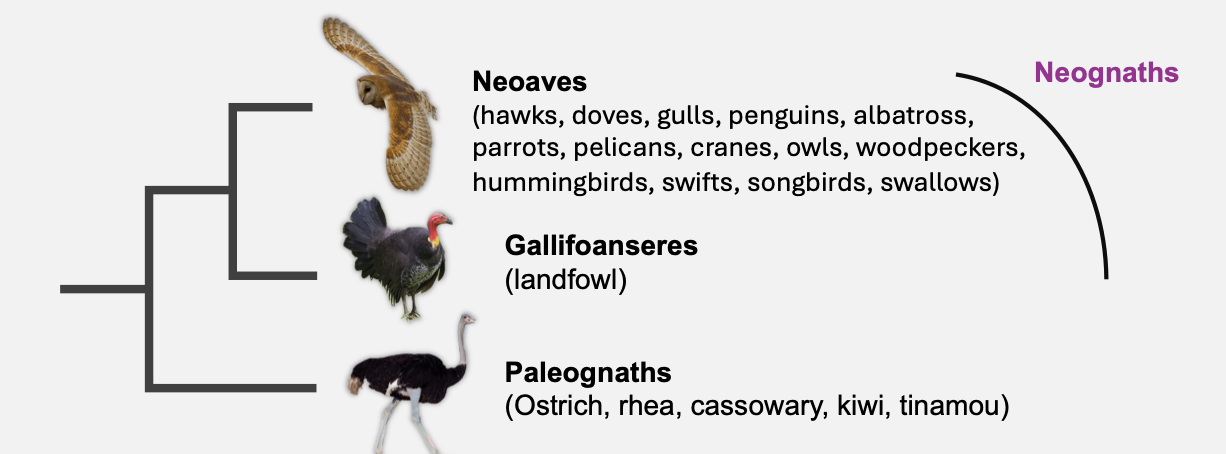
Waterbirds like penguins, tubenoses and pelicans sit within a broader assemblage
Earliest landbirds may have been predatory
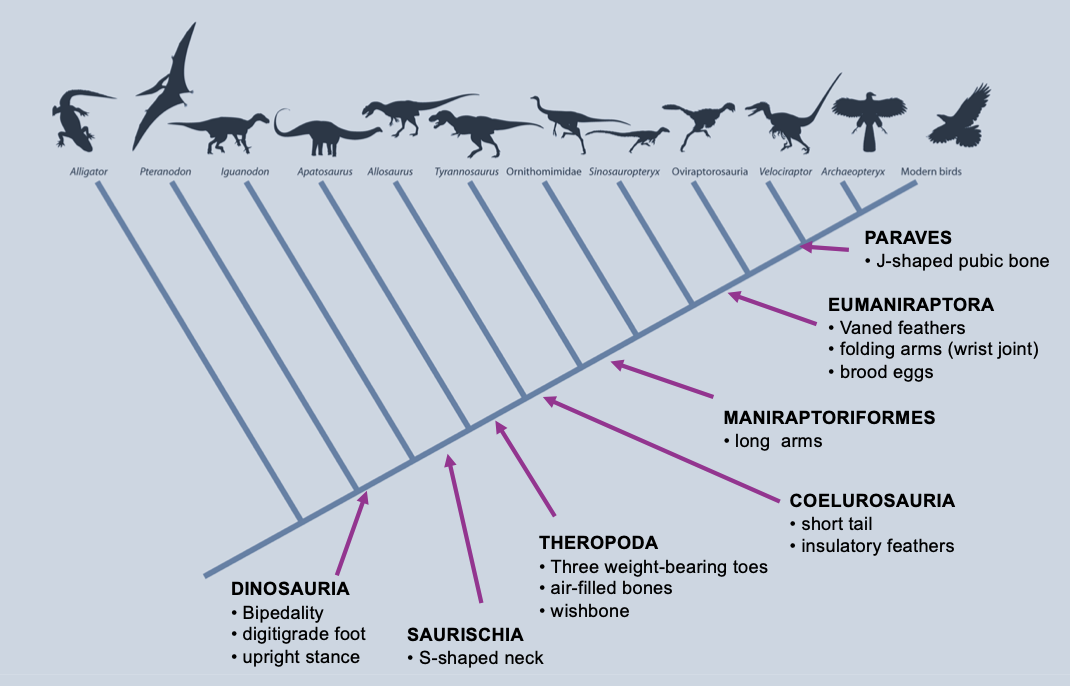
Origin from Dinosaurs
Birds evolved from theropod dinosaurs
Closely related to carnivorous dinosaurs like Velociraptor
Link to Reptiles
Birds are part of the reptile lineage (amniotes)
Share a common ancestor with modern reptiles like Crocodilia
Crocodiles are their closest living relatives
Transitional Fossils
Key fossil: Archaeopteryx
Shows both:
Reptilian traits (teeth, long tail)
Avian traits (feathers, wings)
Shared Characteristics with Theropods
Hollow bones
Three-toed limbs
Wishbone (furcula)
Feathers (present in some dinosaurs)
Placement in Evolution
Birds belong to:
Clade Aves
Within Dinosauria (they are technically living dinosaurs)
Evolutionary Significance
Represent a transition from:
Ground-dwelling dinosaurs → flying vertebrates
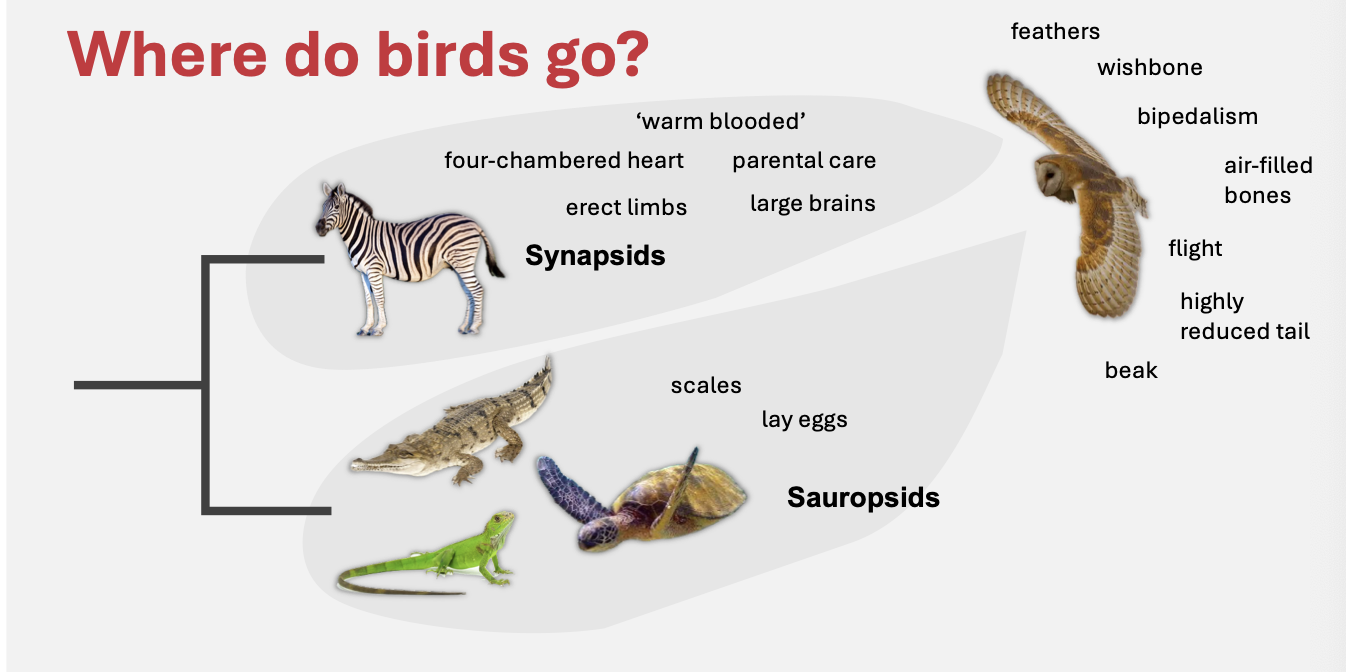
where are birds classified
Domain: Eukarya
Kingdom: Animalia
Phylum: Chordata
Subphylum: Vertebrata
Clade: Tetrapoda
Clade: Amniota
Clade: Diapsida (reptile group)
Clade: Dinosauria
Class: Aves
origins of birds
Archaeopteryx
Discovered 1861
From late Jurassic – 150 million years ago
Distinctively avian features, but also more typical reptile features
Advanced bird features
Feathers (central shaft, barbs, barbules)
Wings
Wishbone (furcula)
Primitive (reptile) features
Expected in early birds (if they come from reptiles)
Clawed hands
Teeth
Long, bony tail
Thereopod dinosaurs
Bipedal
Digitigrade
Birdlike toe arrangement
Large number of hip vertebrae
Long, birdlike, S-shaped neck
Similarities were interpreted as representing convergence for bipedal lifestyle
Dinosaurs are seen as too specialised to be bird ancestors
dromeosaurs
Wrist
Identical wrist construction in dromaeosaurs and Archaeopteryx
This spurs scientists to revisit dinosaur-bird connection
More features place birds inside Dinosauria
Shape of hip bones
Shape of ankle
Tail structure
Three fingered hand
Foot structure (3 weight bearing toes and a small inner toe)
Wishbone (found in dinosaurs such as Velociraptor and tyrannosaurus)
Upright digitigrade posture
Nesting
Dinosaur nests provide more evidence for dinosaurian ancestry
Skeletons from Gobi Desert show dinosaurs sat on nests, like brooding hens
Suggests body heat is warmed eggs- warm blooded?
Physiology
Rapid growth rates shared with birds and dinosaurs, but not crocodilians
Implies elevated body temperature
Scales
Most dinosaurs were scaly
Birds have scales on their legs and feet, made of keratin
Feathers
Feathers have been discovered in carnivorous dinosaurs
Feathers start as down, later modified into airfoils
Wings
Microraptor had 4 wings
birds and dinosaurs
Birds are just carnivorous dinosaurs, adapted to flight
How did flight evolve
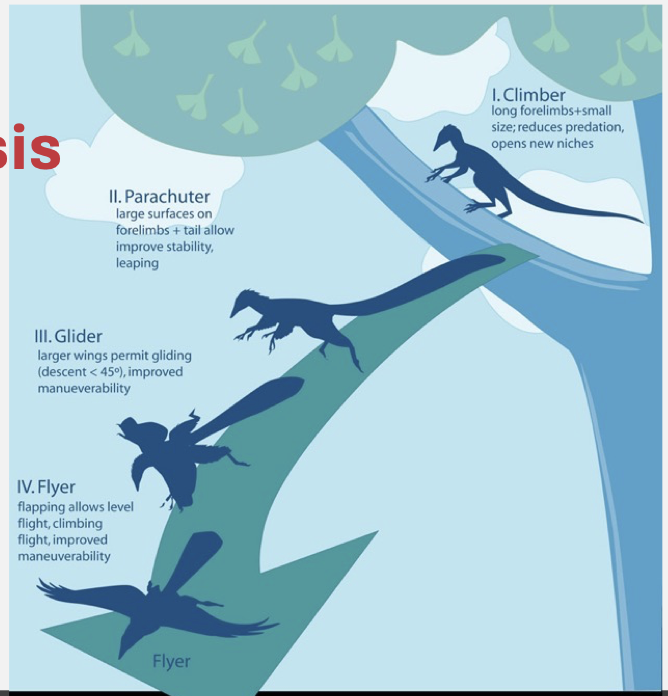
trees down hypothesis
ground up hypothesis
Tree climbing
Hand
Long, slender digits like in bats
Claws curved and flattened side-to-side, as in tree-climbing birds and mammals
Foot
First toe turns to oppose other toes
Toe claws moderately curved, as in birds that both walk and perch with the feet
Trees-down (arboreal) hypothesis
Early bird ancestors lived in trees and:
Climbed and jumped between branches
Began gliding using feathered limbs
Gradually evolved powered flight
Presence of claws and grasping limbs in early fossils like Archaeopteryx
Feathers could have first evolved for insulation/display, later used for gliding
Ground-up (cursorial) hypothesis
Early theropod dinosaurs ran quickly and:
Used their forelimbs for balance and lift
Began flapping while running
Eventually developed powered flight
Early theropod dinosaurs ran quickly and:
Used their forelimbs for balance and lift
Began flapping while running
Eventually developed powered flight
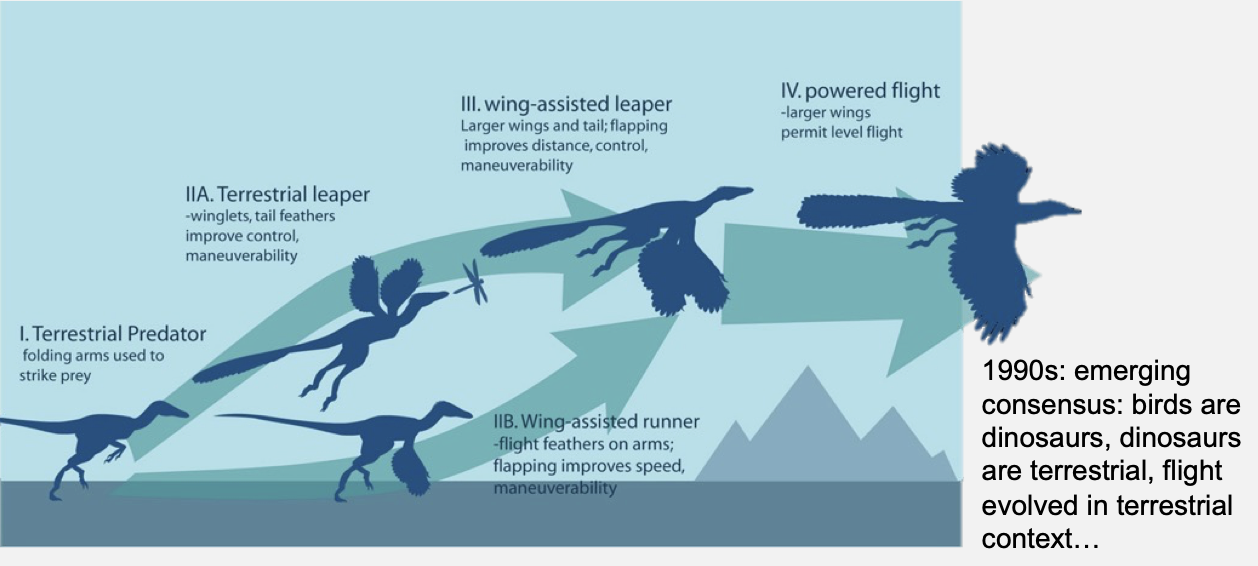
implications for the origins of flight
Multi-winged design like that of parachuting animals, like flying frogs and flying geckos
Suggests birds originated from tree-dwelling animals that extended fore and hindlimbs while parachuting through trees
Four winged stage
Tandem biplane, fore and aft airfoils
Doesn't make sense being an ancestral condition for birds as Microraptor was the only animal that had this
Or was it?
There were well developed feather impressions around the Archaeopteryx legs
Suggests that 4 winged design was probably ancestral, and lost in later birds
birds and the K-Pg extinction
Birds diversify in cretaceous, but they aren't modern birds
They are primitive birds, not closely related to anything living
e.g. Enantiorithes
No archaic birds after the K-Pg boundary
Suggests a mass extinction, but the fossil records are poor, so it is difficult to tell if it is a gradual or catastrophic transition
How to test this
A cladistic analysis based on anatomical characters to see if these things have anything to do with modern birds
Molecular clocks show rapid radiation
Shows modern birds emerged rapidly after the K-Pg boundary
Around 66-55 million years ago, the lineages leading up to modern bird groups – parrots, songbirds, hawks, doves, ducks, fowl etc appear
Possibly as few as 3 species gave rise to all living birds, suggesting aroung 99.9 % extinction

