Psych 3501 Exam 2: Humanistic Psychotherapy
 Studied by 0 people
 Call Kai
 Learn
Learn Practice Test
 Spaced Repetition
 Match
Match Flashcards
 Knowt Play
1/28

There's no tags or description
Looks like no tags are added yet.
Name | Mastery | Learn | Test | Matching | Spaced | Call with Kai |
|---|
No analytics yet
Send a link to your students to track their progress
29 Terms
Humanistic psychology
Mid 1900s psychology dominated by psychoanalysis and behaviorism
Limitations:
Undervalued healthy functioning
- On the pathology, symptoms, disorders
- Don’t say much about how to function in a healthy way
Undervalued healthy life goals
- What is motivating for the person, striving for, trying to achieve
Did not conceptualize the whole person
- Symptoms, problems vs. the whole person in the social context
Excessive focus on sexual and aggressive instincts (psychoanalysis)
Philosophical roots: humanism
Emphasizes individual and social potential
Possibility for an individual to contribute to society in a meaningful way
Emphasizes agency
Individuals as being autonomous, having free will, making own choices
Not slaves to instincts and drives, driven by biological processes
Humans have inherent dignity
Emphasizes morality as mechanism for improving life
Morality as the primary way to live a good and fulfilling life
Principles of humanistic psychology
understanding the whole person
intentionality
motivation and goal-setting
creativity
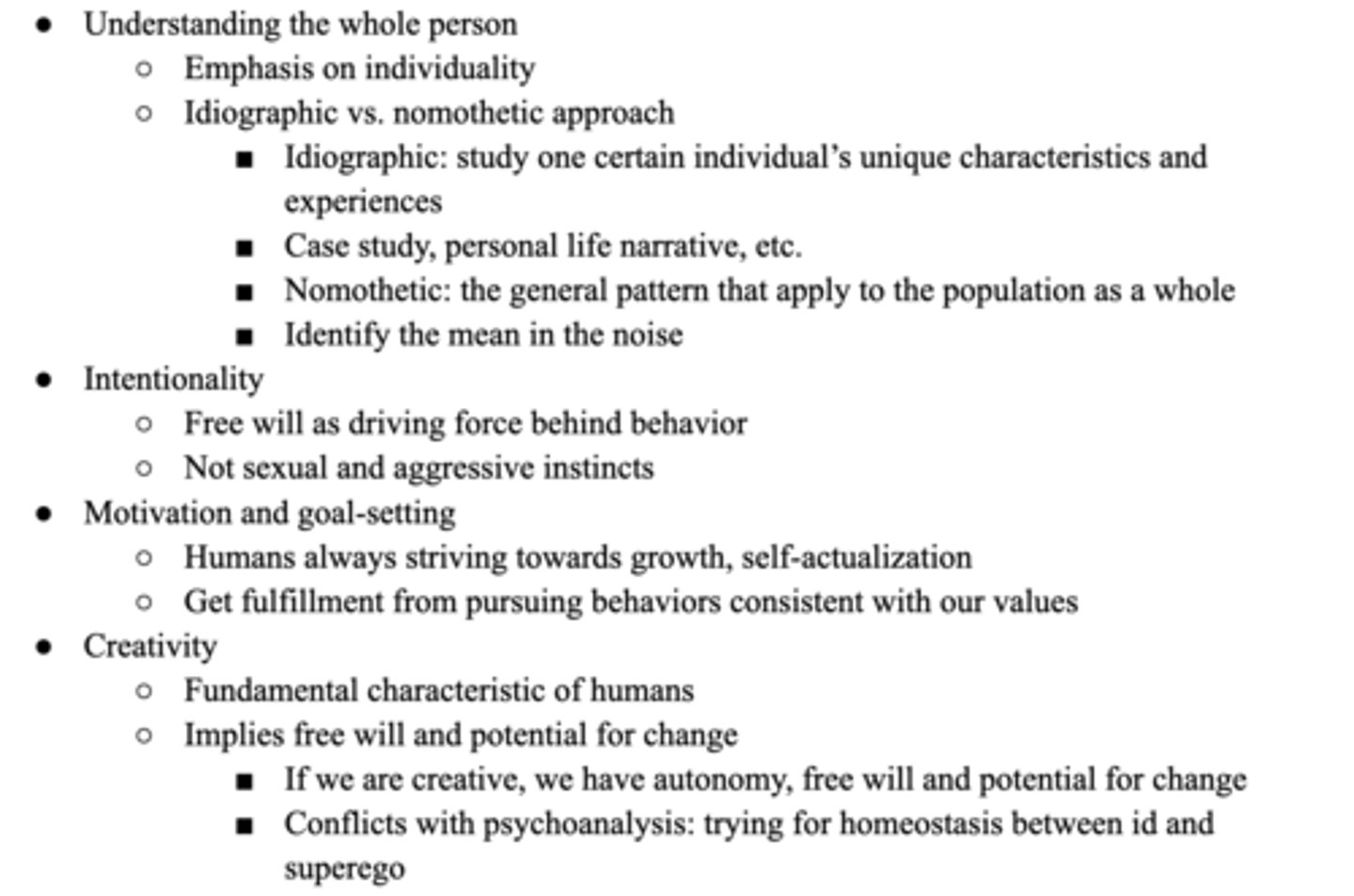
understanding the whole person
Emphasis on individuality
Idiographic vs. nomothetic approach
Idiographic: study one certain individual’s unique characteristics and experiences
Case study, personal life narrative, etc.
Nomothetic: the general pattern that apply to the population as a whole
Identify the mean in the noise
intentionality
Free will as driving force behind behavior
Not sexual and aggressive instincts
motivation and goal-setting
Humans always striving towards growth, self-actualization
Get fulfillment from pursuing behaviors consistent with our values
creativity
Fundamental characteristic of humans
Implies free will and potential for change
If we are creative, we have autonomy, free will and potential for change
Conflicts with psychoanalysis: trying for homeostasis between id and superego
Unifying themes of humanistic psychotherapies
Client’s lives and problems can only be understood through the client’s lens
Therapist cannot take top-down perspectives
Get into their client’s shoes and see through their perspectives
Clients are inherently good and capable of determining their own outcomes
Goal to amplify strengths in addition to addressing problems
Capitalize strengths, helping clients to grow these strengths and solve problems
Addressing the problem & maximizing the good
Therapeutic relationship is curative and primary mechanism of therapy
Distinct: the relationship is the therapy
The relationship itself is a mechanism of action
Psychoanalysis: the relationship is important because it offers opportunities for certain skills, important because it reveals conflicts, but not curative by itself
Forms of humanistic psychology
Person-centered therapy
Gestalt therapy
Existential therapy
Emotion-focused therapy
Person-centered therapy
Developed by Carl Rogers (originally trained in psychoanalysis)
Experienced frustration with the psychoanalysis approach: didn’t like therapists as authority figures constantly searching for unconscious conflicts
Emphasized the unique and valuable perspective of the client
It is the client who knows what hurts, what directions to go, what problems are crucial, what experiences have been deeply buried
The client as an expert on themselves
Self-actualization
All humans have an actualizing tendency
- Universal human motivation, results in growth, development, and autonomy
- “The urge to express and activate all the capacities of the organism”
An inherent biological tendency, not moral imperative (choices we make)
Drive to become fully functioning
- Unlikely
- Acorns have the potential to grow into tree, but only happens if the contexts and environments are optimal
- Most people experience non-optimal environment that places limits on the growth potential
Conditions of worth
Attitudes, beliefs, and values that are expressed by others and taken on by the self
Disapproval or rejection of behaviors, feelings -> belief that acceptance, love, worth is conditional
Often: conditional on what others want/expect from you
Learn to evaluate experiences by whether they satisfy externally imposed conditions
Conditions of Worth Leads to: Incongruence
Internalized conditions of worth becomes the ideal self
- The ideal self: not a good thing
- The self made up by expectation, desires from outside
Distort behaviors, feelings into a socially approved self to be consistent with the ideal self rather than consistent with the real self
Incongruence: degree of discrepancy between the real self and the ideal self
Considered the root of psychological distress
In sum - person-centered therapy
Person-centered psychotherapy views distress through a lens of thwarted potential rather than illness ideology
Person-centered psychotherapy
Goal: allow clients to become aware of their authentic thoughts and feelings to promote personal growth and self-actualization
- More aware and in touch with the real self
- Positive tone
Person-centered techniques
unconditional positive regard
empathy
congruence
Unconditional positive regard
therapist expresses care for and acceptance of the client, regardless of their behavior
Not necessarily approval; “I’m here for you regardless of what you did”
Expressed through non-possessive caring and willingness to listen
Non-possessive caring: expressing positive feelings such that the client feels valued but not obligated to please the therapist
Willingness to listen: no interrupting, changing the subject, or being distracted; expressing genuine interest in what the client has to say
Goal: to create an experience of being valued for who they are (their real self) in order to promote growth and decrease incongruence
If they experience it enough in therapy, they no longer feel they have to be the ideal self in real life
Empathy
therapist tries to see the world through the client’s lens
External vs. internal frame of reference
External: you as a therapist observing the client from the outside, applying your own values and theories to their sayings
Internal: inferring the client’s thoughts and emotions by taking their point of view
Reflective listening:
Conveys the therapist wants to understand their sayings and feelings
Increases client awareness of their feelings
It’s okay if your reflection is wrong and the clients can correct you, but signal to the client that you really want to understand them
Congruence
consistency between the therapists’ feelings and actions towards the client
Necessary foundation for a genuine relationship
Promotes trust between client and therapist
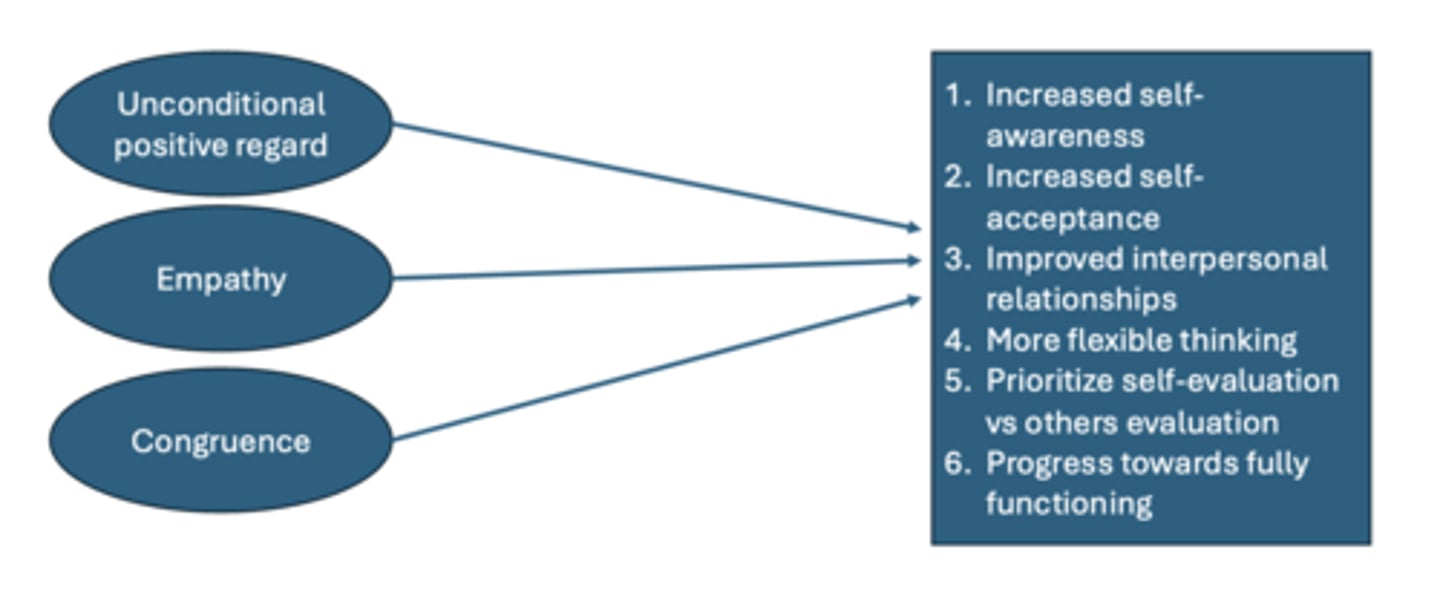
Person-centered therapy: graph
self-awareness
self-acceptance
interpersonal relationships
flexible thinking
prioritize self-evaluation vs. others evaluation
progress towards fully functioning
Gestalt therapy - goal
Developed by Fritz & Laura Perls
Goal: create conditions to increase self-awareness, self-acceptance, and self-integration
- Conditions in the therapeutic setting
Gestalt therapy
Disunity of the self underlies distress
Growth is stalled when genuine self is subverted in favor of a self created to appease others
Techniques help client identify and assimilate the genuine self and reject the fake self
Techniques is very different from person-centered therapy
Much more active and expressive than person-centered therapy
Gestalt therapy techniques
present focus
role-playing
attention to nonverbal behavior
frustrating the client
Present focus
Therapist consistently works to keep client focused on current thoughts, emotions, physiology
Now = experience = awareness = reality
Attempts to talk about past or future: interpreted as an avoidance of present reality
Therapist would highlight the avoidance and redirect the client back to the present experience
Techniques: Role-playing
Used to explore inner conflicts and defenses that maintain symptoms
Empty-chair technique
Have an empty chair and let the client imagine that someone they need to talk to is sitting in that chair
Use the opportunity to express true feelings they haven’t expressed before
Unmailed letter technique
Write a letter but don’t mail it
Go through the experience of processing and getting out feelings but not having consequences
Role-playing reversals
Get in touch with suppressed feelings
Ask them to convey the opposite to what they are currently expressing
When they are pretending, they are getting in touch with the existing feelings that they don’t want to engage with
Attention to nonverbal behavior
Focus on body language, particularly when it contrasts words
May ask client to repeat and exaggerate behaviors to identify associated feelings
Frustrating the client
“The hot seat”
highlight the fakeness and explore it together
Mirror the client’s behavior: interact with client using the client’s own resistances and problematic styles
Goal to bring awareness so these patterns can be explored
Risky: alienate, offend the client
The legacy of humanistic psychotherapy
Few modern psychotherapists identify as humanist
Limited empirical support, despite Rogers emphasis on need for scientific study
Difficult to study
No specific therapeutic goals, methods are vague, hard to measure “get better”
Considered highly influential, particularly the emphasis on the therapeutic relationship & the curative role the relationship can have
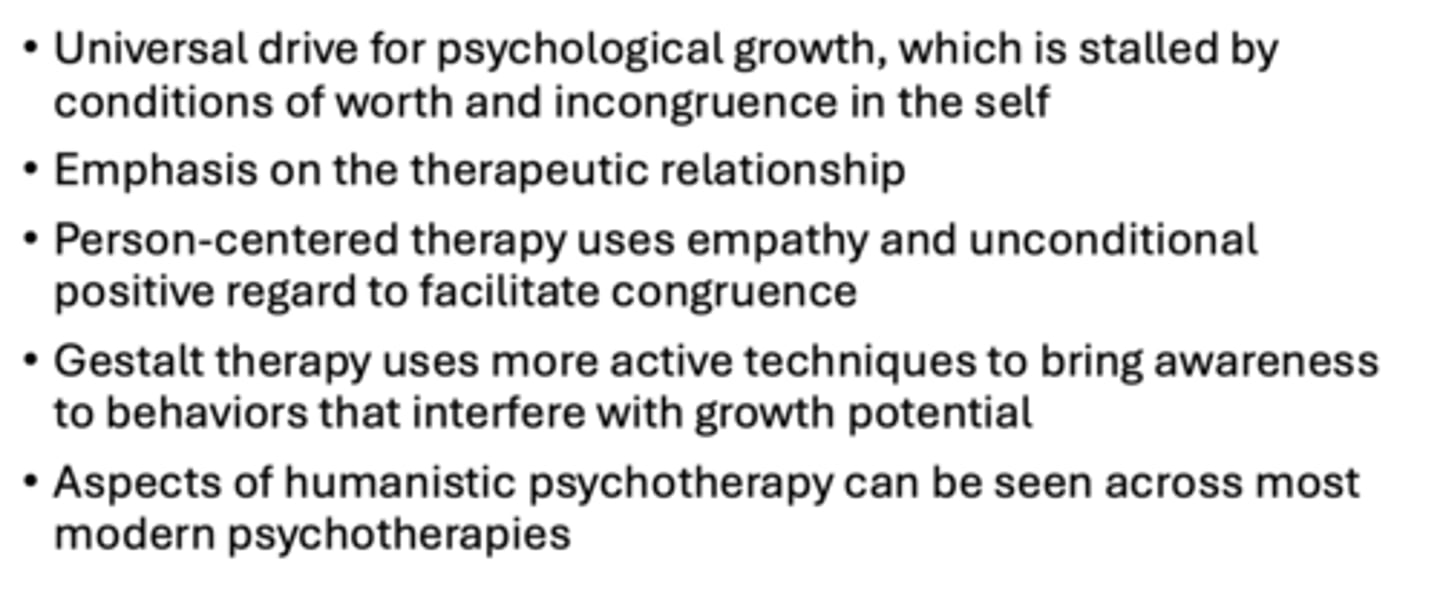
Summary
 Note
Note  Flashcards (46)