Virus/Bacteria
 View linked note
 Call Kai
 Learn
Learn Practice Test
 Spaced Repetition
 Match
Match Flashcards
 Knowt Play
1/46

There's no tags or description
Looks like no tags are added yet.
Name | Mastery | Learn | Test | Matching | Spaced | Call with Kai |
|---|
No analytics yet
Send a link to your students to track their progress
47 Terms
Why are viruses not a true cell?
they are obligate intracellular parasites that need to be inside of a host cell to express genes and reproduce
uses host cell machinery (enzymes, cell energy, cell structures like ribosomes, etc.)
What components do ALL viruses have?
nucleic acid core
DNA or RNA
single or double stranded
capsid
protein coat of the virus
2 different capsid shapes
icosahedral - 20 sided w/ nucleic acid in center
helical - rod-shaped (capsomeres wind about nucleic acid)
What is a capsid?
protein coat of the virus
Describe the two types of capsids
icosahedral - 20-sided (nucleic acid in center)
helical - rod-shaped (capsomeres wind about nucleic acid)
What are components that only SOME viruses have?
envelope (aka membrane)
surrounds capsid
produced from host cell membrane; also contains viral proteins
may have spike-like projections (glycoproteins)
enzymes
usually needed for viral replication or transcription of genes (i.e. RT)
What is the definition of a viral infection?
The nucleic acid of the virus enters the host cell
Name the four types of viruses based on capsid shape and envelope and describe them
Enveloped polyhedron
ex. HIV/Flu
Naked polyhedron
ex. Adenovirus, cold virus
Enveloped spiral
TMV, helical capsid
Naked spiral
ORF virus (scabs from sheep)

How do plant viruses enter the plant cell?
Via an insect vector that pierces thick cell wall and injects the virus
What are the steps of viral infection?
Adsorption
penetration
uncoating
synthesis
assembly
release
ACRONYM TO REMEMBER: APUSAR
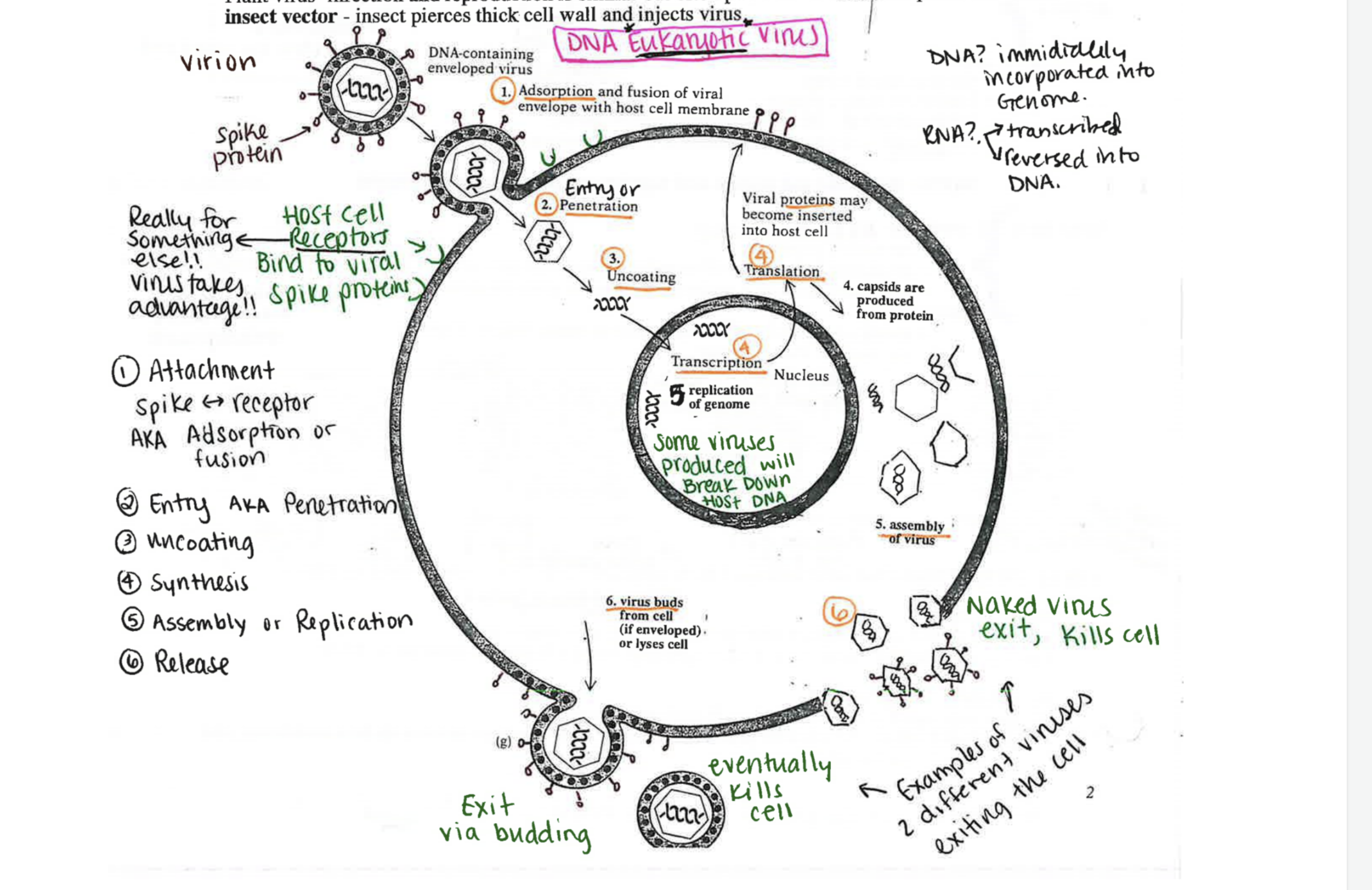
Describe the adsorption stage of viral infection/reproduction
binding to host cell, viral protein—cell receptor interaction
host cell specific - each type of virus can only infect a limited number of host cells
Describe the penetration stage of viral infection/reproduction
entry into cell
non-enveloped viruses use receptor mediated endocytosis
enveloped viruses’ viral envelope fuses with the plasma membrane of the host cell → capsid enters host cells
Describe the uncoating stage of viral infection/reproduction
disassembly of infecting virus (removal of outer structures to expose nucleic acid
Describe the synthesis stage of viral infection/reproduction
synthesis of viral components such as capsid proteins, viral enzymes, envelope proteins, nucleic acid
remember that viral genome often contains a gene that produces an enzyme that degrades host cell DNA/alter host cell RNA poly → host cell can’t transcribe/translate its own genes → virus can hijack cell’s energy to manufacture its own proteins and genome
Describe the assembly stage of viral infection/reproduction
assembly of different virus components to product intact virus that can infect another host cell
capsid surrounds genome + enzymes that need to be encapsulated in the intact virus
Describe the release stage of viral infection/reproduction
enveloped virus
viral proteins are inserted into host cell membrane
nucleocapsids accumulate at sites where proteins are inserted
virus buds out of cell - modified host cell membrane becomes viral envelope
non-enveloped
lysis occurs (host cell death)
Describe the structure and form of entry for bacteriophages
structure: includes icosahedral head + tail
special form of entry
viral tail fiber proteins bind host cell receptors
nucleic acid is injected into host cell as tail contracts; all viral structures including capsid are left outside of cell
What are the two alternative forms of infection?
Lytic and lysogenic
Describe the lytic cycle
complete viral life cycle that ends in lysis of host cell (host cell death)
virus directs the production of lysozyme that breaks open host cell to release viruses
viruses that kill host cells in this way → lytic viruses + virulent
NOTE: not all bacteria are killed once infected by a lytic virus, some bacteria have protective restriction enzymes that recognize and chop up foreign DNA
Describe the lysogenic cycle
host cell is NOT killed
phage DNA enters cells → integrates into bacterial chromosome → phage genome now called prophage
prophage expresses gene for repressor protein that shuts off activity of other viral genes → VIRUS ENTERS A LATENT STAGE
when bacterial cell reproduces, it replicates prophage genome with its own → each new bacterial cell contains viral genome
stimulants such as chemicals/radiation can induce prophage to be excised from bacterial genome → virus undergoes lytic cycle
What are temperate phages?
virus that can undergo a lytic or lysogenic cycle
What is transduction with respect to the lysogenic cycle?
method that increases variation in bacterial genome
during assembly some of the host DNA will become encapsulated in a capsid.
phage may go on to “infect” another bacterium with HOST DNA
What are the three major types of viruses based on type of genetic material/method of replication?
DNA
RNA
retroviruses
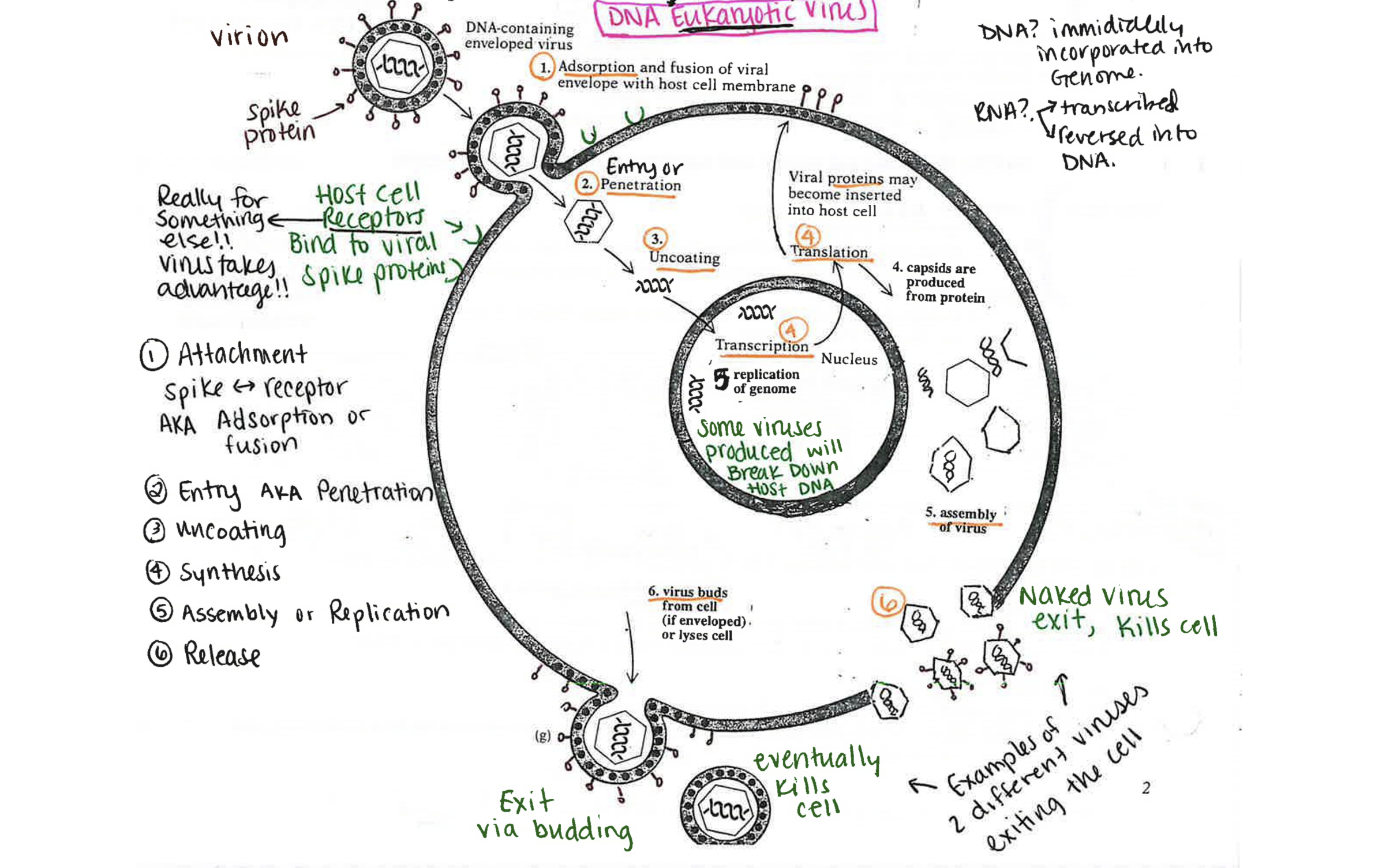
Describe the life cycle of a DNA virus
reference this diagram and remember APUSAR
Describe the life cycle of an RNA virus
similar to DNA viruses, the virus enters the cell and the genome is uncoated
assembly and release are similar to DNA viruses
DIFFERENCE:
RNA acts as an mRNA for immediate translation and as a template to produce more RNA genome
some of the genes need to be translated first before replication b/c virus needs to produce enzyme that uses RNA as template in order to produce more of the RNA genome.
host-cell doesn’t contain an RNA dependent RNA poly)
Provide examples of DNA viruses
herpes, Hepatitis B, smallpox, papilloma
Provide some examples of RNA based viruses
polio
rabies
influenza
rhinovirus
Describe the life cycle of a retrovirus
retroviruses contain RNA genomes that are changed into DNA genomes → then integrated into host cell DNA
integration into host cell DNA allows the host machinery to transcribe viral Genes → viral replication
carry reverse transcriptase (RT)
transcribes RNA into DNA (this enzymes lowkey makes a lot of mistakes → why HIV mutates so fast)
NOTE: HIV has two identical strands of RNA inside the capsid (idk why, gotta ask)
Describe the function of integrase in retroviruses
enzyme that enables the virus to insert its reverse-transcribed genetic material into the DNA of a host cell
Describe the function of protease in retroviruses
brought in with virus during infection cleaves polyprotein into separate function proteins (remember that viruses don’t have introns)
Describe the types of antibiotics that are used to treat HIV
AZT - nucleotide base analog inserted into the DNA as reverse transcription takes place
RT will sometimes add AZT in chain instead of nucleotide → b/c AZT is a chain terminator → incomplete genome → viral life cycle stops
Protease inhibitors - binds to and inhibits protease enzyme from cleaving polyprotein into functional proteins by competitively binding to protease active site
(integrase inhibitors do the same thing but with integrase)
Describe what vaccines and are and what they consist of
consists of an altered (attenuated) virus that’s been inactivated by removal of certain genes/proteins that make it unable to cause disease
vaccine is recognized as a foreign substance → initiates immune response → production of antibodies + WBCs that target for antigens of the virus
some vaccines just consist of the antigens rather than a whole virus
Describe Interferons
chemical naturally produced by viral-infected cells that’s secreted into the surrounding environment and helps prevent infection of nearby cells
What are the examples we have to know about DNA viruses that cause cancer
Hep B → can cause liver cancer after a prolonged infection of ~20 years
HPV → can cause cervical cancer
Describe the hypothesis for the origin of viruses
evolved as fragments from cellular genomes that acquired specialized packaging
may have evolved from plasmids or transposons
evidence - many viral genes are very similar to hots cellular genes and in fact are more similar to host genes than to genes found in other types of viruses.
What are prions?
infectious agent that contains no nucleic acid
abnormally folded proteins that interacted with normal cellular proteins in the brain and change them into abnormal proteins
accumulation of the abnormally folded proteins causes disease
What are viroids?
naked pieces of RNA, very short, 200-400 bases, circular (shorter than a typical virus which is ~ 2000 nucleotides)
cause disease mainly in plants but there are no protein codes in the RNA
circular RNA may be broken down by dicers into siRNA → silence mRNA in plant cell → reduction in yield
Describe the two domains that prokaryotes are divided into
Bacteria
includes most prokaryotes
Archaea
more primitive prokaryotes
live in extremely challenging habitats
methanogens - produce methane by reducing CO2 with H2 (strictly anaerobic)
halophiles - require high salt concentration to live
thermophiles - live in extremely hot environments
Are eukaryotes more closely related to Archaea or Bacteria domain?
Archaea (more recent last common ancestor)
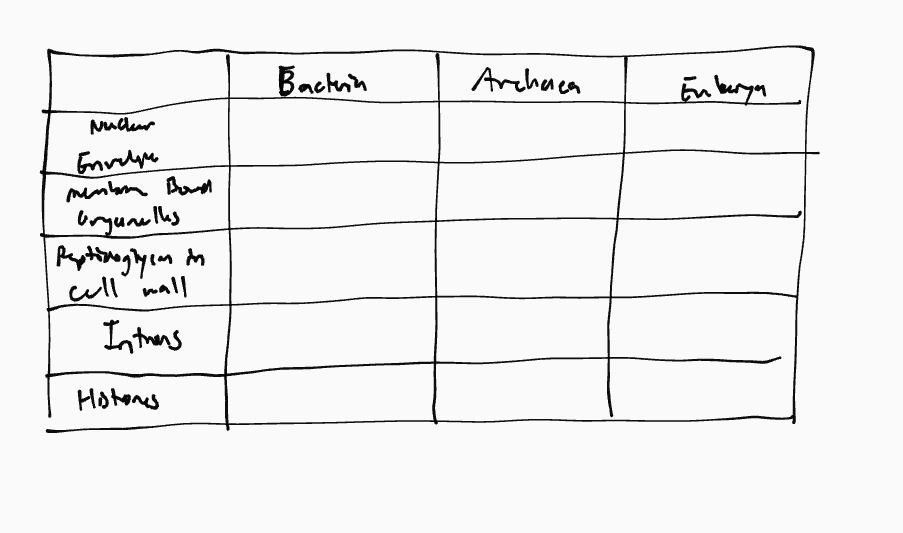
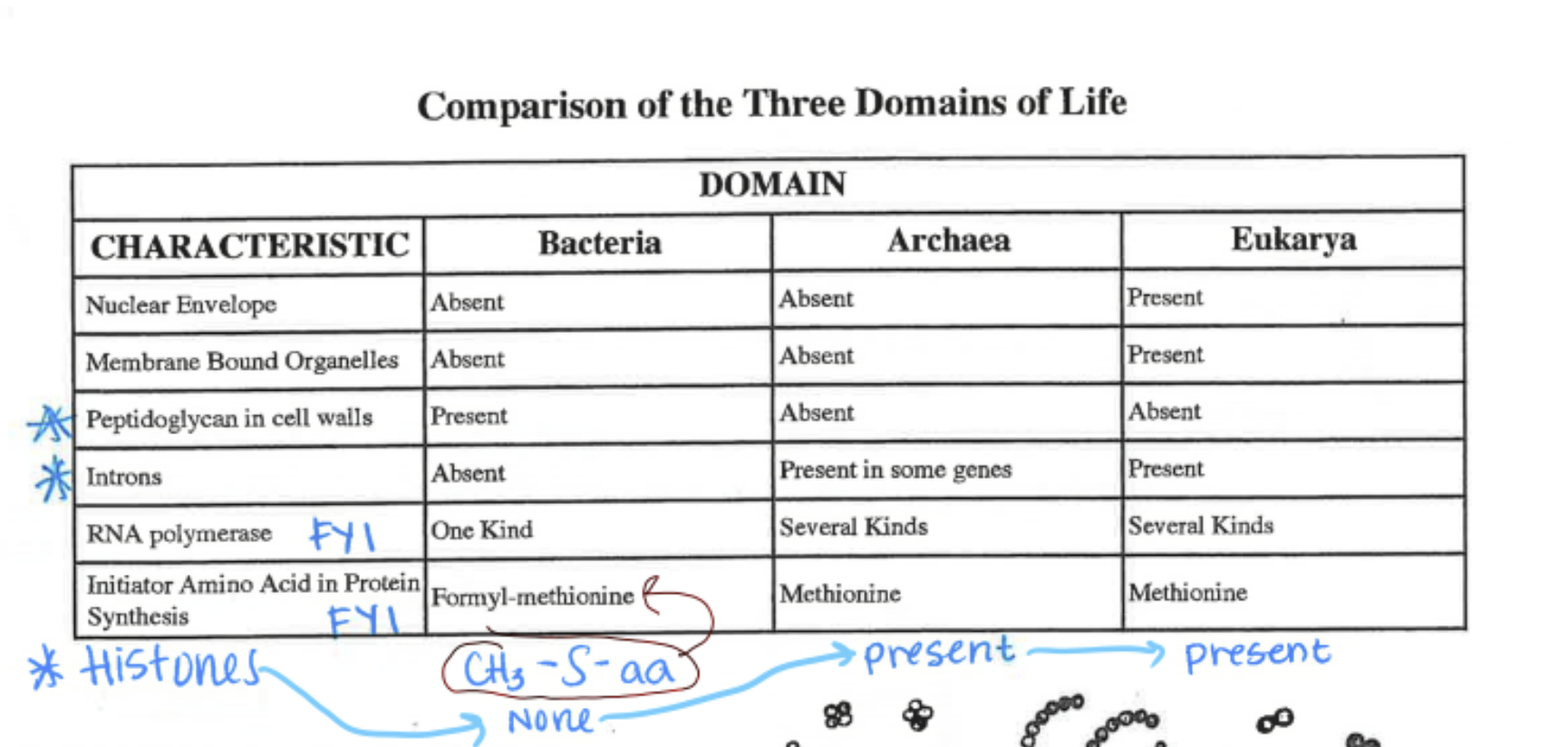
Fill in this chart comparing the three domains of life
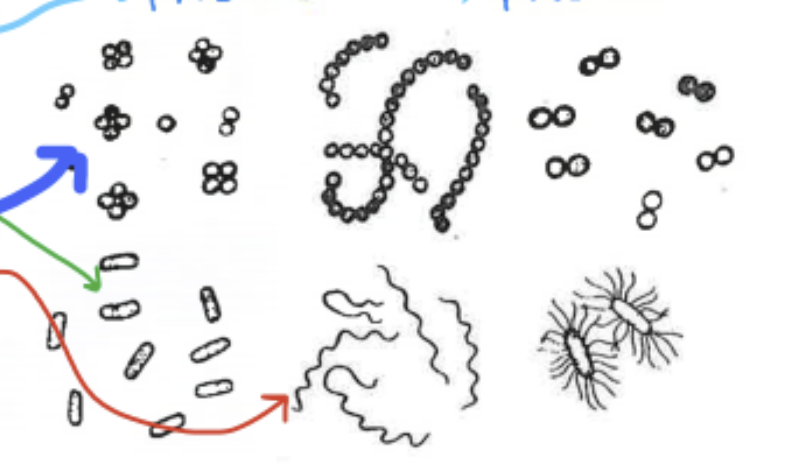
What are the three main cell shapes for bacteria?
bacilli - rod-shaped
cocci - spherical
spirilli (spirochetes) - helical/spiral
Describe the components of bacterial cell structure
All have:
cell wall
plasma membrane
cytosol
ribosomes
DNA
circular chromosome (no histones, basically no other protein)
plasmids
the small circular sections of DNA
replicate independent of main chromosome
often contain genes for antibiotic resistance
Some have:
flagella
for motility
anchored to cell wall + plasma membrane
bacteria can have 0, 1, or more flagellum
pili
extensions from cell that aid in attachment from host
some pili are important in exchange of genetic material (conjugation)
capsule
polysaccharide, slimy film outside cell wall
can make bacteria more pathogenic - evade phagocytosis by white blood cells
also can aid attachment to host
What are episomes
plasmids that can integrate into the main chromosome
Conjugation
transfer of DNA by cell-to-cell contact (plasmid/part of chromosome is transferred)
occurs across sex pilus coded for by genes on plasmid called F (fertility) factor
only F+ or Hfr cells have this plasmid
F+ or Hfr donor "cell transfers DNA to an F- recipient cell
btwn F+ and F-
F+ cell’s pili attach to F- cells → F factor transferred
F- cells become F+ cells
Hfr and F-
Hfr cell is an F+ cell where the plasmid is integrated within the chromosome
F factor DNA has a break
part of the F factor AND the attached chromosome move through the conjugation pilus into F- cell
pilus breaks down before last part of F-factor is transferred → F- cell REMAINS F-
parts of Hfr chromosome transferred into F- cell can recombine with F- chromosome
extra DNA ending up outside the chromosome during the recombination process are degraded by enzymes
Transformation
DNA is taken up PASSIVELY from surroundings (think Griffith experiment)
Transduction
pieces of DNA are transferred from one bacterium to another by a viral vector
General Transduction
lytic cycle →host DNA is fragmented → random pieces are packaged in the viral capsid during viral replication
virus infects another cell → carries pieces of DNA from the last host
first host cell DNA can integrate itself into second host cell DNA
Gram Positive vs Gram Negative Bacteria
gram positive
less pathogenic
thick, peptidoglycan layer and RETAINS stain → appear purple
gram negative
more pathogenic
thinner peptidoglycan layer → doesn’t retain stain → appears pink
has outer membrane made of lipopolysaccharides (LPS/endotoxin) → causes disease
