[ORGB3201] Exam 2: Org. Structure, Culture & Change
 Call Kai
 Learn
Learn Practice Test
 Spaced Repetition
 Match
Match Flashcards
 Knowt Play
1/54

There's no tags or description
Looks like no tags are added yet.
Name | Mastery | Learn | Test | Matching | Spaced | Call with Kai |
|---|
No analytics yet
Send a link to your students to track their progress
55 Terms
Why do firms exist?
To minimize transaction costs (the expenses incurred when buying/selling)
Reduced through in-house activities and economies of scale
Allow for coordination
Maximize collective knowledge and skill development (prevent process loss)
Firms tend to appear (minimize cost) when:
Activities are complex and thus transactional savings can be achieved
Risks can be minimized
Sustaining activities and goals through norms and rules
Prices can be reduced (i.e. technology, labor, purchase volume)
Organizational structure
How job tasks are formally divided, grouped, and coordinated
Six dimensions:
Work specialization
Departmentalization
Chain of command
Span of control
Centralization/decentralization
Formalization
Examples of structure: simple (low departmentalization), bureaucracy, matrix (functional + product departmentalization)
Work specialization
The degree to which activities in the organization are divided into separate jobs
Division of labor
Can increase productivity, but there is an optimal work specialization level
If past that, it can decrease productivity (when the work is too specialized)
Can lead to boredom
Benefits of work specialization
Efficiency
Expertise development (grouping different type of work together)
Reduced training time
Drawbacks of work specialization
Monotony
Reduced motivation (if you’re working on the same things together)
Lower satisfaction
Departmentalization
The basis by which jobs are grouped together so that common tasks can be coordinated
Common basis: function, product, geography, process, customer
Matrix structure combines multiple forms of departmentalization (i.e. function and product)
Maximizes output without having to worry about other functions
Creates efficiency and increased accountability for performance
Chain of command
Unbroken line of authority that extends from the top of the organization to the lowest echelon
Clarifies who reports to whom
Important if you want:
Authority (right to give orders)
Unity of command (one boss)
Span of control
The number of employees a manager is expected to effectively and efficiently direct
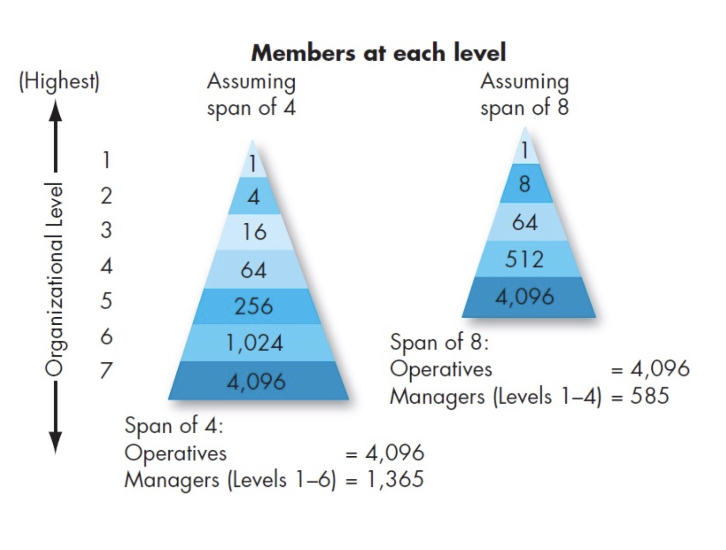
Ex: span of 4 → each level of employees increases by 4x
Span of control is bigger when the number is larger (i.e. span of 8)
Hierarchy (organization level) becomes taller if span is smaller (i.e. span of 4)
Determines the number of levels and managers an organization has
Narrow (tall): more levels, closer supervision, higher costs
Wide (flat): fewer levels, less oversight, lower costs
Drawbacks to narrow span of control
Expensive → adds levels to management
Makes vertical communication in the organization more complex
Added levels of hierarchy slow down decision making and isolate upper management
Overly tight supervision → discourages employee autonomy
Benefits of wider span of control
Reduces costs → cuts overhead
Speeds up decision making
Increases flexibility
Get closer to customers
Empower employees
Centralization/Decentralization
The degree to which decision making is concentrating at a single point in the organization
Highly centralized when top managers make most decisions
Highly decentralized when frontline employees make most decisions
Centralized organization (tall)
Decision-making concentrated at the top
Clear hierarchy, top-down authority
Ex: US Federal Government, Military
Use when: clear goals, efficiency priority, routine tasks, coordination essential
Decentralized organization (flat)
Decision-making distributed throughout
Empowered lower levels, distributed authority
Ex: universities, startups, Valve Corporation
Use when: unclear goals, dynamic environments, innovation needed, expertise distributed
Formalization
The degree to which jobs within the organization are standardized
Think of like an employee handbook
Low formalization: freedom to act as necessary
Professional judgment emphasized
Usually professional judgment emphasized since employees have to make recommendations
Ex: research positions, creative roles
High formalization
High formalization: detailed rules and regulations (explicit job description)
Minimal discretion over what/when/how
Ex: fast food operations, call centers
Usually detailed rules for safety reasons
Low formalization
Low formalization: freedom to act as necessary
Professional judgment emphasized
Usually professional judgment emphasized since employees have to make recommendations
Ex: research positions, creative roles
Bureaucracy
A hierarchical organization characterized by rules and regulations
Theoretically good to have (meets people’s needs)
Ex: large corporations, government agencies, or universities
Weber’s Argument: Rationality
Human action is driven by different kinds of rationality
Substantive: based on feelings/emotions (values-driven)
Practical: efficient means to address needs
Formal: traditional/conventional
Theoretical: abstract concepts or beliefs guide actions (reaction to Marx on economic gain)
Result: Iron Cage
As bureaucracies spread, individuals become trapped in systems built around efficiency, calculation, and control
Trapped in this cage to meet their goals
Rationalization trends
Scientific Management → McDonaldization of Society → Emotional Labor
Taylor’s Scientific Management
In response to Weber’s bureaucracy (not literally, but related)
Replace informal, "rule of thumb" work methods with scientifically studied, standardized procedures to maximize efficiency
Analysis and redesign of workflows for maximum efficiency
Standardization of tasks and procedures
Transfer of knowledge into documentation
Separation of planning (management) and execution (workers)
Impact:
Improved work productivity
Increased standardized, predictable output
Decreased monotony and repetitive work
Decreased skill variety, task autonomy, and worker feedback
McDonaldization of Society (Ritzer)
An organization characterized by McDonaldization emphasizes:
Efficiency
Minimization of costs/energy to achieve outcomes
Predictability
Products and experiences conform to expectations
Calculability
Emphasis on quantifiable measures
Quantity > quality (more focus on output rather than the work environment you create)
Technology replacing humans
Substitution and deskilling of work
Think about AI now
Control over certainty
Minimize risk and the unknown
Emotional Labor
Tasks requiring workers to produce/manage emotional states in themselves or others
~60% of US workforce in customer-facing roles
More prominent in service work (i.e. hotel management, retail work)
Concern: emotional burnout from routinized emotional performances
Surface acting
Deep acting
Ex: Disney, Southwest Airlines, retail workers
Usually deep acting at Disney
Southwest Airlines employees report higher job satisfaction because the company knows the importance of emotional labor
Surface acting
Where an individual’s underlying emotions or feelings run counter to how they’re behaving at work
Deep acting
Where an individual aligns required and true feelings (can also be detrimental to your wellbeing)
Organizational structure
Formal architecture (visible, documented, explicit)
Org charts, job descriptions, reporting relationships
Modern Take on Organizational Structure
Virtual organization
Boundaryless organization
Matrix structure
Virtual organization
A small, core organization that outsources its major business functions (sometimes called a network or modular organization)
Small group of executives
Highly centralized with little to no departmentalization
Minimizes bureaucratic overhead → no lasting organization to maintain
Lessens long-term risks and their costs because there is no long term
Advantages of the virtual organization
Flexibility → allows individuals with an innovative idea and little money to successfully compete against larger, more established organizations
Saves a lot of money (eliminates permanent offices and hierarchical roles)
Drawbacks of the virtual organization
Roles, goals, and responsibilities are unclear → sets the stage for political behavior
Cultural alignment and shared goals can be lost → low degree of interaction among members
Information and knowledge can be hard to share if members are geographically dispersed and communicate infrequently → limits innovation and slows response time
Sometimes less adaptable and innovative than organizations with well-established communication and collaboration networks
Boundaryless organization
An organization that seeks to eliminate the chain of command, have limitless spans of control, and replace departments with empowered teams
Removes vertical boundaries → flattens the hierarchy and minimizes status and rank
Cross-hierarchical teams (includes top executives, middle managers, supervisors, and operative employees)
Participative decision-making practices
360-degree performance appraisals (peers above and below the employee evaluate performance)
Reduce horizontal boundaries (which stifle interaction among functions, product lines, and units) by replacing functional departments with cross-functional teams and organize activities around processes
Can also rotate people through different functional areas using lateral transfers → turns specialists into generalists (think of job rotation from the job redesign strategies)
Breaks down cultural barriers → considers geography as a tactical, logistical issue than a structural one
Most large US companies see themselves as global corporations
Can be done through strategic alliances (joint partnerships with other companies to work on joint projects) and telecommuting
Matrix structure
Combines 2 forms of departmentalization: functional and product
Breaks the unity-of-command concept
Employees have 2 bosses: their functional department managers and their product managers
Strengths of the matrix structure
Putting like specialists together while allowing the pooling and sharing of specialized resources across products
Facilitates coordination when the organization has a number of complex and interdependent activities
Allows information to quickly permeate the organization → more quickly reaches the people who need it
Achieves economies of scale
Weaknesses of the matrix structure
Difficulty coordinating the tasks of diverse functional specialists on time and within budget
Can create confusion, power struggles, and stress on employees
Ambiguity about who reports to whom
Organizational culture
Informal meaning system (invisible, felt, implicit)
Shared values, beliefs, assumptions, norms
7 characteristics of the essence of organizational culture:
Innovation and risk taking
Attention to detail
Outcome orientation
People orientation
Team orientation
Aggressiveness (aggressive and competitive or more easygoing?)
Stability (maintain status quo or growth?)
How do organizational structure and organizational culture work together?
Both together shape:
How work actually gets done
Who succeeds and why
What behaviors are valued and punished
How organization responds to challenges
Organizational Culture Components
A system of shared meaning held by members that distinguishes one organization from another
Components:
Key values (what’s important)
Beliefs (what’s true about the world)
Norms (expected behaviors)
Assumptions (taken-for-granted truths)
Cultural strength: varies from strong (intensely held, widely shared), to weak (inconsistent, fragmented)
Core Function of Organizational Culture
Social control in conditions of uncertainty
When formal rules don’t exist or don’t apply, culture guides behavior
Tells employees “how we do things here” without explicit instructions
More powerful than rulebooks in many situations
Schein’s Model of Organizational Culture
Artifacts
Espoused values
Basic underlying assumptions
Artifacts
High visibility and awareness
Visible organizational structures and process (hard to decipher)
What you observe (see, feel, hear)
Physical environment, dress codes, architecture
Ex: language, stories, rituals, ceremonies
Espoused Values
Lower visibility and awareness
Strategies, goals, philosophies (espoused justifications)
What you are told
What organization SAYS it values (mission statement)
Often aspirational → what organization wants to believe about itself
Not visible
Reinforces artifacts
Ex: “We’re in business to save our home planet.”
Basic Underlying Assumptions
Lowest visibility and awareness
Unconscious
Taken-for-granted beliefs
What organization ACTUALLY values → revealed through consistent patterns
Perceptions, thoughts, and feelings
Hardest to change because it’s unconscious (often not communicated)
Ultimate source of values and action
The Process of Creating and Sustaining Culture
Philosophy of organization’s founders
Initial vision and values set cultural DNA
Founders embed their beliefs into the organization
Selection criteria
Hire for cultural fit, not just skills
Self-selection: candidates choose organizations matching their values
Philosophy of founders flows to top management and socialization
Socialization: teaching culture to newcomers through formal and informal processes (i.e. stories, rituals, material symbols, language)
Transmit assumptions and norms to next generation (effective during employee training)
All these things combined create the organizational culture
Leaders model desired behaviors
What gets rewarded and punished signals values
Culture becomes a self-reinforcing cycle
Strong culture
Core values intensely held and widely shared
Consistently embodied across organization
Clear, unambiguous behavioral expectations
High agreement on what’s important
Effects (increases):
Greater influence on member behavior
Strong coordination without formal controls
Employee commitment and identity
Ex: IDEO, Theranos
Weak culture
Values vary significantly across subgroups
Inconsistent interpretations of what matters
Ambiguous or conflicting behavioral norms
Low agreement on priorities
Effects (decreases):
Less influence on member behavior
More reliance informal rules and controls
Weaker employee identification
Key Takeaways from IDEO vs. Theranos (Org. Culture)
Strong culture doesn’t equal good culture
Schein’s Model can show disconnect
Say doesn’t equal do
Structure reinforces culture
Leadership creates culture
Culture resists change
Strong culture can be the organization’s greatest asset (IDEO) or most dangerous liability (Theranos)
Organizational change efforts
Mergers and acquisitions
Implementing new enterprise software
Switching to “better” HR practices
Layoffs
New products
New organizations
The Harsh Reality of Organizational Change
70% of organizational change efforts fail
Coordination challenges → don’t know how to implement changes
Limited vision/buy-in
Poor communication
Stakeholder misalignment
Overcoming obstacles (resistance to change)
Resistance ignored
Barriers not addressed
Problems buried
Incomplete implementation → slowly reverse to old ways
Incomplete change efforts
Not institutionalized
The Change Paradox: despite high failure rates and enormous costs, reducing to change isn’t the answer either
Organizations face a tough decision
Change and risk failure OR don’t change
Factors that influence organizational change
Markets evolve → customer expectations shift constantly
Technology advances → AI, automation, digital transformation
Competitors innovate → fall behind or become irrelevant
Individual sources of resistance to change
Self-interest (may lose something of value like status)
Habit and security
Economic factors (i.e. concerns about pay cuts and job loss)
Fear of unknown
Misunderstanding
Lack of trust
Selective processing (hear only information confirming current beliefs and ignore disconfirming data)
Organizational sources of resistance to change
Structural inertia (i.e. established systems and procedures)
Embedded routines
Limited focus (partial changes don’t address root causes)
Threat to expertise
Threat to power
Threat to resources
Group inertia (team norms and peer pressure reinforce status quo)
Managing Different Types of People During Change
Early adopters (15%)
Mavens
Enthusiastically support from the beginning
Leverage these people as champions
Observers (70%)
Buys the idea from the mavens
The majority (wait to see what happens and will follow once change is real)
Primary target
Leads into the Conservatists
Resisters (15%)
The skeptics
Openly and publicly criticize
Refuse to adopt
Play politics → sabotage
Increased absenteeism
Lewin’s Model for Managing Change
Change only occurs when driving forces > restraining forces
Start change by:
Increasing driving forces (push strategy but might face backlash)
Decreasing restraining forces (remove obstacles before moving forward gradually)
Examples of driving forces: competition, technology change, leadership pressures
Examples of restraining forces: fear of unknown, habit and scrutiny, power threats
Lewin’s Three-Step Model
Unfreezing: prepare and motivate people to change
Communicate why status quo isn’t working and change is necessary
Get employees participating
Address doubts and concerns
Movement: implement change
Employees begin to adapt
Requires communication and time
Refreezing: change becomes permanent
Change is reflected in external communication and internalized by employees
Hard work involved in change is celebrated
Kotter’s Eight-Step Plan for Implementing Change
Unfreezing:
Establish a sense of urgency
Form a powerful coalition
Create a new vision
Communicate the vision
Movement:
Remove barriers to change
Reward short-term wins
Reassess changes and make adjustments
Refreezing:
Reinforce changes by demonstrating success
Explore top notes

