4.2.3 - Plant tissues, organs and systems
 Call Kai
 Learn
Learn Practice Test
 Spaced Repetition
 Match
Match Flashcards
 Knowt Play
1/46

There's no tags or description
Looks like no tags are added yet.
Name | Mastery | Learn | Test | Matching | Spaced | Call with Kai |
|---|
No analytics yet
Send a link to your students to track their progress
47 Terms
What are plants made of?
Oegans like stems, roots, & leaves
What do plant organs work together to make? what can these do + give an example?
Organ systems. these can perform the various tasks that a plant needs to carry out to survive & grow, e.g. transporting substances around the plant
What are plant organs made of?
Tissues
Name all of the 6 plant tissues
Epidermal tissue, palisade mesophyll tissue, spongy mesophyll tissue, xylem tissue, phloem tissue, meristem tissue
What does the epidermal tissue do? how is the structure of it related to its function?
Covers the whole plant. the epidermal tissues are covered with a waxy cuticle which helps to reduce water loss by evaporation
What does the palisade mesophyll tissue do? how is the structure of it related to its function?
This is the part of the leaf where most photosynthesis happens. the palisade layer has lots of chloroplasts and they are near the top of the leaf where they can get the most light; the palisade cells are also column-shaped and arranged closely together
What are chloroplasts?
The little structures where photosynthesis takes place
What does the spongy mesophyll tissue do? how is the structure of it related to its function?
It is in the leaf and contains big air spaces to allow gases to diffuse in and out of cells - the air spaces increase the rate of diffusion of gases. the spongy mesophyll tissue is packed loosely for efficient gas exchange; the cells are covered by a thin layer of water and gases dissolve in this water as they move in & out of the cells. when the plant is photosynthesising during the day, these features allow carbon dioxide to diffuse into the spongy mesophyll cells and oxygen to diffuse out of them.
What do the xylem & phloem tissues do? how is the structure of them related to their function?
They transport things like water, mineral ions, & food around the plant - they do this through the roots, stems, and leaves
What does the xylem transport?
Water & minerals
What does the phloem transport?
Sugars & amino acids dissolved in water
In the root the xylem forms a _ _ _ _ _ _ _ _ _ _ _ _ _ . it forms a solid support. the phloem is towards the _ _ _ _ _ _ , outside the xylem
Central column … centre
In the stem, the transport tissues of the xylem & phloem are grouped into / form a network of what? what does this do?
Vascular bundles. this delivers water & other nutrients to the entire leaf and takes away the glucose produced by photosynthesis - they also help support the structure
What does the mersistem tissue do? how is the structure of it related to its function?
The meristem tissue is found at the growing tips of shoots & roots and is able to differentiate (change) into lots of different types of plant cell, allowing the plant to grow
How are plant leaves adapted for gas exchange & photosynthesis?
They have a large surface area for maximum absorption of light and optimum absorption of carbon dioxide
They have a thin flattened blade (there are some exceptions) so that water & gases have a limited distance to diffuse
They have a vascular tissue in the midrib & veins
They have air spaces between cells within the leaf for the diffusion of gases
The leaf is a plant organ made up of which types of tissue?
Epidermal, mesophyll, xylem, phloem
Explain how the tissues of leaves are adapted for efficient gas exchange
The lower epidermis is full of little holes called stomata which let CO2 diffuse directly into the leaf
What is the opening and closing of stomata controlled by? in response to what?
Guard cells. in response to environmental conditions
What happens as the stomata opens?
Water is lost by the process of transpiration
What does closing the stomata help to control?
Water loss
Explain what phloem tubes transport, their strucure, the direction, and the name of the process of the transport
Phloem tubes transport food substances - mainy dissolved sugars - which are made in the leaves by photosynthesis to the rest of the plant for immediate use, e.g. in growing regions, or for storage organs such as bulbs & tubers, or for developing seeds
They are made of columns of elongated living cells with small pores in the end walls to allow cell sap to flow through - cell sap can move from one phloem cell to the next through pores in the end walls
The transport goes in both directions, and this process is called translocation
What is cell sap?
A liquid that is made up of the substances being transported & water
The phloem consists of living cells. explain how the cells that make up the phloem are adapted to their function
Sieve tubes are specialised for transport and have no nuclei. each seive tube has a perforated end so its cytoplasm connects one cell to the next
Companion cells - these live alongside a sieve tube in the phloem, and provides the sieve tube with energy to transport sugars & amino acids in solution
. A sieve tube is completely dependent on its companion cells
Explain what xylem tubes transport, their strucure, the direction, and the name of the process of the transport
Xylem tubes carry water & mineral ions from the roots to the stem & leaves
They are made of dead cells joined end to end with no end walls between them and a hole down the middle. they’re strengthened with a material called lignin - this is needed because vessels lose their end walls so the xylem forms a continuous hollow tube
The transport of the water is upwardsm and the movement of water from the roots through the xylem and out of the leaves is called the transpiration stream
Transform in the xylem is a physical process and does not require energy
In a mature flowering plant or tree, what are most of the cells that make up the xylem called?
They are specialised cells called vessels
What is transpiration?
The loss of water from leaves by evaporation through the stomata - when the plant opens stomata to let in carbon dioxide, water on the surface of the cells of the spongy mesophyll & palisade mesophyll evaporates and diffuses out of the leaf
Why is a continuous column of water pulled up the stem in the transpiration stream by evaporation from leaves?
Water molecules inside the xylem cells are strongly attracted to each other - there is strong cohesion between the molecules because of hydrogen bonding
What is transpiration?
The loss of water from the plant
What is transpiration caused by? where does most transpiration happen?
The evaporation & diffusion of water from a plant’s surface - the evaporation creates a slight shortage or water in the leaf, and so more water is drawn up from the rest of the plant through the xylem vessels to replace it; this in turn means more water is drawn up from the roots, and so there’s a constant transpiration stream of water through the plant. most transpiration happens at the leaves
Transpiration is just a side effect of the way leaves are adapted for photosynthesis, why do they have to have stomata in them?
So that gases can be exchanged easily
What happens because there is more water inside the plant than in the air outside?
The water escapes from the leaves through the stomata by diffusion
What are the 4 main things transpiration rate if affected by?
Light intensity, temperature, air flow, humidity
Explain how light intensity affects transpiration rate
The brighter the light, the greater the transpiration rate
Stomata begins to close as it gets darker; photosynthesis can’t happen in the dark, so they don’t need to be open to let co2 in - when the stomata are closed, very little water can escape
As light intensity increases, so does the rate of transpiration; this is because an increase in light intensity generally increases the number of open stomata, so the rate of diffusion of water from inside the leaf to outside increases
Explain how temperature affects transpiration rate
The warmer it is, the faster transpiration happens
When it is warm, the water particles have more energy to evaporate and diffuse out of the stomata
An increase in temperature increases evaporation, so the rate of diffusion of water from inside the leaf to outside increases
Explain how air flow affects transpiration rate
The better the air flow around a leaf, e.g. stronger wind, the greater the transpiration rate
An increase in air movement removes water vapour from outside the leaf, so the rate of diffusion of water from inside the leaf to outside increases
If air flow around a leaf is poor, the water vapour just surrounds the leaf and doesn’t move away. this means there is a high concentration of water particles outside the leaf as well as inside it, so diffusion doesn’t happen as quickly
If there is good air flow, the water vapour is swept away, maintaining a low concentration of water in the air outside the leaf. Diffusion then happens quickly, from an area of higher concentration to an area of lower concentration
Explain how humidity affects transpiration rate
A decrease in humidity reduces the concentration of water molecules outside the leaf, so the rate of diffusion of water from inside the leaf to outside increases
The drier the air around a leaf, the faster transpiration happens
This is like what happens with air flow; if the air is humid, there’s a lot of water in it already, so there’s not much of a difference between the inside & the outside of the leaf
Diffusion happens if there’s a really high concentration in one place, and a really low concentration in the other
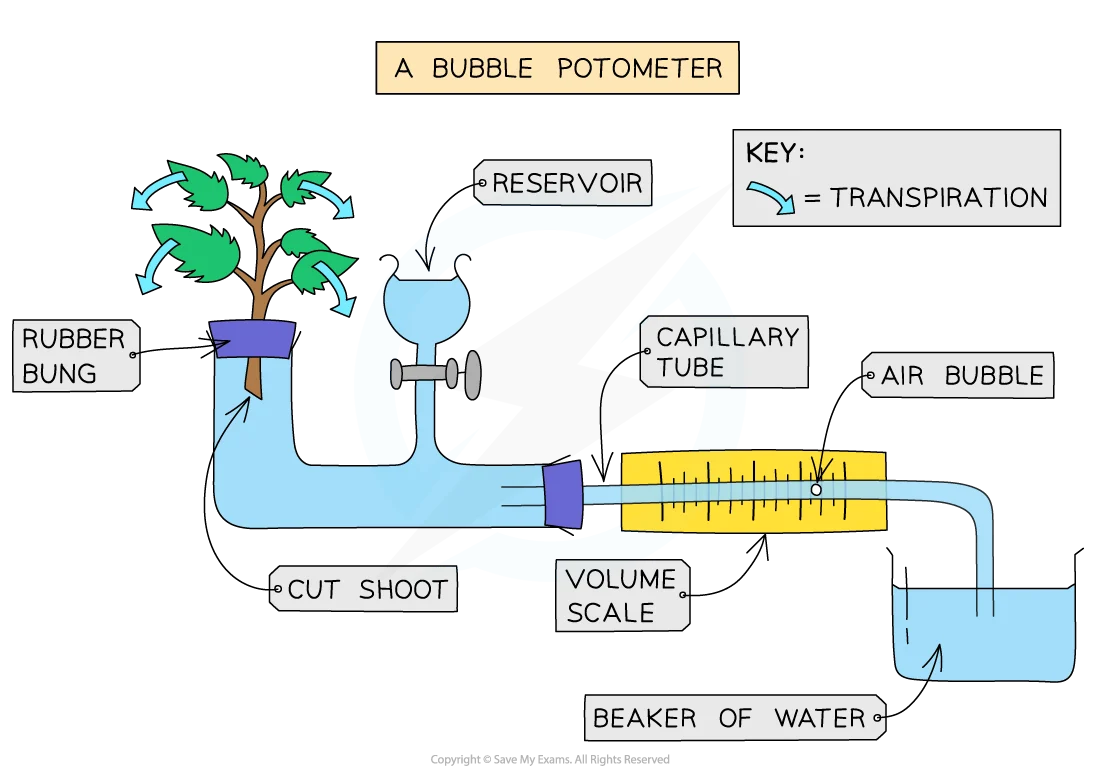
What can be used to estimate transpiration rate? how?
A potometer. you can estimate the rate of transpiration by measuring the uptake of water by a plant - this is because you can assume that water uptake by the plant is directly related to water loss by the leaves (transpiration)
You should set up the apparatus, then record the starting position of the air bubble. next start a stopwatch and record the distance moved by the bubble per unit time, e.g. per hour. keep the conditions constant throughout the experiment, e.g. the temperature & air humidity
How are guard cells adapted to open and close the stomata?
They have a kidney shape which opens and closes the stomata in a leaf.
when a plant has lots of water the guard cells fill with it and go plump & turgid - this makes the stomata open so gases can be exchanged for photosynthesis.
when a plant is short of water, the guard cells lose water and become flaccid, making the stomata close - this helps stop too much water vapour escaping.
Thin outer walls and thickened inner walls make the opening & closing work.
They’re also sensitive to light and close at night to save water without losing out on photosynthesis.
You usually find more stomata on the undersides of leaves than on the top; the lower surface is shaded & cooler, so less water is lost through the stomata than if they were on the upper surface.
Guard cells are therefore adapted for gas exchange and controlling water loss within a leaf.
What forms a plant organ system for transport of substances around the plant?
Roots, stems, & leaves
What are root hair cells adapted for?
The efficient uptake of water by osmosis, and mineral ions by active transport
How is the structure of root hair cells adapted to their function?
Root hair cells are cells on the surface of plant roots, which grow into long ‘hairs’ that stick out into the soil; this gives the plant a big surface area for absorbing water & mineral ions from the soil as each branch of a root will be covered in millions of these microscopic hairs. plants need these mineral ions for healthy growth.
Why can’t root hair cells use diffusion to take up minerals from the soil?
The concentration of minerals is usually higher in the root hair cells than in the soil around them
How do root hair cells take in minerals?
Through active transport. it allows the plant to absorb minerals from a very dilute solution, against a concentration gradient - this is essential for its growth, but active transport needs energy from respiration to make it work
How is the structure of phloem & xylem cells adapted to their function?
Phloem & xylem cells form phloem & xylem tubes, which transport substances such as food & water around plants
To form the tubes, the cells are long and joined end to tend
Xylem cells are hollow in the centre, and phloem cells have very few subcellular structures, so that stuff can flow through them
What is the role of stomata and guard cells?
To control gas exchange and water loss
What is the movement of food molecules through phloem tissue called?
Translocation

