PAM Assessment revision flashcards
 Call Kai
 Learn
Learn Practice Test
 Spaced Repetition
 Match
Match Flashcards
 Knowt Play
1/597

Earn XP
Description and Tags
Flashcards information based around each ILO, the feedstuffs practical & some breeds from each of the domestic species that we must know (apparently).
Name | Mastery | Learn | Test | Matching | Spaced | Call with Kai |
|---|
No analytics yet
Send a link to your students to track their progress
598 Terms
Name some human-animal interactions.
Companionship
Products e.g. food & clothing
Sports & entertainment
Service e.g. guide dogs, hearing dogs, guard dogs, as transport
Research & education
Conservation
Why do people keep pets?
Companionship
Nurturance (opportunity to give care)
Neoteny (look like babies)
Fashion/status
Collection
(Hoarding)
What are the top 5 most common species of pet in the UK (excluding fish)?
Dogs
Cats
Indoor birds
Domestic fowl
Rabbits
*NB - 6. tortoises & turtles
horses & ponies
Guinea pigs
Hamsters
Snakes
What is domestication?
When wild animals become adapted to humans and the captive environment over many generations.
What are the key features that a species needs in order to become domesticated?
Diverse diets (non-specialised food requirements)
Non-migratory lifestyle
Suitable reproductive pattern
Tolerance of humans
Ability to adapt to a wide range of environments
What are the five welfare needs mentioned in the UK Animal Welfare Act 2006?
Suitable environment
Suitable diet
Able to exhibit normal behaviour patterns
Housed with or apart from other animals
Protected from pain, suffering, injury & disease
What is the thermoneutral zone (TNZ)?
The range of environmental temperatures over which an animal’s metabolic rate is constant, at a minimum & independent of the environmental temperature.
How should non-ruminants be housed, accounting for optimum temperature requirements?
Non-ruminants have a narrow TNZ therefore they should be housed under controlled temperature conditions.
How should ruminants be housed, accounting for optimum temperature requirements?
Ruminants have a wide TNZ so they should be housed according to the climate.
What changes in general body functions typically indicate an animal is in pain?
reduced food intake
decreased production
lameness
physiological responses like an accelerated heart rate
What factors should be controlled to ensure good air hygiene?
Stocking density
Ventilation
What is biosecurity?
The set of precautions taken to minimise the risk of introducing and spreading an infectious disease within an animal population.
Prevents introduction of disease (external biosecurity) & helps control their spread within a unit (internal biosecurity)
How do pathogens get onto animal units?
Airbourne
Rodents, birds, flies
Transport systems
Any external people, e.g. vets, stock people
Equipment & bedding
Feed & water
What is bio-exclusion?
The prevention of disease from entering the unit
Involves ensuring animals are healthy before being brought to the unit.
How do you ensure that new animals do not spread the disease to existing animals on the unit?
Veterinary examination upon arrival
Quarantines for a period exceeding the maximum incubation period for a disease
The quarantine period must contain regular monitoring
What is the difference between a vector & a fomite?
Vector = living carrier of disease e.g. people, rats, wild birds
Fomite = non-living carrier of disease e.g. boots, clothing, tyres, equipment
What is bio-containment and how is it carried out?
Prevention of disease spreading through a unit
Done through separation of healthy and diseased animals and different ages/classes of animal
All-in-all-out cleaning utilised
Accommodation should limit contact between animal groups, including sharing the same air space & flow of manure
What is veterinary public health?
The contribution of an understanding & application of veterinary science to the mental, physical & social well-being of humans.
Which global companies regulate veterinary public health?
World Health Organisation
World Organisation for Animal Health
Food & Agriculture office of the United Nations
What are the general veterinary public health aims?
Eradicate diseases
Live with diseases but at the acceptable level
Prevent the introduction of new diseases
What are some of the roles performed by vets that contribute to public health?
Treating sick animals
Collecting/analysing samples
Inspecting
Negotiating
Teaching/communication
Trade
Surveillance
What is a zoonotic disease?
Any disease or infection that can be transmitted naturally between vertebrate animals and humans.
*NB - can be species specific or group specific (food producing animals, wild animals, companion animals).
What are some routes of infection of zoonotic diseases?
Ingestion
Inhalation
Across mucous membranes
Via cuts/abrasion
Injection
Transplantation
What are some food borne diseases from farm animals and poultry?
Campylobacter
Salmonella
STEC (Shiga Toxin producing E.coli)
What are some notifiable zoonotic diseases between farm animals & poultry?
Anthrax
Bovine tuberculosis
Brucellosis
BSE
Avian influenza
What are some general zoonotic diseases for farm animals and poultry that can spread to humans?
Leptospirosis
Cryptosporidiosis
Pox viruses
Ringworm
Q-fever
Enzootic abortion of ewes
Toxoplasmosis
Erysipelas
Streptococcus suis
What types of disease can anthrax cause?
Pulmonary
Gastrointestinal
Cutaneous
*NB - all are fatal, cutaneous fatal if left untreated. Registers as sudden death in cattle. Spores can stay in the ground for decades.
How can bovine tuberculosis be caught?
From milk/meat
*NB - can be caught from other species that are not cows, e.g. cats too
How should you protect yourself from pseudocowpox if you are working with cows?
Wear appropriate PPE, e.g. gloves
*NB - not fatal but painful nodules on hands
What is orf and from what species is it caught?
Scabby lesions all over the body.
Can be caught from sheep & handling animals’ mouths
What is erysipelas?
A bacterial disease that is caught from pigs
In pigs it manifests as acute septicemia with arthritis & classic diamond shaped dermatitis
In humans it forms painful circular lesions on the hand
*NB - responds well to penicilin
What animals get ringworm?
Disease of all mammals
Fungal infection caused by Microsporum spp & Trychophiton spp
Usually self-resolving but anti-fungal agents are often used
What types of zoonoses are dogs & cats at risk of?
Food-borne pathogens such as campylobacter, salmonella & cryptosporidium
Parasites like toxocara, tapeworm, mange mites, fleas and cats can get toxoplasma
Other diseases due to bites/injury/infection (e.g. rabies), leptospirosis, ringworm, cowpox
What is toxocara canis and who does it usually affect?
Dog roundworm
Symptoms include fever and affects eyesight (usually in one eye) but is treatable
What is a common isolate in dog attacks?
Pasteurella spp.
Capnocytophaga canimorsus - can progress to renal faliure and very significant in the immunosuppressed
What causes cat scratch fever and what are the usual symptoms?
Bartonella henselae carried in the blood or saliva of cats
Symptoms are infected lesions with swelling of local glands & conjunctivitis
*NB - 38% of cats may carry the infection
What were the top 3 most expensive food-borne pathogens in the UK in 2011?
Campylobacter
Norovirus
Listeria monocytogenes
What is the role of the veterinary surgeon in animal welfare?
Provide clients with information as to the best course of action for their pets.
In order to do this, the state of suffering of the animal has to be assessed.
Poor welfare often causes poor health
What is the definition of ‘health status’ of an animal?
The state of an animal regarding it’s ability to cope with pathology.
What is pathology?
The detrimental derangement of molecules, cells and functions (including behaviour) in a living organism in response to injury or deprivations.
What is the link between poor welfare and poor health?
Poor welfare creates poor health due to a weakened immune system because of the stress response
Poor health causes poor welfare because it makes the animal feel sad :(
What are the roles of vets in legal enforcement of animal welfare?
State veterinary service
Official veterinarians (OVS)
Named veterinary surgeon (NVS)
Approved RCVS inspector
Expert witness
What is welfare?
The state of an animal with regard to it’s ability to cope with its environment
What are the Farm Animal Welfare Committee’s (FAWCs) 5 freedoms?
Freedom from hunger or thirst (access to water & a diet that maintains vigor)
Freedom from discomfort (appropriate environment)
Freedom from pain, injury & disease (prevention/rapid diagnosis & treatment)
Freedom to express normal behaviour (sufficient space, facilities & appropriate company)
Freedom from fear/distress (conditions & treatment avoid mental suffering)
What is telos and how does this link to animal welfare?
Telos = the set of needs specific to that animal due to their evolutionary characteristics/behaviours
Can help with welfare as it acknowledges that not all animals respond to pain in the same way we do (critical anthropomorphism) and so understanding animals and their environment can help us treat them
How do we determine what an animal’s needs are?
Ethological studies using observation of its biological habits (telos)
Preference choice test
Aversion tests
Strength of preference/motivation tests
Deprivation tests
What is a stressor & what are some examples?
A stimulus that exceeds its normal limits in terms of intensity/duration.
e.g. physical change to the body, like thirst; psychological, fear; behavioural; disease
What is stress & how does it lead to a stress response?
The response of an animal to a stressor as it tries to adapt to maintain its homeostasis
Cumulative response of an animal interacting with its environment via its receptors
Leads to a stress response because the animal engages in behavioural/physiological changes in order to restore mental & body stability
How can you tell when an animal is stressed?
Anatomical signs of pathology (e.g. chickens plucking feathers)
Physiological state for signs of stress
Normal or abnormal behaviour
What are some adaptive mechanisms for stress?
behavioural responses
autonomic nervous system responses
neuro-endocrine response
immune response
What should you look for physiologically & anatomically to measure the welfare of an animal?
Physiological indicators of pleasure
Are normal physiological processes & anatomical developments possible?
Whether the animal is demonstrating physiological attempts to cope
To what extent the animal is undergoing suppression of the immune system
Extent of disease & damage to body
To what extent the circumstances are reducing its ability to grow & reproduce
What should you look for behaviourally to measure the welfare of an animal?
Indicators of pleasure
To what extent strongly preferred behaviours are shown
To what extent there are a wide range of normal behaviours performed
To what extent are coping behaviours shown
To what extent aversive behaviours are shown
To what extent behavioural pathologies are demonstrated
How could you tell if an animal is releasing adrenaline & cortisol?
Pupil dilation & increased heart rate (e.g. fight or flight response activated)
Mobilisation of nutritional factors through gluconeogenesis, lipolysis & protein breakdown
What is classed as abnormal behaviour?
Behaviour that differs in pattern, frequency and context from that shown by the majority of the species, in conditions that allow a range of behaviour.
What does ethics mean?
A critical enquiry into our ideas regarding moral & right conduct
(essentially what society thinks is right/wrong conduct: provides an external scientific view as to what is right & wrong that is not about personal preferences - provides an objective framework.)
What are the three main ethical theories?
Virtue ethics
Deontology (rights) ethics
Utilitarianism
What are the main principles of virtue ethics?
Focuses on whether the motivation of the actor would be perceived by society as exhibiting morally appropriate behaviour.
About whether underlying character that leads to behaviour is virtuous or vicious
Where is virtue ethics used in relation to animals and veterinary surgeons in the animal welfare act 2006 & veterinary surgeons act 1966?
Animal welfare act 2006 - “whether the conduct concerned was in all the circumstances that of a reasonably competent and humane person”
Veterinary surgeons act 1966 - “any such person is judged by the disciplinary committee to have been guilty of disgraceful conduct in any professional respect”.
What are the main principles of deontology?
A set of rules that should always be followed no matter the scenario/outcome, e.g. killing is wrong, so it must never be done.
This is does not take into account intention, e.g. euthanasia cases
Where is deontological language used in relation to animals and veterinary surgeons in the animal welfare act 2006?
(a) an act of his, or a failure of his to act, causes an animal to suffer
(b) he knew, or ought reasonably to have known, that the act, or failure to act, would have that effect or be likely to do so.
What are rights?
A moral claim that cannot be overridden by claims to utility.
What is utilitarianism?
What is morally correct is centered on the consequences of an action, which may be unpredictable.
*NB - there is also negative utilitarianism too, which concentrates on reducing harm rather than pleasure
What is contractarianism?
There is a social contract where the societal norms follows the idea of a mutual agreement
How does contractarianism apply to veterinary surgeons in the veterinary surgeon act 1966?
“Subject to the following provisions of this section, no individual shall practise, or hold himself out as practising or as being prepared to practise, veterinary surgery unless he is registered in the register of veterinary surgeons or the supplementary veterinary register”
What is moral anthropocentrism?
Humans are at the centre of an decision, with animals considered subordinate to human well-being
Animals have no intrinsic moral value/worth
What are animal rights?
Animals have certain moral rights that cannot be usurped for human gain, e.g. animal research is fine in the utilitarian view but not in the strong animal rights view
What is the strong animal rights position?
Animals have the same moral rights as humans, providing they meet the criteria for personhood.
What is the weak animal rights view?
The rights of humans are more important that the rights of animals who are sentient.
i.e. humans are more sentient so can subvert animal rights on occasion
What is the animal welfare perspective?
Humans may use animals so long as any suffering that they cause is not unnecessary.
Forms the basis of much animal welfare protection legislation
What is rule utilitarianism?
An action is right if it leads to the greater good.
What is utility-ism?
Varying levels of concern about animals from the same species depending on the extent to which people use them, e.g. rabbits as farm animals, research, pets etc.
What are the 3 criteria suggested by the farm animal welfare council about coming to an ethical conclusion about animal welfare?
The arguments that lead to the conclusion are supported by fact, scientific deductions & reason
Arguments are conducted within a well-established framework
Degree of consensus arises from a debate/discussion
What are the 3Rs?
Replace - use alternative techniques to prevent the use of live animals altogether
Reduce - use less animals to obtain the same information or more information from the same number of animals.
Refine - improve the experimental method so that animals suffer as little as possible, e.g. improve housing, use painless procedures etc.
What are the Banner principles?
Harms of a certain degree should never be inflicted
Any harm caused to an animal must be justified and feasibly outweighed by the good that comes of it. This harm must be minimised as much as possible.
What are the four principles in principle-ism?
The right to choose (autonomy)
Doing good (beneficence)
Not doing harm (non-maleficence)
Justice
(scope - the social & economic situation the animal finds itself in)
What are the factors that affect the breakdown & use of nutrients?
Digestibility of the diet
Anatomical differences in the GI tracts between species
Health of the GI tract, e.g. parasites or inflammation
Husbandry of the animal
Interactions of nutrients with each other, e.g. in the cat, more K is needed with more protein.
What is the difference between balanced, complementary & complete feed?
Balanced - provides the vitamins and minerals needed
Complementary - does not provide all the vitamins & minerals
Complete - provide everything that an animal needs
*NB - balanced & complementary often used for horses as they need forage for their diet to be complete
What are additives?
What is added into the product only
usually accounts for functional, active ingredients or added vitamins & minerals
What is the nMER and how is it calculated for dogs & cats?
Energy requirement of a mild to moderately active adult animal in a thermoneutral environment
nMER dog = 110 x (BW^0.75) kcal per day
nMER cat = 75 x BW kcal per day
What factors need to be taken into account when deciding on the energy requirements of an animal?
Current body condition score
Metabolic needs
Activity level
Health status
Age
What vitamin can be synthesised in the hindgut in a horse & in ruminants?
B vitamins
What are the water & fat soluble vitamins?
Water soluble: B & C
Fat soluble: A, D, E, K
From what do herbivores derive their energy?
Cellulose
Little dietary glucose
Ruminants: post-prandial gluconeogenesis by flora in the rumen
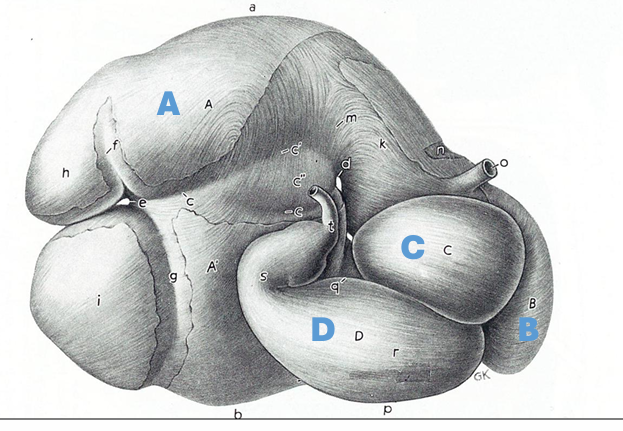
Name the compartments of the ruminant stomach.
A: rumen
B: reticulum
C: omasum
D: abomasum
What are the functions of the components of the ruminant stomach?
Rumen & reticulum - microbial fermentation, bacteria degrade fat, cellulose, protein & make B & K vitamins
Abomasum - glandular stomach
Ingested nutrients metabolised by the flora in the rumen then presented to the digestive tract
glucose absorption is minimal
What are the conditions in the rumen?
pH: 5.5 - 7.0
temperature: 39 - 41 oC
anaerobic conditions
ammonia is for growth
What molecules fed to ruminants can they use for gluconeogenesis?
propionate
amino acids
lactate
glycerol
How is ruminant insulin different from human/dog insulin?
less effect on the liver & inhibition of gluconeogenesis
release is stimulated by short chain fatty acids
What are the disadvantages of feeding propionate to ruminants?
inhibits the rumen flora that produce propionate
depresses appetite and is unpalatable
How is lactic acidosis caused in cows?
Fed high grain rations
D form of lactic acid accumulates in the rumen
rumen pH falls, inhibiting other flora and causing inflammation of the rumen wall
How is lipid metabolised in ruminents?
Dietary lipids are metabolised in the rumen
Little uptake in the SI as none present
Most fatty acid and triglyceride synthesis occurs in the mammary glands & adipose tissue
Nature of ruminant adipose tissue not dictated by dietary fat as much as us
very little FA oxidation & synthesis in the liver
What are escape proteins?
Proteins that pass through to the small intestine undegraded
Microbes in the rumen can use non-protein sources of nitrogen like dietary ammonia, which is cheaper than protein sources
What is the relationship between the rumen and ammonia?
Ammonia is essential for microbial growth, but too much ammonia absorbed across the rumen wall is toxic to the host
What does increasing the quantity/quality of rumen undegraded protein do?
Increases wool/body/milk production
*NB - but too much excess protein increases levels of nitrogenous waste in the environment
What are the metabolic demands of the dairy cow?
Mammary glands use 85% of the total glucose use at peak lactation
Glucose is synthesised all from gluconeogenesis
Starts at parturition and rises quickly
How is milk synthesised?
lipid synthesis commences before lactation
lactose & protein synthesis commence at parturition and are linked
How is ketosis caused in the dairy cow?
Insufficient glucose supply in early lactation
Mobilisation of body fat → glycerol for gluconeogenesis
FAs diverted to liver → storage or ketone body formation
What are 2 important differences between the brain & liver in ruminants compared to the other domestic species?
Liver cannot oxidise fatty acids & brain cannot use ketones for energy
What happens if the feed intake does not reach energy demand in the dairy cow?
Insufficient production of propionic acid (glucose precursor) in the rumen
not enough glucose
metabolism of fatty acid & glycerol stores —→ acetyl-CoA
Excess of acetyl-CoA converted to ketone bodies
Ketone bodies accumulate in milk and urine due to ketosis
What is the equine equivalent of bovine ketosis?
Hyperlipidemia
(high lipid content in the blood rather than ketones)
*NB - also affects cats

