9. Case Examples and Neurolocalizing Outside the Brain
 Studied by 0 people
 Call Kai
 Learn
Learn Practice Test
 Spaced Repetition
 Match
Match Flashcards
 Knowt Play
1/36

Earn XP
Description and Tags
1/16/2026; Dr. Sullivan
Name | Mastery | Learn | Test | Matching | Spaced | Call with Kai |
|---|
No analytics yet
Send a link to your students to track their progress
37 Terms
Localize the lesion:
12 yr MN Wire Dachshund: Trouble eating
mentation: dull
tetraparesis & ataxia x4
postural reaction deficits x4
decreased gas reflex
(go through each bullet point and localize, then establish the overall lesion localization)
mentation: dull = forebrain or brainstem
tetraparesis & ataxia x4 = brainstem or spinal cord
postural reaction deficits x4 = forebrain, brainstem, spinal cord
decreased gas reflex = brainstem
overall = brainstem
Localize the lesion:
6 yr FS Frenchie: Right head tilt
circling to R, Ataxia
R head tilt
Nystagmus, fp to L
(go through each bullet point and localize, then establish the overall lesion localization)
circling to R, Ataxia = forebrain or vestibular
R head tilt = R vestibular- central or peripheral
Nystagmus, fp to L = R vestibular - central or peripheral
overall = Right Vestibular (not enough to know central or peripheral)
Localize the lesion:
2 yr Siamese Cat: Head pressing
head pressing
without even examining the cat, where is this neurolocalization?
head pressing = forebrain
overall = forebrain
The spinal cord is a conduit for:
Descending _____ (sensory/motor) information
Ascending ______ (sensory/motor) information
motor; sensory
describe the clinical presentation of the bladder with a patient with UMN signs
-this is commonly seen with lesions located where?
increased tone, difficult to express (seen with lesions cranial to L4)
describe the clinical presentation of the bladder with a patient with LMN signs
-this is commonly seen with lesions located where?
decreased tone, dribbling urine, easy to express (seen with lesions caudal to L3)
describe the response seen in a reflex arc
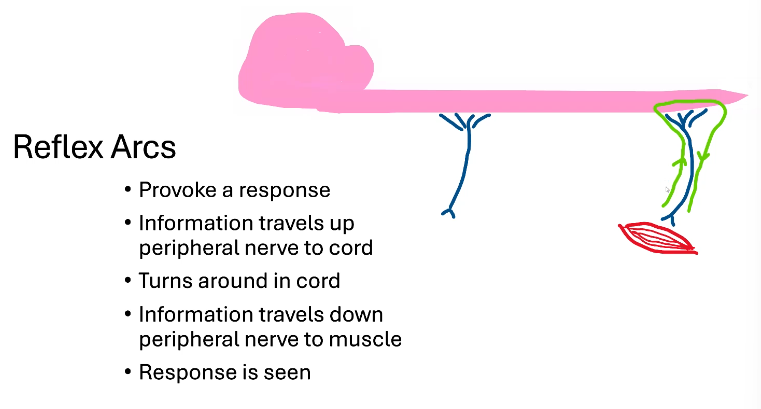
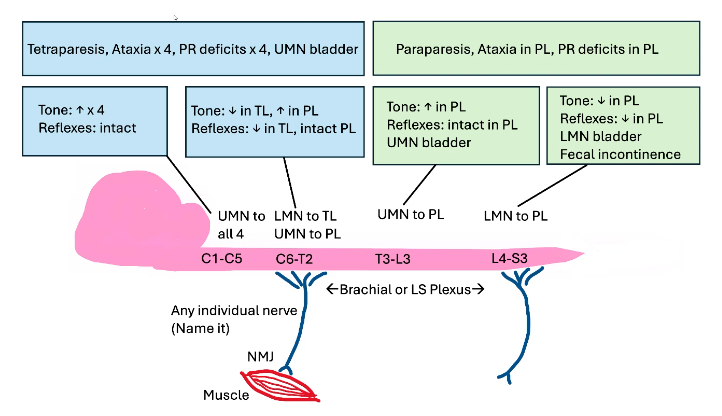
just read this one good time
ok
what type of signs (UMN/LMN) would you expect to see with a lesion in the C1-C5 region
Upper motor neuron (UMN) signs, such as increased tone and hyperreflexia (reflexes would be intact)
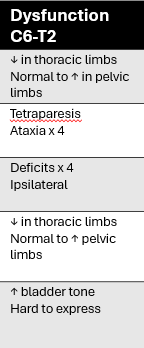
what type of signs (UMN/LMN) would you expect to see with a lesion in the C6-T2 region?
LMN in thoracic limbs (decreased tone, decreased reflexes)
UMN in pelvic limbs (increased tone, intact reflexes)
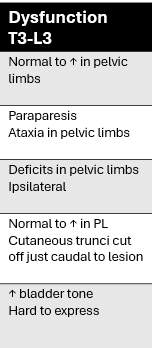
what type of signs (UMN/LMN) would you expect to see with a lesion in the T3-L3 region?
UMN in pelvic limbs (increased tone in PL, intact reflexes in PL, UMN bladder)
what type of signs (UMN/LMN) would you expect to see with a lesion in the L4-S3 region?
LMN to PL (decreased tone in PL, decreased reflexes in PL, LMN bladder, fecal incontinence)
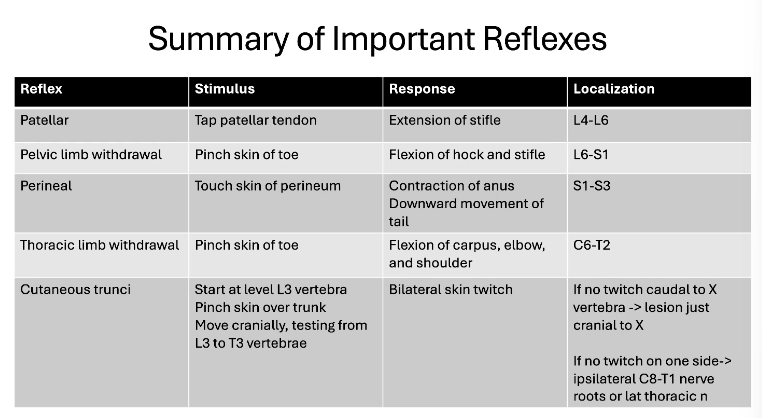
just read this!!
ok
Reflex: Patellar
Stimulus: Tap patella tendon
Response: Extension of stifle
Localization: lack of patellar reflex localizes specifically to ______
lack of patellar reflex localizes specifically to L4-L6
Reflex: Pelvic limb withdrawal
Stimulus: Pinch skin of toe
Response: Flexion of hock and stifle
Localization: lack of pelvic limb withdrawal localizes specifically to ________
L6-S1
Reflex: Perineal
Stimulus: Touch skin of perineum
Response: Contraction of anus, downward movement of tail
Localization: Lack of a perineal reflex localized specifically to ________
S1-S3
Reflex: Thoracic limb withdrawal
Stimulus: Pinch skin of toe
Response: Flexion of carpus, elbow, and shoulder
Localization: Lack of a thoracic limb withdrawal localizes specifically to _____
C6-T2
Reflex: Cutaneous trunci
Stimulus: Start at level L3 vertebra, pinch skin over trunk, move cranially, testing from L3-T3
Response: bilateral skin twitch
Localization: Lack of a cutaneous trunci reflex localizes to _____
if no twitch caudal to “X” vertebra = lesion just cranial to “X”
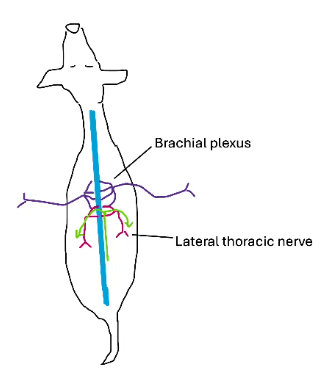
if no twitch on one side ipsilateral C8-T1 nerve roots or lateral thoracic nerve.
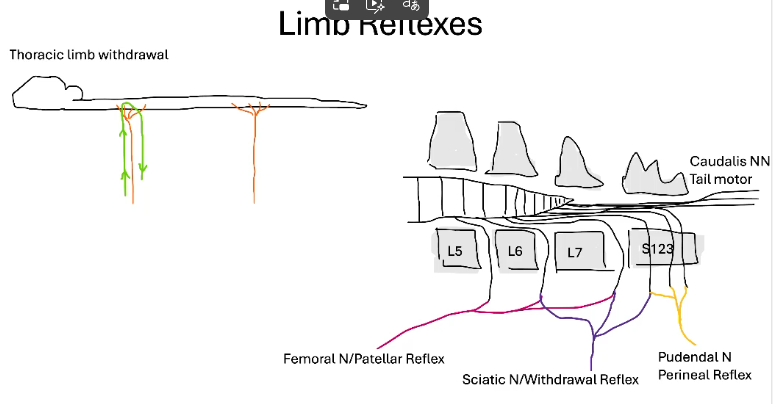
look over this, but do not expect this to be tested
can the cutaneous trunci reflex be used to localize to the brachial plexus?
yes!
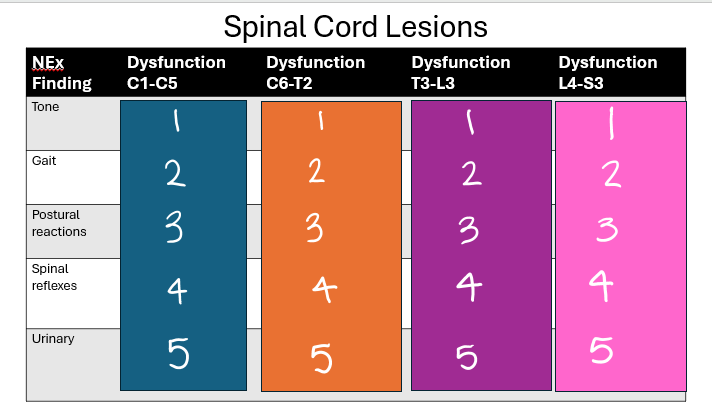
Dark Blue
-fill in the findings #1-5
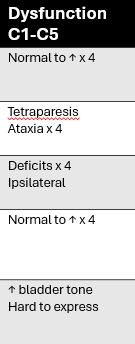
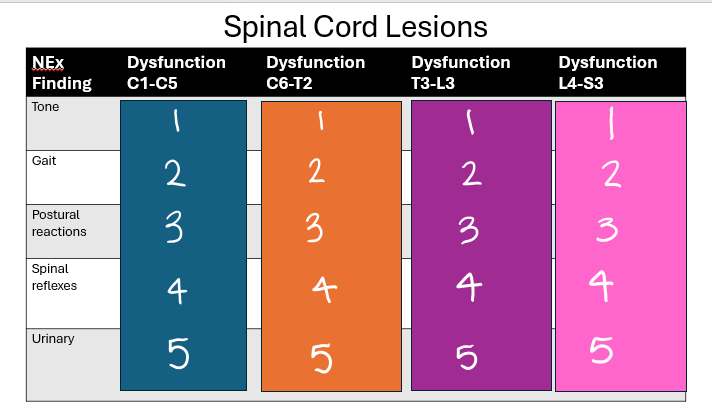
Orange
-fill in the findings #1-5
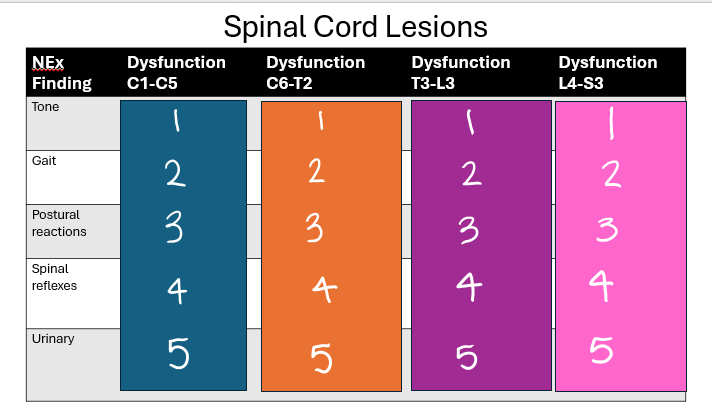
Purple
-fill in the findings #1-5
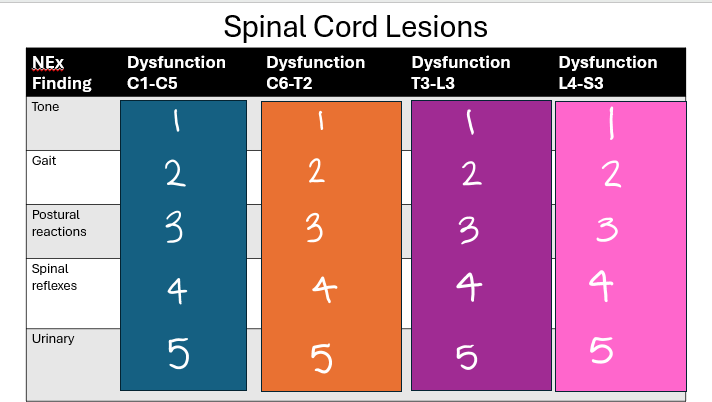
Pink
-fill in the findings #1-5
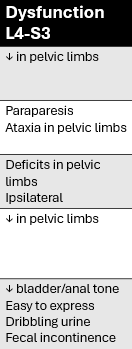
Localize the lesion:
3 yr MN Hound Mix: Can’t walk in hind limbs
Nonambulatory paraparesis
Postural reaction deficits in PL
Normal spinal reflexes
(go through each bullet point and localize, then establish the overall lesion localization)
Nonambulatory paraparesis = T3-L3 or L4-S3
Postural reaction deficits in PL = T3-L3 or L4-S3
Normal spinal reflexes = T3-L3
-overall localization = T3-L3 spinal cord segments
Localize the lesion:
7 yr FS DSH: Dragging R hind leg
Paraparesis, worse R
Postural reaction deficits R
Decreased withdrawal reflex R pelvic limb
(go through each bullet point and localize, then establish the overall lesion localization)
Paraparesis, worse R = Right T3-L3 or L4-S3
Postural reaction deficits R = Right T3-L3 or L4-S3
Decreased withdrawal reflex R pelvic limb = Right L4-S3
-overall localization = Right L4-S3 spinal cord segments
Localize the lesion:
10 yr MI Terrier Mix: Unable to walk
Tetraparesis
Postural reaction deficits x4, worse on Right
Decreased withdrawals in thoracic limbs
(go through each bullet point and localize, then establish the overall lesion localization)
Tetraparesis = Forebrain, brainstem, C1-C5, C6-T2
Postural reaction deficits x4, worse on Right = L forebrain, R brainstem, R C1-C5 or C6-T2
Decreased withdrawals in thoracic limbs = C6-T2 spinal cord segments
-overall localization = C6-T2 spinal cord segments
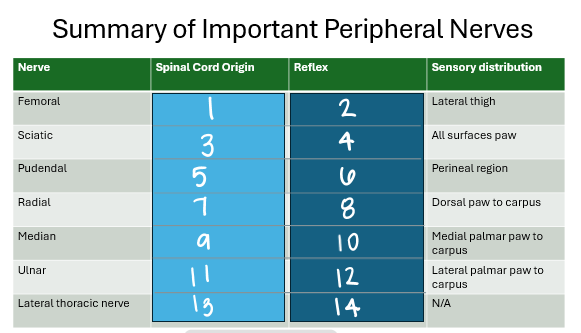
ID: 1 & 2
L4-L6
Patellar
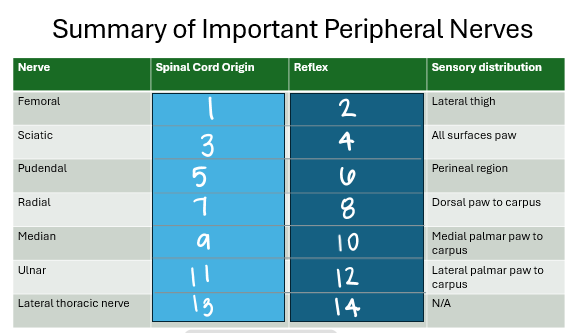
ID: 3 & 4
L6-S1
Withdrawal
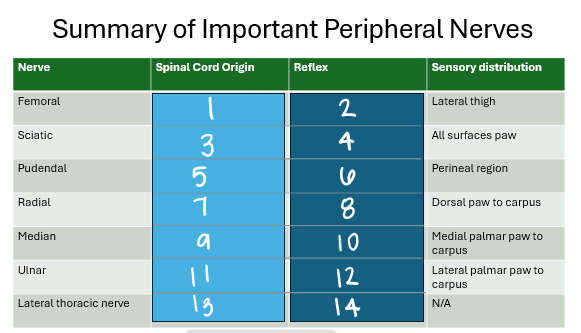
ID: 5 & 6
S1-3
Perineal
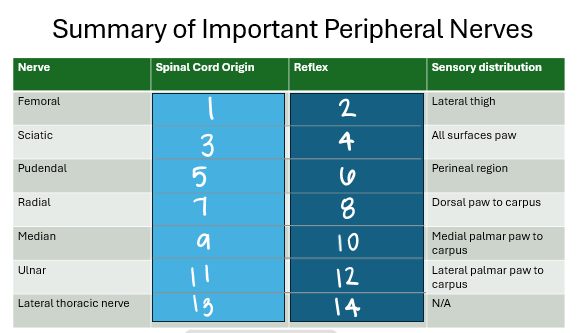
ID: 7 & 8
C6-T2
Withdrawal
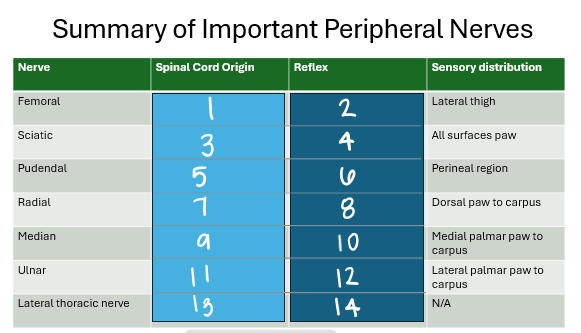
ID: 9 & 10
C8-T2
Withdrawal
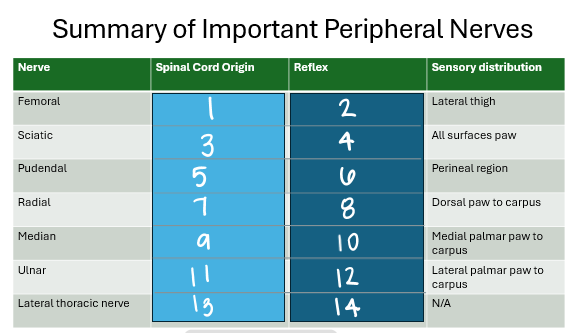
ID: 11 & 12
C8-T2
Withdrawal
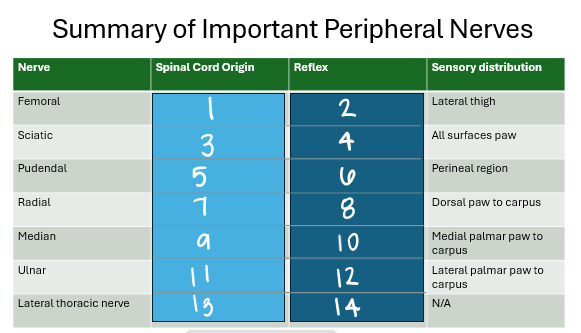
ID: 13 & 14
C8-T2
Cutaneous Trunci
Localize the lesion:
9 yr FS Shep Mix: Dragging L Front leg
L thoracic limb monoparesis
Decreased withdrawal
Absent cutaneous trunci reflex L
(go through each bullet point and localize, then establish the overall lesion localization)
L thoracic limb monoparesis = L brachial plexus or peripheral N
Decreased withdrawal = L C6-T2, brachial plexus or peripheral N
Absent cutaneous trunci reflex L = L C8-T1 nerve roots or lateral thoracic N
-Overall localization = L brachial plexus
Localize the lesion:
5 yr FS Lab: Collapsing in Hind Legs
Collapses in pelvic limbs with exercise
Normal gait and NEx when rested
(go through each bullet point and localize, then establish the overall lesion localization)
Collapses in pelvic limbs with exercise = NMJ
Normal gait and NEx when rested = NMJ
-overall = NMJ
Localize the lesion:
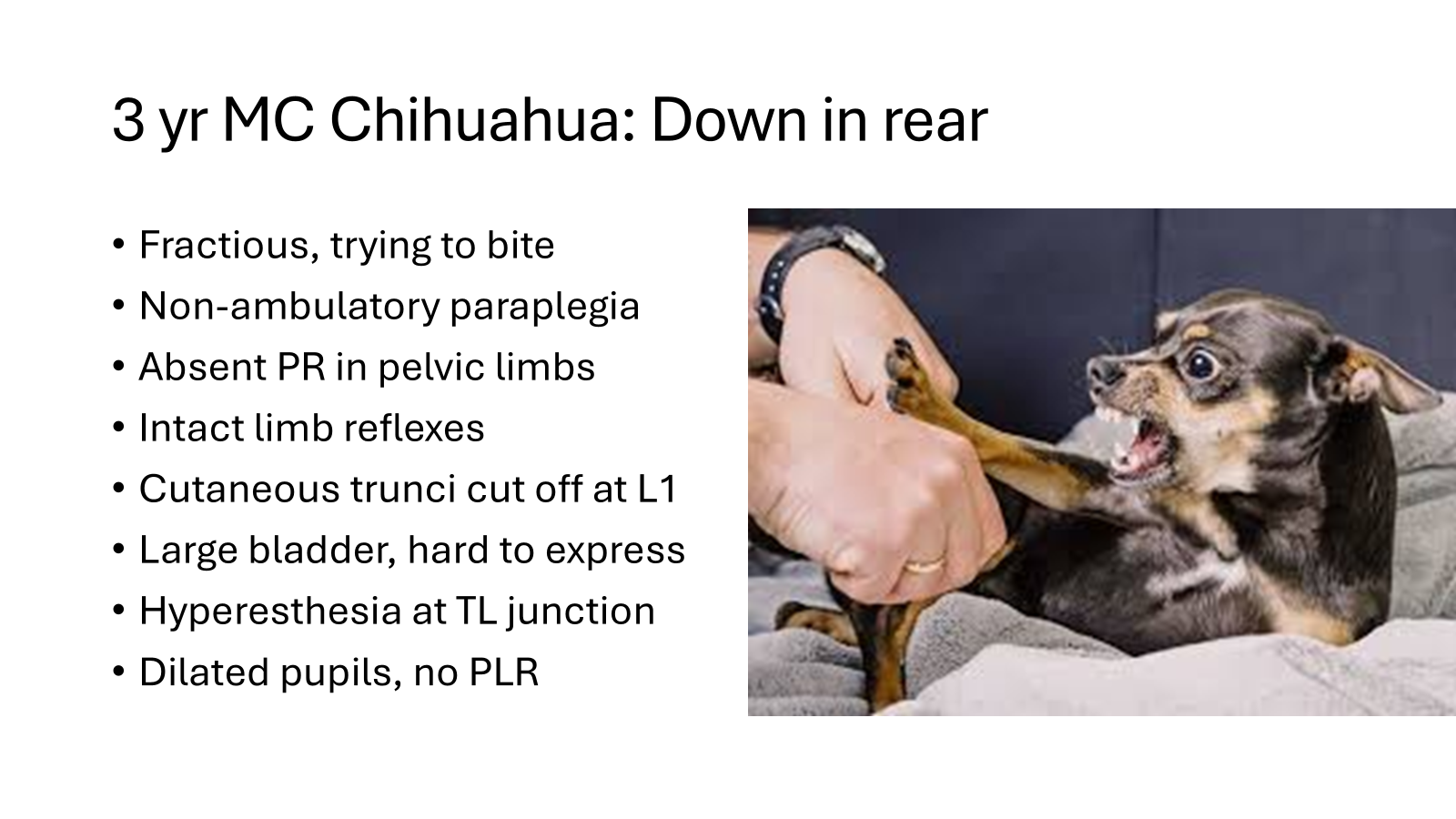
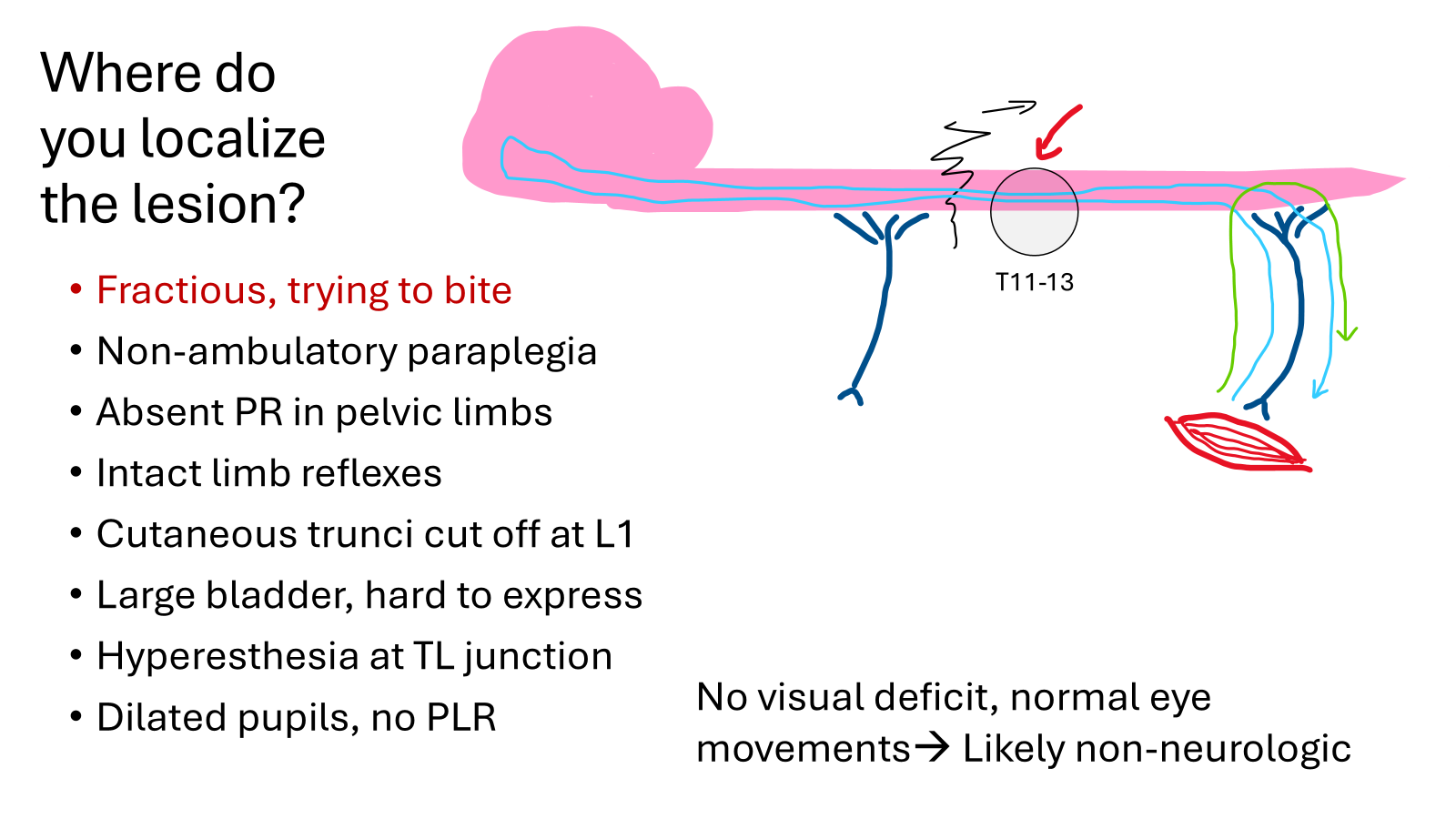
 Note
Note  Flashcards (56)