insight-related cognition in animals
 Studied by 0 people
 Call with Kai
 Learn
Learn Practice Test
 Spaced Repetition
 Match
Match Flashcards
 Knowt Play
1/36

There's no tags or description
Looks like no tags are added yet.
Name | Mastery | Learn | Test | Matching | Spaced | Call with Kai |
|---|
No analytics yet
Send a link to your students to track their progress
37 Terms
in what two ways can animal models of impaired cognition be beneficial
clinical relevance → assessing similarities/differences in brain structure + how they result in certain conditions
treatment development → animals with same condition can be tested in order to treat resulting behaviours in humans
what is cognitive flexibility
the ability to perform a wide range of behaviours/tasks and select them flexibly according to what different contexts require → the ability to adapt
allow us to shift focus/attention + update rules/systems of what they are doing quickly, while maintaining old info
which task can be used to test cognitive flexibility + what does impairment suggest
Wisconsin Card Sorting Task → requires understanding of when a rule has changed + reasoning of what behaviour is needed to adapt to new situation
impairment in task performance may be due to damage to PFC
how did Veit et al. (2014) measure cognitive flexibility in crows + what were the two conditions
performed delayed match-to-sample task (similar to WM one), but a visual or auditory cue was used between after sample was shown + an initial delay → this indicates what the crow must do with the held information. either:
trial type 1 (delayed non-match-to-sample) → had to pick stimulus that was not present during sample on a high pitch or red circle
trial type 2 (delayed match-to-sample) → pick stimulus that was present during sample on low pitch or blue circle
inserted single electrode recordings into NCL to track differences in neuronal response rate
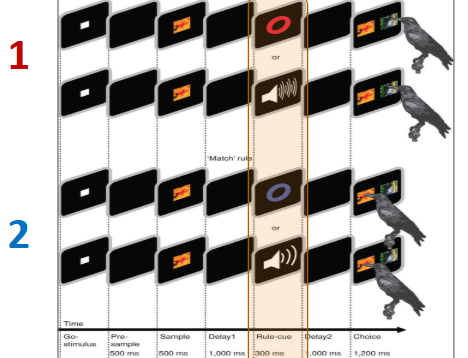
what made Veit et al. (2014)’s study of cognitive flexibility more methodologically sound
there was no reward, so no neural interference from reward anticipation
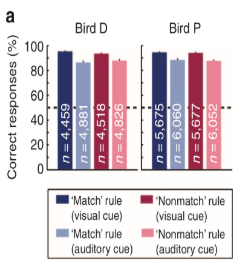
what did Veit et al. (2014) find in terms of differences in firing rate
overall, crows performed very well on the task (+ slightly better at assessing visual cues) → we can conclude this was not a conditioned response due to:
high firing rate found for non-match rules trial(1) in both auditory + visual cues
lower firing rate found for match rules trial (2) in both auditory + visual cues
shows not only that they are attending to rules (rather than identifying different types of stimuli), but firing rate at non-match higher due to selecting one you didn’t see = more cognitively demanding
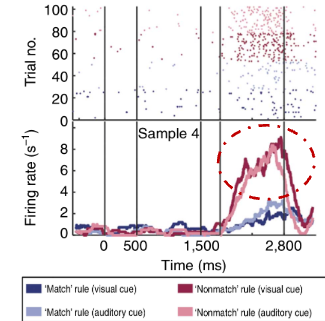
what do Veit et al. (2014)’s results imply about avian cognition
they found response to abstract rules on a single-cell level in the NCL → supports evidence for NCL as a functional analogue to the PFC, and gives evidence for cognitive flexibility in birds
how did Zhang et al. (2005) assess cognitive flexibility in bees
used tunnel method with two possible visual samples that could be correct (separated by 50cm - which one is correct differs depending on trial), then has to go through the correct tunnel to receive reward
learning test tests ability to follow rules + whether rules can be generalised to other tasks
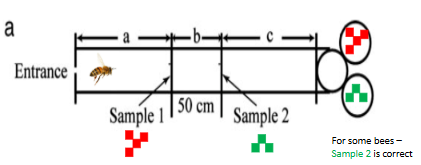
what did Zhang et al. (2005) find + could these be generalised/how
results of learning tests showed bees can learn the rule + perform well on trained stimuli → sample 2 = slightly worse than 1, but still better than chance rate
tested generalisability (means not just conditioning) through transfer tests, which introduced novel patterns + meaning they have to follow specific order of presentation
found bees performed above-chance levels, indicating they can generalise to more abstract tasks
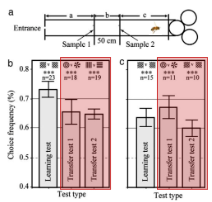
what do Zhang et al. (2005)’s results imply about cognitive flexibility in bees
ability to generalise shows bees can engage in cognitive flexibility, as a new rule was applied to novel incoming stimuli
how did Glurfa et al. (2001) assess the learning of abstract concepts in bees in initial portion of the study
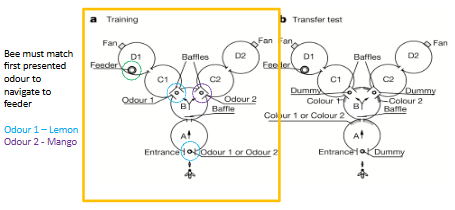
performed match-to-task → study created a maze to prompt the learning of new rules using more naturalistic stimuli. goal is to navigate way to the feeder through various chambers
bee is given an odour when it first enters chamber (lemon or mango) → first presented is what needs to be matched later on to get reward
at next chamber, odour 1 leads them to reward, while wrong turn leads them to a fan which pushes them out the maze
chambers can rotate + move into different configurations → means bee learns from olfactory cue rather than directions
how did Glurfa et al. (2001) assess generalisation of learned concepts in bees
after initial training, had to complete a transfer task → replaced odours with different type of stimulus (colours)
tested ability to generalise rule of first stimulus encountered leads to food reward
what did Glurfa et al. (2001) find regarding learning/generalising + what does this imply
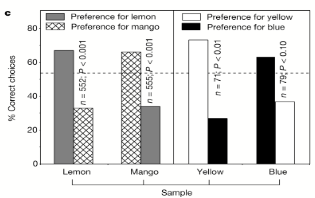
found bees performed above-chance in delayed match-to-sample task + could adequately generalise rule from odour to visual stimulus
this demonstrates above-chance level cross-modal learning, so can apply concept of ‘sameness’ to different scenarios → evidence for CF
what is object permanence
a type of higher-order (insight-related) cognitive function → understanding of one’s own existence + existence of other objects in space, even if we cannot see them currently
is object permanence present in crows + how would it develop (Hoffman et al., 2011)
yes, consistently → when food reward location has changed without crow directly seeing, crows can still reason + identify where it would be
research found that crows move through object permanence trials similarly to how young children world
how similar are humans to macaques + what is our common brain area associated with object permanence
we share 93% of our DNA + most of our neuroanatomy → both contain an inferotemporal cortex, which is associated with OP
how did Puneeth et al. (2016) investigate object permanence in macaques
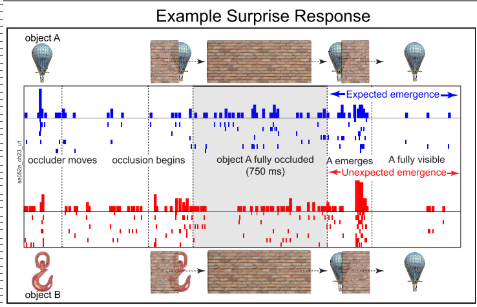
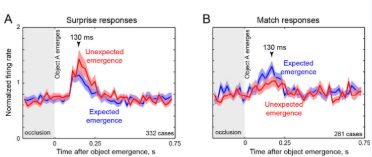
took single-unit recordings of ITC while they completed a match response task → macaques tracked progression of an object moving across a screen, behind a wall, then emerging from the other side. two conditions:
expected emergence → same item emerges on other side
unexpected emergence → different item from that which entered emerges
task assesses whether macaques identified difference between conditions → if no object permanence, there will be no difference in neuronal activity
what were Puneeth et al. (2016)’s results + what does this imply
found selective firing for unexpected object emergence + different general neuronal activity between the two conditions (some neurons responded higher to expected, while others responded higher to surprise)
suggests macaques have object permanence + ITC is associated with its use
what two animals have researchers found have self-recognition abilities
dolphins have demonstrated in captivity, e.g. with a mirror → will move + observe resulting action, showing understanding of the position of their own bodies/ability to perceive themselves
magpies/other corvids → when a red sticker is place on a magpie + they stand in front of a mirror, they will instantly direct action towards it due to identifying the difference
what is mental time travel
a form of higher-order (insight-related) cognitive function → the ability to look through time to our past/future, so events not immediately in our space
what is caching + what species has it been observed in
the act of storing food in a safe location to be consumed later rather than immediately → sign of forward-planning
this has been observed in scrub jays
how did Clayton + Dickinson (1998) study MTT in scrub jays
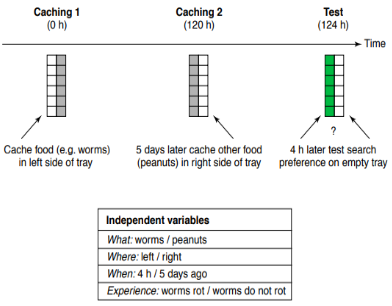
had jays engage in instinctual caching behaviour in controlled environment:
they were provided with a grub, which they stash in the exposed side of a tray (which is then covered up) to eat when they want (cach 1)
they were provided with peanuts 5 days later, which was stashed in the right side of the tray (cach 2)
then observed what tray they went to 124 hours later
what were Clayton + Dickinson (1998)’s findings + what does this suggest
found when scrub jays could access tray, they immediately went to search for the grub. this means they had a sense of:
where the food was stored → representation of location
when it was placed there → had sense of time to conceive of when the group would go bad, so needed to eat it sooner
this requires mental time travel via episodic memory in order to complete instinctual eating behaviours, but may not necessarily demonstrate MTT
what are 4 examples of chimpanzees showing theory of mind behaviours in the wild
there is evidence of them displaying ability to understand the thoughts and feelings of others:
can show patience with individuals willing (but unable) to share food over those unwilling to share
can discriminate between accidental + intentional interactions → chimp bumping into another is less likely to respond aggressively
can follow/track the gaze of others
will use gestural communication when facing one another + orient if facing away → understand they need to be perceived to communicate
how did Krupenye et al. (2016) test TofM in chimpanzees
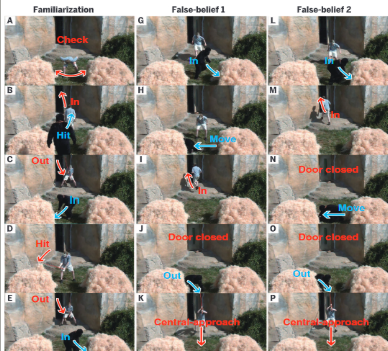
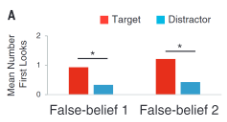
engaged in false-belief task → showed chimpanzees a visual story in which someone (a chimp) comes into a room + moves an object while second person was not present, and the second person (zookeeper) enters
chimp indicates via eye-tracking where the second person would think the object is
eye-tracking on the initial location of object would demonstrate understanding of TofM due to acknowledging the perspective of others
what were Krupenye et al. (2016)’s findings + what does this suggest
found chimp will look to where the second person believes the first to be → they look to the target over the distractor by a significant margin
overall demonstrates TofM capabilities comparable with human studies → may explain the extent of prosocial behaviour observed in chimps
what are features of tool use + who is it previously believed to have been specific to
the use/development of objects that perform a function → requires understanding of causal relationships
is thought to be intrinsic to human behaviour due to being observed cross-culturally
in evolution, came about around the same time that speech emerged → brain areas seemed to have emerged simultaneously + are lateralised to the left hemisphere
previously seen to be what separates us from the animal kingdom
what 3 species have Beck (1980) + St Amant & Horton (2008) observed tool use in
primates → used in foraging behaviours in order to receive food, e.g. using sticks to extend reach/dig
dolphins → use makeshift sponges to protect their noses from being hurt while foraging on the ocean floor. this is learnt + taught intergenerationally
New Caledonian crows → manufacture hook-tools by stripping layers of a stick in order to dig into branches for food
have demonstrated tool preferences → making of an inefficient one will cause them to remake/tweak the design
what is Beck’s framework of tool use in humans + animals
the external employment of an unattached environmental object to alter more efficiently the form, position or condition of another object, organism or user itself when tool is held → user is responsible for the proper + effective orientation of the tool
which animal has been observed to have ‘tool-kits’ + what did they consist of
chimpanzees in Gabon have been observed to make different tools for different tasks necessary to harvest insects from underground:
‘pounder’ stick used to break into termite habitat, then an ‘enlarger’ stick to make habitat easier to get into
will manufacture a brush tool by chewing it to dig + harvest insects
shows intelligent tool use due to employing them at different stages most relevant to their shape in order to achieve desired result → sequential + specific
what is the issue of inferring tool use behaviour from natural observations + how does animal tool use differ from human tool use
though tool use can be trained in a lab, actual occurrences of tool use in nature = very rare → Beck’s framework of tool use constrains instances observed
most tool use behaviours consist of extending each etc. rather than for interaction between tools + other objects
tools being manufactured specifically for purpose, which requires causal reasoning, doesn’t occur as much in animals + is not an intrinsic part of life as it is for humans
tool use + language is defining for humans in a way it isn’t for animals, but studying animal took behaviour is still useful for inferring about our own
why specifically can studying animal tool use be useful
studying animals with similar genetic makeup/neuroanatomical structure can be useful for uncovering the brain areas implicated in idiomotor apraxia → condition affecting volitional tool use in humans, e.g. interacting with cutlery
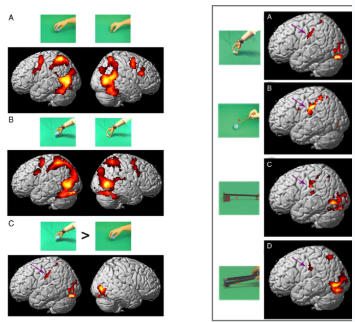
how was tool use comparatively studied in humans + Rhesus monkeys (Peeters et al., 2009)
used fMRIs on both species while observing actions + interactions with tool use, as both humans + monkeys present similar activation of brain pathways when interacting with tools
assessed how brain activation differs
what brain area specific to tool use do humans possess that Rhesus monkeys do not
humans present unique left-lateralised inferior parietal lobe activation when using tools
possess a brain area called the anterior supramarginal gyrus (aSMG) which is specifically activated → monkeys do not have a neural analogue for this
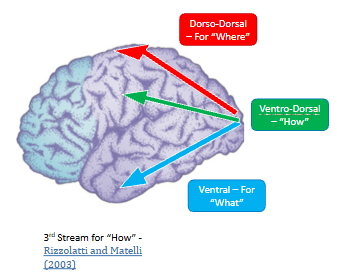
what are Rizzzolatti + Matelli (2003)’s 3 streams of perception + action
dorso-dorsal → the ‘where’ stream
ventral → the ‘what’ stream
ventro-dorsal → the ‘how’ stream → projects to inferior parietal lobule
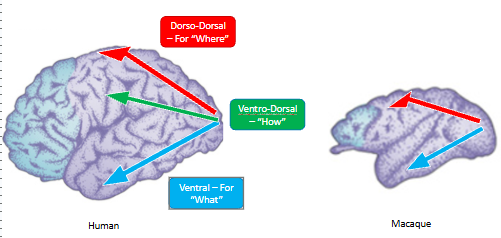
how does neuroanatomy of tool use differ between humans + Rhesus monkeys
monkeys do not possess the ventro-dorsal stream, so do not have the ability to understand how one object impacts another like humans do
suggests human brain areas = necessary in uniquely + expertly interacting with our environment, in a way that separates us from other animals
what 4 insight-related skills have Kirsch et al. (2008) identified in corvids
object permanence
theory of mind
mental time travel
tool use/causal reasoning
 Note
Note  Flashcards (23)