Organizational behaviour - Chapter 13: Organizational structure
 Call Kai
 Learn
Learn Practice Test
 Spaced Repetition
 Match
Match Flashcards
 Knowt Play
1/77

There's no tags or description
Looks like no tags are added yet.
Name | Mastery | Learn | Test | Matching | Spaced | Call with Kai |
|---|
No analytics yet
Send a link to your students to track their progress
78 Terms
Organizational structure
How job tasks are formally divided, grouped, and coordinated
The seven key elements managers should address seven key elements when they design their organization's structure
Work specialization
Departmentalization
Chain of command
Span of control
Centralization and decentralization
Formalization
Boundary spanning
Work specialization/ division of labour
The degree to which tasks in the organization are subdivided into separate jobs.
Work specialization/ division of labour (con’t)
Rather than an entire job being completed by one individual, it's broken down into several steps completed by different people
Benefits of specialization
It can be efficient, easier, and cheaper, especially for highly sophisticated and complex operations.
Benefits of specialization (con’t)
Giving employees a variety of activities to do, allowing them to do a whole and complete job, and putting them into teams with interchangeable skills can result in significantly higher output and increased employee satisfaction.
Drawbacks of specialization
It can lead to boredom, fatigue, stress, low productivity, poor quality, increased absenteeism, and high turnover rates
Departmentalization
How jobs are grouped for ease of coordination
Functional departmentalization
Grouping activities by the functions performed for increased efficiency by putting people with common skills and orientations together into common units.
Product departmentalization
Grouping activities by the product(s) produced by the firm for increased accountability for product performance, since all activities related to a specific product line are under the direction of a single manager
Geographical departmentalization
Grouping activities by their location based on whether the needs of customers in different areas are similar
Process departmentalization
Grouping departments by the processing that occurs.
e.g., an aluminum tubing manufacturer might have the following departments: casting, pressing, tubing, finishing, inspection, packing, and shipping.
Customer departmentalization
Grouping activities by the basis of the particular type of customer the organization seeks to reach
e.g. Microsoft’s organized around four customer markets: consumers, large corporations, software developers, and small businesses.
Chain of command
The unbroken line of authority that extends from upper organizational levels to the lowest level and clarifies who reports to whom.
Authority
Refers to the rights inherent in a managerial position to give orders and expect them to be obeyed
Authority (con’t)
Each manager is given a degree of authority to meet his or her responsibilities to facilitate coordination
Unity of command
Helps preserve the concept of an unbroken line of authority.
i.e. A person should have one and only one superior to whom he or she is directly responsible.
Unity of command (con’t)
If broken, an employee might have to cope with conflicting demands or priorities from several superiors, as is often the case in organization charts' dotted-line reporting relationships depicting an employee's accountability to multiple managers.
Delegation
The assignment of authority to another person to carry out specific duties, allowing the employee to make some of the decisions
Span of control
The number of employees who report to a manager.
Span of control (con’t)
This number will vary by organization, and by unit within an organization and is determined by the number of employees a manager can efficiently and effectively direct.
e.g. A sales manager, by contrast, might have to give one-on-one supervision to individual sales reps, and while an assembly-line factory manager may be able to direct numerous employees,
Centralization
The degree to which decision-making is concentrated at a single point in the organization
e.g. In centralized organizations, top managers make all the decisions, and lower-level managers merely carry out their directives, but in organizations at the other extreme, decentralized decision making is pushed down to the managers closest to the action or to work groups
Centralization (con’t)
It’s better for avoiding communication errors
Decentralization
The degree to which decision-making is given to lower-level employees
Decentralization (con’t)
Employees can act more quickly to solve problems, and more people provide input into decisions, and employees are less likely to feel alienated from those who make decisions that affect their work lives
Benefits of decentralization
It can make it easier to address concerns
Formalization
The degree to which jobs within the organization are standardized
Formalization (con’t)
If a job is highly formalized, the employee has a minimal amount of discretion over what to do and when and how to do it, resulting in consistent and uniform output.
Formalization example
At McDonald’s, where employees are instructed in such things as how to greet the customer (smile, be sincere, make eye contact), ask for and receive payment (state the amount of the order clearly and loudly, announce the amount of money the customer gives to the employee, count change out loud and efficiently), and thank the customer (give a sincere thank you, make eye contact, ask the customer to come again)
Boundary spanning
When individuals form relationships with people outside their formally assigned groups.
e.g. An HR executive who frequently engages with the IT group is engaged in boundary spanning
The simple structure
An organizational design defined by low degree of departmentalization wide spans of control, authority centralized in a single person, and little formalization
The simple structure (con’t)
It’s a flat organization, usually with only 2 or 3 vertical levels, and is seen in companies which are just starting out
The simple structure (III)
It's fast, flexible, and inexpensive to maintain, and accountability is clear, but it's difficult to maintain in anything other than small organizations.
Bureaucracy
Highly routine operating tasks are achieved through:
Specialization
Strictly formalized rules and regulations
Tasks that are grouped into units
Centralized authority
Narrow spans of control
Decision-making that follows the chain of command.
Strengths of bureaucracy
It can perform standardized activities in a highly efficient manner with little need for experience
Weaknesses of bureaucracy
Bureaucratic specialization can create conflicts in which unit perspectives override the overall goals of the organization, and obsessive rule following can leave no room for modifications
The functional structure
Groups employees by their similar specialties, roles, or tasks
e.g. An organization organized into production, marketing, human resources, and accounting departments
Benefits of the functional structure
It allows specialists to become experts more easily than if they worked in diversified units
Employees can also be motivated by a clear career path to the top of the organization chart, specific to their specialties.
Drawbacks of the functional structure
It creates rigid, formal communications because the hierarchy dictates the communication protocol.
Coordination among many units is a problem, and infighting in units and between units can lead to reduced motivation.
Divisional structure
Groups employees into units by product, service, customer, or geographical market area in a highly departmentalized manner
Divisional structure (con’t)
Sometimes this structure is known by the type of division structure it uses:
e.g.
Product/service organizational structure (like units for cat food, dog food, and bird food that report to an animal food producer)
Customer organizational structure (like units for outpatient care, inpatient care, and pharmacy that report to hospital administration)
Geographic organizational structure (like units for Europe, Asia, and South America that report to corporate headquarters)
Benefits of the divisional structure
The organization's marketing function employees in two places may represent an increased cost, in doing basically the same task in two different countries.
Drawbacks of the divisional structure
It facilitates coordination in units to achieve on-time completion, budget targets, and the development and introduction of new products to market, while addressing the specific concerns of each unit. It provides clear responsibility for all activities related to a product, but with duplication of functions and costs.
The matrix structure
Combines functional and product departmentalization with a dual chain of command that breaks the unity-of-command concept.
Benefits of the matrix structure
It can foster coordination when the organization has several complex and interdependent activities.
Information permeates the organization and more quickly reaches those people who need it.
It achieves economies of scale and facilitates the allocation of specialists by both providing the best resources and ensuring they are efficiently used.
Drawbacks of the matrix structure
It can create confusion and power struggles, as well as placing stress on individuals
The virtual structure
A small core organization that outsources its major business functions
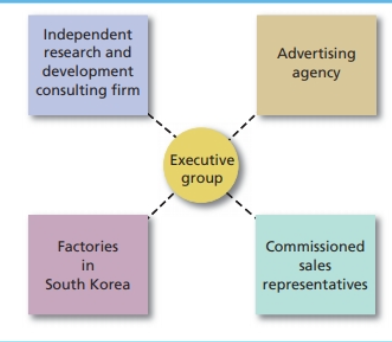
Benefits of virtual structures
They’re flexible and allow for individuals with an innovative idea and little money to successfully compete against more established organizations.
Drawbacks of virtual structures
They’re in a state of perpetual flux and reorganization, which means roles, goals, and responsibilities are unclear, setting the stage for political behaviour
Cultural alignment and shared goals can be lost because of the low degree of interaction among members.
Team members who are geographically dispersed and communicate infrequently find it difficult to share information and knowledge, which can limit innovation
and slow response time.
The team structure
Seeks to eliminate the chain of command and replace departments with empowered teams
The team structure (con’t)
Removes vertical and horizontal boundaries as well as breaking down external barriers between the company and its customers and suppliers.
Circular structure
Executives are in the centre and radiating outward in rings grouped by function are the managers, then the specialists, then the workers.
Circular structure benefits
Has intuitive appeal for creative entrepreneurs,
Circular structure drawbacks
Employees are apt to be unclear about whom they report to and who is running the show.
Downsizing
A systematic effort to make an organization leaner by closing locations, reducing staff, or selling off business units that do not add value.
Why might a company downsize?
To direct efforts toward their core competencies
To create a leaner organization
To reduce bureaucracy and speed decision-making.
Mechanistic model
Defined by:
High specialization
Rigid departmentalization
Clear chain of command
Narrow control spaces
Limited information network
Centralization
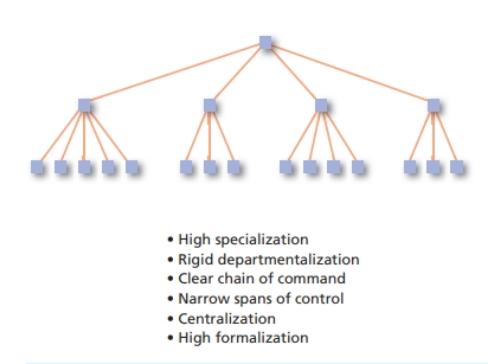
Mechanistic model (con’t)
Is usually synonymous with bureaucracy
The organic model
It's flat, has fewer formal procedures for making decisions, has multiple decision makers, and favours flexible practices
The organic model (con’t)
Also contains:
Cross-functional/hierarchical teams
Free flow of information
Wide spans of control
Decentralization
Low formalization
Innovation strategy
Advocates for the introduction of major new offerings
Cost-minimization strategy
Emphasizes tight cost controls as well as the avoidance of unnecessary innovation, expenses, or price cuts
Imitation strategy
Moving into new products/markets only after their viability has been proven
e.g.
Technology
The way an organization transfers its inputs into outputs
Technology (con’t)
Every organization has at least one technology for converting financial, human, and physical resources into offerings
e.g. The Chinese consumer electronics company Haier uses an assembly-line process for mass-produced products, which is complemented by more flexible and innovative structures to respond to customers and design new products
Environment
Outside institutions or forces that can affect the organization's structure and performance
e.g. Suppliers, customers, competitors, and public pressure groups.
Dynamic environments
Rapidly changing government regulations affecting their business, new competitors, difficulties in acquiring raw materials, continually changing product preferences by customers, etc
Dynamic environments (con’t)
Creates more challenges and uncertainty for managers
Static environments
Few forces in their environment are changing
Static environments (con’t)
Creates less challenges and uncertainty for managers
Capacity of an environment
The degree to which the environment can support growth.
e.g. Rich and growing environments generate excess resources, which can buffer the organization in times of relative scarcity.
Volatility
The degree of instability in an environment
e.g. A dynamic environment with a high degree of unpredictable change, makes it difficult for management to make accurate predictions.
Complexity
The degree of heterogeneity and concentration among environmental elements
e.g., Simple environments like the tobacco industry, where the methods of production, competitive and regulatory pressures, and the like haven’t changed in quite some time, are homogeneous and concentrated. Heterogeneous and dispersed envelopes like the broadband industry are complex and diverse, with numerous competitors.
Institutions
Cultural factors that act as guidelines for appropriate behaviour.
Institutional theory
Describes some of the forces that lead many organizations to have similar structures and focuses on pressures that aren't necessarily adaptive.

