4.6 Transfer between circulatory system and cells
 Call Kai
 Learn
Learn Practice Test
 Spaced Repetition
 Match
Match Flashcards
 Knowt Play
1/12

There's no tags or description
Looks like no tags are added yet.
Name | Mastery | Learn | Test | Matching | Spaced | Call with Kai |
|---|
No analytics yet
Send a link to your students to track their progress
13 Terms
What is tissue fluid and how is it formed? (2)
- Tissue fluid is the fluid that surrounds and bathes the cells in the body's tissues.
- At the arterial end of a capillary, the high hydrostatic pressure inside the blood vessel forces plasma and its dissolved solutes out through the capillary walls.
Why are proteins and erythrocytes not normally found in tissue fluid? (1)
The capillary walls are selectively permeable, and their pores are too small to allow large molecules like plasma proteins and cells like erythrocytes to pass through.
How does the lymphatic system relate to tissue fluid? (3)
- Excess tissue fluid that is not reabsorbed at the venous end of the capillaries drains into a network of lymph capillaries.
- These capillaries merge to form larger lymph vessels, which contain valves to ensure the one-way flow of this fluid, now called lymph.
- The lymph vessels eventually return the lymph to the blood circulatory system, draining into veins located near the heart.
What mechanisms cause lymph to move through the lymphatic vessels? (3)
- The hydrostatic pressure of the tissue fluid itself provides a force that pushes lymph into and along the lymph capillaries.
- The contraction of skeletal muscles during movement compresses the lymph vessels, squeezing the lymph along them.
- Inspiratory movements create a lower pressure in the thorax, which helps to draw lymph up towards the chest.
What are the main functions of the blood? (3)
- It transports respiratory substrates, like oxygen and nutrients, to all the body's cells.
- It transports excretory products, such as carbon dioxide and urea, away from the cells to excretory organs.
- It is involved in the distribution of heat, hormones, and dissolved proteins like antibodies throughout the body.
What are the main components of blood? (2)
- Blood is composed of a liquid medium called plasma.
- Suspended in the plasma are erythrocytes, leucocytes, and platelets.
What are the differences between blood plasma and tissue fluid? (2)
- Blood plasma has a higher protein content because large plasma proteins are too big to filter out of the blood capillaries.
- Tissue fluid has less dissolved oxygen because oxygen diffuses out of the blood and into the surrounding body cells for aerobic respiration.
Why is the production of tissue fluid vital for cells in the human body? (2)
- Tissue fluid surrounds body cells, supplying them with necessary substances such as oxygen and glucose, while also removing waste products.
- This exchange of materials enables essential metabolic processes, such as aerobic respiration and protein synthesis, to take place within the cells.
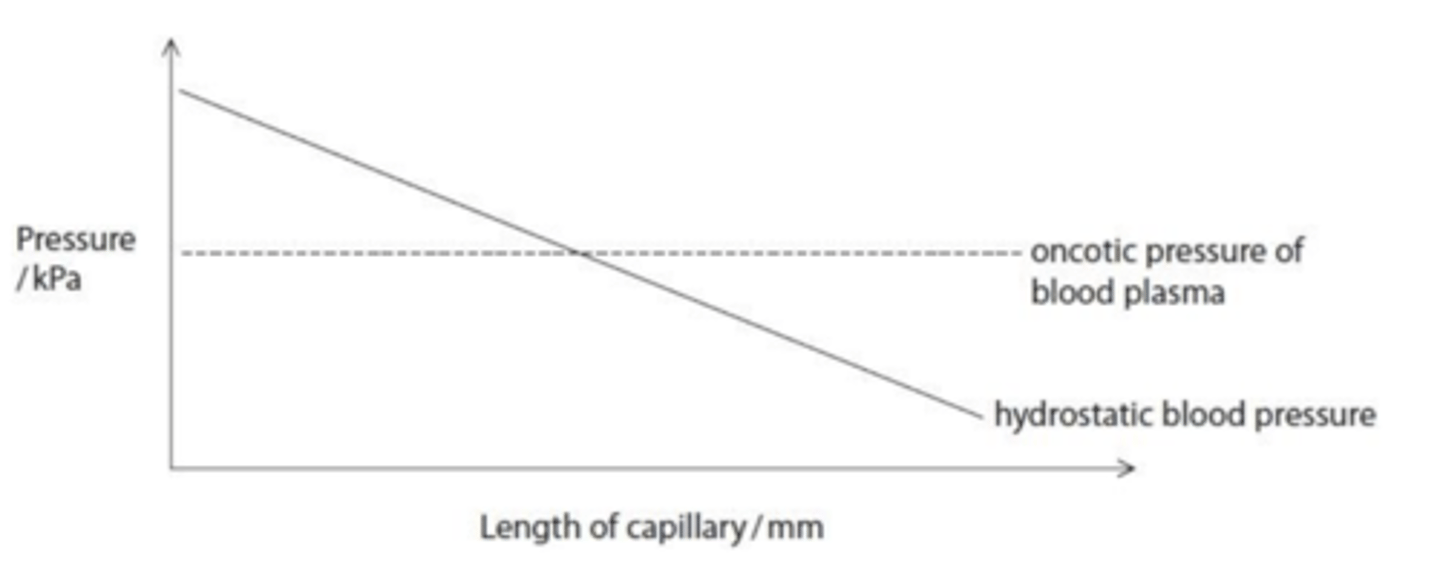
How is tissue fluid returned to the capillaries? (3)
- As blood flows to the venous end of the capillary, the hydrostatic pressure decreases due to the loss of fluid.
- Large plasma proteins remain in the blood, creating a higher solute concentration and therefore a lower water potential compared to the tissue fluid.
- At the venule end, the inward osmotic pressure is greater than the outward hydrostatic pressure, causing water to move from the tissue fluid back into the capillary by osmosis.
How could a blockage of a lymphatic duct lead to lymphoedema? (2)
- A blockage prevents the lymphatic system from draining large proteins from the tissue fluid, causing these proteins to accumulate.
- This build-up of protein lowers the water potential of the tissue fluid, causing excess fluid to move out of the capillaries and accumulate in the tissues, which results in swelling.
How does the blockage of lymph vessels by roundworms lead to the swelling of legs? (3)
- The blockage of lymph vessels prevents the normal drainage of proteins from the tissue fluid, causing their concentration to increase.
- This accumulation of proteins lowers the water potential of the tissue fluid.
- Consequently, more fluid moves by osmosis from the blood capillaries into the tissue fluid, and less is reabsorbed, leading to fluid accumulation and swelling, known as oedema.
Why do children suffering from kwashiorkor disease often suffer from an excess of tissue fluid? (2)
- A lack of dietary protein results in a lower concentration of protein in the blood plasma.
- This reduces the oncotic pressure of the blood, leading to less fluid being returned to the capillaries by osmosis, which causes fluid to accumulate in the tissues.
How does furosemide, a medication which acts on nephrons in the kidney cause an increase in urine production? (3)
- Furosemide inhibits the active transport of sodium ions from the filtrate in the ascending limb of the loop of Henle into the medulla.
- This raises the water potential of the interstitial fluid in the medulla and reduces the water potential gradient between the filtrate and the medulla.
- Consequently, less water is reabsorbed back into the blood by osmosis, resulting in a larger volume of dilute urine being produced.

