Heart sound 2 new

0.0(0)
studied byStudied by 0 people
0.0(0)
call kaiCall Kai
learnLearn
examPractice Test
spaced repetitionSpaced Repetition
heart puzzleMatch
flashcardsFlashcards
GameKnowt Play
Card Sorting

1/111

encourage image

There's no tags or description

Looks like no tags are added yet.

Last updated 5:19 AM on 2/3/26
Name
Mastery
Learn
Test
Matching
Spaced
Call with Kai

No analytics yet

Send a link to your students to track their progress

112 Terms

1
New cards
What produces Second Heart Sound (S2)?
Aortic (A2) valve closure + Pulmonic (P2) valve closure
2
New cards
What is splitting of S2?
Time gap between A2 and P2 closure
3
New cards
Which component of S2 varies with respiration?
P2 position
4
New cards

Changes of P2 as per respiration

  • On expiration - Early closure of P2

  • On inspiration - late closure of P2

5
New cards
What is physiological splitting of S2?
Splitting between A2 and inspiratory P2 of about 30 msec
6
New cards
When does P2 occur during inspiration?
Late P2
7
New cards
When does P2 occur during expiration?
Early P2
8
New cards
Best site to auscultate physiological splitting of S2?
Erb’s point
9
New cards
Which side of chest is used to hear S2 splitting?
Left side of chest
10
New cards
Intercostal space for hearing S2 splitting?
3rd intercostal space
11
New cards
Phase of respiration when S2 splitting is best heard?
Inspiration
12
New cards
Normal size of aortic valve orifice?
3–4 cm²
13
New cards
Severe aortic stenosis valve area?
Less than 1 cm²
14
New cards
Why is A2 delayed in aortic stenosis?
Narrow aortic valve causes delayed blood exit
15
New cards
Cause of delayed A2 closure in AS?
Prolonged left ventricular ejection time
16
New cards

Causes of valvular aortic stenosis

  • Bicuspid aortic valve (infants)

  • Rheumatic fever

  • Valve calcification (>65 years)

17
New cards

Why narrow splitting in aortic stenosis?

S2 = A2P2

  • first A2 close and the P2 closes

  • In aortic stenosis, A2 is delaying as per condition

  • This will cause narrowing of s2 / narrow splitting S2

  • In severe cases, single S2 is heard and sometimes P2A2 (reverse splitting) can also heard

  • Severity depend on time ( early - narrow splitting, late - single s2, severe - reverse splitting )
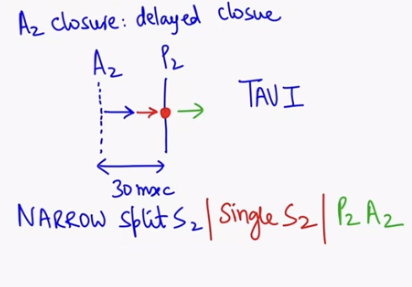
<p>S2 = A2P2</p><ul><li><p>first A2 close and the P2 closes</p></li><li><p>In aortic stenosis, A2 is delaying as per condition</p></li><li><p>This will cause narrowing of s2 / narrow splitting S2</p></li><li><p>In severe cases, single S2 is heard and sometimes P2A2 (reverse splitting) can also heard</p></li><li><p>Severity depend on time ( early - narrow splitting, late - single s2, severe - reverse splitting )</p></li></ul><p></p>
18
New cards
Mnemonic for clinical findings of aortic stenosis?
SAD
19
New cards
What does S in SAD stand for?
Syncope on exertion
20
New cards
What causes syncope in AS?
Fixed cardiac output during exertion
21
New cards
What does A in SAD stand for?
Angina
22
New cards

Cause of angina in AS?

Aortic stenosis →LV hypertrophy → increased O₂ demand

23
New cards
What does D in SAD stand for?
Dyspnea on exertion
24
New cards
Cause of dyspnea in AS?
Increased LV end-diastolic pressure → pulmonary congestion
25
New cards

Characteristic pulse in aortic stenosis?

Pulsus parvus et tardus/ anacrotic pulse ( slow rising with low amplitude pulse)

26
New cards
Meaning of pulsus parvus et tardus
Slow rising pulse + low amplitude
27
New cards

Type of apex beat in AS?

Heaving apex beat ( due to left side hypertrophy )

28
New cards

What is heaving beat?

forceful beat that can lift your finger

29
New cards
Cause of heaving apex beat in AS?
Left ventricular hypertrophy
30
New cards

What special apical impulse is seen in AS?

Double apical impulse ( due to both LVH and LAH )

31
New cards

Apex beat position in AS?

6th intercostal space (normally in 5th intercostal space )

32
New cards

Apex beat finding in aortic stenosis

  • heving beat

  • Double apical impulse

  • Displacement of apex beat to 6th space

33
New cards
Type of S2 splitting in aortic stenosis?
Narrow split S2
34
New cards
A2–P2 gap in AS?
Less than 30 msec
35
New cards
When does single S2 occur in AS?
Severe AS with simultaneous A2 and P2 closure
36
New cards
What is reverse splitting of S2?
A2 closes after P2
37
New cards
Cause of reverse split S2 in AS?
Worsening severity of AS
38
New cards
Additional heart sound in AS?
Atrial gallop (S4)
39
New cards
Best instrument to hear atrial gallop?
Bell of stethoscope
40
New cards

Type of murmur in AS?

Ejection systolic (crescendo–decrescendo) murmer

41
New cards

Murmer in aortic stenosis present in

systole

<p>systole</p>
42
New cards

Which word in question directly find aortic stenosis?

carotid thrill

43
New cards
Where is thrill felt in AS?
Carotid artery
44
New cards
Investigation of choice for AS?
Transthoracic echocardiography (TTE)
45
New cards
Definitive treatment option for AS?
Transcatheter Aortic Valve Implantation (TAVI)
46
New cards

Why balloning is contraindicated AS manageent?

it will break valve because of calcification

47
New cards

Which test is contraindicated in severe AS

tredmill test ( because low output → syncope)

48
New cards

What is Patent Ductus Arteriosus (PDA)?

Persistent connection between pulmonary artery and aorta
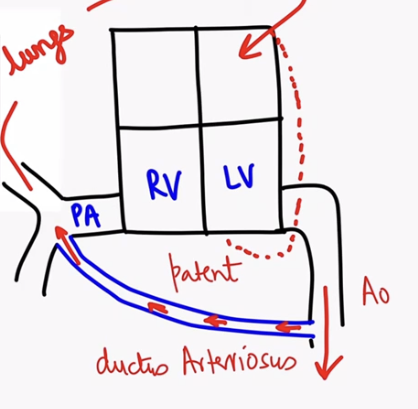
<p>Persistent connection between pulmonary artery and aorta</p>
49
New cards

Why left ventricle is failing in PDA?

Most blood is bypassing RV. Due o connection, blood is going to pulmonary artery and then to LA→LV
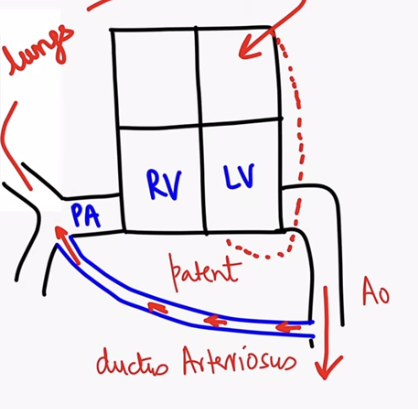
<p>Most blood is bypassing RV. Due o connection, blood is going to pulmonary artery and then to LA→LV </p>
50
New cards
Origin of ductus arteriosus?
Bifurcation of pulmonary artery
51
New cards
Termination of ductus arteriosus?
Beginning of descending aorta
52
New cards
Normal time of ductus arteriosus closure?
Starts at 10–15 hours after birth
53
New cards
Functional closure of ductus arteriosus by?
Day 7 of life
54
New cards
Type of shunt in PDA?
Left to right shunt
55
New cards
Which ventricle fails in PDA?
Left ventricle
56
New cards
Why LV failure occurs in PDA?
Volume overload of left heart
57
New cards
Direction of blood flow in PDA?
Aorta → Pulmonary artery → Lungs → Left heart
58
New cards

S2 finding in PDA?

Narrow split S2 (because delay in aortic valve closure)

59
New cards
Reason for delayed A2 in PDA?
Prolonged blood exit time
60
New cards

Characteristic murmur of PDA?

Machinery / continuous murmur
<p>Machinery / continuous murmur</p>
61
New cards
Timing of PDA murmur?
Heard in systole and diastole
62
New cards
Peak of PDA murmur?
At S2
63
New cards
Cause of PDA in preterm babies?
Hyaline membrane disease
64
New cards

Mechanism of PDA in preterm infants

Hyaline membrane disease→Hypoxia → ↑ PGE₂ → PDA

65
New cards
Cause of PDA in term babies?
Congenital rubella syndrome
66
New cards

Difference in continuous /machinery and cresendo-decresendo murmer?

Continuous murmer peak at S2 and present in both systole and diastole

Cresendo decresendo presnet only in systole

67
New cards

Clinical features of PDA in babies

  • Poor feeding |

  • Irritability |

  • Dyspnea during breastfeeding

68
New cards

Diagnostic test for PDA?

TTE (tranbsthoracic echo)

69
New cards
Treatment of PDA in preterm babies
Ibuprofen or Indomethacin IV
70
New cards
Treatment of PDA in term babies
Surgical ligation
71
New cards

Complications of PDA

  • Pulmonary hypertension |

  • NEC |

  • CHF |

  • AKI

72
New cards

Severe Complication of PDA

eisenmenger syndrome

73
New cards

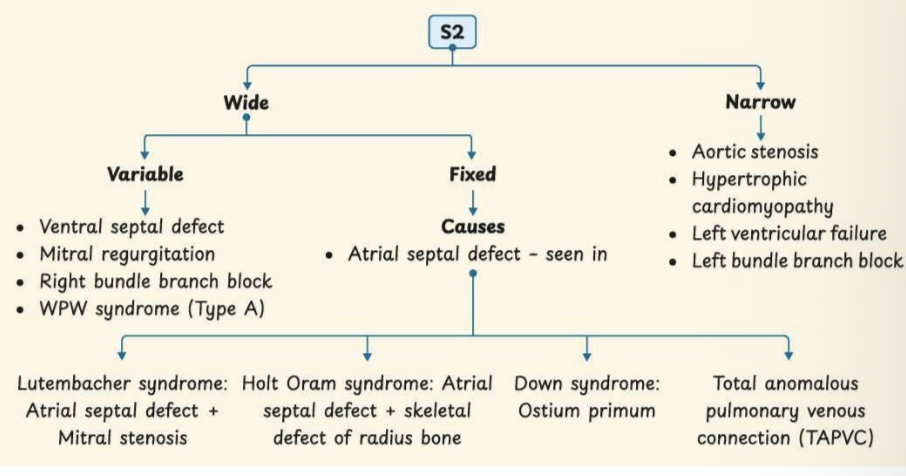
Causes of narrow split s2

  • Aortic stenosis

  • Hypertrophic cardiomyopathy ( subvalvular AS)

  • Left ventricle failure →

  1. Anterior wall MI

  2. Myocarditis

  3. Wet beri beri ( with pulmonary edema )

  4. PDA

  5. Severe anemia

74
New cards

Causes of mitral valve regurgitation

  • mitral valve prolapse

  • Infectiveendocarditis

  • Myocardial ischemia

75
New cards

Pathophysiology of MR

blood leak in left atria → less blood pumped to aorta

76
New cards

Examination finding of MR

  • S2 wide split

  • Pansystolic murmer

77
New cards

Why wide spllit murmer in MR?

  • less blood come in ventricle → less time to exit blood →early A2 closure

78
New cards
Most common congenital heart disease in infants?
Ventricular septal defect
79
New cards
Type of shunt in VSD?
Left to right shunt
80
New cards
Cause of shunt in VSD?
LV pressure > RV pressure
81
New cards
Effect of VSD on aortic output?
Reduced blood pumped to aorta
82
New cards

S2 finding in VSD?

Wide split S2 ( less blood - less time )

83
New cards
A2–P2 gap in VSD?
More than 30 msec
84
New cards
Reason for early A2 in VSD?
Less blood exit time
85
New cards
Most common type of VSD?
Perimembranous VSD
86
New cards

Types of VSD

  • Perimembranous VSD

  • Muscular VSD

  • Supracristal VSD

87
New cards

VSD with spontaneous closure?

Muscular VSD ( close till 3rd birthday)

88
New cards
VSD associated with aortic regurgitation?
Supracristal VSD
89
New cards
Pressure nature of ASD?
Low pressure shunt
90
New cards

Pressure difference between left and right atrium

4 mmhg

91
New cards

Which ventricle fails in ASD?

Right ventricle (due to volume overloading)

92
New cards

S2 finding in ASD?

Wide fixed split S2 ( delayed pulmonary closure and early A2 closure)

93
New cards
Why no physiological splitting in ASD?
Same RV filling during inspiration and expiration
94
New cards
Most common age of ASD presentation?
5 years
95
New cards
Adult presentation of ASD?
Rare
96
New cards

ASD diffrenece in inspiration and expiration

Feature

Normal – Inspiration

Normal – Expiration

ASD – Inspiration

ASD – Expiration

Venous return to right heart

↑↑ Increased

↓↓ Decreased

↑↑ Increased

↓↓ Decreased

Inter-atrial pressure difference

-

-

No pressure difference

Pressure difference develops

Inter-atrial shunting

-

-

❌ No shunt

✅ LA → RA shunt

Right ventricular filling

Increased

Decreased

Same

Same

Right ventricular ejection time

Prolonged

Shortened

Constant

Constant

Pulmonic valve closure (P2)

Delayed

Earlier

Delayed

Delayed

Effect on S2

Physiological split

Split narrows / single

Wide fixed split

Wide fixed spli

1st column - normal inspiration

2nd column - normal expiration

3rd column - ASD inspiration

4th column - ASD - expiration

97
New cards

Wide fixed split 2nd heart sound is characteristic of

ASD

98
New cards

ASD seen in

  • Lutenbacher syndrome

  • Holt oram syndrome

  • down syndrome

  • Total anomalous pulmonary venous connection

99
New cards

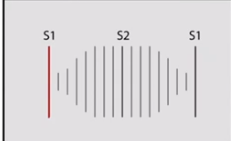
Chart of s2 splitting

knowt flashcard image
100
New cards
Bundle of His function?
Responsible for septal activation