Lecture 9: Animal cognition - insight related cognition
 Studied by 1 person
 Call Kai
 Learn
Learn Practice Test
 Spaced Repetition
 Match
Match Flashcards
 Knowt Play
1/31

There's no tags or description
Looks like no tags are added yet.
Name | Mastery | Learn | Test | Matching | Spaced | Call with Kai |
|---|
No analytics yet
Send a link to your students to track their progress
32 Terms
cognitive flexibility
-taking on new information, adapting and learning rules about the environment you are in
-performing a large range of behaviours and tasks and selecting them flexibly to suit different contexts
wisconsin card sorting task (cognitive flexibly)
-not told rule and have to sort card into relevant pile
-have to figure out rule based on if answer is correct or not
-then rule changes and have to figure it out again
-struggling with this task is associated with PFC damage
delayed-match-to-sample task
-crow presented with stimulus
-must hold information for a delay period
-identify correct stimulus in choice period
Veit - method (cognitive flexibility in crows)
-shown stimulus
-a visual or auditory cue dictates what the crow must do with the held information:
trial type 1 → cue tells crow to pick stimulus that was not present during sample
trial type 2 → cue tells crow to pick stimulus that was present during sample
-inserted electrodes into crows’ NCL to see if it is involved in cognitive flexibility and whether there was a difference in response rate in neurons depending on the task type
Veit - task performance results (cognitive flexibility in crows)
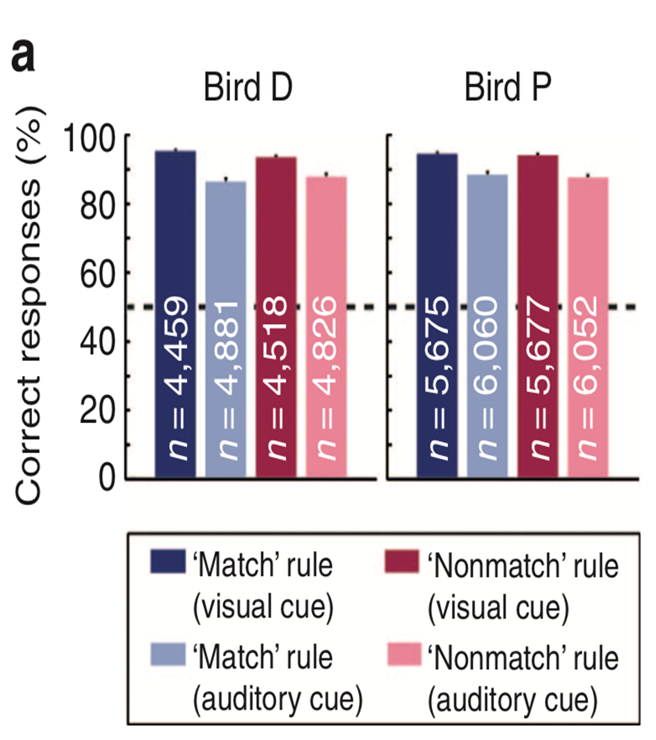
-consistently score highly and above chance → demonstrating cognitive flexibility
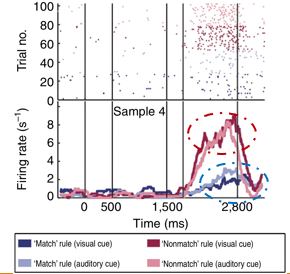
Veit - firing rate results (cognitive flexibility in crows)
-high firing rate for ‘non-match’ rule trials
-low firing rate for ‘match’ rule
-does not matter whether cue was signalled auditory or visually → shows the firing rate is about the rule and not the type of stimulus
-supports cognitive flexibility and role of NCL as analogue to PFC
Zhang - method (cognitive flexibility in bees)
-match-to-sample task
-vary the sample and positions
-teach the bee a rule to follow → the first sample you see leads to food reward and the second sample does not (other bees learn other way around)
-have to see if they can generalise the rule to other stimuli
Zhang - results (cognitive flexibility in bees)
-learning tests show bees can learn the rule and perform well on trained stimuli
-transfer test 1 and 2 introduce novel patterns, not known to the bees but the rule remains the same (first pattern leads to reward)
-still perform above chance levels
-indicates bees can generalise from specific visual stimulus to more abstract tasks
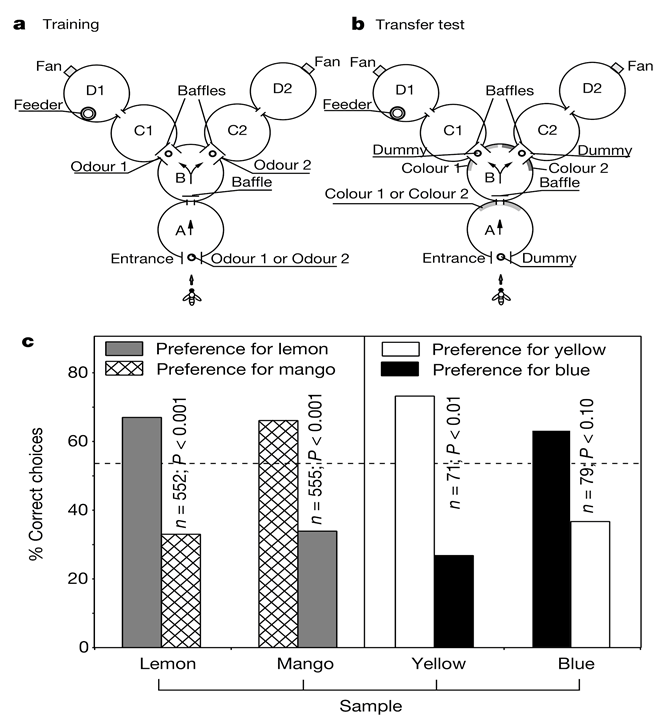
Giurfa - training method (learning of abstract concepts in bees)
-made bee mazes where bee has to go through different chambers to receive food reward
-bees learning new rules with different stimuli
-bee is given an odour when it first enters → marks the entrance with odour 1 or odour 2
-have to learn rule → first odour that they are presented with is what they have to match to to receive food reward
-odour one guides them through the maze to the food reward
Giurfa - transfer test method (learning of abstract concepts in bees)
-put bees from scent trials into mazes where the odours are replaced with colours
-can perform match-to-sample task → have to follow the same rule of first stimulus presented leads to reward - but have to generalise from odour stimulus to visual stimulus
Giurfa - results (learning of abstract concepts in bees)
-bees perform above chance level in delayed match-to-sample task
-bees can generalise the rule from odours to visual stimulus
-demonstrates above chance level cross-modal learning
-shows bees can find common sameness across two types of stimuli
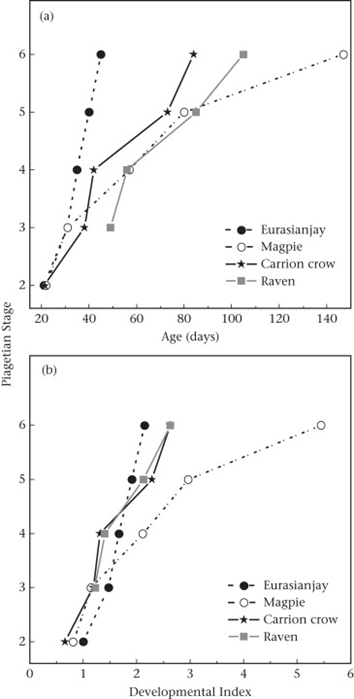
Hoffman (object permanence in crows)
-place mealworm in cup
-place cup inside napkin
-crow understands that mealworm is in the cup which is in the napkin so demonstrates understanding of object permanence
corvids go through Piaget stages
Puneeth - method (object permanence in macaques)
-single unit recordings in inferotemporal cortex of macaques → associated with understanding of objects, object permanence and keeping track of objects in space
-object permanence task
-if do not have an understanding of object permanence would see no neuronal difference between expected and unexpected emergence
Puneeth - expected emergence (object permanence in macaques)
-start with an object
-moves behind the wall
-peeps out
-moves behind the wall and when it emerges again
Puneeth - unexpected emergence (object permanence in macaques)
-start with an object
-moves behind the wall
-peeps out
-when it emerges again the object will have changed
-measures tracking of object permanence and whether or not animals have a perception there is a difference
Puneeth - results (object permanence in macaques)
-selective firing for unexpected object emergence
-some neurons respond higher to expected, others to surprise
-demonstrate different neuronal activity for expected outcomes vs non-expected outcomes
-shows likely to have an element of object permanence
mirror self-recognition in birds
-place yellow stickers on various different positions on magpies
-magpies will direct action towards the dot → pecking it, grooming it
-see themselves in the mirror, identify something that is different, and so will investigate it
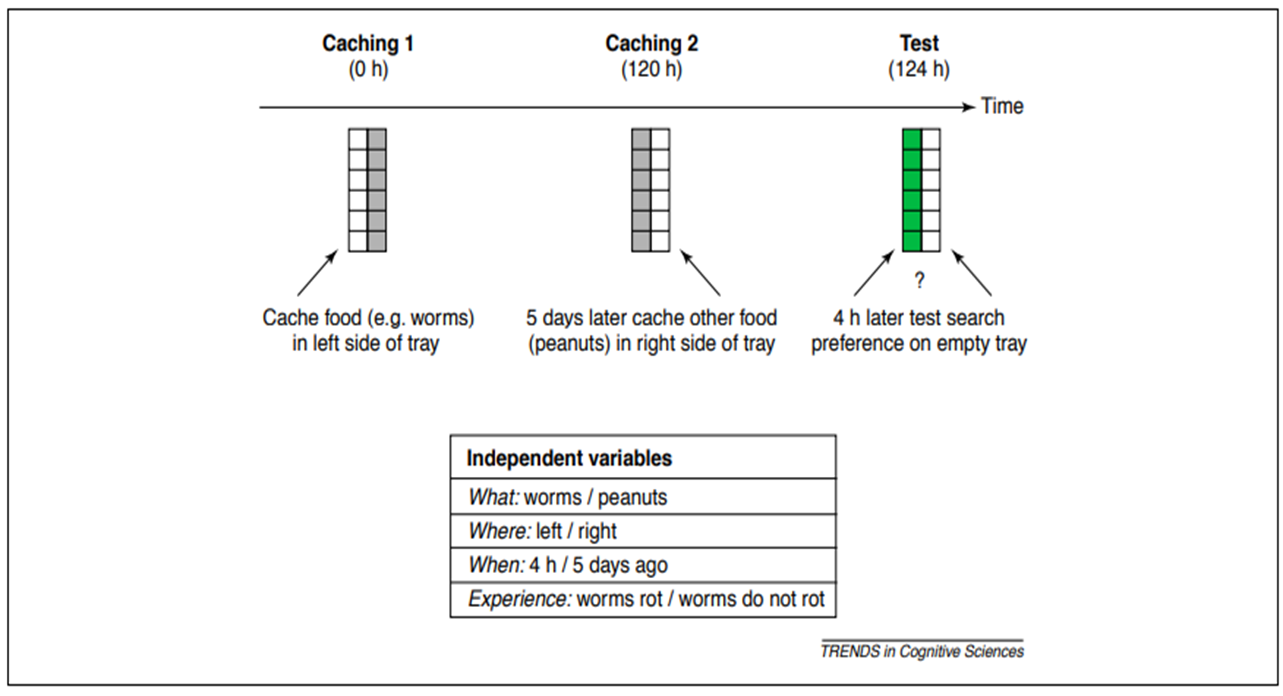
Clayton - method (mental time travel in scrub jays)
-jays engage in cashing behaviour → stash away food and eat it when they need it
-built cashing areas for scrub jays
-provided them with grubs, which they stashed in the left side of the tray
-researchers empty the stash and cover the left side of the tray and expose the right side
-provided them with nuts, which they stashed in the right side of the tray
Clayton - results (mental time travel in scrub jays)
-believe the grubs are in the left side
-nuts don’t spoil but the grubs do spoil
-so birds go straight for left side after a period outside of their enclosure (120h) to search for grubs
-has to have an understanding of time to know when the grubs will go bad and have episodic memory to know where they stored the grubs
ToM in animals
-chimpanzees have shown TOM
-show patients with individuals willing to share food over those unwilling to share
-discriminate between accidental and intentional actions
-follow gazes of others
-gestural communication when facing another, will move to face if other is orientated away
ToM in chimpanzees
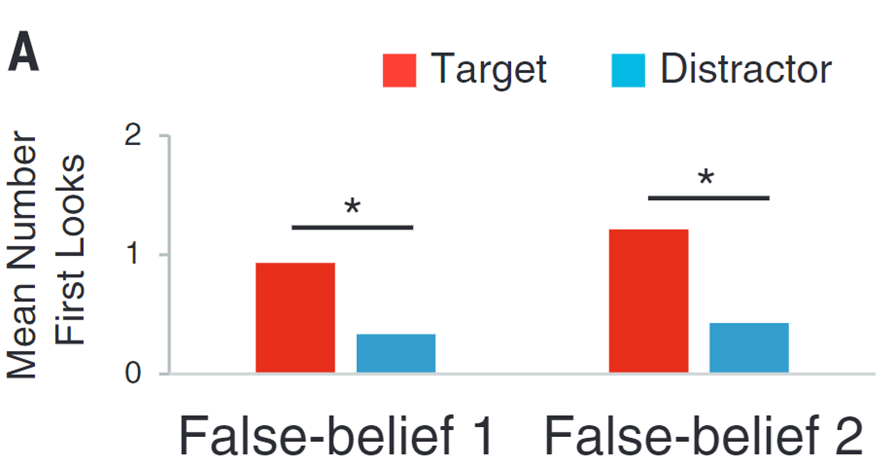
-false belief task
-engaging story for chimps
-used eye-tracking to examine where the chimps think the injured party will look
-chimps perform well and look toward target over distractor by significant margin
-demonstrates ToM - comparable with human studies
tool use and causal reasoning
-important leap for humans
-development of technology
-tools for a purpose
-cross-cultural
tool use in animals
-widespread across species → from insects to primates
-used in foraging behaviour - digging, knocking stuff down, dragging things, extending reach
-actual occurrences of tool use very rare
-lots of trained tool use within the lab but less so in the wild
Beck (tool use in animals definition)
-external employment of an unattached environmental object to alter more efficiently the from, position or condition of another object, another organism or the user itself when the user holds or carries the tool during or just prior to use
-responsible for the proper and effective orientation of the tool
tool use in dolphins
-corals have natural defences and can be unhelpful when dolphins are foraging
-dolphins hold sponges in their mouths to protect their noses when they are foraging
-cultural transmission of tool use behaviour → observe other dolphins doing it, do it themselves and then teach other dolphins to do it
tool use in crows
-manufacture hooks to fish for beetles
-find a stick that provides material to make a tool - pull off leaves, cut stick down to size, strip outer layers, change shape into a hook
-always hook to the left
tool use in chimpanzees
-tool-kits
-use tool kits to access honey from underground hives or termites
-find sticks that perform different tasks
-pounding sticks - breaking into nests
-enlarging sticks - after breaking
-collecting stick - bristles at end, made by chewing sticks, used to get bugs and honey
-sequential tool use → using one tool before they use another
limitations of tool use in animals
-most observable behaviours in foraging - no interaction between tool and other objects
-tools not manufactured specifically for purpose
-tools often serve only one purpose
-not intrinsic part of life for species
-not defining characteristic of species that engage in tool use
comparative perspective (tool use in humans and rhesus monkeys)
-provides a framework for understanding our own neuroanatomy that supports tool use
Peeters - method (comparative perspective for tool use in humans and rhesus monkeys)
-fMRI for observed actions and interactions with tool use
-humans compared with rhesus monkeys
Peeters - results (comparative perspective for tool use in humans and rhesus monkeys)
-similar activation for hand object interaction
-unique inferior parietal lobe activation in humans for tool object interactions - left lateralised
-located in anterior supramarginal gyrus (aSMG) → activation not present in rhesus monkeys
two streams for perception and action
-humans have two streams for perception and action
dorsal pathway → understanding where things are
ventral pathway → understanding what things are
ventro-dorsal pathway → understands how things work and how they interact → projects to aSMG (which monkeys do not have)
-would explain why monkeys can interact objects but cannot understand how objects can impact on another
-pathway that is specific to humans and tool use
 Note
Note  Flashcards (97)