Unit 3 Social and Moral Development
 Studied by 0 people
 Call Kai
 Learn
Learn Practice Test
 Spaced Repetition
 Match
Match Flashcards
 Knowt Play
1/102

There's no tags or description
Looks like no tags are added yet.
Name | Mastery | Learn | Test | Matching | Spaced | Call with Kai |
|---|
No analytics yet
Send a link to your students to track their progress
103 Terms
why do groups matter
allow for feelings of belonging
we want social community
and we need to know who to learn from and who to follow
Apicella and Silk 2019—hunter gathers
hunter-gathers cooperate widely; not just with kin
groups were small but fluid: ppl move between camps, cooperation persists
cultural norms maintain cooperation despite shifting membership
suggests that humans evolved for flexible, norm-based group living, not just family ties
our tendacy to form and favor groups builds on these deep evolutionary roots
dunhams definition of a group
collections of people united by commonality
the minimal group paradigm— dunhams “mere membership”
using existing groups have too much context when trying to determine how children think about groups and group membership
the claim: in group bias is derived from spontaneous consequence of self-categorization into social groups
ingroup bias appears even in the absence of conflict or when the groups are meaningless
Henri Tajfel 1970s
created minimal groups- groups stripped of real meaning to find the base line of group bias
even with arbitrary or random assignments (eg dot estimation, art preferences) , people still favored their own group
showed that in group bias can arise without history, competition or real stakes
Social Identity theory
tajfel and turner noted that self-eseteem tied to group membership → motivation to see the group positively
Dunham and Colleagues minimal group experiment
1) assigned the children to red or blue group via a coin
asked kid a variety question
Explicit Attitude: rated their liking of different targets
resource distribution: they could distribute five different tokens between two people
behavioral attribution: would ask them positive and negative questions to see which group they would associated it with
implicit association task
Rizzo et al 2018
do children distinguish between inequality that is a result of individual v structural causes
children tend to understand individual causes
structural factor: gender
dependent measures: expected leader allocation—how children expected group leader to allocate resources
own allocation:assed how children wanted to allocate the extra 8 prixes
reasoning as well
judgement of rectifying allocation: assessed participants judgements of a different child allocation of prizes that with rectified, maintained, or perpetuated inequality
Nortoon and Ariely 2011
-plotted us adults ideal, actual, and estimated wealth distribution
adults are aware of income inequality but are unaware of the vastness
people desire much more equal wealth distribution then either reality or their own estimates
inequality persist bc people are unaware of how unequal things are
Rizzo et al 2018 individual inequality causes
unequal allocations of resources based on differences in recipients
challanges of studying children’s inequality
children are biased to want equality
world is unequal so
Rizzo et al 2018 structural causes
unequal allocation of resources based on a group factor; uses gender—-inequality as a function of discrimination against social group
rizzo et all individual condition vs structural
individual condition: vignettes where group leader in camp allocated prizes based on recipients performances; inequality is created based on individual causes
structural condition was a vignette where group leader allocated the prizes based on recipients gender
Rizzo et al 2018 results
younger children recognize that resource distribution on the basis of merit will continue into the future, but do not recognize that resource distribution on the basis of structural causes will continue into the future
older children understand that both biases will continue in future no matter if the cause is individual or structural
both younger and older children are more likely to perpetuate inequality when it is justified via individual causes and are more likely to rectify structural inequalities in their own distribution of prizes
for younger children, regardless of individual vs structural children prefer equal distribution even when compared to rectification
for older children, they believe that perpetuating structural inequality is not okay but are more okay with perpetuating inequality for merit based inequality
Childrens belief on inequality
children believe that merit is a completely legitimate reason for inequality
Shao and heyman 2025
across middle childhood children believe that merit base systems encourage harder work compared to egalitarian systems
Leshin and Rhodes 2023
children show reduced bias and more fairness in resource allocation when structural inequalities are explained as being created by the high status group
structural explanations are ineffective if they cite a neutral third party or provide no explanation for why inequalities exist
interventions must explicitly address the role of high status groups to influence children’s perceptions and behavior
bias in force choiced
when children are forced to choose between two different options bias is more extreme
IAT
measures how quickly people associate different concepts (i.e. good vs bad) with different groups (men vs women)
its done on the computer words or pictures appear on the screen and people sort them into categories as fast as they can
this idea is that people respond faster when things are more closely linked in their minds share the same key
by comparing reaction times, the test reveals automatic or unconscious associations that people might not even be aware they have
Dunham and Colleagues minimal group experiment results
explicit attitude: children liked kids in their in group vs their outgroup
resource distribution: children showed a weak tendency to distribute more resources to their ingroup than their outgroup
behavioral attributions: there was little evidence of behavioral attribution based on group status
IAT: random assignment to a color group had a strong effect on iplicit preference for the group
Yang and Dunhams—limits of minikmal grouos
is there a way to turn of minimal group effect?
two conditions: minimal (random ) and maximal (assigned to group)
Measures: who do you like better, who is more like u, who would you like to share with
results found that ingroup was found in both minimal and maximal conditions
in group love
choosing your group because you really like your group
outgroup hate
choosing ur group because you really dislike the other group
aka outgroup derogation
buttelmann & bohm 2014
gave children the opportunity to divide positive and negative resources to no one, in group, or to out group members
for positive resources for both 6 & 8 year olds, most children choose to give to their in group over the out group or no one—evidence of in group love
for negative resources, 6 year olds are equally as likely to give to the out group as to give to no one; 8 year olds are more likely to give negative resource to outgroup—evidence of out group hate
in group love emerges earlier than outgroup hate
Misch et al 2021
— assigned different colors to children and asked in which group they like better as ingroup check
had kids log onto online games
two conditions: control—connection w the in group and it failed
in the experimental condition the child is expecting to work with the out group and connection fails
wanted to see if anticipatory cooperation can decrease ingroup bias
results: expermental conditions showed decrease in group options
Naturalistic fallacy
just because children say something does not mean its correct or right
limitations of social group race research
predominately focuses on white children
predominate focus on racial prejudice against Black individuals
predominant focus on monoracial participant and stimuli
ignores intersectionality
stereotyping
cognitive process of assigning characterisis tonindividuals based o their group membership
belief based (can be pos or neg)
ex: thinking “asians are good at math”
predjuidce
affective (emotional) attitude—typical negative—toward a groupand its members
emotion-based
feeling discomfort or dislike toward immigrants
discrimination
behavioral manifestation of prejudice—acting unfairly toward members of a group
behavior based
ex: refusing to hire someone because of their race
ingroup bias
tendency to favor one’s own group (ingroup) over others (outgroup)
can occur even without hostility; based on group identity
ex: preferring to work with people from your university over others
Raabe & Beelman 2011 developement of in group bias over childhood
meta analysis of 113 research reports worldwide (121 cross-sectional, 7 longitudinal studies)
saw that most studies were abt white children thinking about black children and explicit prejudice
from ages 2-4, there is no evidence of prejudice
rises between 4 and 5
peaks in middle childhood
declines in adolescence but could social acceptability bias
Shutts et al 2011, race preferences in South Africa
in south africa largest and most familiar group is black but white ppl have higher status as compared to US where white ppl have all 3 higher
wanted to see if pro white biases go away when whit is majority or is status causing it
results: for white, black and colored participants, they show a white bias ; children also perfer their own gender
black children never prefer their own race
the frequency of one race does not impact race preference
childrens preferences seem tied to social status
national unity messaging does not erase racial bias
social status isn’t the only influence
Rizzo et al 2022
children saw photos of gender matched peers (asian,black, latina, asian) and were asked who they want to play with
black child was chosen the least and below chance
latinos were chosen below chance
asian child were chosen at chance
white children were chosen more often than chance (pro white preference)
found no evidence of age, familiarity w black ppl, parent political identity, median family income, or region of residence changed the choice to not pick black ppl
OVERALL: Children showed consistent pro-White and anti-Black playmate
preferences, and these biases were not explained by measured
demographic or environmental factors
Perry et al 2022
researchers tested whether guided parent-child conversations about racism reduce racial bias in White U.S children (ages 8-12) and their parents
both children and parents showed declines in pro-white implicit bias after watching videos with blatant or subtle racism and disscussing it
color-conscious messaging predicted greater reductions in children’s bias
color blind ideology and external attributions predict smaller reductions in children’s bias
only worked in cases of subtle racism
had mixed or inconsistent effects on parents bias
color-conscious parent-child conversations may help reduce implicit pro-white bias in white children
color conscious messaging
were statements that directly acknowledged prejudice in the scenario or named the behavior as racially biased. They also included connecting the event to broader societal racism or explaining why the biased behavior was unacceptable
Colorblind ideology
were statements that downplayed or dismissed the role of race—for
example, suggesting the White child’s actions weren’t about race or shifting the conversation to non-racial explanations. They also included claims that skin color “doesn’t matter,” minimizing its significance
external attribution
were comments that blamed the White child's prejudiced behavior on outside influences rather than the child themselves. For example, participants attributed the behavior to things like parents’ comments or media exposure.
Leslie et al 2015 Brilliance and gender
adults study
looked at 30 different academic disciplines
FAB ( field specific abilities belief) fields that have success dependent upon innate brilliance or genius tend to have fewer women
innate gifts needed to succeed
measured fab vs percent of us phds that are women
results: in stem and humanities, the more ppl that endorse fabs show a lower amount of women
Bian et all
study 1: worked w 5, 6 and 7 year olds
would ask kids who they thought was really-really smart : two men and two men
control would ask who is really really nice
study 2: same as study one but was about children
results: at age 5 both genders have in group bias, as girls get older their in group bias decreases for being smart: the opposite is true
Study 3: 6 and 7 year olds introduced novel games, said that one game was only for children who are really smart
other condition was only for kids who try really really hard
asked kids whether or not they want to play the game
results: 6 and 7 y olds boys are more interested in the smart game, both genders equally interested in the try hard game
5 year olds show no difference in gender preferring the smart game, 6 year olds show boys choosing the smart game and girls not
cues to high social studies
physical size, physical strength, material wealth, decision-making power, and social influence
subjective social status (SSS0
a persons belief about his or her location in a staus of order
an individual’s perception of his or her place in the socieconomic status
lower SSS
lower overall health
reduced life expectancy
more depression
Amir et al 2019 SSS in children of diverese societies
uses the macarthur ladder task
4-18 yo across US, India, Argentina, Ecuador
across all sites, as you get older you are more likely you are to put yourself lower
sss decreases with age
macarthur ladder task
asks ppl to imagine the ladder as their country
top of the ladder are the ppl with highest amount of schooling, best hobs, and the most respect
bottom is the opposite
asks participant to put their family on the ladder
conflates a lot of different status types together
lower numbers= higher status
peretz-lange et all haves to haves not
377 4 to 10 yo in the US
MacArthur ladder task and relative social status
had families indicate their income on a scale and gave zipcode so they can compare
also asked kid to ask why they put themselves on ladder and coded for status cues and if they relied on what they have vs what they don’ t have
results: as children get older they place themselves lower on the ladder; as children get older they get more accurate and younger children perceive themselves as higher than reality;
the number of things children do not have correlates with sss; if they don’t have more things they perceive themselevs with low sss (did not correlate with what they have)
Mandalaywala et al 2020 race and gender as ques to social status
study 1: gender
diverse group of 3-6/7
used a rope, kids at the top had a lot of stuff and get to pick games and snacks; bottom was the opposite (mizes diff types of status)
asked where they would put a boy and a girl (racially matched)
results: male kids put boys above girls and this gets stronger as they get older; initially girls do not distinguish between boys and girls and as they get older they start to put girls lower
study 2: race
same set up as 1 but had them different races w gender standardization
children did not use race to predict status and age did not make a difference
children were however more likely to place the black kid in the worse house
Heck et al
looked at the different tasks used to measure status house vs ladder
These items are could be measuring very different thoughts about status, so we need to unbundle these different sorts of concepts
• One set of items is a forced choice measure and the other is not
Children in the United States
• Take in account gender when placing kids on the status ladder but do not take gender into account when assigning kids to nice or less nice houses
• Do not take race into account when placing kids on the status ladder* but
do take race into account when assigning kids to nice or less nice houses
goals of status work
To understand asymmetries in ingroup bias (i.e., girls not preferring
girls). Can status help resolve that conundrum?
Rhodes et al 2019—linguistic cues to increase girls in stem
kids often hear science as something special people
children may internalize the images associated w science
describing science as an activity may boost engagement
be a scientist condition: scientist use their five sense to learn about the world
do science condition:today we do science, when ppl do science they use their five senses
did four rounds, first two easy and second two were more difficult and misleading
children were given the opportunity to complete up to 10 additional trials and they wanted to measure persisting
girls are more likely to persist when in the do science condition; boys were more likely to persist in the be a scientist
action focused language increases girls persistence
hilliard & liben 2010 gender salience
high vs low salient classrooms
high= they were told to separate and emphasize gender differences
dependent measure
children were shown pictures of occupations and activities and asked if girl boys or either should do it
results: high salient classrooms showed decline in reporting both genders can do it
Enright et al 2020
wanted to see if children differentiate between the four dimensions of status
study 1
gave them vignettes for each of the different power cues and asked who was in charge based on the results of each story
children use all of the cues
study 2
same as study 1 but using macauthers ladder, no longer forced choice
children use all of the cues
study 3 and 4
how do 4,5, ad 6 think about resource distribution
would ask who would they give an eraser to
study 3 w 4 and 5 yo was inclusive
study 4 found that both 5 and 6 gave to lower status person
study 5
study 1 and 2 w 3 yo
they used all cues
four dimensions of status
wealth, physical dominance, decision making power, and prestige
Schwartzstein & hwang 2025
do us children express social preferences based on political group markers
did political affiliation interview; asked kids what their political party who they voted for and then what they thought their parent was
6 and 7 yo most do not report a party tht they are in
age 8-12 about 2/3 pick a group to be affiliated with
a lot of kids dont sort themselves into groups
also asked kids who they like more comparing campaign signs
kids who pick a party tend to like the person who are associeted with their political party
all kids tend to not have a prefence in broad political party
but , children show preferences for those whose political affiliations match their parents’ even if they themselves aren’t political
Schwartzstein & hwang 2025 political identity take aways
In middle childhood, children are developing a political identity
• I’m skeptical about how deep this is, but these data provide a foundation
• For children who identify politically, they show ingroup bias
• But that’s perhaps not that surprising given the minimal group work
• What’s perhaps more interesting is that, for children who do not
yet really understand politics, they express an ingroup bias that
aligns with their parents. So perhaps children are subtly picking up
on things?
Leshin et al
asked kids about costly third party punishment in science musem about outgroup (vistors) vs ingroup (from the area)
parents political party effects who children choose to punish
kids of conservative parents are more likely to punish outgroup children
kids of liberal parents punish ingroup more
overall political identiy take aways
Again, children seem to be developing a political identity in
middle childhood, but I think there’s still a lot to know regarding
what precisely it is that they know about political groups.
2. Despite not having a robust political identity, they express
ingroup preferences that align with their parents AND their
parents’ political ideology appears to shape their cooperative
preferences
religion
For the purposes of this lecture, I’ll define religion as a system of
spiritual beliefs, practices, or both, typically organized around the
worship of an all-powerful deity + involving behaviors such as
prayer, meditation, and participation in collective rituals
two positions of religion in cognitive science
religion as an adaptationn something abt a religion increases fitness
religion as a byproduct of different evoloved functions
bloom and banerjee
byproduct position
human mind has evolved systems like
hyperactive agency( seeing agents where non exists)
theory of mind (infering intention)
teleological thinking (assuming purpopse in nature )
these are evolutionary and religion comes out of theses as a side effect
we are prepared to form religioys beliefs but religion itself was not selected for because it solved anything
cultural learning, testimony and upbringing then stablize and transmit religious ideas
adaptation position
religion evolved because it provided survival benefits such as
promoting cooperation
strengthening group cohesion
supporting moral norms
increasing group success in conflict
religion is biologically culturally selected solution to social coordination
ex: costly rituals—promotes group cohesion and norms and success
richert and corriveau— developement of religious cognition
religious cognition developed through cultural transmission a
studying how children come to understand religious agents, existence and religious identity reveals how cognition and culture shape other throughout development
religious agents
Gods, prophets, and angels
Do children endorse the existence of these agents?
• How do children think about the minds and bodies of these agents?
• Do children appeal to supernatural agents when explaining events in the
world?
world?
Davoodi et al 2020—unobserbvable beliefs
Children often believe in things they can’t see (like germs or God), and this study looked at how they explain those beliefs.
children were asked about the exisgtence of heaven, god and angels and askedd them why
• Researchers compared children from a religious minority group (Christians in China) with religious majority groups (Muslims in Iran, Christians in the U.S.).
• All children generally believed both scientific and religious unobservable entities exist.
• For scientific unobservables (germs, oxygen), children across all groups mostly gave explanatory or fact-based justifications, not “someone told me.”
• For religious unobservables, minority-group children relied more on testimony (e.g., “my parents told me”), while majority-group children used more elaborative explanations.
• This suggests that community status matters: when children’s beliefs are less supported by the broader society, they depend more on trusted sources to justify them.
encounter explaination

source explaination
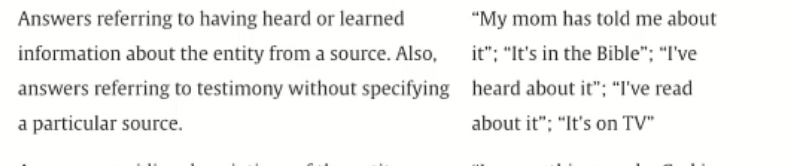
elaboration explaination

uninformative explaination

davooid et al results
for religious beliefs
younger children in US and Iran rely more on elaboration explaination while in china they rely more on source
When kids hear different or conflicting ideas, they pay more attention to who said what and use that to explain why they believe something.
whe kids are minorities they rely more on trusted adults
nature of existence
What does it mean to exist?
• What are the origins of life?
• Considers concepts such as the afterlife, pre-existence, and souls
tenebaum and hohenstein 2016
The study looked at how 124 British children and their parents explained the origins of humans, animals, and plants
• Participants engaged in a storybook task where they were prompted to discuss humans, animals, and plants
• 7-year-olds tended to favor creationism, while 10-year-olds endorsed creationism and evolution equally
• Children’s views were strongly linked to their parents’ views across all three kinds of living things
• Overall, the study highlights how parent–child conversations play a key role in shaping children’s understanding of scientific ideas
tenebaum and hohenstein 2016 results
Children whose parents strongly
endorsed evolution showed
balanced support for evolution and
creationism, while children whose
parents did not strongly endorse
evolution showed more creationist
beliefs.
• This supports the idea that parents’
beliefs are linked to children’s
beliefs.
• Age mattered: 7-year-olds favored
creationism, while 10-year-olds
endorsed evolution and creationism
equally.
religious identity
6- to 8-year-olds show ingroup bias for their religious group
• At the same time, there is newer evidence that children don’t really fully understand what it means to be a part of a religious group until age 7/8, even in places where religion is very central (such as Northern Ireland) (Dautel’s unpublished work)
ingroup is based on actions they dont really understand what it means to sort themeselevs into a group
Religious essentialism
is the belief that a person’s religion reflects deep, inherent qualities that define who they are
conflict and religious essentialism
Essentialism is stronger where religious categories are tied to socio-political conflict (Israel, Northern
Ireland) than in contexts with lower salience of conflict
parental influence and essentialism
Children whose parents use essentialist language or endorse avoidance of outgroup contact show stronger essentialist thinking
exposure to diversity and religious essentialism
Greater contact with religiously diverse peers in schools predicts lower essentialism and greater flexibility
peter singer— expanding the circle bok
comes from utilitarianism perspective—what is moral has the greatest positive impact
two aspects—our moral circle has expanded over human history (rights have been expanded such as human rights )
argues that rationality is the explanation for this expansion
peter singer historical argueent
our moral circle has expanded over time
peter singer psych arguement
our moral circle expands over development
• Relies on arguments about Piaget and Kohlberg
crimson et al 2016 moral expansiveness scale
would ask adults to place varius entities within different circles of moral concern, validated the different circles of moral concern based on how people grouped their responses
Inner circle of moral concern:
Entities within your inner circle are those closest to you and deserve the
highest level of moral concern and standing. You have a moral obligation to ensure their welfare and
would even make personal sacrifices to ensure they are treated morall
Outer circle of moral concern
Entities within your outer circle are deserving of moral concern and
standing. You are still concern about their moral treatment; however, you are less likely to make personal
sacrifices to ensure they are treated morally
Fringes of moral concern:
Entities on the fringes of moral concern may have some moral rights and
standing, but you do not feel a personal sense of responsibility for their moral treatment
Outside the moral boundary:
Entities outside the moral boundary have no moral standing and are not
deserving of moral consideration; to be concerned about their moral treatment seems extreme or
nonsensical.
kirkland et al. 2023
how does moral concern vary across different cultures based on different societal factors
broader moral concern is shown by higher MES
there is some varriability across cultures
waytz et al 2019
ideological differences effect on expanse of mes score
very liberal individuals cafe more equally about humans vs non humans
for very conservative people they care much more about humans vs non human actors
what do we know about adults circles of moral concern
The Moral Expansiveness Scale (MES) is an effective way of measuring adults’ moral expansiveness
• Moral expansiveness varies across cultures and across ideological lines
• These findings have connections to rich philosophical discussions
marshall et al 2024
evidence shows that children tend to exhibit more constructivism
relational closeness
family members vs stranger
physical closeness
close stranger vs far away stranger
phylogentic closeness
human vs non human animal
moral expansion developmental trajectory
as children develop they begin to care more about distant groups
moral expansion developmental trajectory
as u get older you care less about out groups
neldner et al 2022—i may not like u but i still care
showed children mat w concern circles
3 circles and gave them pictures to sort how they care about things
children show a hierarchy of moral concern along the lines of what you’d expect, and that seems relatively stable across age (care a lot about a lot of things but prioritize family and such)
moral concern for non human entities tend to loose care while for the needy it increases with age
children moral concern and care
Children distinguish between moral concern in terms of protection from mere liking
There are some age-related changes with respect to specific targets but less overarching age-related changes
Having established this measure as effective, future questions remain, including understanding what factors lead to greater moral expansiveness or narrowness
four circles of moral expansiveness in order
IOFO
inner, outer, fringes, outside the moral boundary
wilks et al 2021
do children between the ages 5-9 treat the lives of human as morally more important that the lives of animals and how does it compared to adults
hypothetical dilemmas where they had to pick a boat to save, with different quantities of each animals in the boars to determine how participants save off one human vs animals
Results:
Children were far less likely than adults to prioritize humans over animals.
Many children chose to save multiple animals (esp. dogs) over a single human. In some cases, children valued a dog’s life as much as — or more than — a human’s.
Challenges assumption that humans inherently see other humans as
more morally valuable than animals; points toward developmental and
cultural origins of speciesism.
speciesism
“human > animal” bias
 Note
Note  Flashcards (46)