International Politics Study Guide
 Studied by 12 people
 Call Kai
 Learn
Learn Practice Test
 Spaced Repetition
 Match
Match Flashcards
 Knowt Play
1/112

There's no tags or description
Looks like no tags are added yet.
Name | Mastery | Learn | Test | Matching | Spaced | Call with Kai |
|---|
No analytics yet
Send a link to your students to track their progress
113 Terms
Rationality
actors make choices that maximize their utility or meet their goals on preference and available information.
Interests
what actors want to achieve through political action (security/wealth/power/ideology)
General/National Interest
those shared by all actors within a country (security, welfare)
Particularistic Interests
those held by a small number of actors within a country
Cooperation
act of groups working together to achieve common goals or mutual benefits.
Pareto Frontier
the line representing the possible divisions of the maximum feasible benefit.
Free riding
when actors have incentives to defect from their originals arrangement benefiting from recourses/services they did not pay or work for.
Pareto Optimality
a situation where no participant can improve their own outcome without making at least one other participant worse off. (assume actors will be okay with any division on the line)
Pareto Optimal Solution
utility has been maximized, and someone has ended up better off.
Bargaining
negotiation process where two or more parties engage in discussions to reach an agreement on the distribution of a good, resource, or outcome.
Asymmetrical similarities
(a lot of the reason why states go to war)
Bargaining One Assumption
war is a costly gamble in lives and expenses; no one will know how it will end, and there is unknown information about its resolution.
Bargaining Two Assumption
A gets everything or B gets everything, which is their ideal outcome for both sides; any gain for one is at the expense of the other.
Iteration
repetition or recurrence of a process or action, often with the goal of achieving a particular outcome or resolving a problem.(involve repeated interactions between actors, leading to the development of norms, expectations, and cooperation over time.)
Reciprocity
involves responding to actions or behaviors with similar actions or behaviors, often as a way to create mutual benefits or maintain equilibrium.
Iteration
Limiting numbers/ identifying privileged groups
Increasing iteration to punish defection
Increasing linkage to reward cooperation
Providing better information
Collective Action Problem
a group of individuals, despite having a shared interest or goal, faces difficulties in coordinating and cooperating to achieve that goal due to barriers like free-riding, where individuals benefit from the collective effort without contributing equally.
Collective Action Problem Easiest
magnify the influence of relatively small, but organized groups.
= in a smaller group. People retain sovereignty, but you need a leadership structure to channel these interests into something tangible.
Power
ability of a state or actor to influence the behavior of other states, shape outcomes, or achieve its objectives.
Power measurements
military strength
economic resources
diplomatic influence
culturally
ideologically
Alliances Historically
risen from concerns about maintaining a balance of power in which the capabilities of one actor or group of actors are roughly equal to those of another.
Institutions
refers to formal organizations, rules, and structures established to govern and regulate various aspects of human interaction within a society or across nations.
Why do actors struggle to cooperate?
Incentives to defect
Large numbers of actors, conflicting interests
Singular interactions (one-shot game)
Imperfect information
Institutions can help solve these problems
Kellogg-Briand Pact
was a treaty or Pact of Paris. It was a Pact, not an Alliance. (1928)
Set standards of behavior
Meant to trip us up (not the answer)
NOT AN ALLIANCE
Security Dilemma
The security dilemma is a concept in international relations and security studies. It describes a situation in which one state’s efforts to increase its own security are perceived as a threat by other states, leading them to respond with similar measures for their security.
Factors Exacerbating the Security Dilemma
Technology
Geographical proximity
Costs of defense/ offense
Bargaining Power
Divisible Goods
bargaining and its difficulties; how can this problem be exasperated by outside perspectives (strategic)
Bargaining range
set of possible agreements or outcomes that are acceptable to both parties engaged in a bargaining or negotiation process.
Incomplete Information
refers to a situation in which decision-makers, such as political leaders or policymakers, do not possess all the relevant data or knowledge needed to make optimal decisions.
Actors are always…..
operating with incomplete information
Credible Signals
refers to communication or action by one party in a conflict or negotiation that convinces the opponent that the threat being made is genuine and likely to be carried out.
First-Strike Advantage
A first Strike advantage is a strategic advantage that one party has when it is capable of launching an attack preemptively against its adversary.
Alliance
An alliance is a formal agreement or treaty between two or more states in which they cooperate and provide support. (ALLIANCES: FIGHTING SOMEONE ELSE WAR)
Offensive alliances
help actors coordinate strategy and divide the spoils of war (ex: Molotov-Ribbentrop Pact)
Defensive Alliances
set standards of behavior and secure commitments of support in case of attack by a third party (ex: NATO)
Interest Groups
organized associations of individuals or organizations that advocate for specific policy preferences or interests.
Interest Groups Function
as a way to organize the menu of things out there, into a cohesive idea and agreement.
Interest Groups Seek…
influence government decisions and policies
lobbying
mobilizing public support
engaging in various advocacy activities
Rally Effect
during a crisis or conflict, there is a surge in public support and unity for a country’s leadership, particularly its head of state or government.
Bandwagoning
is a strategy in international relations where a state aligns itself with a more powerful or threatening state or ideal to gain benefits. it typically involves joining the stronger side.
Collective Security
multiple states commit to mutual defense and the prevention of aggression by standing together against any state that initiates armed conflict.
Collective Security aims
deter potential aggressors
maintain peace by collective action
cooperation among members
ex: United Nations, League of Nations
Coordination
driving on the same side of the road
Collaboration
stag hunt
Irredentist
goal is to change the nature of government and the system as a whole (ex: Irish group)
Separatist
is to break away from government (ex: )
Tying hands
creating audience costs that they will suffer if they do not follow through on their threat or commitment.
Cheap-talk
talk that has no credibility
Commitment problems
Audience costs are negative repercussions for failing to follow through on threats or commitments.
Absorbing audience costs helps actors “tie their hands.”
Needs to be credible commitment to the other country with signing alliances.
Collective security organizations
broad-based institutions that promote peace and security among their members
MECHANISMS OF COLLECTIVE SECURITY
Sovereignty
The expectation that states have legal and political supremacy within their territory
Which category of interest is usually considered the most basic and a prerequisite for other goals?
Security
Why did the United Nations Security Council not endorse the preventive war against Iraq in 2003?
Several permanent members of the Security Council opposed going to war against Iraq and could veto any endorsement of the war.
A person goes to college with the hope of improving his or her earning power and future income upon graduation. This is an example of which type of goal an actor might have?
material welfare
Leaders within a country may want to enact democratic reform to increase voter participation. This is an example of what kind of state goal?
Ideological
Which of the following would be considered a threat to the nature of sovereignty?
A superior international government
What is a strategic interaction?
A condition in which each actor’s plan is contingent upon its estimate of what the other actor is expected to do
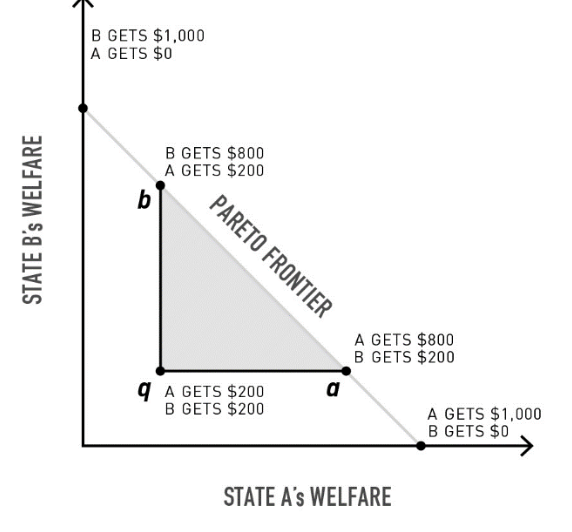
In the figure, a point on the line segment ab represents what is in relation to q?
A gain for both actors
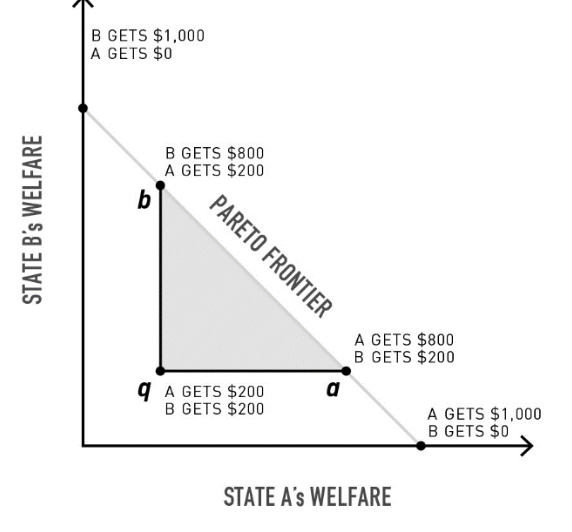
What does line segment QB represent?
Possible improvements for actor B that do not affect the welfare of A
In which of the following situations would you expect defection?
Individual interests of one supersede the collective interest
Which of the following is an example of a solution to a coordination problem?
Cybersecurity experts set a universal standard format for malware reporting so that all firms can share.
Why does anarchy cause war?
No authority exists to stop a state from using force to advance its own interests.
Which of the following is the most common reason states have historically gone to war?
Two states claim the same territory.
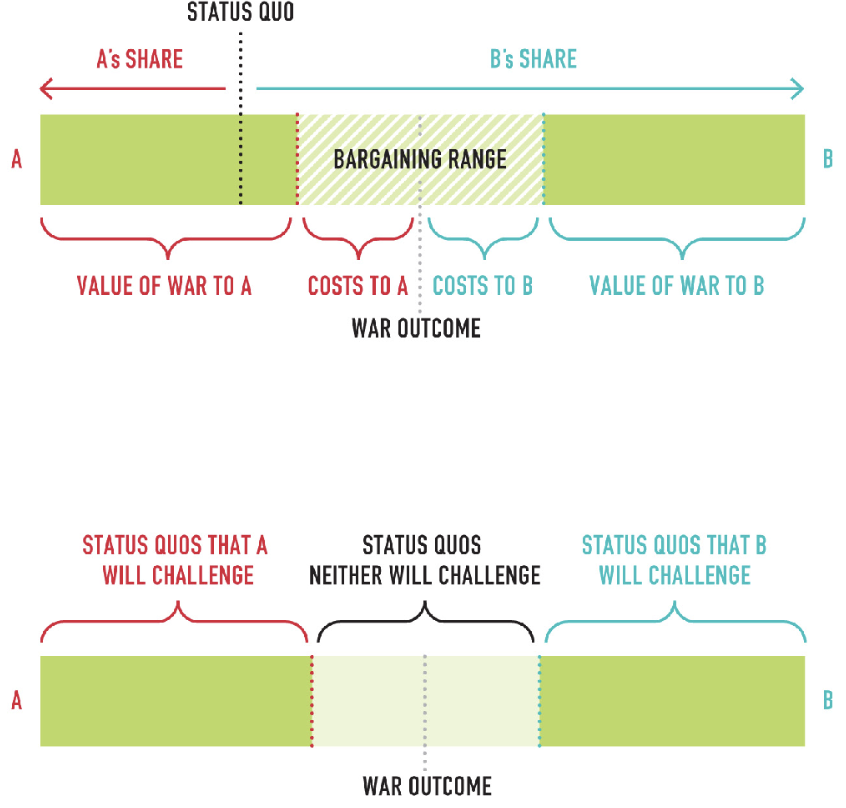
In the figure, what do the words “Bargaining Range” represent?
The set of deals to which both states will agree
Why might states decide not to go to war over a disputed good?
The costs of war are higher than the expected benefits from war.
In the case of the threat by the United States to attack Afghanistan in 2001, the status quo was:
Taliban control of Afghanistan.
Which of the following explains the decline in interstate conflict?
International institutions have helped states overcome important bargaining problems.
During the Cuban missile crisis, the United States put nuclear missile crews on alert and took other advanced steps to prepare for war. This is an example of what?
Brinksmanship
Which of the following is an example of a national interest?
The need for a country to maintain economic growth
In 1982, British Prime Minister Margaret Thatcher responded aggressively to the Argentine invasion of its little-valued Falkland Islands territory in order to distract the British people from their economic problems. What kind of motivation did this conflict constitute?
Diversionary incentive
Which of the following would be considered an interest group in the United States?
The Cuban American National Foundation, a Florida-based group seeking increased democracy in Cuba
Game theory
a tool for analyzing strategic interactions. Over the last 50 years, it has been developed and applied broadly in nearly all the social sciences.
cooperation (c) and defection (d)
Prisoner’s Dilemma
Each prisoner can either cooperate with his accomplice and refuse to provide evidence to the district attorney or defect on his accomplice by ratting him out.
Chicken Game Theory
Two drivers speed down the middle of the road toward one another. The first to turn aside, the “chicken,” earns the name.
The Stag Hunt
capture the rabbit alone, but to do so he must abandon the stag, ensuring that it will get away.
work together to capture the stag which allows food for everyone.
Why do states often engage in interactions (bargaining, cooperative, diplomatic), when potential challenges can arise during these interactions?
In international relations, how can the absence of clear rules and norms lead to conflicts or disagreements among nations?
Discuss the various diplomatic and economic tools that a country like the United States could employ to influence the actions of another nation, using a real-world example if possible.
Explain the role of intelligence gathering in foreign policy decision-making and provide an example of a situation where incomplete information impacted a nation's actions.
Illustrate the concept of "tying hands" in international diplomacy, citing an example from history or current events.
Compare and contrast the strategies used in international negotiations with strategies employed in a high-stakes game of chicken. What are the similarities and differences?
Why do interest groups often hold significant influence over a country's foreign policy decisions, and how might this influence shape international relations?
Discuss the advantages and disadvantages of a nation possessing a first-strike capability in modern geopolitics. Provide examples to support your arguments.
Explain the concept of the "rally effect" in international politics and analyze its impact on a leader's decision-making during times of crisis.
How does the transparency of democratic institutions affect a country's credibility and ability to negotiate in international conflicts?
Analyze the historical trends in the formation of defensive alliances between nations and their impact on international stability.
Evaluate the role of emerging technologies in shaping international security dynamics. Which technological developments are more likely to contribute to stability, and which may increase instability?
Discuss the responsibilities and challenges faced by peacekeepers in post-conflict zones, highlighting their role in maintaining peace and security.
Provide examples of historical instances where states engaged in bandwagoning or balancing strategies in response to changing international power dynamics.
Examine the ethical and practical considerations that states weigh when deciding whether to support or oppose humanitarian intervention in another country's internal conflicts.
Assess the evolution of the veto power within the United Nations Security Council and its implications for global governance.
Suppose a group of people with cars are trying to coordinate with one another on which side of a road to drive on. In their efforts to do so, they are
likely to find a mutually acceptable solution that requires little enforcement from the police.
Under what conditions would a nuclear deal between the United States and Iran most likely succeed?
The current Iranian government is replaced by a liberal democracy
Which of the following statements best describes the possible constraints leaders face when considering whether to go to war?
Most leaders have to consider the response of the public when thinking of going to war.
Which of the following is an example of the rally effect?
A leader enjoys a temporary boost of public support after declaring war
Why are the United States and South Korea more likely to cooperate on security issues?
Because they are better able to threaten reciprocal punishment and cooperation in the future by breaking trading ties.
Why was the Doomsday machine an ineffective mechanism for tying hands?
No one else knew about it
Which of these is the best example of "cheap talk"?
An autocratic leader who vows to respect human rights.
Which of the following technologies is least likely to exacerbate a security dilemma?
The development of trench networks.
A peacekeeper's main job is to patrol a post-conflict zone and to witness violations of peace agreements between opposing parties in a dispute.
True
 Note
Note  Flashcards (31)