Biology Exam Review Grade 11 - GENETICS
 Studied by 0 people
 Call with Kai
 Learn
Learn Practice Test
 Spaced Repetition
 Match
Match Flashcards
 Knowt Play
1/17

Earn XP
Description and Tags
Unit 2 - Genetics part 1 and 2
Name | Mastery | Learn | Test | Matching | Spaced | Call with Kai |
|---|
No study sessions yet.
18 Terms
How many chromosomes and SETS of chromosomes do humans have?
We have 46 chromosomes and 23 sets
What is the structure of a chromosome?
The DNA is tightly wound around a histone, and forms a nucleosome. Multiple of these form chromatin, which makes up a chromatid. There are also telomeres at the ends of each chromatid. 2 chromatids are held together with a centromere
how many chromosomes are inherited from each parent
You get 23 chromosomes from your mother and 23 from your father, totaling 46 chromosomes (23 pairs) in each cell
Define alleles
Alleles are variants of genes
Define dominant
A dominant trait is a trait that can easily overrule the other trait.
Define recessive
A recessive trait is a trait that can be easily overrruled by the other trait.
Define genotype
the complete set of an organism's genetic instructions, essentially its entire DNA blueprint containing all the information needed to build, function, and maintain that living being
Define hybrid
An offspring resulting from the combination of two genetically different parents, such as different species, subspecies, breeds, or varieties, inheriting traits from both.
Examples: Liger
How do cells turn DNA into proteins?
Step 1: The DNA is transcribed into mRNA. The DNA hydrogenous bases are unzipped by a special enzyme that builds a complementary RNA strand on it. This strand is known as mRNA
Step 2: This mRNA makes its way to the ribosomes for protein synthesis.
Step 3: The tRNA brings amino acids to the ribosome and attaches the corresponding amino acid to the right codons. As this is happening, the amino acids are bonded with peptides
Step 4: After the ribosome hits a stop codon, the mRNA is turned into a polypeptide chain. The polypeptides are folded into proteins
Step 5: The proteins go to the rough E.R for quality control and folding, and then they are sent to the Golgi Apparatus to be modified, stored, and packaged.
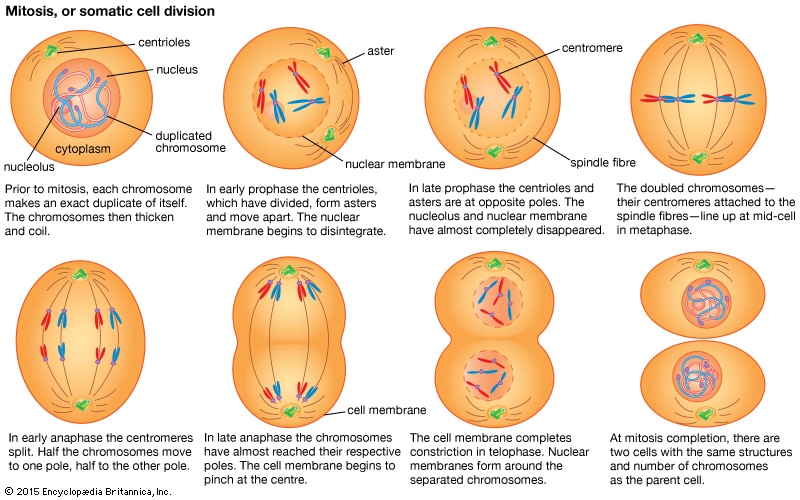
Describe the stages of mitosis
Interphase - growth 1 - regular lifecycle, synthesis - chromosomes duplicate and prepare for division, growth 2 - growth prep for mitosis
Prophase - Centrioles go to opposite ends of the cell, nuclear membrane starts to disappear, spindle fibres start to form, nucleolus disappears, chromosomes condense
Metaphase - chromosomes line up on metaphase plate and spindle fibers attach
Anaphase - Chromosomes are pulled apart to opposite ends of the cell
Telophase - Nuclear membrane begins to reform, spindle fibers break down
Cytokinesis - Cell splits
2 diploid daughter cells are formed
Describe the stages of meiosis
Interphase 1 - Original cell is diploid. DNA and chromosomes are doubled. Growth and synthesis occur
Prophase 1 - chromosome pairs join together at the centromere to for tetrads. The alleles cross over and the nuclear membrane disappears. Spindle fibres also start to form
Metaphase 1 - Tetrads line up at the metaphase plate
Anaphase 1 - tetrads are pulled apart to form homologous chromosomes
Telophase 1 - Chromosomes uncondense and nuclear membrane begins to reform. Cells divide and 2 different haploid (23 chromosome) cells are formed
Interphase 2 - Brief period of growth and protein replenishment
Prophase 2 - Same as prophase 1 but no crossing over and different chromatids.
Metaphase/anaphase 2 - same except each chromosome gets pulled apart to chromatids
Telophase 2 - End up with 4 individual haploid cells with genetic diversity
Describe what a silent mutaton is
A silent mutation occurs when there is a change or problem in a chromosome, but that change does not result in a change in phenotype. (the mutation is not expressed, the individual functions normally)
Mutations that occur in non-coding DNA (junk DNA)
The DNA is altered but no structures or chemicals are made from it
Recessive mutations in diploid organisms
This mutation can be silent for me but not for my kids if me and my partner both have recessive genes to form a homozygous recessive allele.
Explain the types of genetic mutations
Point mutations - Only one point in the gene is incorrect, so only one gene malfunctions. Usually minor, but can be dangerous. Example: Colour blindness: When cone cells in the retina don’t work properly
Chromosomal Deletion - A piece of a chromosome is broken off or goes missing, so genetic information is lost and cannot be passed down. Because of this, body parts can’ be properly made. Caused by unequal crossing over/synapsis. Example: Angleman’s syndrome
Polyploidy - This happens when cells do not go through the second division of meiosis, and a gamete with too many chromosomes is produced. 3n cell, Gametes have a full set of chromosomes + 1 ½. Examples: In lizards: they can grow back tails. In humans: can cause miscarriage and even death of the child after birth.
Describe what happens during nondisjunction
Chromosomes fail to separate properly during meiosis, resulting in gametes with abnormal numbers of chromosomes. Examples: Down syndrome - Extra chromosome 21 (trisomy 21)
Difference between Trisomy and monosomy
Trisomy is when each cell has 22 pairs of chromosomes and one set of chromosomes with 3 pairs, and monosomy is when each cell has 22 pairs of chromosomes and one set of chromosomes with only one. Trisomy is when there is an extra copy of a chromosome (47), and monosomy is when there is an absence of one copy of a chromosome (45).
Describe incomplete dominance
Occurs when a heterozygous individual expresses a 3rd phenotype that’s a blend between the other 2 phenotypes. Neither is dominant.
Example: let b be black, let w be white, let bw be grey
Describe co-dominance
Occurs when a heterozygous individual expresses a 3rd phenotype where both phenotypes are expressed at once. Neither is affected by eachother.
Example: let b be black, let w be white, let bw be black and white stripes
Describe Mendel’s 3 laws of segregation
1. Offspring receive one factor (allele) from each parent for each inherited trait.
2. For each trait there is a dominant factor (allele) and a recessive factor (allele).
3. There is an equal chance that a parent will donate either factor to their offspring
 Note
Note  Flashcards (55)