Y8 Biology (help me please) (copy)
 View linked note
 Call Kai
 Learn
Learn Practice Test
 Spaced Repetition
 Match
Match Flashcards
 Knowt Play
1/133

Earn XP
Description and Tags
heh.....
Name | Mastery | Learn | Test | Matching | Spaced | Call with Kai | Chat |
|---|
No analytics yet
Send a link to your students to track their progress
134 Terms
Define the term “cell”
Cells are the basic building blocks of life and are the smallest structural and functional unit of all living organisms.
What is the function of the cell membrane?
It regulates what enters and exits the cell.
State the 3 points of cell theory
all living things are made of cells
cells are the basic building block of all organisms
new cells are formed from the division of parent cells
What is the cytoplasm?
A watery, jelly-like substance that contains the organelles and dissolved substances.
What is the mitochondria?
The powerhouse of the cell that helps convert glucose into energy the cell can use.
What do ribosomes do?
build protein for amino acids
What does the smooth ER do?
builds lipids and carbohydrates
What does the rough ER do?
stores protein made by ribosomes
What is the function of the Golgi apparatus?
It takes in sacs of raw material from the endoplasmic reticulum and sends out sacs containing finished cell products.
What are lysosomes
sacs filled with digestive enzymes that digest worn-out cells and nutrients
what are centrioles
a pair of bundled tubes that organise cell division
What is the function of the cytoskeleton?
Gives shape to cells and facilitates organelle movement
What is the role of chloroplasts in plant cells?
Carries out photosynthesis
what is a vacuole?
A large, water-filled sac that keeps plant cells pressurized
what is a cell a wall, and what is it made out of in a fungal cell?
a cell wall is a very strong, rigid structure that is made of cellulose and protects the cell from rupturing. in a fungal cell, it is made of chitin.
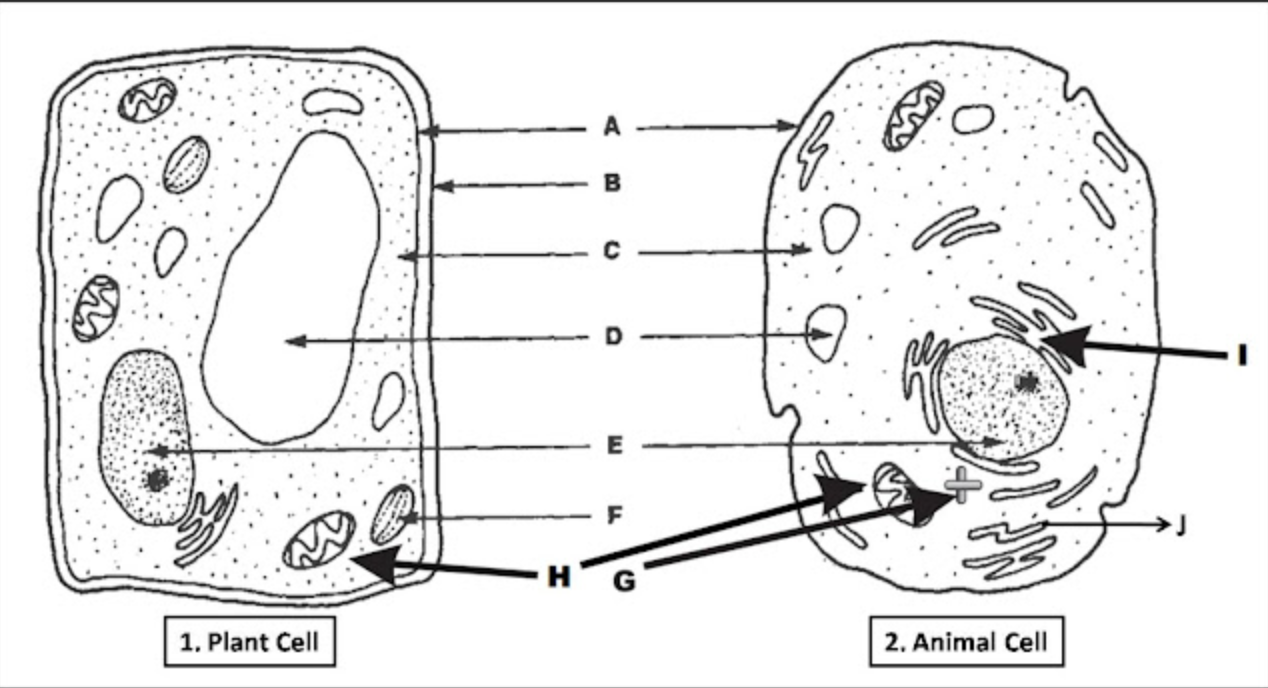
Label:
A: cell membrane
B: cell wall
C: cytoplasm
D: vacuole
E: nucleus
F: chloroplast
G: centriole
H: Mitochondria
I: smooth ER
J: rough ER
What is the primary difference between unicellular and multicellular organisms?
Unicellular organisms are composed of a single cell, while multicellular organisms consist of multiple cells.
What is the difference between a eukaryotic and a prokaryotic cell?
Prokaryotic cells have circular DNA, are unicellular, smaller in size, organelles lack a membrane, and ribosomes are their only organelle, where has eukaryotic cells have linear DNA, are multicellular, larger, and have multiple organelles
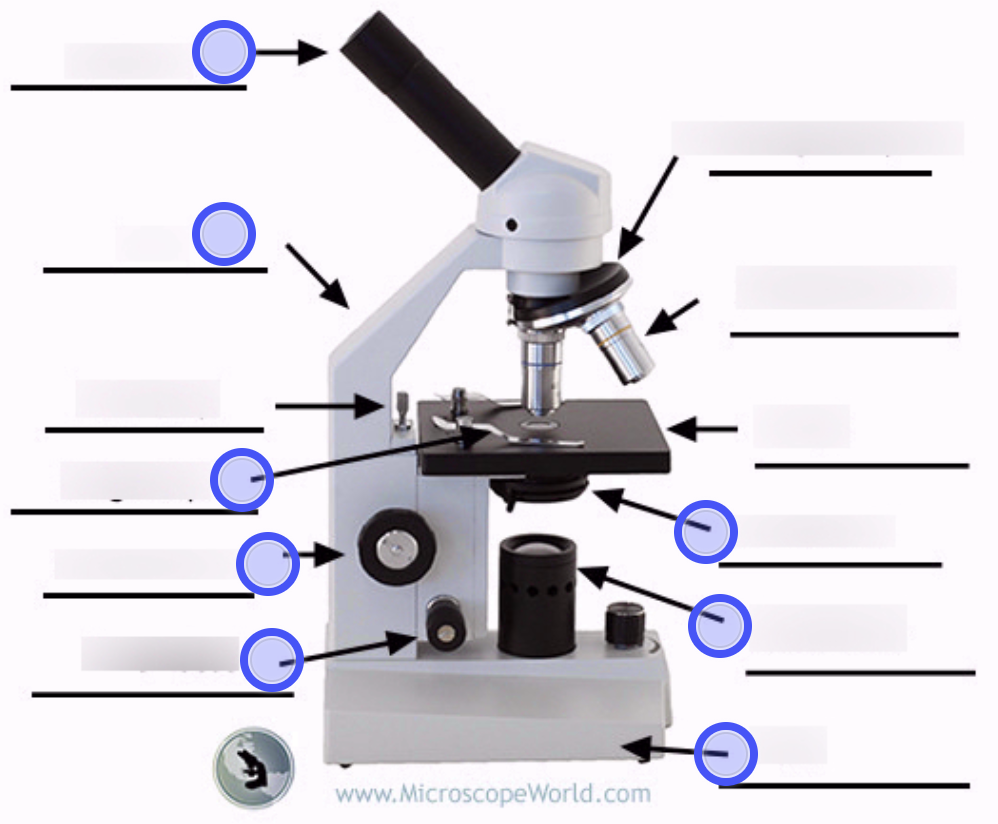
Going from up to down in columns, label this diagram. (ignore the third arrow)
eyepiece/ocular lense
arm
stage clips
course adjustment knob
fine adjustment knob
revolving nosepiece
objective lens
stage
diaphragm
light source
base
what is the body tubes function?
used to look at the specimen and magnify the image for the second time
what is the revolving nosepiece’s function
it can be rotated clockwise or counter clockwise to change the magnification
what is the objective lens?
it magnifies the image for the first time
what is the stage clip?
it holds the slide in place
what is the function of the diaphragm
it controls the amount of light that reaches the specimen
what is the function of the light source
the light projects up through the slide to illuminate the sample
what is the function of the ocular lense or eyepiece
it is used to look at the specimen
what is the function of the arm?
it supports the microscope when it is being carried
what is the function of the stage?
the stage is where the specimen is placed for viewing
what is the function of the course adjustment knob?
it moves the stage up and down for focusing
what is the function of the fine adjustment knobs?
it moves the stage slightly to sharpen the focus
what is the function of the base?
it supports and provides stability for the microscope
How do you calculate total magnification in a microscope?
Multiply the ocular lens magnification by the objective lens magnification.
what are the advantages and disadvantages of a light microscope?
Advantages | Disadvantages | |
Light |
|
|
what are the advantages and disadvantages of an electron microscope?
Advantages | Disadvantages |
Electron |
|
|
what is mitosis?
Mitosis is the simple duplication and division of a cell and all of its parts, and occurs for growth and repair.
What is the acronym for the stages of mitosis?
IPMAT
What is the interphase?
The resting stage of a cell
what happens during the prophase?
a cell gets the idea it is time to divide so it duplicates DNA, gets certain pieces such as centrioles in the right position, and generally prepares the cell for mitotic division
what happens during the metaphase
The DNA lines up along a central axis and the centrioles send out specialised tubules that connect to the DNA
What happens during anaphase?
Half of the chromosomes are pulled to opposite sides of the cell.
What is the telophase?
When the cell membrane closes in and splits into 2 new pieces called cleavage. There are now 2 separate cells each with half the original DNA
What happens during cytokinesis
the cytoplasm of a parental cell is divided into two daughter cells.
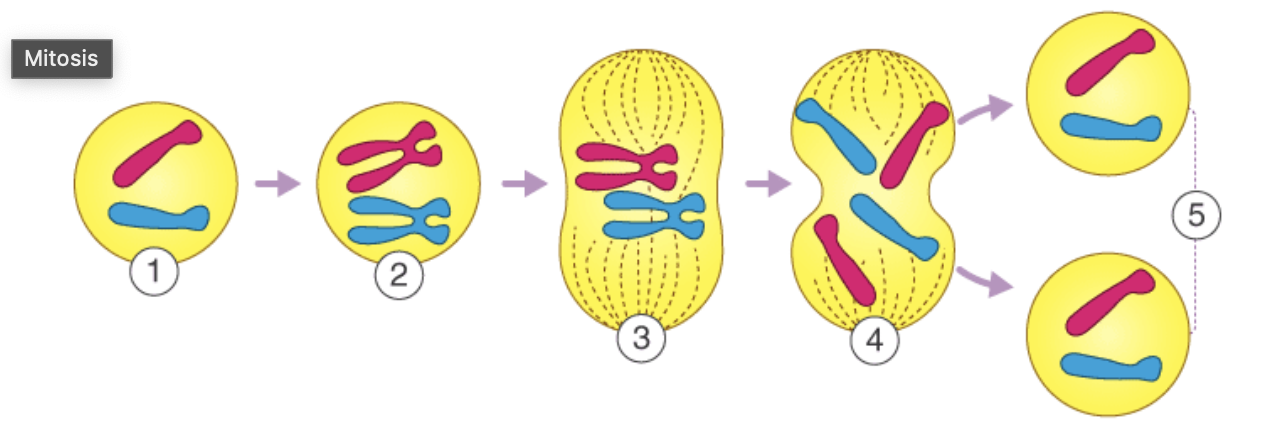
which stage matches each diagram?

explain the relationship between cells, tissue, organs, systems, and whole organisms
cell - a structural and functional unit (i.e a nerve cell)
tissue - a group of cells with common structures/functions (i.e nervous tissue)
organs - group of tissues working together for a common task (i.e brain)
system - composed of several organs working together (i.e nervous system)
organism - an individual containing several organ systems (i.e human)
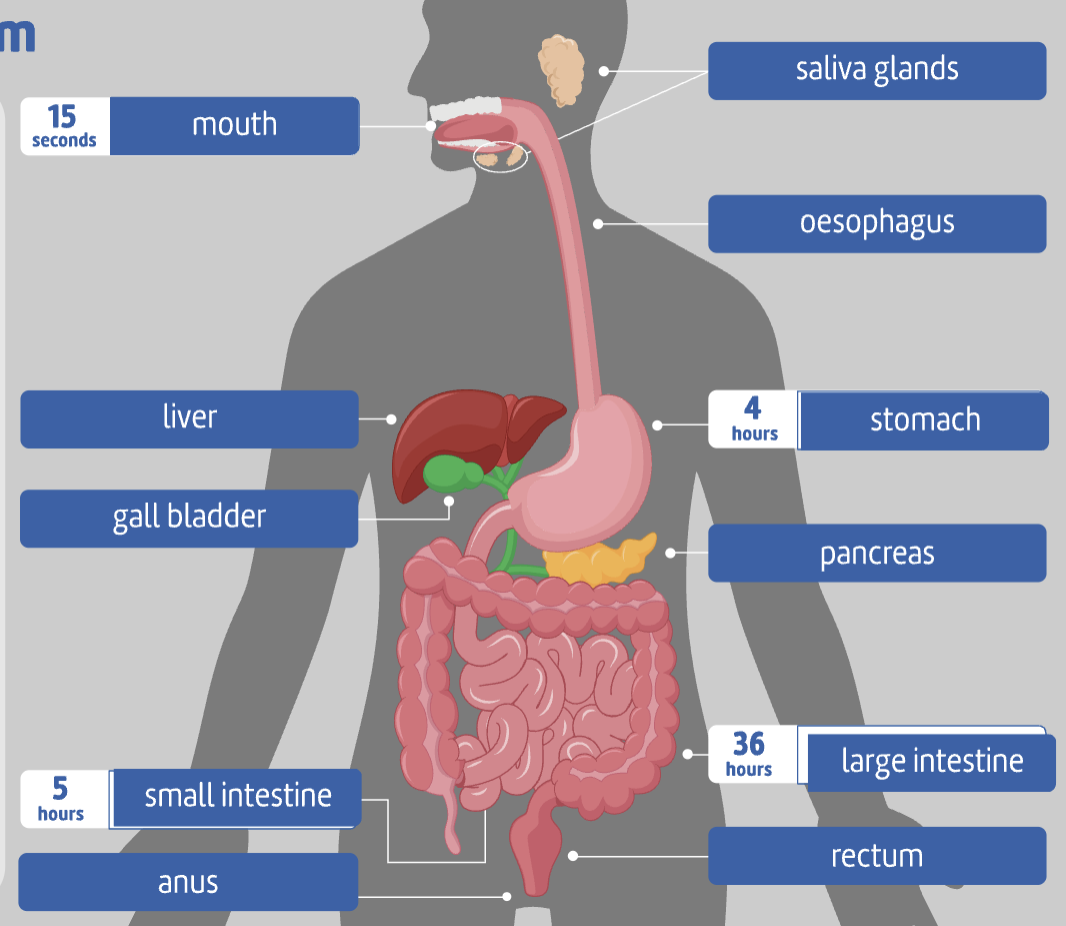
what is the mouth
where food enters and it is responsible for some digestion in the form of chewing and saliva
what is the pharynx
a tube where food and air travel through that is connected to the oesophagus. when the food is being swallowed, the epiglottis closes over the trachea so food doesn’t enter the lungs
what is the oesophagus
tube where food travels through after digestion and also where peristalsis occurs
what is the stomach
a bag-like muscular structure that stores and churns food to break it down. it contains enzymes that start to break down food and hydrochloric acid that kills bacteria and sterilises food
what does the liver do
makes bile for the digestion of fats/lipids. it also processes the blood containing the nutrients absorbed from the small intestine, and detoxifies blood.
what does the gallbladder do
stores and concentrates the fats/lipids made by the liver, and releases them into the small intestine
what does the pancreas do
produces enzymes for digestion, and also insulin for controlling the absorption of glucose into cells
What is the function of the small intestine?
it is the final point of chemical digestion and nutrient absorption. once the food has been digested, the villi and microvilli lining this tube absorb the nutrients and send them into the bloodstream
what is the function of the large intestine?
where vitamins and minerals are stored. waves of peristalsis moves undigested food waste through this tube, which then becomes more solid as it progresses due to the water being absorbed
Which part of the digestive system stores waste?
Rectum.
what does the anus do?
it controls the process of defecation and gets rid of waste
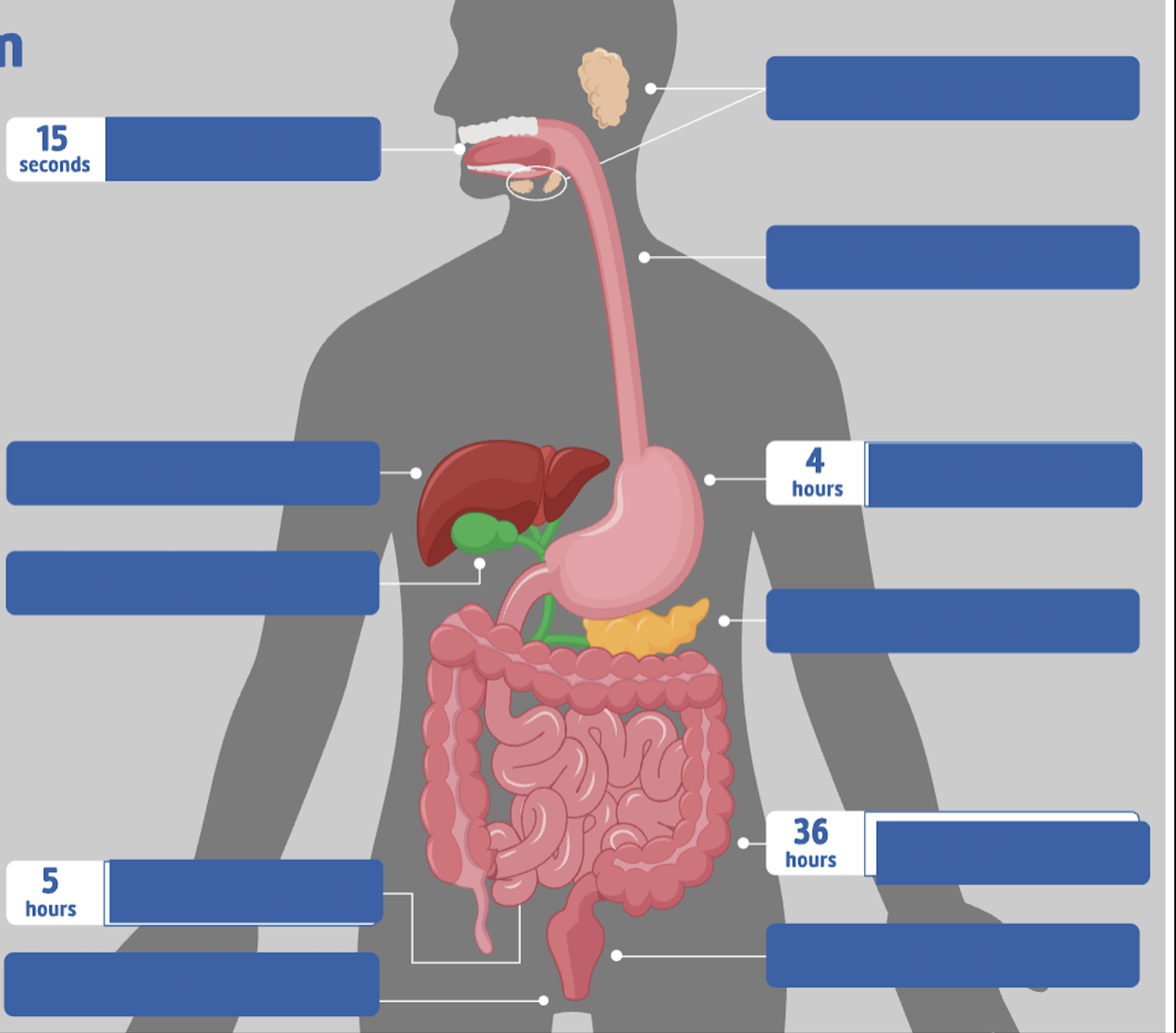
fill in the spaces:
define ingestion
taking in food
define digestion
breaking food down into molecules so they are small enough to be absorbed
define absorption
absorbing the nutrients from the food
define egestian/defecation
eliminating undigested waste product
explain the importance of enzymes
they break down important components in food so that they are easier to absorb
speed up chemical reactions in living organisms
without them, many processes would occur to slowly to sustain life
list the main nutrients in food and state examples of food that contain them
Type of Food Nutrient Example |
Carbohydrates - Bananas |
Proteins - Pineapples |
Lipids/fats - Avacados |
What is the difference between mechanical and chemical digestion?
chemical digestion uses enzymes to break down food into smaller, absorbable molecules and produce a new substance when doing this, while mechanical digestion breaks down food physically like chewing and churning.
compare the digestive systems of carnivores herbivores and omnivores
carnivores
short digestive tracts
sharp teeth
strong digestive enzyme
herbivores
long digestive tracts
flat teeth
omnivores
shorter digestive tracts than herbivores but longer than carnivores
range of digestive enzymes
range of sharp and flat teeth
Why do they have different digestive systems?
due to the difference in their diets.
carnivores - sharp teeth to tear and hold down prey; since meat is easy to digest, they have strong enzymes to break it down and a short digestive tract to process food quickly
herbivores - flat teeth to grind fibrous plants; long digestive tracts to maximise nutrient absorption
omnivores - eat both meat and plants, so their digestive systems are in between carnivores and herbivores
what does the nasal cavity do?
the air enters through the nasal cavity and gets filtered and humidified by hairs
what does the larynx do?
the larynx (voice box) is reinforced with of cartilage to protect the airway and also keeps fluid or food from entering.
What is the primary function of the trachea in the respiratory system?
The trachea (windpipe) has rings of cartilage that maintain the shape to prevent it from closing, and cilia that helps prevent particles and fluid from getting into the lungs. It the forks into 2 bronchi.
Bronchi
distributes air into bronchioles
bronchioles
fine tubes that allow passage of air
smooth muscle layer that helps regulate airflow
also have cilia and mucus to help prevent any unwanted particles such as dust from reaching the lungs
What is the role of alveoli in the respiratory system?
Gas exchange occurs here; they allow oxygen and carbon dioxide to move to and from the bloodstream.
lungs
where the bronchioles and alveoli are found
what do the intercostal muscles do during inhalation and exhalation?
during inhalation, the external intercostal muscles contract and lift the ribs upward, expanding the chest cavity and creating negative pressure, which draws air into the lungs.
during exhalation the internal intercostal muscles contract, they pull the ribs downward, reducing the chest cavity and forcing air out of the lungs
ribs
protect the lungs and allow for expansion and contraction during breathing
sternum
breastbone and central bone in ribs (same function)
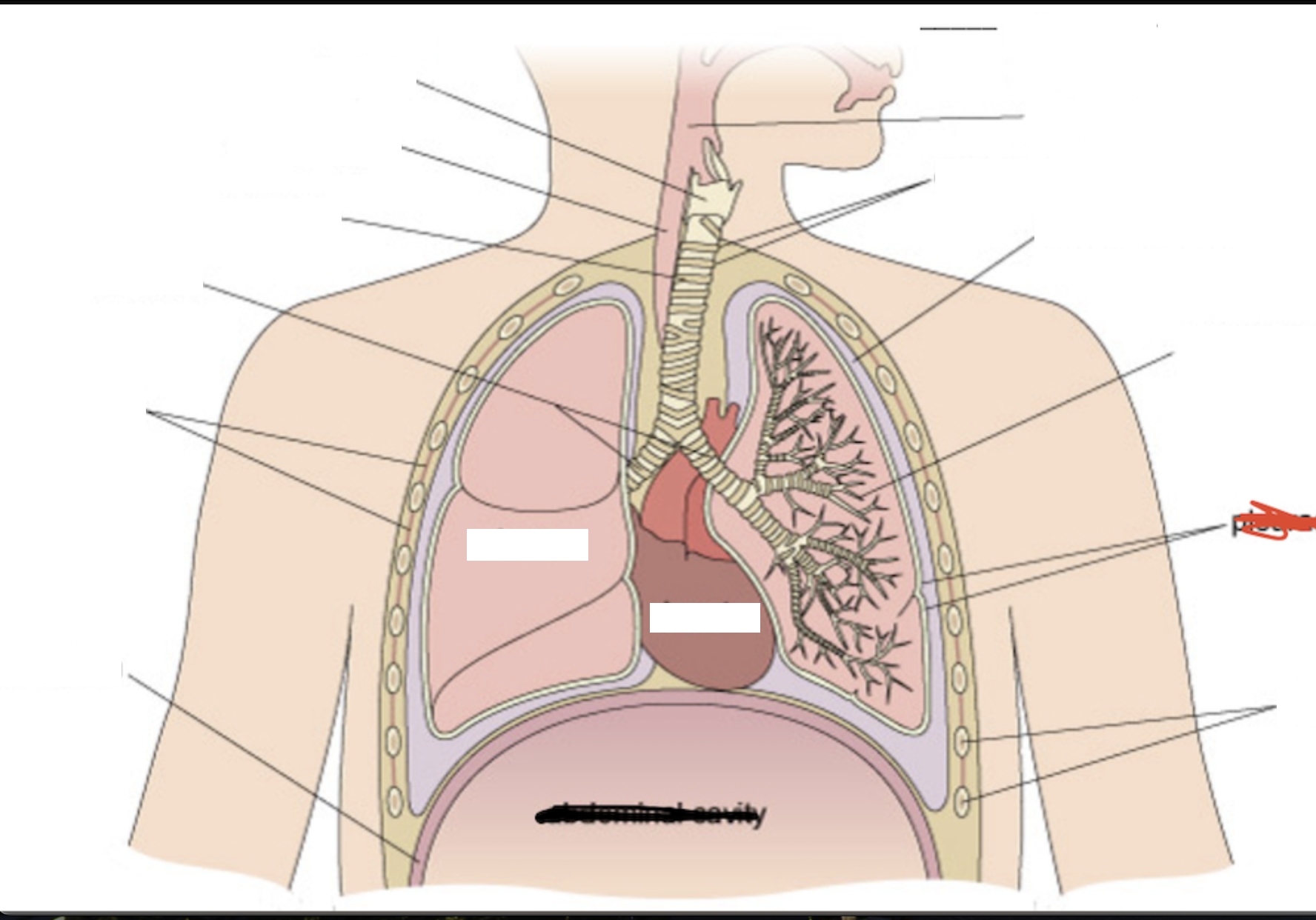
Label the arrows (not counting red or black crossed out labels)
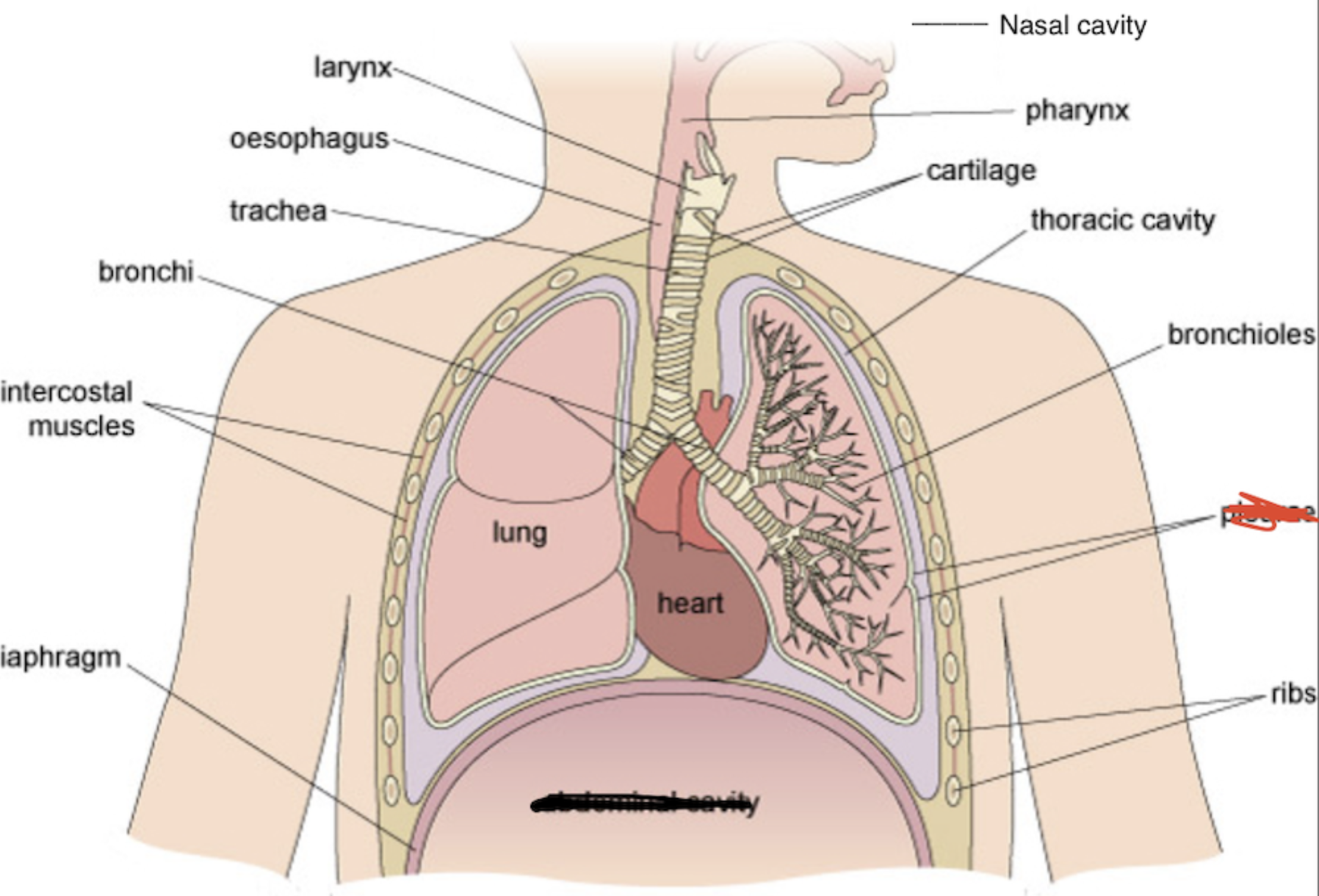
In reference to the diaphragm, intercostal muscles, ribs and sternum, volume of the chest, pressure, and direction of airflow, explain what happens when you inhale
intercostal muscles between the ribs contract, pulling the chest walls up and out
diaphragm muscle below the lungs contracts and flattens, increasing the size of the chest
lungs increase in size, so the pressure inside them falls. This causes air to rush in through the nose or mouth
In reference to the diaphragm, intercostal muscles, ribs and sternum, volume of the chest, pressure, and direction of airflow, explain what happens when you exhale
intercostal muscles between the ribs relax so that the chest walls move in and down
the diaphragm muscle below the lungs relaxes and bulges up, reducing the size of the chest
the lungs decrease in size, so the pressure inside increased and the air is pushed up the trachea and out through the nose or mouth
Identify the differences between fish and mammal respiratory systems
Animal
have a mouth, a pharynx, lungs, a trachea, bronchi, bronchioles, diaphragm, alveoli
Fish
have gills that take in oxygen from surrounding water and eliminate carbon dioxide from the blood
gill arches that hold the gills in place and support 1 or 2 filaments
spiracles that are an opening used to draw water into the gills for respiration
most-efficient system for exchanging water and carbon dioxide between blood and water
differences reflects the adaptations to the environment
what do all circulatory systems consist of?
a pump, carrier, fluid, and tubes/vessels
what are the 4 components of blood? describe them.
plasma
makes up just over half of the blood
water based-liquid
white blood cells, red blood cells, platelets all in this solution
red blood cells (erythrocytes)
carry oxygen from the lungs to the rest of the body
contains haemoglobin that carries the oxygen and the carbon dioxide to and from the heart/lungs
white blood cells (leukocytes)
help fight infections and aid in the immune system
platelets (thrombocytes)
broken down parts of cells
help in blood clotting
form scabs
What is a closed circulatory system?
When blood is always in the vessels and never directly makes contact with the body’s tissues
What is a double circulatory system?
When the blood pumps through the body twice on each full circuit. it also involves 2 circuits - the pulmonary circuit and and the systemic circuit
What is pulmonary circulation?
When the heart pumps deoxygenated blood to the lungs, and then returns the oxygenated blood to the heart.
What is systemic circulation?
when the heart pumps oxygenated blood to the rest of the body, and then the deoxygenated blood gets pumped back.
What is an artery? How is its structure useful for its function?
Arteries carry oxygenated blood away from the heart and to the rest of the body. The blood has a very high pressure, so the artery’s walls are very thick.
What is a capillary? How is its structure useful for its function?
Capillaries take nutrients and oxygen to cells and takes waste products away from the body. To do this, they penetrate every part of the body, which is why they are very small and have very thin walls.
What is a vein? How is its structure useful for its function?
veins carry deoxygenated blood back to the heart. By the time the blood gets to the veins, it is much lower in pressure, which is why it has thinner walls than arteries. It also has valves to prevent the blood from flowing backwards
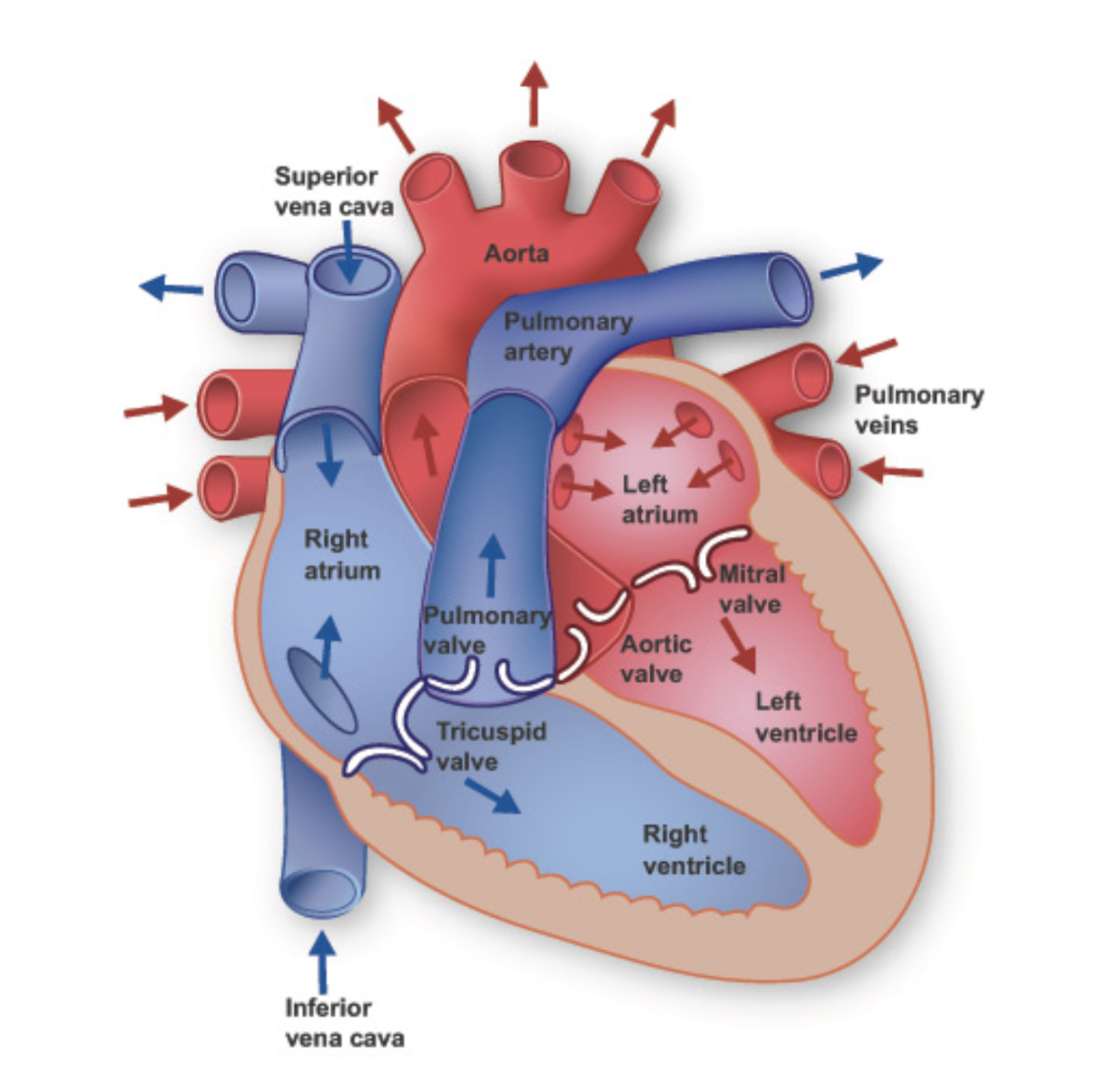
Where is the heart located? Name its chambers.
It is located in the centre of the chest behind the lungs, and has 4 chambers - 2 ventricles. and 2 atriums
solve the quizlet: https://quizlet.com/gb/219844718/label-the-heart-diagram/
What is the airflow of the heart (where does the air come in, where does it exit, what path does it take) use the quizlet
for blue - deoxygenated - blood, it enters through the superior and inferior vena cavas and exits through the pulmonary arteries
for red - oxygenated - blood, it enters through the pulmonary veins and exits through the aorta
define reproduction
reproduction is the biological process where new individual organisms called offspring are produced from their parent(s)
What is the difference between asexual and sexual reproduction?
Asexual reproduction involves one parent and produces genetically identical offspring; sexual reproduction involves two parents and produces genetically unique offspring.
name an example of asexual reproduction in plants
vegetative propagation - when new plants grow from parts of their parent plants like the stem, stalk, leaves, roots, without the use of runners. e.g strawberries
name an example of asexual reproduction in animals
parthenogenis - when an unfertilised egg develops into a new individual without any feritlisation by sperm, e.g wasps
what are the advantages and disadvantages of asexual reproduction
advantages - it is faster, easier, a larger amount of organisms can be produced in a small time, and it does not require finding a mate
disadvantages - lack of genetic variation as they are all exact copies, they are only suited to one environment, and it is not as easy to adapt
what are the advantages and disadvantages of sexual reproduction
advantages - genetic variation, natural selection, adaptation
disadvantages - requires much more time, isolated individuals cannot reproduce, no guarantee the offspring will inherit beneficial traits
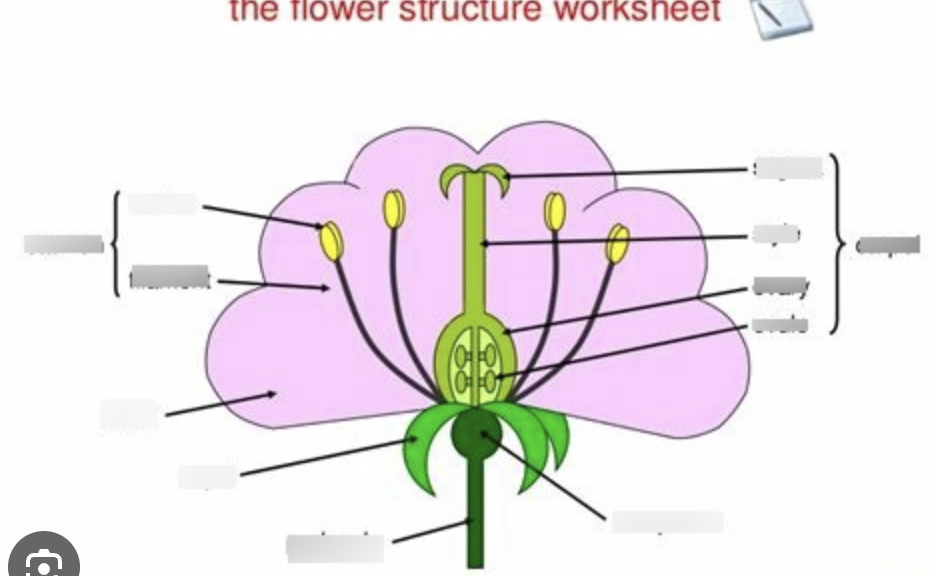
finish these labels:
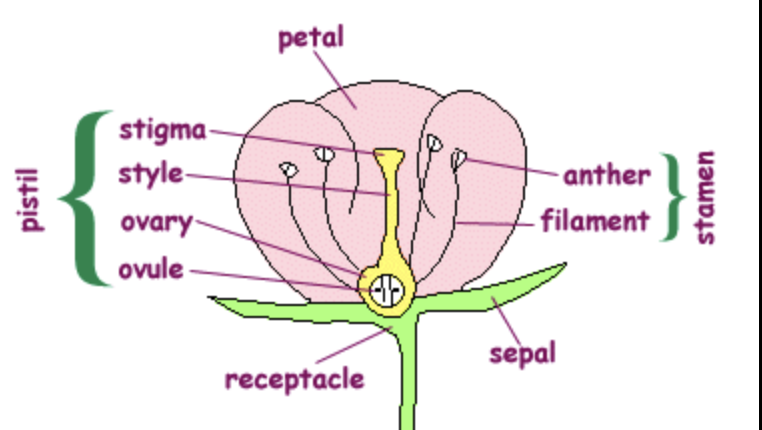
What is the purpose of a petal?
They are colourful and sweet to attract pollinators
What is the purpose of a stem?
To hold up the plant and provide support. They also provide a highway for water and food for the plant to get nutrition.